
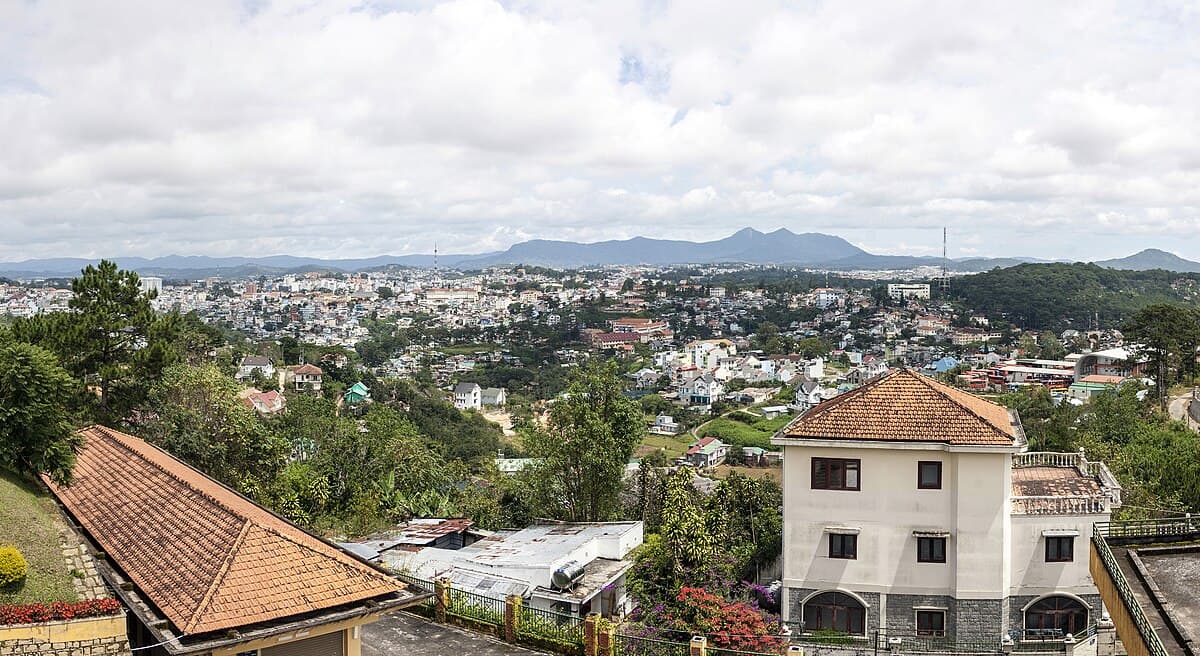
Da Lat is Vietnam's oddest city: a hill-station built by French colonials in the 1920s to escape the lowland heat, set on a pine-forested plateau at 1,500m in the Central Highlands. The air is 10°C cooler than Saigon, the coffee is grown on the slopes around town, and the vibe is halfway between Vietnamese honeymoon destination and backpacker adventure hub.
Why visit Da Lat
Three reasons. First, the climate: 15-25°C year-round is a revelation after a week of Hanoi humidity or Mekong heat. Second, the landscape: pine forests, waterfalls, and Vietnam's best coffee farms. Third, the activities: canyoning, Easy Rider motorbike tours, and proper hiking, all things that barely exist elsewhere in the country.
It is also weirdly kitsch. The Crazy House (Hang Nga Guesthouse) is a walkable Gaudi-on-ketamine concrete sculpture you can sleep in. Honeymooners pose in front of heart-shaped topiaries. Swan pedalos clutter Xuan Huong Lake. Lean into it.
Best time to visit
December to March is peak — dry, cool, clear. Cherry blossoms flower in January and February. April and May are warmer and still dry. June to September brings daily afternoon rain that shuts down canyoning operators. October to November is transitional, with fewer crowds and better prices.
How to get there
- Fly: Lien Khuong Airport (DLI) has flights from HCMC (50 minutes, from 800,000 VND) and Hanoi (2 hours). The airport is 30km south of town; a taxi is 350,000 VND.
- Bus from Ho Chi Minh City: 6-7 hours overnight on a sleeper bus (down from 7-8h pre-expressway as the Dau Giay-Phan Thiet and Tan Phu-Bao Loc corridors have come online — see the Vietnam Travel Time Atlas 2026 for the corridor-by-corridor build-out). Phuong Trang and The Sinh Tourist are reliable, from 250,000 VND.
- Bus from Nha Trang: 4 hours through a gorgeous mountain road, 180,000 VND.
- Bus from Mui Ne: 4 hours, great scenic route.
Where to stay
Most travellers stay in the town centre around Xuan Huong Lake and the night market — walkable, atmospheric, cheap. Mid-range hotels run $25-50, guesthouses from $15. The Hoa Binh Square area has the most backpacker places. If you want quiet and views, look at Tuyen Lam Lake a few kilometres south, where pine-forest resorts sit at $80-150.
Top things to do
- Crazy House (Hang Nga) — part gallery, part guesthouse, all insane. 60,000 VND entry. Go early before the tour groups arrive.
- Canyoning at Datanla Falls — abseil down waterfalls, slide down rock chutes, jump off cliffs. Full day with a reputable operator (Viet Challenge, Groovy Gecko) is $65-80.
- Easy Rider day tour — waterfalls, coffee farms, silk village, flower farms. $35-50 all in.
- Langbiang Mountain — 2,167m peak 12km from town. The easy jeep ride goes to the lower peak; the full hike to Summit 2 takes 4-5 hours return.
- Cau Dat Tea Hills & coffee estates — 25km east. Photogenic tea rows and some of Vietnam's best specialty arabica at La Viet and Là Việt Coffee.
- Elephant Falls — 30km west near Nam Ban village. Thundering cascades you can climb behind. Combine with weasel-coffee tastings.
How many days
- 1 day: just the town — lake, Crazy House, night market
- 2 days: add canyoning or an Easy Rider loop
- 3 days: add Langbiang hike or the Cau Dat tea/coffee area
- 4+ days: slow down, do a multi-day Easy Rider to Mui Ne or up to Buon Ma Thuot
Typical costs
- Budget guesthouse: $12-18
- Mid-range hotel: $30-55
- Pho or com tam meal: 40,000-70,000 VND
- Specialty coffee: 45,000-70,000 VND
- Motorbike rental: 150,000 VND/day
- Canyoning day: $65-80
Da Lat night market (Cho Dem) is essential. Grilled rice paper ("Vietnamese pizza"), soy milk, sweet potatoes cooked in ash, and artichoke tea — all for under 100,000 VND a head.
The city gets a bad rap from travellers who arrive expecting a European alpine town and find instead a chaotic Vietnamese city with pine trees. Calibrate accordingly: come for the activities and the climate, not the aesthetics, and Da Lat pays back in full.
Limitations
Da Lat's hill-station microclimate (year-round 14–24°C) is the city's biggest draw, but Vietnamese honeymooners and domestic tourists know it too — the centre can feel crowded on weekends and holidays despite the cool weather. Workaround: travel midweek and stay slightly outside the centre (toward Truc Lam Monastery or the Valley of Love) for quieter accommodation and easier access to the surrounding pine forests and waterfalls.
Da Lat's coffee scene is the centre of Vietnamese arabica production (the Coffee Origin Atlas covers the region in depth), but visitor-side coffee tourism is uneven — some farms welcome visitors well, others are weekend-only or unmarked. Workaround: book coffee-farm tours in advance through K'Ho Coffee or La Viet rather than walking up unannounced; see our forthcoming Da Lat coffee farm tours guide for the operator-by-operator breakdown.
