The Mekong Delta — the Nine Dragon River Delta, as Vietnamese call it — is the braided floodplain where the Mekong fans out into the South China Sea. Seventeen million people live across 40,000 km² of rice paddies, orchards, and canals. It is Vietnam's rice bowl, its fruit basket, and one of the country's most misunderstood destinations, usually experienced as a bad day trip from Saigon when it deserves at least two nights.
Why visit the Mekong Delta
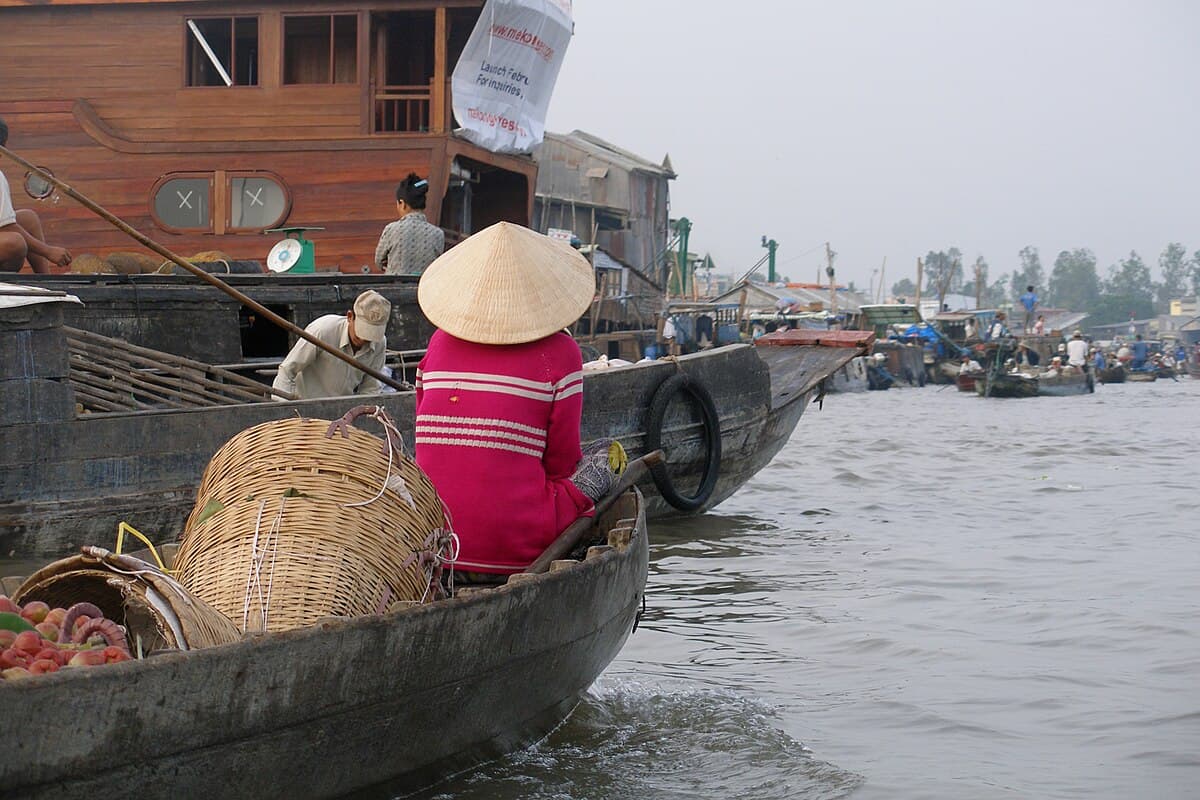
Rural Vietnam at its most rural: sampans drifting between nipa palms, pagodas on stilts, markets held on water because there is not enough flat land. Cai Rang floating market at dawn is still one of the most photogenic scenes in the country. Evenings in a riverside homestay, with fish caught from the family's pond and rice wine shared across a long wooden table, are the sort of experience you cannot get on the main tourist trail.
The delta is also the gateway to Cambodia by boat — a genuinely scenic alternative to flying.
Best time to visit
- November to April: dry, cool, pleasant. Peak season.
- May to August: hot and increasingly wet. Lush but muggy.
- September to November: flood season (mua nuoc noi). Atmospheric — flooded rice paddies, fish markets, lotus fields. Some roads close.
How to get there
- HCMC to Can Tho: 170km. Sleeper bus 3h 30m-4h on the now-continuous HCMC-Trung Luong + My Thuan + My Thuan-Can Tho expressway corridor (down from 4-5h pre-expressway); private car or limousine van runs 2h 30m-3h on the same route (see the Vietnam Travel Time Atlas 2026). Futa Bus Lines departs every 30 minutes from Mien Tay station, 165,000 VND. Private car $90-130.
- HCMC to Chau Doc: 5-6 hours by bus, 220,000 VND.
- Fly to Can Tho (CXT): 1h from Hanoi, 1h45 from Da Nang.
- From Phu Quoc: ferry to Ha Tien then bus to Can Tho (4 hours total).
Where to stay
Can Tho is the biggest city (1.2m people) and the best base for first-timers. Stay along Ninh Kieu quay for river views (Muong Thanh, Vinpearl, TTC — $60-100) or in guesthouses one block back for $20-35.
Homestays along the canals around Can Tho and Vinh Long are the real experience. Expect $25-45 per person including dinner, breakfast, and usually a boat trip. Recommended: Nguyen Shack, Green Village, Mekong Rustic.
Chau Doc is the far-west base for Sam Mountain, Tra Su cajeput forest, and the Cambodia border.
Ben Tre / My Tho are the closest to HCMC but the most touristed — skip if you can.
Top things to do
- Cai Rang floating market — 05:30 boat from Ninh Kieu quay. Two hours, 150,000-250,000 VND per person on a shared sampan, or 450,000 VND for a private boat. Get noodle soup handed up from a floating pho stall.
- Canal sampan tour — the small canals beat the main river. Combine with Cai Rang or do separately.
- Homestay overnight — eat elephant-ear fish, learn to make rice paper, cycle through orchards.
- Tra Su cajeput forest (near Chau Doc) — flat-bottom boat through a green tunnel of flooded forest. 150,000 VND.
- Coconut candy workshop in Ben Tre — touristy but tasty.
- Sam Mountain (Chau Doc) — sunset view over Cambodia's rice plains.
- Boat to Phnom Penh — 5-7 hours from Chau Doc. $25-40.
How many days
- 1 day trip from HCMC: not recommended. You only see My Tho/Ben Tre.
- 2 days / 1 night in Can Tho: the minimum that works. Floating market + canal tour + homestay.
- 3 days: add Chau Doc or Vinh Long.
- 4+ days: slow cycle tour through multiple districts, or cross to Cambodia.
Typical costs
- Bus HCMC-Can Tho: 165,000 VND
- Guesthouse in Can Tho: $18-28
- Homestay (all-inclusive): $25-45
- Floating market boat: 150,000-250,000 VND
- Street-food meal: 35,000-60,000 VND
- Private driver full day: $80-110
The delta rewards slow travel. Budget at least two days, expect to get sweaty, and leave the day tour from Saigon to someone else.
Limitations
The "Mekong Delta day trip" most travellers do from HCMC is a 12-hour round trip with 2–3 hours of actual river time — the Mekong is genuinely far and a meaningful experience requires overnight. Workaround: overnight in Can Tho or Ben Tre to do the 5 a.m. Cai Rang floating market properly; the My Tho day trip from HCMC catches the river-life surface but skips the depth.
The floating-market scene has changed meaningfully over the last decade — Cai Rang is still authentic but smaller than its 2010 peak as river commerce shifts to road transport. Workaround: prefer Cai Rang over the Cai Be / Vinh Long markets which have become more tourist-staged; the Vietnam culinary tourism research tracks Mekong food-tourism patterns in finer detail.