
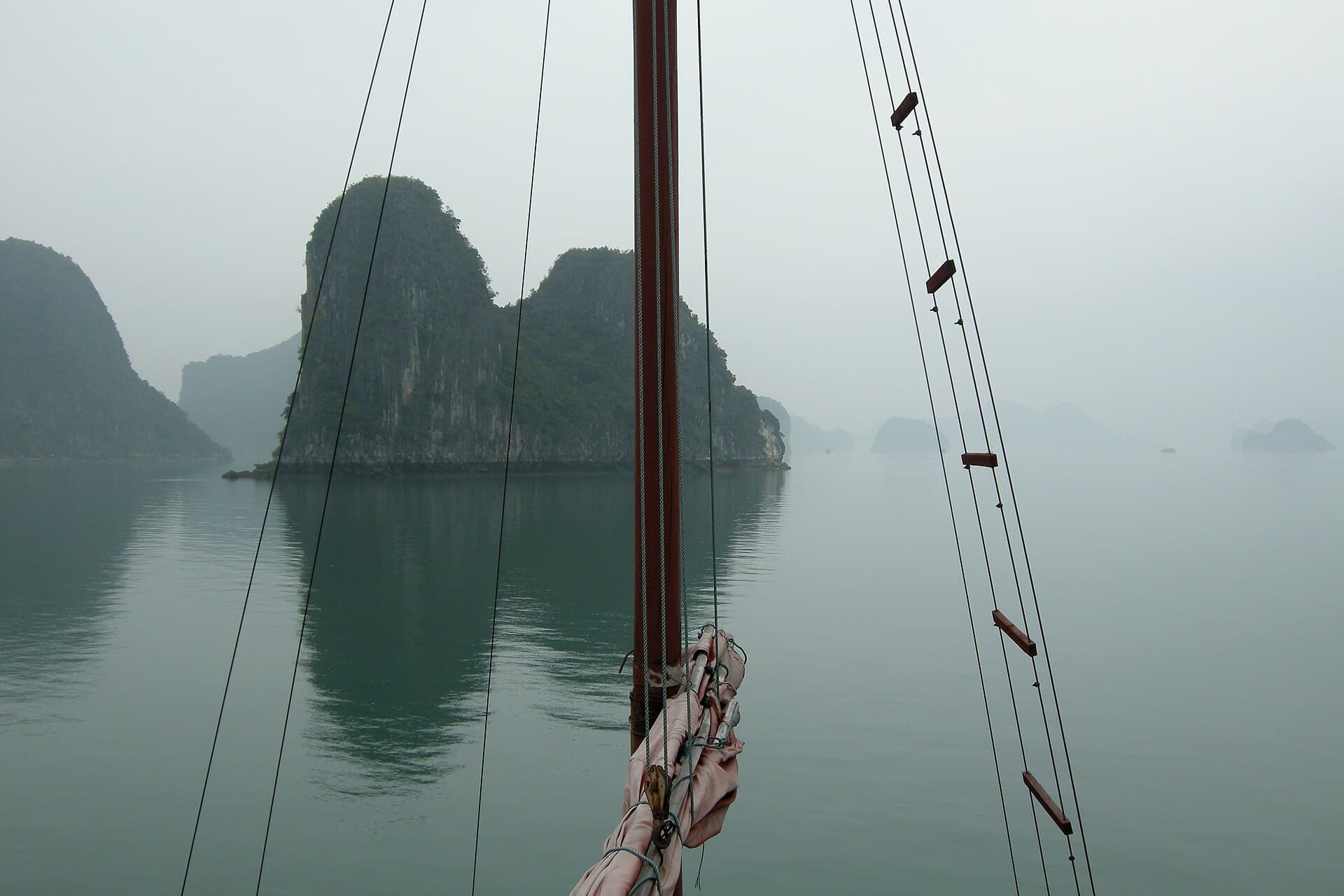
A Ha Long Bay day trip from Hanoi is the most-booked single day excursion in Vietnam — and the one that most consistently underwhelms travellers who didn't realise the trade-off. The bay itself is a 1,553-km² UNESCO World Heritage zone with roughly 1,600 limestone karst islands, inscribed in 1994 and re-inscribed with expanded boundaries in 2000. The problem isn't the bay; it's the day-trip format.
The format constrains you to the most-crowded central zone, the busiest two hours of the day (10 a.m.–1 p.m.), and a one-cave/one-paddle itinerary that any half-day cruise from Tuan Chau pier could deliver. The cruise boats average 6 hours of total scheduled time on the water on a day trip, of which 1.5 hours is the cave visit and lunch — leaving roughly 4.5 hours of actual cruising. Per Quang Ninh provincial tourism reporting, the central bay sees 14,300+ daily visitor averages in peak season.
What a Ha Long Bay day trip includes
- Hotel pickup in Hanoi between 7:00 and 8:00 a.m.
- Transfer to Tuan Chau pier (3 to 3.5 hours on the expressway via Hai Phong)
- Boarding a day-cruise junk for roughly 4 hours on the water
- A visit to one limestone cave — usually Thien Cung (Heavenly Palace, well-lit, accessible) or Sung Sot (Surprising Cave, larger, more strenuous)
- Kayaking or a bamboo-boat paddle (30 minutes)
- Lunch on board (seafood, rice, vegetables, fruit; drinks extra)
- Return to Hanoi by 8:30 to 9:30 p.m.
Day trip vs overnight cruise — the trade-off
| Day trip | 1-night cruise | 2-night cruise | |
|---|---|---|---|
| Hours on the water | ~4 | ~20 | ~36 |
| Sunset / sunrise | No | Yes (1 each) | Yes (2 each) |
| Cruising zone | Central bay (busiest) | Lan Ha or central | Lan Ha + Bai Tu Long |
| Crowd density on water | High | Medium | Low |
| Cost per person (mid-range) | $55–90 | $120–250 | $200–400 |
| Total time from Hanoi | 14 hours | 2 days / 1 night | 3 days / 2 nights |
| Best for | Time-constrained final-day visitors | Most travellers | Photography, dedicated relaxation |
When the day trip does make sense
- You land in Hanoi with one free day before flying out and Ha Long is non-negotiable
- You don't sleep well on boats
- You're on a tight budget and want to see the bay at all (vs. not at all)
- You have severe motion sensitivity that worsens overnight on water
For everyone else: book a one- or two-night cruise in Lan Ha Bay (accessed via Cat Ba Island) or Bai Tu Long Bay (north, quieter) instead. See our Ha Long Bay destination guide for cruise operator selection.
Cost structure
| Component | Day trip | 1-night cruise |
|---|---|---|
| Tour package | $55–90 | $120–250 |
| Tip for guide and crew | $5–10 | $10–15 |
| Drinks on board | $5–15 | $15–40 |
| Cave-entry photo fee (optional) | $2 | $2 |
| Total realistic spend | $70–110 | $150–300 |
What's actually a good Ha Long day-trip operator
The mass-market day-trip market is high-volume and undifferentiated; most operators package the same Tuan Chau pier → Thien Cung Cave → kayak → lunch loop. Quality varies in:
- Transport vehicle comfort (limousine vans vs. crowded buses)
- English-language depth of the guide
- Boat-class (older 1990s wooden junks vs. modern small-passenger boats)
- Lunch quality
Mid-tier operators with consistent reputation include Bonjour Vietnam, Indochina Junk, and Halong Hub (day-trip arms). Premium day-trip rates are around $90–120 with limousine-van transfer and small-passenger boats.
When to go
| Months | Conditions | Verdict |
|---|---|---|
| March – May | Mild 20–28 °C, mist often | Good — atmospheric |
| June – August | Hot 28–34 °C, occasional typhoons | Peak crowds; book ahead |
| September – November | 22–28 °C, clear skies | Best window for clear water |
| December – February | Cold 14–20 °C, foggy | Cheapest; views often grey |
Getting there
Day trips include door-to-door transfer from Hanoi Old Quarter hotels, but if you want to combine with a Cat Ba or Lan Ha extension, the Hanoi to Ha Long Bay transport guide covers the independent options (express bus, hydrofoil, train + bus combinations).
The expressway via Hai Phong opened in 2015 and cut the old five-hour drive roughly in half, which is the only reason a same-day return is feasible at all. Most tours make a single 15–20 minute comfort stop each way at a roadside complex (toilets, coffee, the inevitable handicraft showroom). If you are prone to carsickness, request a front seat when the operator confirms — the rear of a full 16-seat van on the expressway is the worst place to be.
What to bring
- Layers and a windbreaker — the open top deck is breezy even in summer, and genuinely cold November to March.
- Motion-sickness tablets if you are prone, though central-bay waters are calm most of the year.
- Sun protection and swimwear — some itineraries include a short swim or kayak; the deck sun is strong by midday.
- Cash for drinks and tips — onboard drinks are cash-only on most day boats, and a small tip for the guide and crew is customary.
- Grippy shoes for the cave steps, which are damp and uneven.
Limitations
The 14-hour round trip leaves only 4 actual hours on the water, and those 4 hours are concentrated in the busiest visitor window of the day — central Ha Long Bay sees 14,300+ daily visitors in peak season per Quang Ninh tourism reporting, and the central cruising zone is shoulder-to-shoulder with junks at midday. Workaround: if you can spare even one overnight, the 1-night cruise option ($120–250) doubles the water time, accesses quieter cruising zones, and includes the sunset / sunrise hours; the day-trip experience is a 30-40% subset of what makes Ha Long worth visiting at all.
Day cruises rotate among 4–6 operators at the Tuan Chau pier and the boat assignment is sometimes only confirmed on arrival — quality of the actual cruise can vary day-to-day even when booking through the same tour office. Workaround: book through one of the mid-tier reputational operators (Bonjour Vietnam, Indochina Junk, Halong Hub) at the $80+ price point, where the operator owns its own day-cruise fleet rather than sub-contracting; or switch to an overnight option where the boat is the accommodation and the operator's reputation correlates more reliably with the on-board experience.