
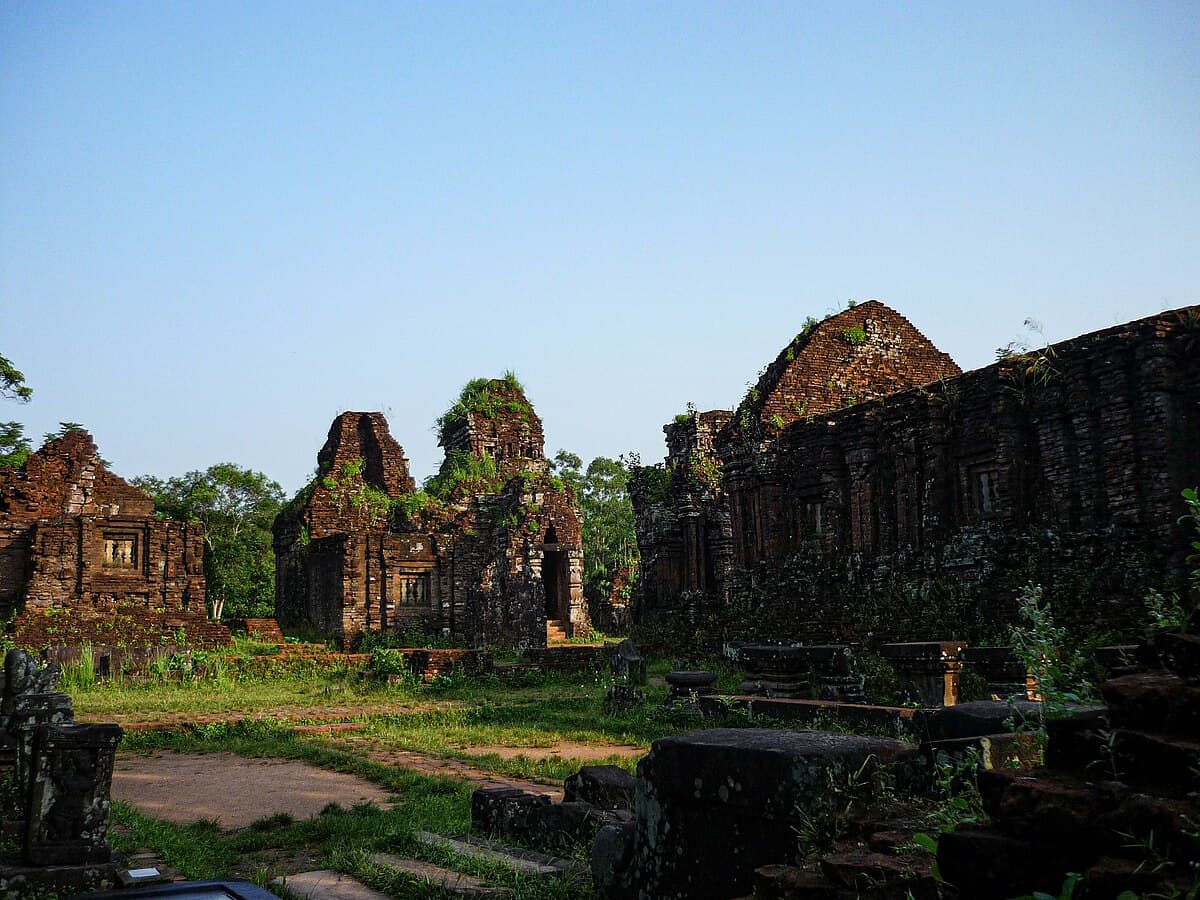
My Son is a UNESCO World Heritage cluster of more than 70 Hindu temple ruins built by the Cham kingdom between the 4th and 13th centuries, sitting in a humid jungle bowl 40 km west of Hoi An. It's one of Southeast Asia's most important Hindu-religious archaeological complexes — older than Angkor Wat, older than Bagan — and the closest substantial archaeological site to the Hoi An / Da Nang tourist corridor.
The site was inscribed by UNESCO in 1999 for cultural value criteria (ii) and (iii); the Cham kingdom's Hindu civilisation flourished in central Vietnam for nearly a thousand years before being absorbed by southward-expanding Vietnamese dynasties in the 15th century. Restoration is ongoing — an Italian-led UNESCO programme has been working on Groups G and H since 2003.
Why sunrise matters
My Son sits in a forested basin with very little shade. By 9 a.m. the jungle bowl is 32 °C and humid; tour buses arrive at 8:30 a.m. and by 10 a.m. the temple clusters have 80+ visitors at peak. By sunrise (around 5:45–6:15 a.m. depending on month) it's 22 °C, the brick towers catch the first golden light, and the site is essentially empty. The same ruins read entirely differently in those two conditions.
The sunrise operators pick up from Hoi An hotels at 5:00 a.m., reach the site for the 5:30–6:00 a.m. soft-opening window, and have you back in Hoi An for breakfast by 9:30 a.m.
What you see — the four temple groups
| Group | Period | State | Notes |
|---|---|---|---|
| A | 8th–10th century | Heavily damaged | Once the most ornate; mostly rubble after 1969 bombing |
| B, C, D | 7th–13th century | Best-preserved | The main visitor cluster; Group B includes the largest intact tower |
| E, F | 8th–11th century | Partially restored | Smaller, fewer visitors |
| G, H | 12th–13th century | Italian-led restoration ongoing | Restricted access during active work |
The site features the Cham brick-firing technique — bricks were laid without mortar and then the entire structure was fired together, a method that has never been fully replicated despite multiple academic attempts.
A sunrise visit hour by hour
Knowing the rhythm of the morning helps you understand why the early start is worth losing the lie-in for.
- 5:00 a.m. — hotel pick-up in Hoi An. The roads west are empty and the drive takes around 50 minutes.
- 5:45–6:00 a.m. — arrive at the entrance, cross the small stream, and ride the electric shuttle buggy the last kilometre into the basin. The towers emerge from mist.
- 6:00–7:30 a.m. — the core of the visit. Guides usually walk you through the best-preserved Groups B, C, and D first while the light is low and the crowds are still on the road. This is the stretch where photography and atmosphere peak.
- 7:30–8:15 a.m. — quieter wandering through the partially restored Groups E and F and the edges of the bombed Group A, often as the first standard-tour buses begin arriving.
- 8:30–9:00 a.m. — depart, sometimes via a slow Thu Bon river boat back toward Hoi An if you booked that upgrade.
- By 9:30 a.m. — back at your hotel, with the rest of the day free.
The standard 8 a.m. departure compresses all of this into the worst part of the day — you reach the towers at the same time as the buses and the rising heat, and the same walk that felt meditative at 6 a.m. becomes a slow shuffle past other groups.
On-site practicalities
The complex is spread across a forested valley with packed-earth and gravel paths between the tower groups; total walking is modest, perhaps 1.5–2 km, but the ground is uneven and there's a small stream crossing near the entrance. An electric buggy ferries visitors between the car park and the inner site at no extra charge. There's a Cham dance performance staged a couple of times each morning in a pavilion near the entrance — short, touristy, but a reasonable shelter if a shower passes through. Toilets and a drinks kiosk are clustered at the entrance only; once you're among the towers there are no facilities, so use them before you walk in.
Costs at a glance
| Component | Cost |
|---|---|
| Group sunrise tour with English-speaking guide | $25–35 |
| Standard 8 a.m. group tour | $18–30 |
| Private car with driver, full day | $60–80 |
| Entrance fee (usually included) | 40,000 VND ($1.50) since 10 Aug 2026 |
| Boat-return upgrade (Thu Bon river to Hoi An) | +$5–8 |
How to get there
Group tour from Hoi An (recommended). Sunrise tours pick up at 5:00 a.m. from your hotel and return by 9:30 a.m. Booking through a Hoi An tour office (Old Quarter has dozens) is straightforward; most reputable operators charge $25–35 with English-speaking guide and entrance fee. Some operators include a Thu Bon river boat for the return — slow but scenic.
Private car. $60–80 round-trip with driver from a Hoi An hotel. Best if you have mobility needs, are travelling with kids, or want to extend into Marble Mountains on the way back. See our Vietnam transport guide for booking patterns.
Independent (motorbike). 40 km each way along QL14B. Map out the route — the final 6 km on rural roads has limited signage. Doable but requires basic motorbike confidence.
When to go
Dry season (February to August) is the safe window — March and April are the most reliable for clear sunrise photographs. May to August is the hottest stretch (33–35 °C by midday); the sunrise advantage is largest in these months. Late September through January brings the central-Vietnam rainy season — flooding occasionally closes the site for a day or two; check tour operator confirmations the night before.
What to bring
- Long trousers and a covered top (the Hindu-religious site convention still applies, though loosely enforced)
- Closed shoes (uneven terrain, ant-prone)
- Insect repellent (the basin is mosquito territory at dawn)
- Water (limited on-site vendors, especially at sunrise)
Who it's best for, and who can skip it
My Son rewards travellers with a genuine interest in history, archaeology, or quiet atmospheric ruins, and it is the strongest cultural day trip within easy reach of Hoi An. Photographers in particular get the most from the sunrise slot, when low light, mist, and an empty site line up. It also pairs naturally with a Marble Mountains stop on the drive back if you book a private car.
Be honest with yourself if temples aren't your thing. If you've already explored Angkor in Cambodia or Bagan in Myanmar, the scale here will feel modest — much of the most ornate work was lost to 1969 bombing, and several towers are reconstructions. Travellers on a tight two-day Hoi An schedule, or anyone who can't face a 5 a.m. alarm, may get more from the Old Town and a cooking class. The midday standard tour, in particular, is the version most likely to underwhelm: hot, crowded, and stripped of the atmosphere that makes the place special.
Limitations
The 1969 American bombing destroyed many of the most ornate towers, particularly Group A's central spire — the on-site interpretation acknowledges this damage but visitors expecting Angkor-scale intact monuments will be disappointed. Workaround: read the brief on-site museum first so the context lands before you walk into the partially-restored clusters; the surviving Cham brick-firing detail in Groups B and C is genuinely remarkable up close even if the overall scale is more modest than Cambodian peers.
By 9 a.m. the site becomes crowded and uncomfortable — the standard 8 a.m. tours arrive simultaneously with international tour buses, peaking at 80+ visitors per cluster. Workaround: take a sunrise tour (5:00 a.m. pickup, on-site by 5:45 a.m.) or arrive independently before the 6:30 a.m. opening window; either gets you 90 minutes of empty-site time before the bus wave starts.