
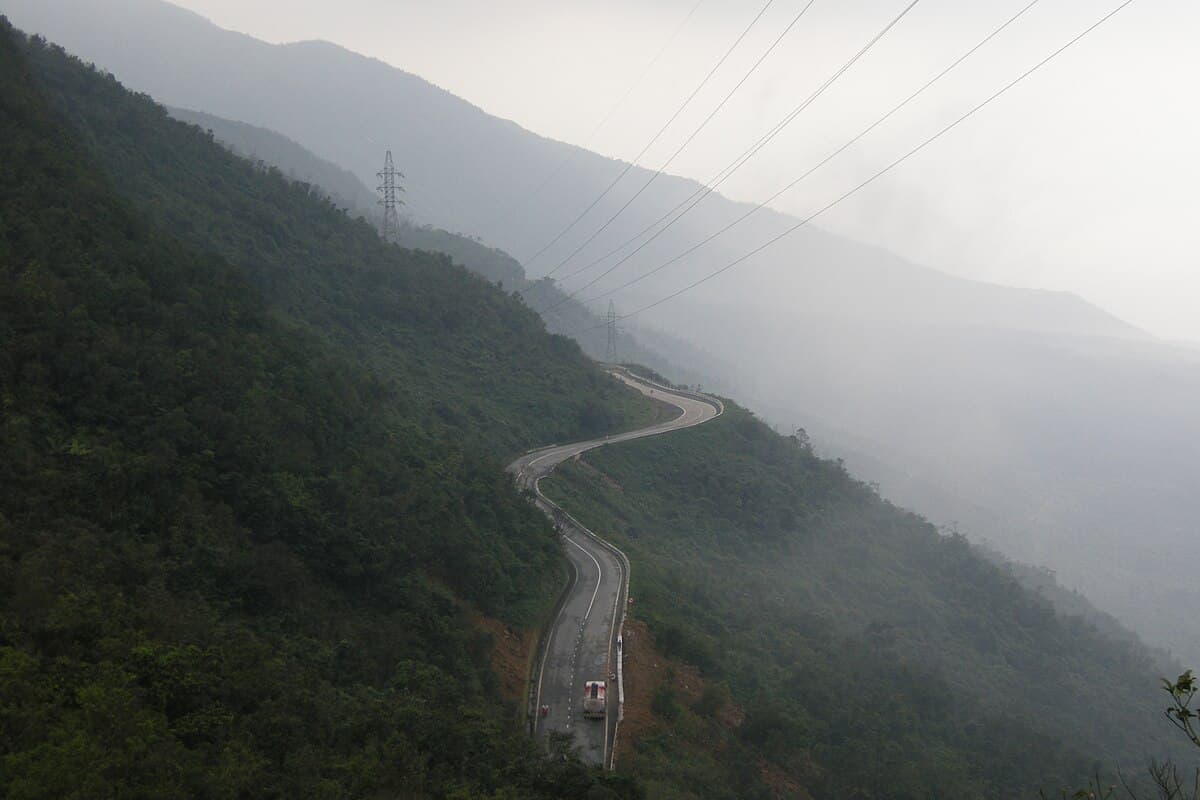
The Hai Van Pass is a 21-km coastal switchback between Hue and Hoi An, climbing to 496 m above the sea at its summit. The pass crosses the Truong Son mountain range — a natural climatic and historic boundary between northern and southern Vietnam, and during the Vietnam War the dividing line between the central-coast theatres.
The road was historically the only land route between Hue and Da Nang until the 6.3-km Hai Van Tunnel opened in 2005. Top Gear's Vietnam Special (2008) famously called it "one of the best coast roads in the world" and re-popularised it as a tourist drive — much of the long-distance bus traffic now takes the tunnel, which leaves the pass road meaningfully quieter than its early-2000s state.
Why the pass over the tunnel
The tunnel is 6.3 km of fluorescent light and concrete; the pass is 21 km of switchbacks, ocean views, fishing-village pulloffs, and a French-colonial-era summit bunker with the best photo stop in central Vietnam. The pass climbs through changing vegetation as you cross from northern (often misty, cooler) climate to southern (clearer, hotter) — a transition visible from the road.
Group long-haul shuttle buses now mostly take the tunnel; private cars, Easy Rider motorcycles, and Jeep tours are the pass-road majority.
The classic Hue → Hoi An day
From Hue, heading south:
- 8:00 a.m. — Depart Hue. The first 30 km south is flat farmland.
- 9:30 a.m. — Lang Co Beach — wide white-sand crescent backed by lagoons. Short walk, photo stop.
- 10:00 a.m. — Lap An Lagoon — shallow mirror-calm bay with oyster-farm bamboo structures. Drone-camera-popular.
- 10:30 a.m. — Begin the Hai Van Pass climb.
- 11:00 a.m. — Hai Van Pass summit — French-colonial bunker, the iconic photo point, 360° view over Lang Co lagoon and Da Nang.
- 12:00 p.m. — Lunch in Da Nang (a beach restaurant on My Khe or a city cafe).
- 2:00 p.m. — Marble Mountains — 20-minute climb, caves, pagodas. See our Marble Mountains day trip guide for the detail.
- 3:30 p.m. — Linh Ung Pagoda (Lady Buddha) on the Son Tra Peninsula — 67-metre standing Buddha statue, panoramic city view.
- 5:30 p.m. — Drop-off at your Hoi An hotel.
Costs at a glance
| Option | Cost | Notes |
|---|---|---|
| Private car with driver, one-way + stops | $65–90 | Most common; 4–6 stops included |
| Easy Rider motorbike + luggage shuttle | $55–75 | Pillion riding with local guide |
| Jeep group tour | $40–55/person | 3–6 passengers, more atmospheric |
| Self-drive motorbike | $15–25 day + fuel | Luggage problem makes one-way hard |
| Shuttle bus through the tunnel | $10–15 | Skips the pass — not recommended |
The Easy Rider option
"Easy Riders" are local motorbike guides who take a single passenger pillion (you sit behind, they drive). Your bag travels separately on a courier shuttle and meets you in Hoi An that evening. The model started in Da Lat in the 1990s and spread across Vietnam; on the Hai Van Pass it's been the signature alternative to driving yourself since Top Gear.
Reputable Easy Rider operators include Hue Easy Rider and Hai Van Easy Rider — book through your hotel or directly. Confirm: licensed driver, helmet, luggage transfer included, English language ability.
How the transfer day actually works from Hue
The thing to understand is that this is a one-way transfer dressed up as a day trip. You check out of your Hue hotel in the morning, your luggage either rides in the car boot or goes ahead on a separate courier, and you arrive in Hoi An that evening having seen the best of the coast in between. You don't come back to Hue.
That changes the booking logic. With a private car, your bags travel with you and there's nothing to arrange. With an Easy Rider, you can't realistically carry luggage pillion, so the operator runs a separate shuttle that meets you in Hoi An; confirm this is included and agree where the handover happens. Self-drive is where people come unstuck: a one-way scooter rental plus the luggage problem usually isn't worth the saving for a transfer.
Pick-ups from Hue are typically 8 a.m.; an earlier 7 a.m. start buys you quieter roads at the summit and more time at Marble Mountains.
Who it's for, and who should skip it
The pass-as-transfer suits anyone moving from Hue to Hoi An who'd rather turn a dull shuttle leg into the highlight of their central Vietnam days. It rewards photographers, couples, and travellers who like scenery and a bit of road-trip romance. The Easy Rider version, in clear weather, is one of the genuinely memorable things you can do in Vietnam.
Skip the pass — or at least don't pin your day on it — if you're travelling in the misty November–January window when the summit views vanish, if you get badly carsick on switchbacks, or if you simply need to get between the two cities cheaply and quickly, in which case the tunnel shuttle or the train does the job. Riders who aren't confident on a motorbike should take the Easy Rider as a passenger or a car, not rent and drive the pass themselves.
When to go
| Months | Conditions | Verdict |
|---|---|---|
| February – April | Dry, 22–28 °C, mild | Best window |
| May – August | Hot 28–34 °C, dry | Good but warm; bring water |
| September – October | Building rain, transition | Acceptable if forecast is dry |
| November – January | Wet, low cloud, often misty at summit | Worst — views frequently obscured |
The pass weather is the binding constraint: in low cloud, the famous summit views are gone and the descent is slippery. Always check the forecast the night before.
What to bring
- Sunscreen and a wind layer (the summit is breezier and 5–8 °C cooler than the coast)
- Camera with neutral-density filter if you want long-exposure ocean shots
- Cash for entry fees (Marble Mountains, Linh Ung) — most stops accept VND only
- Motion-sickness tablets if you're prone (the switchbacks are tight)
Limitations
The pass loses much of its appeal in the November–January rainy season — low cloud at the summit hides the headline view and wet pavement makes motorbike riding genuinely risky. Workaround: if you're travelling in those months, default to a private car (not a motorbike) and treat the pass as one of several day-trip-with-transfer stops rather than the main attraction; or skip the pass entirely and take the Hue–Da Nang train, which threads a parallel coastal route at sea level with reliable views regardless of cloud.
Self-driving the pass on a rented motorbike with your own luggage is harder than it looks: every year sees a small number of tourist motorbike accidents on the pass road, and the one-way logistics of luggage transfer aren't trivial. Workaround: use an Easy Rider service ($55–75 with separate luggage shuttle) which gives you the open-air ride with a licensed local rider handling the technical driving; or hire a car-and-driver ($65–90) and put any motorbike-pass-driving plans on a separate, luggage-free loop from Da Nang.