
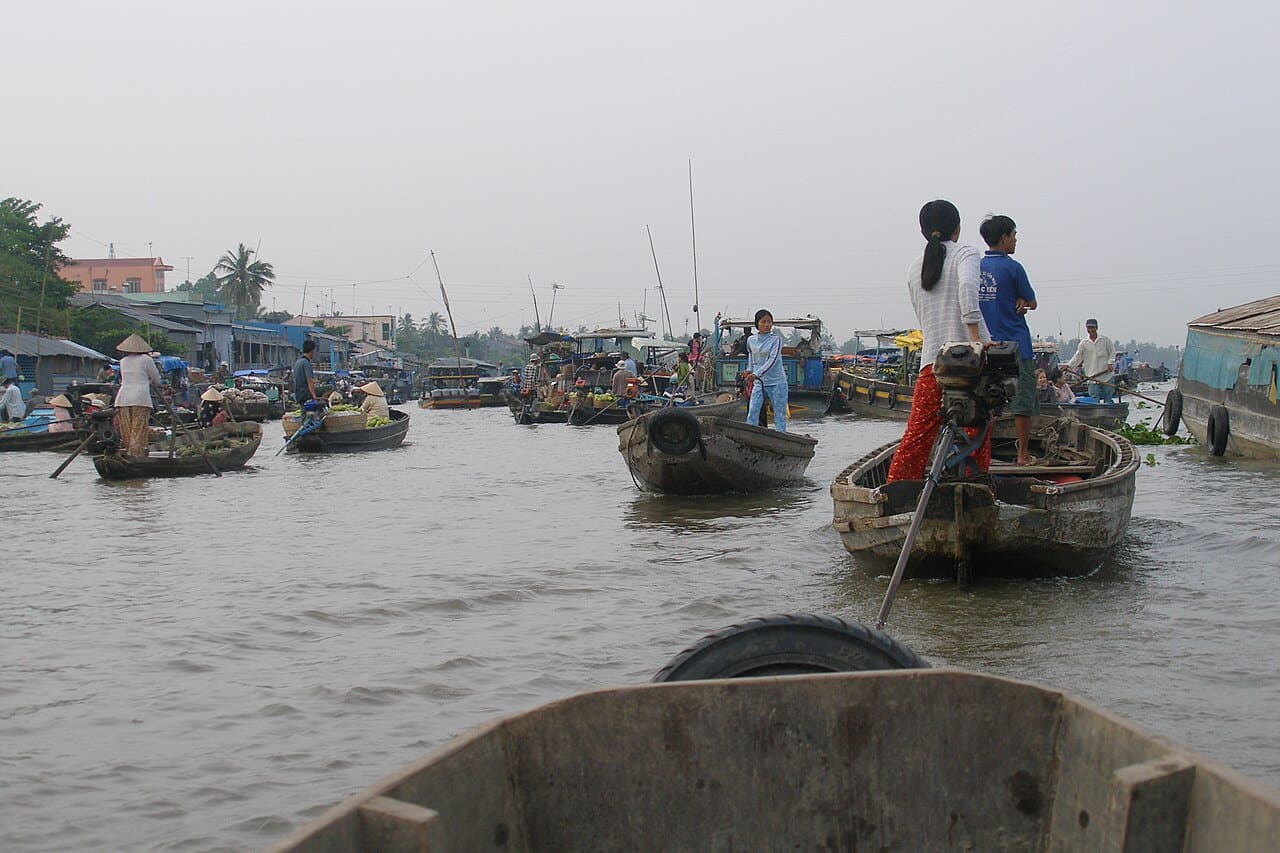
The Mekong Delta's floating markets are one of the most photographed things in Vietnam and one of the most commonly mistimed. Almost every disappointed review comes down to the same mistake: arriving at 10am, at the wrong market, on a boat booked from the wrong city. Done properly — the right market, on the water before sunrise — Cai Rang is still a working wholesale market, and it is genuinely worth rearranging a delta itinerary around.
This guide covers which markets still trade in 2026, the timing that decides everything, what a boat actually costs, and how to read what you are looking at.
The 60-second version
- Cai Rang, outside Can Tho, is the one to plan around. It is the last big market still functioning as real wholesale trade.
- Be on the water by 5am. Peak trading is roughly 5:30am to 6:30am and it thins sharply before 8am.
- Sleep in Can Tho the night before. No day trip from Ho Chi Minh City can reach the market in time, whatever the listing says.
- Hire your own sampan at Ninh Kieu wharf, roughly 200,000 to 400,000 VND for the boat as of mid-2026, rather than joining a big tour boat.
- Treat the other markets as bonuses, not substitutes. Most have shrunk badly or closed.
The markets compared
| Market | Where | Peak hours | Size in 2026 | Verdict |
|---|---|---|---|---|
| Cai Rang | About 6km from Ninh Kieu wharf, Can Tho | 5:30am to 6:30am, over by 8am | Roughly 200 boats, down from 400-plus in the 1990s | The one to go to. Still genuine wholesale trade |
| Phong Dien | About 20km southwest of Can Tho | 4:30am to 6am | Reported as few as a dozen boats | Rowing sampans and quiet, but often nearly empty. Combine with Cai Rang, do not replace it |
| Cai Be | Tien Giang area, on the Ho Chi Minh City side | Formerly early morning | Wholesale trade effectively ended around 2021 | Land market now. Tour stops and island workshops rather than a floating market |
| Long Xuyen | An Giang, about 60km from Can Tho | From about 5am | Small but functioning and local | Best pick if you want a market with almost no other foreigners |
| Nga Nam | Five-river junction in the Soc Trang area | 4am to 7am | Small, local, largely untouristed | Atmospheric and remote. Needs its own overnight |
| Tra On | Vinh Long, at the Mang Thit river mouth | Tide-dependent, early morning | Small | Interesting for the tidal rhythm, hard to plan around |
Cai Rang: the timing that decides everything
Cai Rang sits on the Can Tho River roughly 6km downstream of Ninh Kieu wharf, about 30 minutes by small boat. Wholesalers moor mid-channel with cargo holds full of a single crop — watermelon, pineapple, pumpkin, taro, sweet potato — and retailers come alongside to buy in bulk and take it back to land markets. That is the transaction you have come to see, and it happens in the dark and the first hour of light.
A realistic schedule looks like this. Leave your Can Tho hotel at 4:45am, push off from Ninh Kieu around 5am, and reach the market between 5:20 and 5:35, which is blue hour rolling into sunrise. Trading peaks for the next hour. By 7am the big boats are emptying and pulling away; by 8am what remains is coffee boats, noodle boats and other visitors. If a tour picks you up at 7am, you are buying a photograph of the aftermath.
This is also why the geography matters. Can Tho is about 170km from Ho Chi Minh City, roughly 4 hours by bus, and there is no departure early enough. Our Mekong without a tour guide covers the independent version in full, and the best day trips from Ho Chi Minh City piece explains what the delta day tours actually deliver instead.
Getting to Can Tho and where to sleep
Phuong Trang, usually branded Futa, runs the route most heavily, with departures through the day and a journey of about 4 hours. Standard seats have been quoted around 165,000 VND as of mid-2026, with limousine vans and premium sleeper classes higher; Futa fares generally include a free shuttle between central pickup points and the depot, worth confirming when you book. There is no railway to the delta. Can Tho International Airport operates domestic services only, with Hanoi the busiest route at around six flights a day, plus Da Nang, Hai Phong, Con Dao, Phu Quoc and Vinh.
Sleep close to Ninh Kieu wharf so the 4:45am start is a short walk rather than a taxi hunt. As of mid-2026, riverside options run from around 26 US dollars for simple hotels up to the mid-80s for established riverside properties, with international brands above that. Book two nights if you can — the second morning is your fallback if the weather turns.
Hiring a boat
Two routes. Hire directly at Ninh Kieu wharf, either the evening before or at 5am on the day, or book a small-group sunrise tour online.
Direct hire is cheaper and more flexible. As of mid-2026, a small private sampan for two to four people for a couple of hours commonly runs 200,000 to 400,000 VND for the whole boat, with larger boats and longer routes quoted in the 300,000 to 800,000 VND range. A shared seat is roughly 50,000 to 100,000 VND per person. Prices are negotiated, not fixed. Settle four things before you leave the dock: the route, whether it includes the small canals beyond the market, the duration, and the return time.
Organised sunrise tours run roughly 30 to 80 US dollars per person depending on group size, and the better ones add breakfast, a rice-noodle workshop and cycling through the orchards afterwards. Worth it if you want the language handled; not worth it if your only goal is to be on the water at dawn, which you can arrange yourself for the price of two coffees each.
One tip that costs nothing: ask your boatman to cut the engine and drift once you are among the boats. It turns a river tour into being inside a market.
What is traded, and how to read the poles
Cai Rang is a wholesale produce market, so most boats carry one crop in volume. Watermelon, pineapple, pumpkin, taro, sweet potato, cabbage, onions and seasonal fruit dominate. Weaving between them are the small service boats: coffee, hot soy milk, banh mi and bowls of bun rieu or hu tieu passed across the gunwale.
The bamboo pole at each bow is the cay beo, three to five metres tall with a sample of the cargo tied to the top. Engine noise makes shouting pointless over open water, so the pole does the advertising. Locals describe four conventions, and once you know them the market reads like a page:
- Hang what you sell. A pumpkin on the pole means a hold full of pumpkins.
- Hang but do not sell. Clothes on the pole are laundry — the boat is a family's home as well as their business.
- Sell without hanging. No pole at all usually means a small food or drink boat working the market.
- Hang one thing, sell another. A palm-leaf or thatch frond on the pole means the boat itself is for sale.
Photography
Shoot from low in the boat rather than standing — the water level is where the market looks like a market. Blue hour from about 5:15am gives the moody frames and the light warms fast after sunrise, so plan the wide establishing shots first and the detail work once you have light. A fast lens or a body that behaves at high ISO earns its keep in the first twenty minutes. A short telephoto is better than an ultra-wide for the boat-to-boat trade, because it compresses the hulls into the stacked pattern people recognise. Expect spray and hold your camera with a wrist strap over open water. Skip the flash entirely, and ask before making a portrait of a vendor at work; a bowl of noodles bought from their boat does more good than a tip.
How much has actually been lost
Honestly, a lot. Cai Rang carried more than 400 vessels at its 1990s peak and now runs at roughly 200, with daily counts varying by season. Phong Dien, long recommended as the quiet authentic alternative, has been reported down to fewer than a dozen boats. Cai Be's wholesale trade effectively ended around 2021. Can Tho's own visitor numbers tell a parallel story, from about 7.5 million in 2017 to around 5.9 million in 2023.
The cause is not tourism. It is roads. Bridges and highways made truck haulage cheaper than river haulage, flood-prevention embankments went up without adequate piers, supermarkets replaced boat-to-boat retail, and younger delta families took land jobs. Cai Rang floating market culture was recognised as national intangible cultural heritage by the Ministry of Culture, Sports and Tourism in June 2016, and Can Tho has since run preservation programmes with horizons out to 2030 and beyond, but heritage listings do not change freight economics.
That is not a reason to skip it. It is a reason to go now, go before 6:30am, and go to Cai Rang rather than chase a market someone photographed in 2011. For the wider region, see our Mekong Delta destination guide.
Limitations
- All prices are mid-2026 estimates at roughly 26,300 VND to the US dollar. Boat hire is negotiated rather than fixed, bus fares change with fuel and class, and hotel rates swing with season. Expect 10 to 20 percent movement.
- Boat counts are approximate and contested. Reported figures for Cai Rang range from roughly 200 to 400 depending on source and season; we have used the lower long-run reporting and flagged the range rather than picking one number.
- We could not independently verify the smaller markets. Phong Dien, Long Xuyen, Nga Nam and Tra On change quickly, and Cai Be's status is reported rather than confirmed on the ground for 2026. Ask a Can Tho operator close to your dates.
- Administrative names may not match older sources. Vietnam's July 2025 provincial reorganisation redrew boundaries across the delta, so the province a market is filed under in a guidebook may no longer be current. We have used familiar local names.
- This guide does not cover cruises. Multi-day river ships and the Chau Doc to Phnom Penh crossing are outside its scope.
- We do not sell tours or take commissions. Operators and price bands here are examples, not partnerships.
The bottom line
The Mekong's floating markets are smaller than the photographs suggest, and one of them still works. Get yourself to Can Tho the day before, stay near Ninh Kieu, hire a small boat for the price of a lunch, and be mid-channel at Cai Rang while it is still dark. You will spend about two hours on the water and roughly ten dollars each, and it will be the part of the delta you remember.