
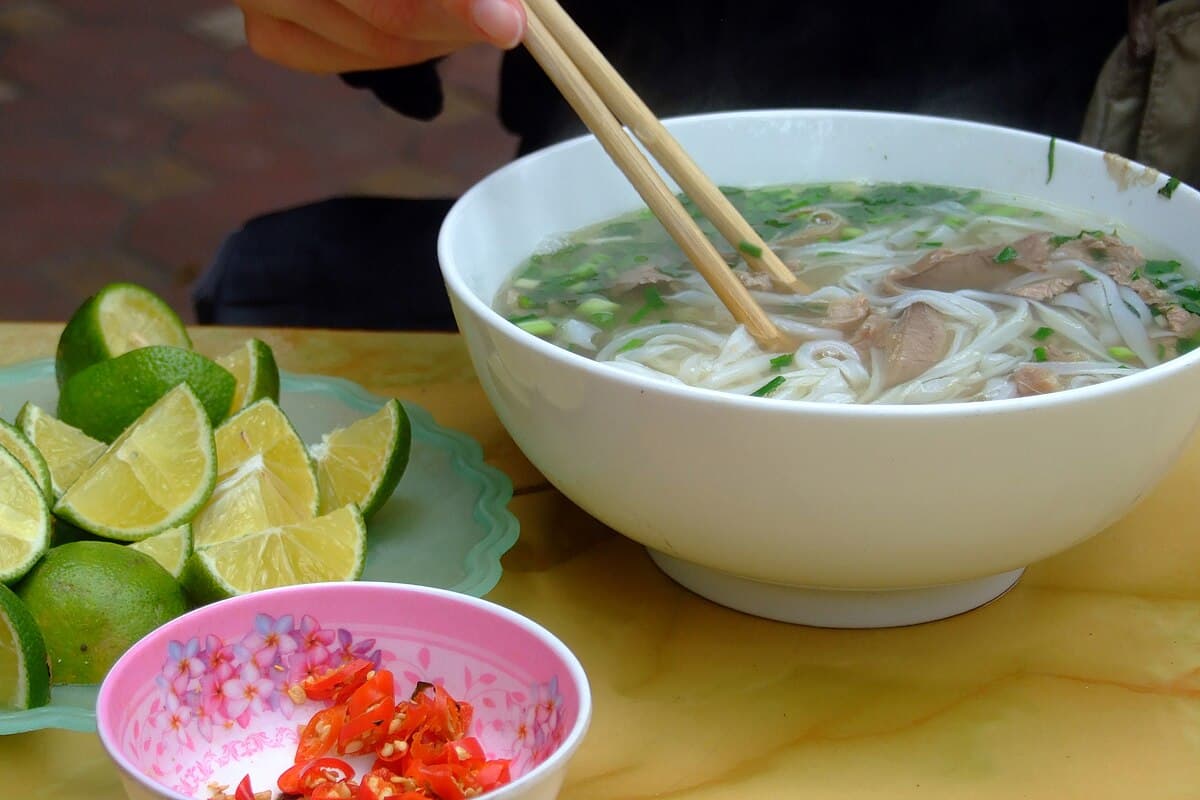
Vietnamese food does not split into one cuisine; it splits into three. Each of the country's three climate zones — northern subtropical, central tropical-monsoon, southern equatorial — produced its own ingredients, flavour profile, and signature dishes long before national kitchens flattened them into menus abroad. The dishes worth travelling for are the ones that only exist in a single city or province.
This guide is the practical eat-where map: what to order, where the signature versions come from, and how to read a Vietnamese street-food stall. For the deeper food research summaries — Hanoi local spending behaviour, Hoi An's food-tourism transformation, the Vietnamese culinary tourism market — see our research corpus.
The three regional cuisines
| Region | Flavour profile | Signature dishes | Best food city |
|---|---|---|---|
| North (Hanoi, Sapa) | Lean, herbal, clearer broths, less sugar | Phở, bún chả, cha cá, bánh cuốn, egg coffee | Hanoi |
| Central (Hue, Hoi An, Da Nang) | Spicier, saltier, more fermented seafood, intricate preparation | Bún bò Huế, cao lầu, mì quảng, nem lụi, bánh xèo (central style), bánh khoai | Hoi An |
| South (HCMC, Mekong, Phu Quoc) | Sweeter, richer, more coconut, more fresh herbs | Bánh xèo (southern style), bún thịt nướng, cơm tấm, hủ tiếu, sweet desserts | Ho Chi Minh City |
Vietnam ranks high on every major global food-quality ranking; the TasteAtlas global cuisine index consistently places Vietnamese among the world's top 20 cuisines, and Hanoi specifically appears in the top tier of food cities globally.
Dishes by region
Hanoi (north)
The northern kitchen leads with phở — beef or chicken noodle soup, breakfast staple, and the dish you'll see Hanoi locals eating at 6:30 a.m. on plastic stools. The northern version has a clear, beefy broth, flat rice noodles, raw onion and herbs added at the table, and very little sugar. Try Phở Gia Truyền on Bát Đàn street or Phở Thìn on Lò Đúc (a Hanoi institution since 1979, famous for its stir-fried-beef twist).
Other essentials:
- Bún chả — grilled pork with cold rice vermicelli, fresh herbs, and a sweet-sour dipping sauce. Bún Chả Hương Liên (the "Obama-Bourdain" spot) is touristy now but still good; locals queue at smaller stalls in the Old Quarter every lunchtime.
- Cha cá — turmeric-marinated fish pan-fried at your table with dill and spring onions, served with rice vermicelli and peanuts. Cha Ca La Vong has been making it since 1871.
- Bánh cuốn — steamed rice-flour rolls filled with minced pork and wood-ear mushroom, served with nuoc cham. Bánh Cuốn Bà Hoành near Hoàn Kiếm Lake is reliable.
- Egg coffee (cà phê trứng) — invented at Café Giảng in 1946 during a wartime milk shortage, when Nguyễn Văn Giảng improvised whipped egg yolk and sugar in place of milk. The recipe stayed in the family; the original café still serves it.
Hue (centre)
Hue's food is the most distinctive regional cuisine in Vietnam — a legacy of its 143-year run as the imperial capital under the Nguyễn dynasty. Court cooks developed dishes with intricate presentation and bigger flavours than the surrounding region; many of those dishes are still only made in Hue.
- Bún bò Huế — spicy lemongrass beef noodle soup, fundamentally different from phở. Heavier, more aromatic, layered with shrimp paste and chilli oil. Hanh Restaurant and Bún Bò Bà Mỹ are reliable.
- Nem lụi — grilled lemongrass pork skewers wrapped in rice paper with fresh herbs and dipped in peanut sauce.
- Bánh khoai — the Hue take on southern bánh xèo, smaller and crispier.
- Cơm hến — clam rice with bean sprouts, peanuts, pork crackling. A local staple that almost no tourist orders.
Hue also produces salt coffee (cà phê muối) — invented in 2010 at a small Hue café, viral on Vietnamese TikTok in 2023, now country-wide. The salt cuts the condensed milk's sweetness in a way that's hard to describe until you've had it.
Hoi An (centre)
Hoi An has more regional specialty dishes per kilometre than any other Vietnamese town. Three are essentially unique to the area:
- Cao lầu — thick chewy noodles, sliced pork, fresh greens, crispy croutons. Authentic versions are made only with water from the Ba Le well in Hoi An's old quarter — the mineral content is part of the noodle's character. Try Cao Lầu Bà Bé or Bale Well.
- Mì quảng — yellow turmeric-tinted noodles, shrimp and pork, peanuts, rice cracker. A central-Vietnamese staple that travels well; Hoi An and Quảng Nam province versions are the canonical ones.
- Bánh mì Phượng — Anthony Bourdain anointed it on his 2009 visit; it's still genuinely good. Bánh Mì Phượng has a queue every day but the bread is hot from the oven and the fillings are right.
Hoi An is also Vietnam's most-recommended cooking-class city. Family-host classes ($25–40) typically include a market visit, hands-on prep, and a sit-down meal. The Hoi An food-tourism transformation research documents how cooking-class tourism has reshaped the local economy since the early 2000s.
Saigon / Ho Chi Minh City (south)
Southern Vietnamese food is sweeter, herbier, and more influenced by Cambodian and Cham cooking than the north. Coconut milk is more common, sugar is more pronounced, and the fresh-herb selection on the side of every plate is wider.
- Bánh xèo — sizzling turmeric crepe with shrimp, pork belly, bean sprouts, fresh herbs. You eat it by tearing pieces off, wrapping with lettuce and herbs, dipping in nuoc cham. Bánh Xèo 46A is the classic.
- Bún thịt nướng — grilled pork over rice vermicelli with fresh herbs, peanuts, fish sauce dressing. Lighter than it sounds; perfect Saigon lunch.
- Cơm tấm — broken-rice plate with grilled pork chop, shredded pork, fried egg. Working-class breakfast and lunch staple.
- Hủ tiếu — clear-broth noodle soup with shrimp, pork, herbs. The southern answer to phở.
- Cà phê sữa đá — iced condensed-milk coffee, the southern coffee drink. Strong, sweet, perfect at 35°C.
Mekong Delta (south)
The Mekong is the rice basket and the fruit basket, and its food shows it. Floating markets serve hủ tiếu in noodle-soup boats; town markets sell fruits you won't see in the north (rambutan, mangosteen, jackfruit). The signature dish is cá kho tộ (caramelised fish in a clay pot), best in a family kitchen rather than a restaurant. The Vietnam culinary tourism market growth research shows Mekong food tourism is one of the fastest-growing sub-sectors, but it's still a quieter food destination than the central coast.
How to read a Vietnamese street-food stall
The single most useful skill is recognising when a stall is good before you sit down. The signals:
- A queue of locals at peak hours is the single most reliable. Locals know what's good in their neighbourhood; they don't queue out of nostalgia.
- Fast ingredient turnover. Watch for two to three minutes — if the cook is constantly cooking and serving, the food doesn't sit. If you see prepared portions sitting under a window for half an hour, walk on.
- A specialist not a generalist. A stall that does one dish well (one kind of phở, one bún bò recipe) outperforms a stall with a 30-item menu. Specialists have the supply chain dialled and the technique consistent.
- Plastic stools, not Instagram décor. Vietnamese street food earned its reputation in workers' lunch shops, not on aesthetic feeds. The good places still look like workers' lunch shops.
- English menus are a yellow flag, not a red one. English menus exist in tourist districts but the food isn't automatically worse — it just means you're paying tourist-district prices. Read the queue and the turnover, not the menu language.
The research backs the queue-of-locals heuristic: the IJRISS Hanoi street-food study found that food quality and price were the dominant predictors of locals' choice, well above location convenience or décor.
Drinks worth ordering
- Bia hơi — fresh draft beer, brewed daily and sold within hours, 8,000–15,000 VND ($0.30–$0.60) per glass. The Hanoi institution. Try Bia Hơi Junction at the Tạ Hiện / Lương Ngọc Quyến crossroads.
- Vietnamese coffee — drip-brewed in a phin filter, served with condensed milk over ice (sữa đá) or hot (sữa nóng). For the deeper coffee tour, our Vietnamese coffee drinks guide decodes every variant.
- Sugarcane juice (nước mía) — pressed in front of you from green sugarcane stalks. The southern Saigon equivalent of iced coffee for street-food companion drink.
- Coconut coffee (cà phê dừa) — a 2010s invention that combines Vietnamese coffee with coconut cream. Best in Hanoi at Cộng Cà Phê.
How to plan a food-led trip
A simple framework: 2 days in Hanoi for the northern canon, 2 days in Hue + Hoi An for central specialty depth, 2 days in HCMC for variety and contemporary takes. Add a day in the Mekong for the river-food immersion.
For the broader trip-planning framing, see the how long in Vietnam guide and the Vietnam Travel Cost Index 2026 which budgets typical food spend by traveller tier ($10–18/day backpacker, $25–45/day mid-range, $60–100/day comfort).
Limitations
Recommendations for specific stalls and restaurants reflect April 2026 observations and our team's recent visits, but Vietnamese food spots cycle quickly — owners retire, locations move, queues shift to a newer place down the street. Workaround: treat the named stalls as starting points and ask your hotel or homestay host where they ate lunch yesterday — neighbourhood word-of-mouth is the most current signal you'll get.
This guide is region-level, not neighbourhood-level — a Hanoi food day in the Old Quarter looks very different from one in the West Lake area or Tây Hồ. Workaround: for deeper neighbourhood food maps, the Hoi An community-based tourism research and named city guides (forthcoming) go finer-grained than space allows here.