
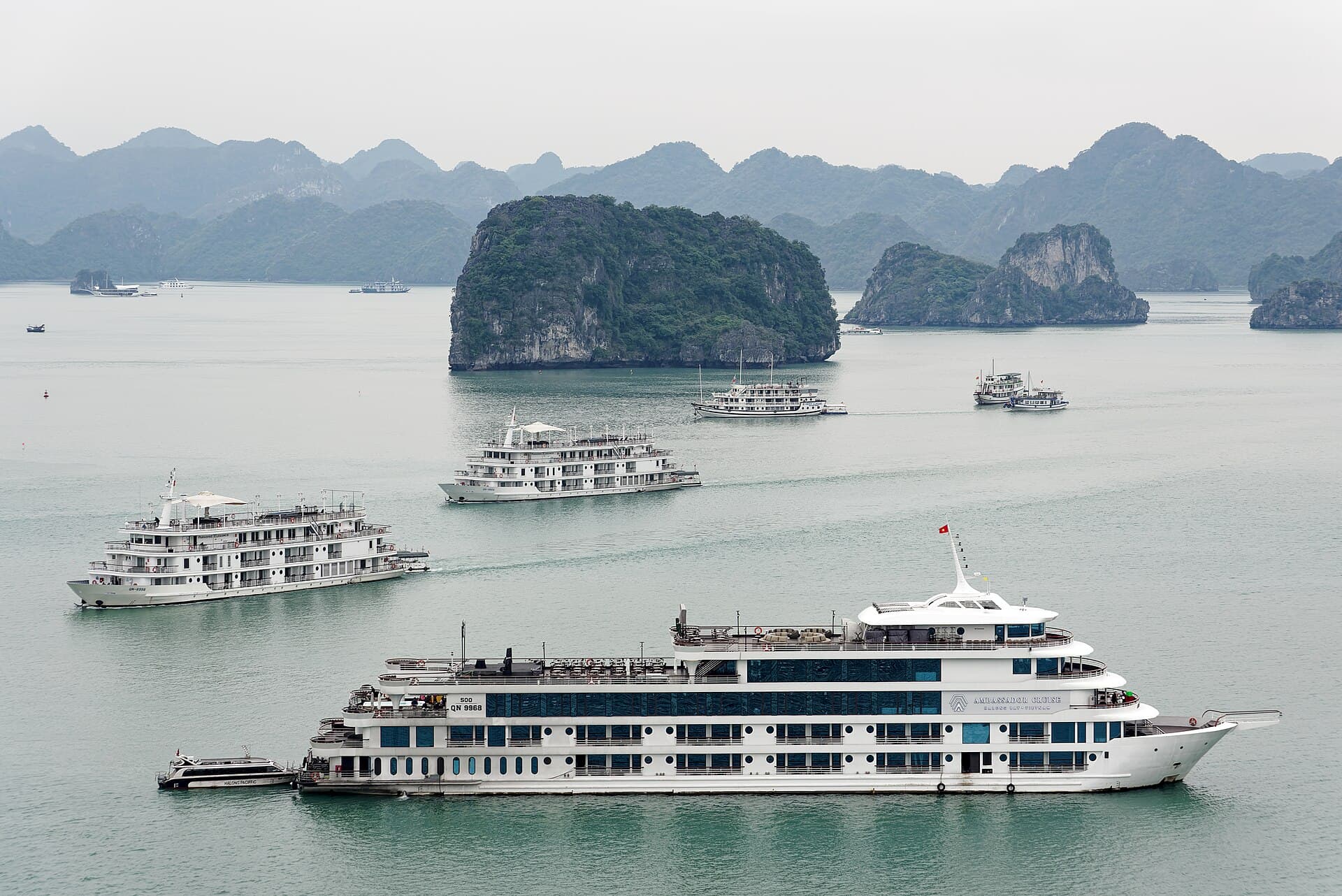
In February 2025, Do Gia Hung of Hoa Binh University published "Overtourism: An Emerging Issue in Ha Long Bay, Quang Ninh" in the university's journal, Issue 15. It's the most recent peer-reviewed academic treatment of Ha Long Bay's tourism pressure, and it's worth reading if you're trying to decide whether to visit, how, or where to go instead.
This article summarises the study's findings and translates them into practical planning advice. Nothing here replaces reading the primary source — the study is in English, freely available, and short.
What the study says
The three-impact framework
The paper organises Ha Long Bay's overtourism pressure into three interconnected categories:
1. Environmental impacts
- Strain on natural resources (fresh water, seafood stocks used in floating restaurants)
- Habitat degradation in sheltered caves and coves where cruise boats anchor repeatedly
- Water-quality reduction from boat wastewater and solid-waste management gaps
- Marine-ecosystem pressure on the bay's coral and fish populations
2. Sociocultural impacts
- Shifts in how long-established floating villages live and work as they get folded into the tourism economy
- Tension between preserving traditional fishing livelihoods and the lucrative pivot to running tourist homestays
- Generational displacement as younger villagers move to tourism work in Ha Long City
3. Economic impacts
- Reduced visitor satisfaction — the study's most important finding for travelers. When a site is too crowded, the experience degrades, traveler reviews drop, and the destination eventually loses the premium brand that made it valuable in the first place.
- Concentration of economic benefits with a small number of cruise operators, rather than distributed to the wider Quang Ninh community.
Contributing factors
The paper names three underlying causes:
| Cause | What it means |
|---|---|
| Limited carrying capacity | The bay's physical space, especially at popular sites, can only absorb so many visitors before the experience degrades |
| Localised overload | Overall visitor numbers across the bay could be sustainable, but congestion clusters at the same 5–6 sites (Sung Sot Cave, Titop Island, Luon Cave, the floating villages) |
| Poor public awareness | Both international and domestic visitors often lack context on responsible-tourism behaviour specific to marine protected areas |
Proposed solutions
The study recommends a multi-pronged approach (paraphrased for clarity):
- Manage visitor numbers — through boat licensing, timed entry, or pier caps.
- Diversify tourism products — move traffic away from the same chokepoints into less-visited parts of the bay.
- Promote eco-tourism — reward operators investing in environmental practices.
- Strengthen governance — clearer authority between central government, Quang Ninh province, and site managers.
- Enforce environmental regulations — especially on boat waste and water quality.
- Raise public awareness — with visitor-facing campaigns on responsible behaviour in the bay.
What this means for your trip
1. Visit — but be deliberate about when and which part of the bay
The study doesn't argue for a tourism boycott. Ha Long Bay is one of the most genuinely beautiful places in Southeast Asia, and skipping it entirely isn't the right response to overtourism research. The right response is where and when:
- Time of day — Morning 6–9am and late afternoon 4–6pm are the quietest windows on the water. Mid-day (11–2) at Sung Sot Cave is the single most congested moment in the entire itinerary.
- Day of week — Weekends are busier with Vietnamese domestic tourists (especially after the high-speed rail to Ha Long opened). Tuesday to Thursday cruise departures see roughly 30% fewer boats at peak sites.
- Part of the bay — See below.
2. Consider Lan Ha Bay or Bai Tu Long Bay for the same experience with a tiny fraction of the boats
The study's "diversify" recommendation is doable at the traveler level today. Two alternatives deliver near-identical scenery:
- Lan Ha Bay — Immediately south of Ha Long, accessed from Cat Ba Island. Same karst formations, same emerald water, roughly one-tenth the cruise-boat traffic. Most independent travellers now base in Cat Ba and take Lan Ha Bay day boats or one-night cruises.
- Bai Tu Long Bay — East of Ha Long, a UNESCO extension covering the same geological features. Almost entirely the domain of overnight cruises (limited day-boat infrastructure), but dramatically less crowded.
3. Choose an operator that publishes its environmental practices
The study's "promote eco-tourism" lever works at the booking stage. Filter operators for:
- Written waste-handling policy (greywater treatment, no discharge)
- Reasonable crew-to-guest ratio (overloaded boats correlate with cut corners)
- Newer vessels (2018+) — older boats have worse engines and emissions
Most reputable overnight cruise operators now publish some version of this on their site. If they don't mention it at all, that's a signal.
4. Skip the mass-market all-inclusive day tour if you can
"Cheap" Ha Long Bay day tours from Hanoi (bus transfer + short boat + one cave + seafood lunch + return bus for $35–$50) are a significant contributor to the peak-day congestion the study documents. Going independently — train or bus to Ha Long / Cat Ba, then a half-day boat from there — both gives you a better experience and reduces the congestion by one bus. It costs roughly the same or slightly more.
Limitations & caveats
- The study is published in a university journal, not a top-tier indexed sustainability journal like Tourism Management or Annals of Tourism Research. It's a useful on-the-ground framework from researchers based in Vietnam, but it doesn't run the kind of quantitative carrying-capacity model you'd see in peer-reviewed Western tourism research.
- No specific visitor-number thresholds. The paper is more conceptual than numerical — "carrying capacity is being exceeded" isn't given a specific daily-visitor number.
- Recommendations are for governance, not travellers. Most of the solutions (licensing, caps, governance) require government action. Our traveler-facing translation (alternatives, timing, operator choice) is our own, informed by but not drawn from the primary source.
- Ha Long Bay tourism policy is actively evolving. The Quang Ninh province has announced several waves of boat-licence tightening in recent years. Conditions on the ground can change 6–12 months after announcements take effect.
Sources & further reading
- Primary source: Do Gia Hung — "Overtourism: An Emerging Issue in Ha Long Bay, Quang Ninh" — Hoa Binh University Journal, Issue 15, February 2025.
- Related academic literature: Multiple peer-reviewed papers on Ha Long Bay resident-perception of tourism and a 2024 economic valuation of tourism's environmental impacts at Ha Long Bay.
Related on this site:
- Ha Long Bay destination guide — operators, timings, where to stay
- Cat Ba Island guide — the better base for Lan Ha Bay
- 2025 Vietnam arrivals data — national crowding context