
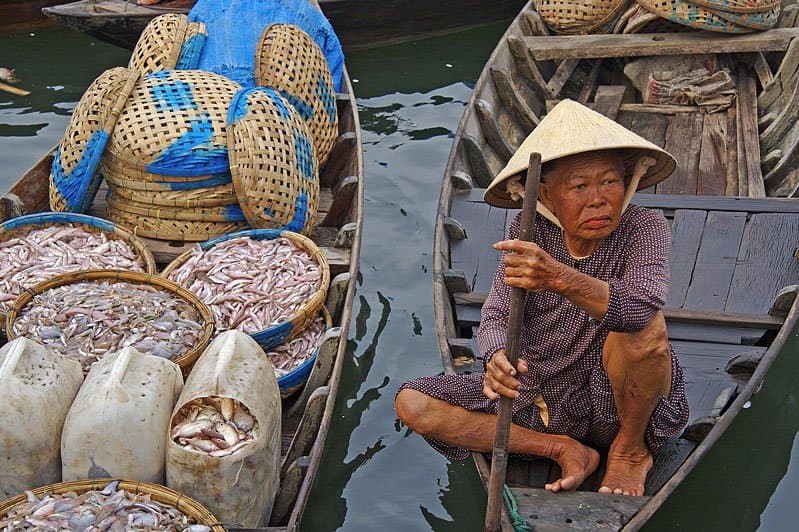
What you'll do on a Hoi An cooking class
The classic half-day format, which most schools follow:
- Hotel pick-up around 8am and a short walk or cyclo to Hoi An Central Market.
- Market tour — 20–30 minutes browsing herbs, noodles, and seafood with your instructor, who picks up ingredients for the class.
- Boat transfer — either a short wooden-boat ride down the Thu Bon to an island school, or a basket-boat paddle through the Cam Thanh water coconut palms.
- Cooking session — 2 to 2.5 hours at individual work stations, making 4 to 6 dishes from scratch.
- Sit-down lunch of everything you've cooked, usually with a glass of local beer or lemongrass tea.
- Drop-off back in the Old Town around 1pm.
How to get to the class from Hoi An
Most classes are walkable, a short cyclo away, or include a pick-up, so getting there is rarely a logistics problem — but it helps to know which type you've booked.
- Old Town schools (Morning Glory, Vy's Market) sit inside or on the edge of the pedestrian zone — a 5–15-minute walk from central hotels, or a 60,000–100,000 VND Grab from the An Bang and Cua Dai beach strip.
- Island and riverside schools (Red Bridge, Thuan Tinh Island) almost always include the transfer: you meet at the market or a jetty and continue by boat, so you arrange nothing yourself.
- Village homestay classes around Cam Thanh or Tra Que are 10–20 minutes by bike; many travellers ride out on a hotel bicycle along the rice paddies, which is half the pleasure. If you're based in Da Nang instead, budget a 45-minute taxi each way — most schools don't include Da Nang pick-up.
The dishes, and what you'll actually learn
The menus repeat across schools because these are the dishes Hoi An is known for, but a good instructor teaches the technique behind each rather than just the recipe.
- Fresh spring rolls (goi cuon) — the confidence-builder, taught first; the lesson is softening rice paper without tearing it.
- Banh xeo — the turmeric crepe, where pan heat and oil decide crisp versus soggy.
- White-rose dumplings — a Hoi An speciality; hand-pleating the translucent dough is fiddly and yours will look rustic.
- Cao lau or pho — noodle dishes where the broth or pork marinade is the teaching point.
The most useful thing you take home isn't the recipe card — it's the Vietnamese balance of fish sauce, lime, sugar, and chilli, and how to adjust it by taste. Ask your instructor to build the dipping sauce (nuoc cham) by eye in front of you; that one skill carries over to almost everything you'll cook later.
How to book
- Branded schools (Red Bridge, Morning Glory, Thuan Tinh Island) — book online 2–3 days ahead, especially November through March. $30–45 per person, 12–16 students max.
- Homestay-run classes — often the best value. Look for places like Herbs and Spices, Bay Mau Eco, or small family operations in An Bang village. $25–35, fewer than 10 students.
- Private class — contact a school directly and pay $60–90 per person for a class of 2 to 4. Worth it if you're picky about dietary needs or want a specific menu.
- Hotel concierge booking — convenient but adds a 10–15% commission. Book yourself online unless your time is tight.
Check recent reviews for the specific school, not the booking platform. Quality varies wildly even between schools with similar prices.
When to go
Cooking classes run year-round and aren't weather-dependent for the actual cooking. But the market tour and boat ride are better when it's dry:
- March–May — ideal. Cool mornings, dry, busy but not packed.
- June–August — hot and humid; classes start early to beat the heat.
- September–November — typhoon season; boat rides can be cancelled but cooking goes ahead.
- December–February — cool and occasionally rainy; the cosiest time to stand over a wok.
Morning classes are more popular; afternoon classes (1pm start) are easier to book last-minute.
Typical cost breakdown
- Half-day group class with market and lunch: 600,000–1,100,000 VND ($25–45)
- Full-day class with farm visit: 1,400,000–1,800,000 VND ($58–75)
- Private 2-person class: from $120 total
- Printed recipe booklet: usually included; some schools email a PDF
- Tips for the instructor: 50,000–100,000 VND if the class is good
Almost all schools cater for vegetarians and most for vegans, but tell them when you book — ingredients are bought fresh that morning.
Is a Hoi An cooking class worth it?
Yes, probably the best-value activity in Hoi An after the Old Town walking itself. Unlike many "hands-on" cooking classes in Asia, the good Hoi An schools actually let you chop, fry, and plate your own food — you're not watching a chef while sipping lemongrass tea.
Skip the flashy big-name schools if you want a quiet, intimate class; book one of the smaller operations in An Bang or on the way to My Son. And don't bother with the "eco-tour plus cooking" combos that cram in a water-buffalo ride — you'll feel herded.
Who it's best for, and who can skip it
A cooking class suits travellers who like food and want one hands-on, indoor-friendly activity that isn't weather-dependent — a reliable choice on a rainy afternoon or a slower day between bigger trips. Families do well too; most schools give children a low-stakes spring-roll station, and the basket-boat ride keeps younger kids engaged.
You can comfortably skip it if you've already done a hands-on class elsewhere in Vietnam, if you have only two days in Hoi An and haven't yet seen the Old Town or My Son, or if you don't cook at home and won't use what you learn.
Practical tips
- Eat a light breakfast — you'll cook and eat four to six dishes, and most people can't finish.
- Flag dietary needs at booking, not on the day, since ingredients are bought fresh that morning.
- Bring a hat and sunscreen for the market and boat segments; the cooking itself is shaded.
- Photograph the steps, not just the dishes — process shots are more useful later than the recipe card.
Limitations
Hoi An cooking-class quality varies sharply — some operators run high-volume 30-person classes where individual instruction is minimal and the dishes are simplified for speed. Workaround: book a small-group class (6-8 people maximum) at a class run by a working restaurant rather than a tourism-only operation — Red Bridge Cooking School, Morning Glory Cooking Class, and Vy's Market Restaurant cooking school are the well-established options at the $35-55 price point; expect to spend half a day and leave with 3-4 dishes you can actually replicate at home.
The market-visit component of most cooking classes is a 30-minute tour with vendor commission relationships, which means the produce-stall stops aren't random. Workaround: treat the market visit as a cultural overview rather than a sourcing demonstration — the vendor tour is useful for context (what each herb is, regional rice varieties) but skip the "let's buy this specific brand of fish sauce" upsells. Ask the class instructor specifically how to source ingredients back home; the substitutions matter more than the brand recommendations.