
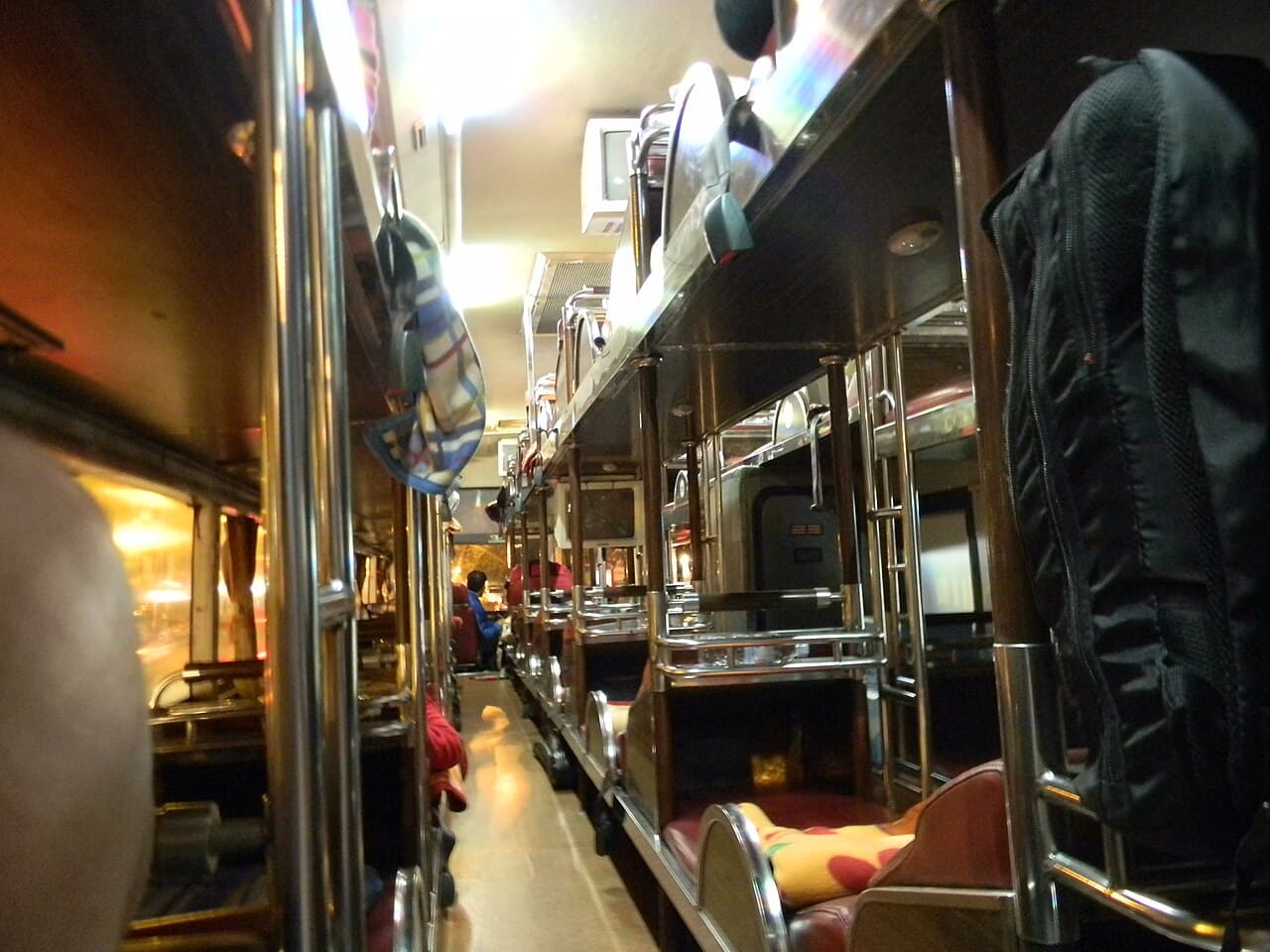
The Vietnamese sleeper bus question dominates solo-female travel forums about Vietnam more than any other transport question. The honest answer takes some unpacking — the buses aren't as dangerous as the dramatic horror stories suggest, but they aren't as routine as some Vietnam-travel-blog posts claim. The truth sits in the middle: with the right operator selection and a few practical habits, sleeper buses are a routine and reasonably safe transport mode that solo female travelers use constantly. Without operator selection, the experience varies wildly and the worst-case stories become more plausible.
This guide is the Vietnamese-woman perspective on the sleeper bus question — what the actual risks are, which operators warrant the premium, when to take the train instead, and the practical berth-and-luggage habits that determine whether a trip is uneventful. The Sleeper Bus Operator Atlas covers the deeper operator-by-operator reviews; this guide is the solo-female-specific synthesis.
Quick summary — the honest sleeper-bus reality
| Concern | Reality |
|---|---|
| Accident risk | Higher than trains (~2-3x); lower than the online-forum stories suggest |
| Harassment risk | Uncommon; curtained berths provide privacy; mostly low-stakes interactions |
| Operator quality variance | Large — reputable operators are routine; budget operators are inconsistent |
| Best solo-female pattern | Phuong Trang or Hanh Cafe; upper-middle berth; curtain drawn |
| When to skip and take train | Hanoi-Hue, Hanoi-Sapa, Da Nang-HCMC long route |
| When sleeper bus is the only option | Hoi An-Nha Trang, Mui Ne, Da Lat, Cat Ba |
| Premium worth paying | $3-5/route for reputable operator vs budget unbranded |
The fast version: book Phuong Trang or Hanh Cafe for any sleeper-bus leg; book the upper-middle berths through 12Go in advance; keep valuables in a small daypack with you (not the cargo compartment); pack earplugs and an eye mask; take the train when both options exist for the route.
Why the answer is "reasonably safe with operator discipline"
The sleeper-bus safety conversation has three layers, and the conflation of all three is what produces the dramatic online forum content.
Layer 1: Vietnamese road safety in general. Vietnam has around 8,000 traffic deaths per year nationally; per-km accident rates are higher than developed-Western standards but in line with Southeast Asian peers. This baseline applies to all road transport including taxis, motorbikes, and buses. A sleeper bus is no riskier than a private car covering the same route, on the same roads, with the same drivers.
Layer 2: Operator-specific quality. Within the Vietnamese sleeper-bus market, the operator variance is enormous. The top-tier operators (Phuong Trang/Futa Bus, Hanh Cafe, The Sinh Tourist, Hoang Long, Mai Linh Express) maintain modern fleets, employ trained drivers with regulated rest hours, have safety inspection compliance, and have customer service recourse. The bottom-tier (unbranded $10-15 buses, smaller private operators with limited online presence) have older fleets, less safety oversight, and produce the bulk of accident-and-incident reports.
Layer 3: Mode-specific safety vs alternatives. Sleeper buses have higher per-km accident rates than trains (rail being the safest mode) but lower rates than the equivalent private-car driving with self-driven travelers (who don't know the roads, the traffic patterns, or the language). For travelers covering the routes the train doesn't serve, the sleeper bus is the practical and reasonably-safe option.
The conflation that produces dramatic forum content treats Layer 1 (general Vietnamese road risk) and Layer 2's worst-case (unbranded budget operators) as if they describe the whole sleeper-bus experience. They don't. The Phuong Trang or Hanh Cafe sleeper bus from Hoi An to Nha Trang at $25-30 is a different product than the $12 unbranded budget bus from the same route.
The operator picks for solo female travelers
Phuong Trang (Futa Bus) is the standard recommendation. Vietnam's largest sleeper bus network with 200+ daily routes, modern fleet (most buses 2-5 years old), free water and snacks, English-speaking staff at major stations, professional bus assistants, and consistently positive recent reviews from solo female travelers on TripAdvisor and Google. $20-40 per route depending on distance.
Hanh Cafe is the backpacker-focused operator with strong solo-female community signal. English-language website and booking, backpacker-friendly pickup points (most hostels), and a multi-leg open-tour pass option that bundles 4-6 sleeper-bus segments. Slightly older fleet than Phuong Trang but still well-maintained.
The Sinh Tourist is the long-established tour operator with sleeper-bus service. Offices in every major tourist city, English staff, consistent quality. Slightly higher prices than Phuong Trang ($25-45 per route) but solid for solo female travelers.
Hoang Long specializes in the longer routes (Hanoi-HCMC direct, Da Lat-HCMC). Reliable for the long routes; less coverage on shorter regional routes.
Mai Linh Express is the spinoff from the Mai Linh taxi company. Smaller route network but consistently positive reviews; worth checking for specific routes.
Avoid: smaller no-brand-name buses at $10-15/route; unbranded private buses; bus operators with limited online presence and no recent reviews on TripAdvisor or Google. The price savings are small; the risk-and-quality differential is large.
Practical solo-female sleeper-bus habits
A few specific practices that make the difference between an uneventful trip and a stressful one:
Book the berth specifically, not just the route. 12Go and Phuong Trang's app let you select the specific berth at booking. The upper-middle berths (rows 4-8 of a typical 10-row sleeper bus) are the best balance — less foot-traffic from boarding/alighting passengers, less proximity to the driver and the bathroom, more privacy from curtain drawing.
Keep valuables with you. Passport, phone, electronics, cash, and any travel insurance documents go in a small daypack that stays in the berth with you. Larger backpacks go in the cargo compartment under the bus (the driver loads at boarding; retrieve at arrival). Tag your larger backpack with name and phone number.
Pack the sleep kit. Earplugs (the bus is noisy with snoring passengers, road sounds, and occasional driver-announcement systems); eye mask (the AC and reading lights stay on); a small blanket or shawl (AC runs cold); flip-flops (shoe-off berths; flip-flops for bathroom walks); phone charger + cable. The total kit is small and lightweight.
Communicate clearly with the bus assistant. Most reputable operators have a bus assistant who handles passenger logistics — boarding, berth assignments, bathroom-stop coordination, English translation. The assistant is your point of contact for any berth-switch requests, security concerns, or destination-stop confirmation.
Use the curtain. The berth curtain provides visual privacy from adjacent passengers and aisle traffic. Draw it on boarding; keep it drawn unless you specifically want to be approachable. The curtain is the most-effective single safety-and-comfort feature on the sleeper bus.
Plan the arrival. Most sleeper buses arrive 04:30-07:30 — the awkward middle-of-the-night-into-morning window. Pre-book your destination accommodation for an early check-in if possible; have a backup plan if the property won't accommodate (most hostels and hotels in major tourist cities can hold luggage from early morning and check you in around 14:00 if needed). The standard backpacker pattern: arrive, store luggage at the hostel reception, get breakfast at a local cafe, return to check in mid-afternoon.
Use Grab for the airport/station transfer. Don't hail random taxis at the bus station — use Grab for the destination transfer for safety, reliable pricing, and a rated driver.
When to skip the bus and take the train
The route-by-route train-vs-bus decision:
Hanoi → Hue (overnight, 12 hours): take the train. Soft sleeper $35-50 vs sleeper bus $25-35. The train is more comfortable, safer, and the cabin door locks. The $10-20 train premium is the standout sleeper-bus-route upgrade.
Hanoi → Sapa (overnight, 8 hours): take the train. The Sapa-bound sleeper buses have a higher accident rate than the train on the mountain roads. Tourist-class operators (Livitrans, Chapa Express, Sapaly Express) at $30-50/berth.
Hanoi → Da Nang or HCMC (16+ hours): take the train for at least part of the route. The continuous bus rides are tiring and the train is the more comfortable alternative.
Hoi An → Nha Trang (11 hours): sleeper bus is the standard — no direct train. Phuong Trang or Hanh Cafe at $22-30.
Nha Trang → Da Lat or Da Lat → HCMC (4-7 hours): sleeper bus is the standard — no rail. Phuong Trang at $12-28.
Mui Ne ↔ HCMC (5 hours): sleeper bus is the standard. The Sinh Tourist or Phuong Trang at $12-18.
What to do if something goes wrong
A few specific protocols for the rare cases where things don't go as planned:
If you feel uncomfortable with adjacent passengers: ask the bus assistant for a berth switch. Vietnamese sleeper-bus assistants are generally accommodating. The protocol: identify a different available berth (preferably with female neighbors); point to it; ask for the switch in friendly-but-firm Vietnamese-pointing-and-English ("excuse me, please switch berth"). Most operators accommodate immediately.
If you experience harassment: notify the bus assistant immediately. The Vietnamese cultural norm is that the bus operator is responsible for passenger safety; expect them to take the complaint seriously. Document the incident (passenger's berth number, time, what occurred) for any later reporting.
If the bus has a mechanical issue or accident: stay calm; the operators have protocols for vehicle replacement. Phuong Trang and the major operators have customer-service phone lines (provided on the ticket) for serious issues.
If you miss the bus: contact the operator immediately. Some allow rebooking for a small fee; others require a new ticket. The reputable operators have customer service that can help; the unbranded ones often won't.
For embassy contact: each major Vietnamese city has functioning consular services for major Western nationalities (US, UK, Australia, EU). Save the embassy phone numbers in your phone before traveling; the protocols for any serious incident (theft, harassment, accident) are documented in our Solo Traveller Safety Atlas.
Limitations
- Pricing and operator details are May-June 2026 USD at ~26,361 VND/USD and reflect direct-website rates as of that window. Hostel + accommodation rates fluctuate 10-20% seasonally; book early for Tet (Feb 17 2026 in 2026) and December peak.
- Solo-female safety experiences vary individually. The patterns we describe are aggregated from named primary sources (UK FCDO + US State Department + Australian Smartraveller advisories, Numbeo crime indexes, Hanoi/HCMC tourism police hotlines, Facebook group reports). Your specific encounters depend on your situation, dress, behavior, and time of day.
- Vietnam motorbike statistics are aggregated nationally — Hanoi vs HCMC vs rural Ha Giang have materially different risk profiles. The 1968 Vienna Convention IDP rule means US, Canadian, Australian, NZ, Japanese passport holders are technically unlicensed on rented motorbikes.
- Vendor + accommodation recommendations may close or relocate; cross-check on Google Maps + TripAdvisor before booking.
- The Tuyên Quang directive of April 13 2026 continues to roll out unevenly across Northern Vietnam — operator-level licensing status changes month-to-month.
The bigger picture
Vietnamese sleeper buses are a routine and reasonably-safe transport mode for solo female travelers when the operator and route are chosen carefully. The dramatic online forum content largely reflects the unbranded budget operators rather than the reputable ones; the practical habits (operator selection, berth choice, sleep kit, valuables management) reduce the marginal risk to acceptable levels. Most solo female travelers I've talked to who've taken Phuong Trang or Hanh Cafe sleeper buses report the experience as unremarkable in the way most overnight transport is — uncomfortable for sleeping but functional, sometimes social with other backpackers, occasionally with views worth being awake for.
For deeper safety context:
- Vietnam Sleeper Bus Operator Atlas — operator-by-operator reviews
- Vietnam Solo Traveller Safety Atlas — country-level safety reference
- Is Vietnam safe for solo female travelers — the broader solo female context
- Backpacking Vietnam by train and sleeper bus — the route-specific transport overlay
- Vietnam Land Transport Atlas — the full transport reference
The honest answer: yes, sleeper buses are safe enough for solo female travelers, with the operator choice doing most of the work.