
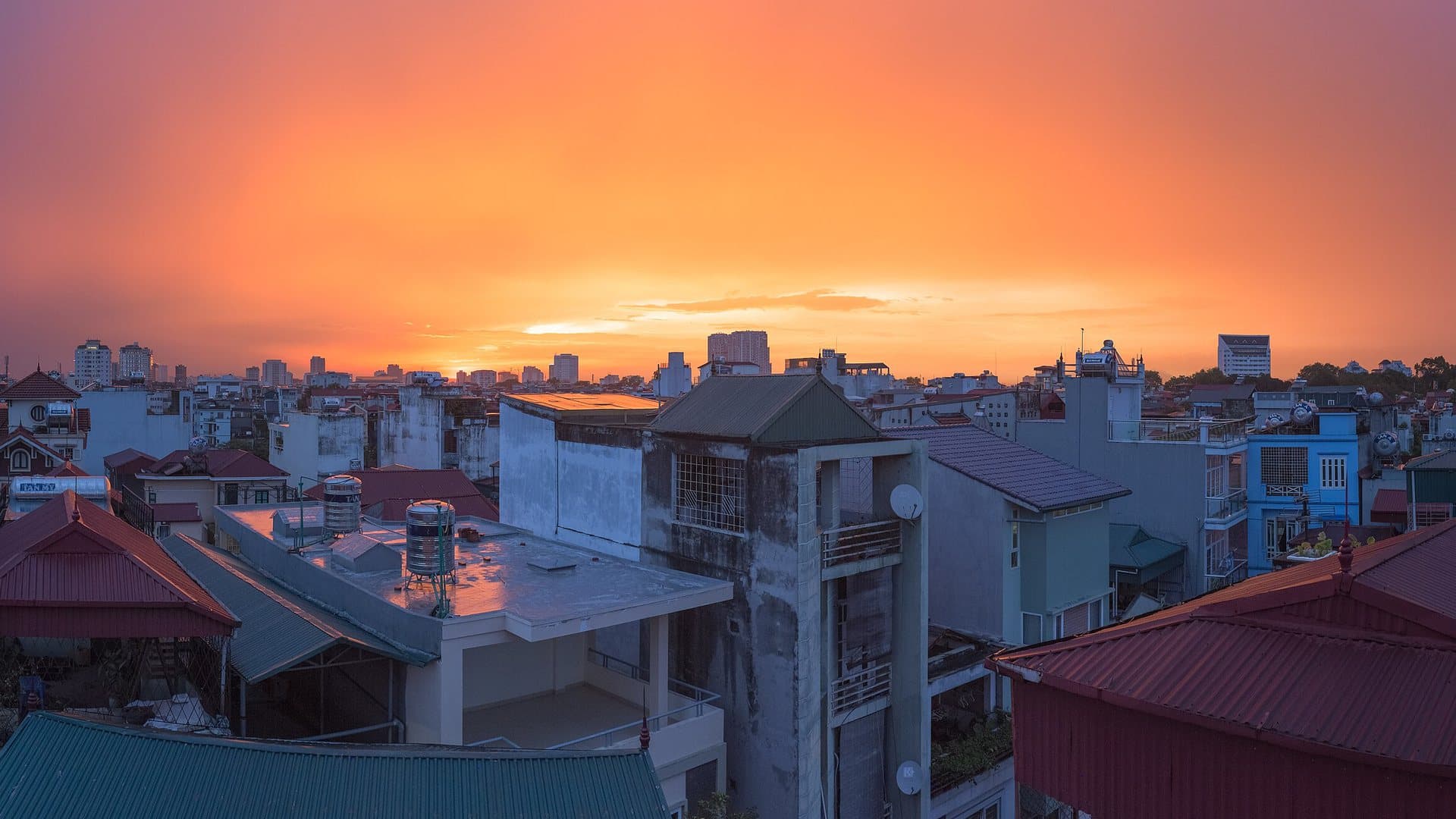
Hanoi is one of the few places in Vietnam with four real seasons, and the best of them is short. Autumn — October and November — brings highs of 26-30°C, the year's clearest skies and only 60-155 mm of rain a month, and it is the time to come. Winter, from December to February, is cool at about 14-22°C and dry in total but grey, with fine drizzle and little sun. Summer, from May to September, is hot and wet, with highs of 32-34°C and 165-275 mm of rain a month — three-quarters of the year's 1,610 mm — and typhoon risk peaking from July to October. Spring is a brief warm-up in April after a drizzly March.
That makes Hanoi different from the rest of the country. The central coast is wettest in autumn and the south in summer, so a month that suits Hanoi can be the wrong month for Hoi An — compare our Da Nang and Hoi An weather guide before fixing a north-to-south route.
Hanoi weather at a glance
The table gives long-run monthly averages for 1991-2020 from Climates to Travel. Read the rain column with the rain-days column: they tell very different stories in February and March.
| Month | High | Low | Rain | Rain days | Sun (h/day) |
|---|---|---|---|---|---|
| January | 20.1°C | 14.1°C | 20 mm | 10 | 2.5 |
| February | 21.5°C | 15.8°C | 20 mm | 12 | 1.5 |
| March | 23.7°C | 18.3°C | 35 mm | 16 | 1.5 |
| April | 28°C | 21.7°C | 105 mm | 14 | 3 |
| May | 32°C | 24.4°C | 165 mm | 14 | 6 |
| June | 34°C | 26.1°C | 265 mm | 15 | 5.5 |
| July | 33.6°C | 26.2°C | 255 mm | 16 | 6.5 |
| August | 32.9°C | 25.8°C | 275 mm | 17 | 5.5 |
| September | 32°C | 24.8°C | 245 mm | 14 | 6 |
| October | 29.8°C | 22.2°C | 155 mm | 11 | 5.5 |
| November | 26.4°C | 18.8°C | 60 mm | 8 | 4.5 |
| December | 22.2°C | 15°C | 20 mm | 5 | 4 |
Hanoi averages about 1,585 hours of sunshine a year, which is low for the tropics, and humidity stays between about 73 and 85 percent all year. The city is rarely dry-feeling, even when it is dry.
Autumn, October and November: the best time
Autumn is short and it is the reason to time a trip. October averages 29.8°C by day and 22.2°C at night, with rain falling to about 155 mm over 11 days after the summer's 245-275 mm, and November cools to 26.4°C and 18.8°C with only about 60 mm over eight days. Sunshine holds at four and a half to five and a half hours a day. This is the season for walking the Old Quarter, sitting outside late, and day trips when the air is clearest.
The first half of October still carries the tail of the typhoon season, and the city can flood in a late storm, as it did in October 2025. By November that risk has largely passed. Our month guides for October and November set Hanoi against the rest of the country for each month.
Winter, December to February: cool, dry and grey
Winter is the season visitors misjudge most. December, January and February each average only about 20 mm of rain, so they are among the driest months of the year, yet they are also the greyest: sunshine falls to between one and a half and four hours a day, and fine drizzle is common. January is the coldest month, at 20.1°C by day and 14.1°C at night, and occasional cold snaps push night-time lows down to 7-8°C.
Two other things come with the season. Air pollution is often high in winter, a reason for anyone sensitive to it to check the daily air-quality reading before long walks. And Tet falls in this season — on 6 February in 2027 — when the city empties of workers returning home, many shops close, and transport fills. Our Tet 2027 guide covers the practical effects, and our December and January guides the rest of the country in winter.
Spring, March and April: the drizzle lifts
March is still winter in feel: 23.7°C by day, 18.3°C at night, 16 days with rain but only about 35 mm of it, and about one and a half hours of sunshine a day. April is the real turn. Highs reach 28°C, rain climbs to about 105 mm as the first storms arrive, and the sun comes back to about three hours a day. Late April is warm and green, a good shoulder month before the summer heat.
Summer, May to September: heat, storms and floods
Summer is hot, humid and wet. Highs average 32-34°C from May to September, lows stay at 24-26°C, and rain rises from about 165 mm in May to a peak of 275 mm over 17 days in August — together, about 1,205 mm, or three-quarters of the year's total. It is also, despite the rain, the sunniest part of the year, at five and a half to six and a half hours a day.
Typhoons can reach the north from late May to early November, most often from July to October, and they bring the city's worst flooding. The 2025 season was a reminder: VnExpress reported that Typhoon Kajiki left up to a metre of water in parts of Hanoi on 26 August, and that Typhoon Matmo paralysed 30 major streets on 7 October. Most summer days are simply hot and interrupted by a downpour; the practical response is to walk early and late, keep the middle of the day for air-conditioned museums and cafés, and watch the NCHMF forecast when a storm is named.
Why rain days mislead in Hanoi
Most weather tables give a rain-days figure, and in Hanoi it is easy to misread. March has almost as many rain days as August — 16 against 17 — but March delivers about 35 mm and August about 275 mm. A March rain day is a morning of drizzle; an August rain day can be a street-flooding storm. The volume column is the one that tells you whether plans will survive, and the sunshine column tells you whether the photographs will. Read all three together.
What the weather means for your plans
Sightseeing in the city. October to early December is the most comfortable walking weather; late winter is fine for walking but grey; summer needs an early start. Our 3 days in Hanoi itinerary and where to stay in Hanoi guide work in any season, with the timing of each day adjusted to the heat.
Day trips. Ninh Binh, about 95 km south, follows the same seasonal pattern, and autumn and spring are the most comfortable months for its boat trips and climbs; late May to early June is when the rice around Tam Coc turns gold. Our guides to getting to Ninh Binh and where to stay in Ninh Binh cover the overnight option, and day trips from Hanoi the rest.
Sapa and the mountains. Sapa shares Hanoi's wet summer and drier winter but is far colder: in winter some days fail to reach 5°C, and snow can cover the summit of Fansipan. Pack for that separately — see our where to stay in Sapa guide.
Evenings out. Autumn is the season for sitting outside at the bia hoi corners and on the pavements until late; in winter, pick places with indoor seating. Our Hanoi nightlife guide covers where to go.
For the country as a whole, our month-by-month guide shows how Hanoi's calendar fits against the centre and south, and the rainy season guide covers travelling through the wet months.
Limitations
These are long-run averages for 1991-2020 from a single city station, and individual years vary widely: 2025 brought repeated typhoon flooding, while other summers pass with only routine downpours. Different datasets publish slightly different normals for Hanoi, so expect monthly rainfall figures elsewhere to differ by 10-20 percent. Cold snaps, air quality and drizzle are day-to-day phenomena that averages smooth out.
Typhoon tracks cannot be forecast reliably more than a few days ahead, and the start and end of each season shift from year to year. Workaround: use this page to pick the month, then check the NCHMF forecast and a daily air-quality reading in the week you travel, and keep outdoor plans flexible in summer.