
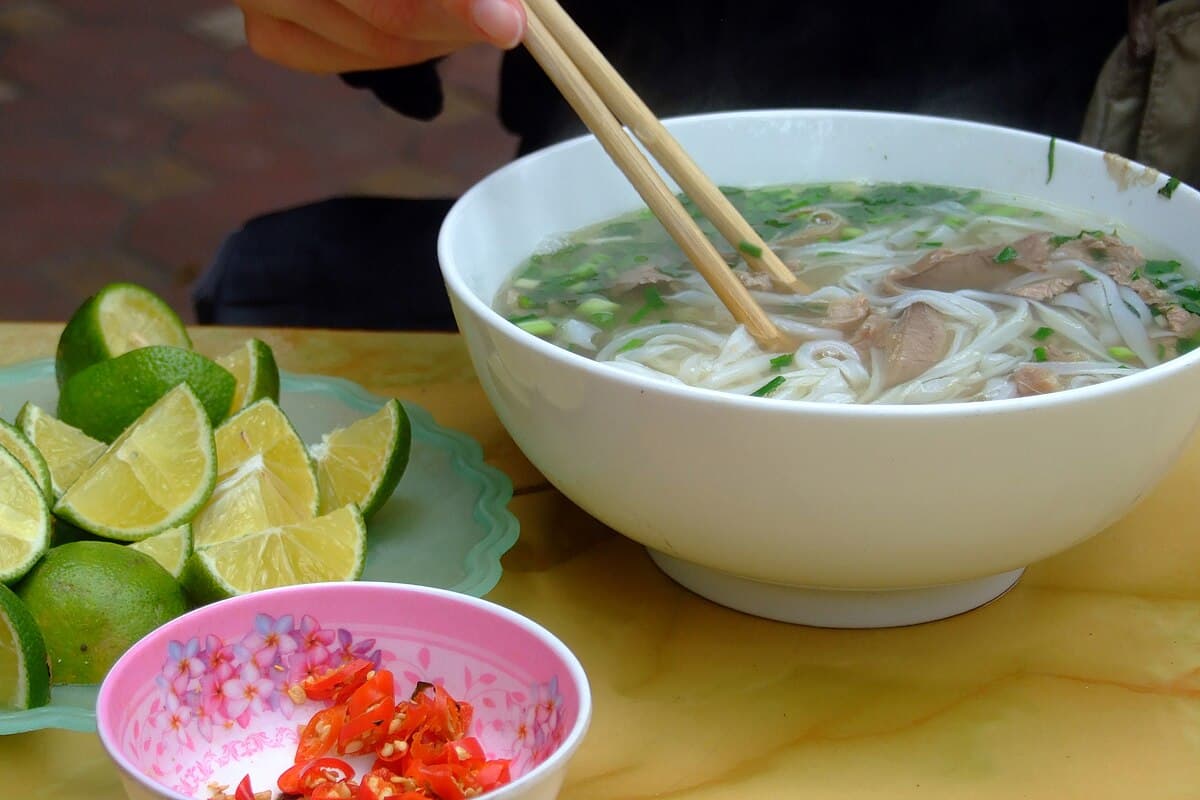
Vietnam street food is generally very safe, and getting sick is uncommon if you follow a few simple rules. Most visitors eat from stalls every day for weeks and have no trouble at all. The small number who do get an upset stomach usually trace it to one of a few avoidable choices, not to street food as a category.
This guide is about one thing: safety and hygiene. It does not list dishes, explain what phở or bánh mì are, or quote prices — for that, see the Vietnam street food atlas (the dishes, regions, and named vendors), the street food price guide (what each dish should cost), and the Vietnamese food guide (dishes city by city, plus how to read a stall). Here the only question is how to eat without getting sick.
The verdict, up top
Vietnam street food is safe for the large majority of travellers. The reason is structural: the best stalls sell out and restock daily, cook each portion to order over high heat, and serve to a constant stream of regulars who would not return if the food were bad. Heat kills most pathogens, and fast turnover means nothing sits around long enough to grow them. Get those two things right — hot and freshly cooked — and you have eliminated most of the risk before you even sit down.
The upsets that do happen are usually mild, short-lived, and caused by raw items, lukewarm held food, or untreated water rather than by cooked street dishes. None of that means you should avoid stalls. It means you should choose them well.
How to pick a safe stall
The single most reliable signal is a queue of locals at a meal-time peak. Locals know their neighbourhood, they will not wait for food they distrust, and a queue guarantees the food is moving fast enough that it never sits. Beyond the queue, run this quick check before you sit:
- High turnover, busy with locals. A stall constantly cooking and serving is restocking from fresh ingredients all day. Empty stalls with pre-cooked food sitting out are the ones to skip.
- Cooked to order and visibly hot. The safest food is assembled and heated in front of you and arrives steaming. Avoid anything lukewarm that has been sitting in a display tray for an unknown stretch of time.
- A clean prep surface and clean hands. Look at the cutting board, the cloth, the water bucket, and whether the cook handles money and food with the same hand. A tidy station is a good proxy for the parts of the kitchen you cannot see.
- Fruit that is peeled or plastic-wrapped. Pre-cut fruit sold from a glass cart is best when it has been peeled and wrapped, or when you watch it cut fresh. Whole fruit you peel yourself (banana, mango, mandarin) is the safest of all.
- A specialist, not a generalist. A stall doing one dish has a tight, fast supply chain for that dish. A 30-item menu means more ingredients held longer.
The 10-second decision checklist
Before you order, ask:
- Are locals eating here right now?
- Is my food cooked to order, or was it sitting out?
- Will it arrive hot, not lukewarm?
- Does the prep surface look clean?
- If there is fruit or raw garnish, was it peeled or wrapped?
Three or more clear yeses and you are good. Two or fewer, walk on — there is another good stall within a block almost everywhere in Vietnam.
Water, ice, and raw items: the real picture
This is where most avoidable upsets come from, so it is worth being precise.
Tap water: do not drink it. Bottled and filtered water is cheap and sold everywhere; use it for drinking and for taking any medication. Most travellers also use bottled water to brush their teeth, though a quick brush-and-spit with tap water is low risk for healthy adults.
Ice: in cities and tourist areas, ice is overwhelmingly safe. Commercial ice in Vietnam is almost all factory-made from purified water and delivered in sealed bags — the give-away is the uniform cylindrical tubes with a hole through the middle, which is what you will see in nearly every café and stall drink. That ice is fine. Be cautious only with irregular, cloudy, hand-cut chips in remote rural spots, where the source water may be untreated. When unsure, order your drink without ice.
Raw herbs and salads: the plate of fresh herbs, bean sprouts, and lettuce served alongside many dishes is delicious and, for most people, fine. It is also the most common cause of mild adjustment upsets, because it is washed in tap water rather than cooked. If your stomach is sensitive or it is your first few days, go light on the raw greens and let the cooked food carry the meal.
A few items deserve genuine caution — not because they are common problems, but because the downside is worse:
- Rare beef (bò tái): thin raw beef slipped into hot noodle soup to cook in the broth is normal and usually fine at a busy stall, but it is lightly cooked. If you want zero risk, ask for it well done (chín).
- Raw and lightly cooked shellfish: oysters, clams, and snails are riskier than finfish, especially in hot weather and away from the coast. Eat them where turnover is high and they arrive hot.
- Tiết canh (raw blood pudding): this is the one dish to simply avoid. It is uncooked animal blood and carries a real risk of serious bacterial infection. Vietnamese health authorities warn against it too, and many locals will not eat it.
Preventing and treating traveller's diarrhoea
Even careful eaters occasionally get a mild upset — often just your gut adjusting to new bacteria, spices, and oils rather than any actual contamination. A little preparation makes it a non-event.
What to pack:
- Oral rehydration salts (ORS sachets) — the single most useful item. They replace the fluids and salts you lose and are what actually helps you recover. Mix with bottled water.
- Loperamide (Imodium) — controls symptoms so you can get through a travel day. Do not use it if you have a high fever or blood in your stool, as it can keep an infection in.
- Hand sanitiser — use it before you eat, every time. Many stalls have no handwashing setup, and your own hands are a common route in.
Pharmacies are widespread in Vietnamese cities and towns and stock ORS and loperamide cheaply without fuss, so you can restock easily on arrival.
Adjustment versus something more: a single rough day with loose stools, mild cramps, and no fever is almost always adjustment or a minor bug, and it passes in 24 to 48 hours with rest, fluids, and ORS. Treat it gently and keep drinking.
When to see a doctor: seek medical help if you have a fever above roughly 38.5°C, blood or mucus in your stool, persistent vomiting that stops you keeping fluids down, signs of dehydration (very dark urine, dizziness, no urination), or symptoms that last beyond about 48 hours. Pharmacies can advise on minor cases; for anything more serious, international-standard clinics operate in Hanoi, Da Nang, and Ho Chi Minh City. The Vietnam healthcare and medical atlas lists clinic options, and the connectivity atlas covers staying online so you can look up a nearby pharmacy or clinic and call ahead. Vietnam's general emergency number is 115 for an ambulance.
Who should be extra careful
The general advice holds for most people, but a few groups should be stricter:
- Pregnant travellers: avoid all raw and undercooked items — rare beef, raw shellfish, soft unpasteurised dairy, and any raw blood dish — and lean on hot, freshly cooked food. Be more conservative with raw herb plates too.
- Immunocompromised travellers (and those on medication that suppresses immunity): stick to cooked-and-hot, skip raw shellfish and raw garnishes, and be quicker to see a doctor if symptoms appear.
- Young children: dehydration sets in faster, so keep ORS on hand and seek care sooner. Favour plain cooked dishes and peeled fruit.
For these groups the rule of thumb is simply: if it was not cooked hot just now, skip it.
Myth-busting: street food is not the risky option
A common assumption is that a sit-down restaurant is automatically safer than a street stall. It often is not. A busy stall cooks each bowl to order, in front of you, from ingredients bought that morning. A quiet restaurant may pre-cook in bulk and hold food warm for hours — which is exactly the condition that lets bacteria grow. Risk tracks turnover and cooking temperature, not whether there are walls around the kitchen.
In practice, the freshest meal in town is frequently the one cooked over a roaring burner on a busy corner with locals waiting. A tablecloth tells you nothing about food safety; a queue tells you a lot.
Limitations
This guide gives general, practical safety advice for healthy adult travellers. It is not medical advice, and it cannot account for individual conditions, allergies, or pregnancy — if any of those apply, follow your doctor's guidance over a travel guide. Workaround: travel with a small medical kit and the contact details of an international clinic in the city you are in.
Hygiene varies stall to stall and season to season, and no checklist guarantees a clean meal every time. The signals here lower the odds; they do not remove all risk. Workaround: when a stall fails the 10-second check, there is almost always a better one nearby — choosing well costs nothing and is the most reliable protection you have.