
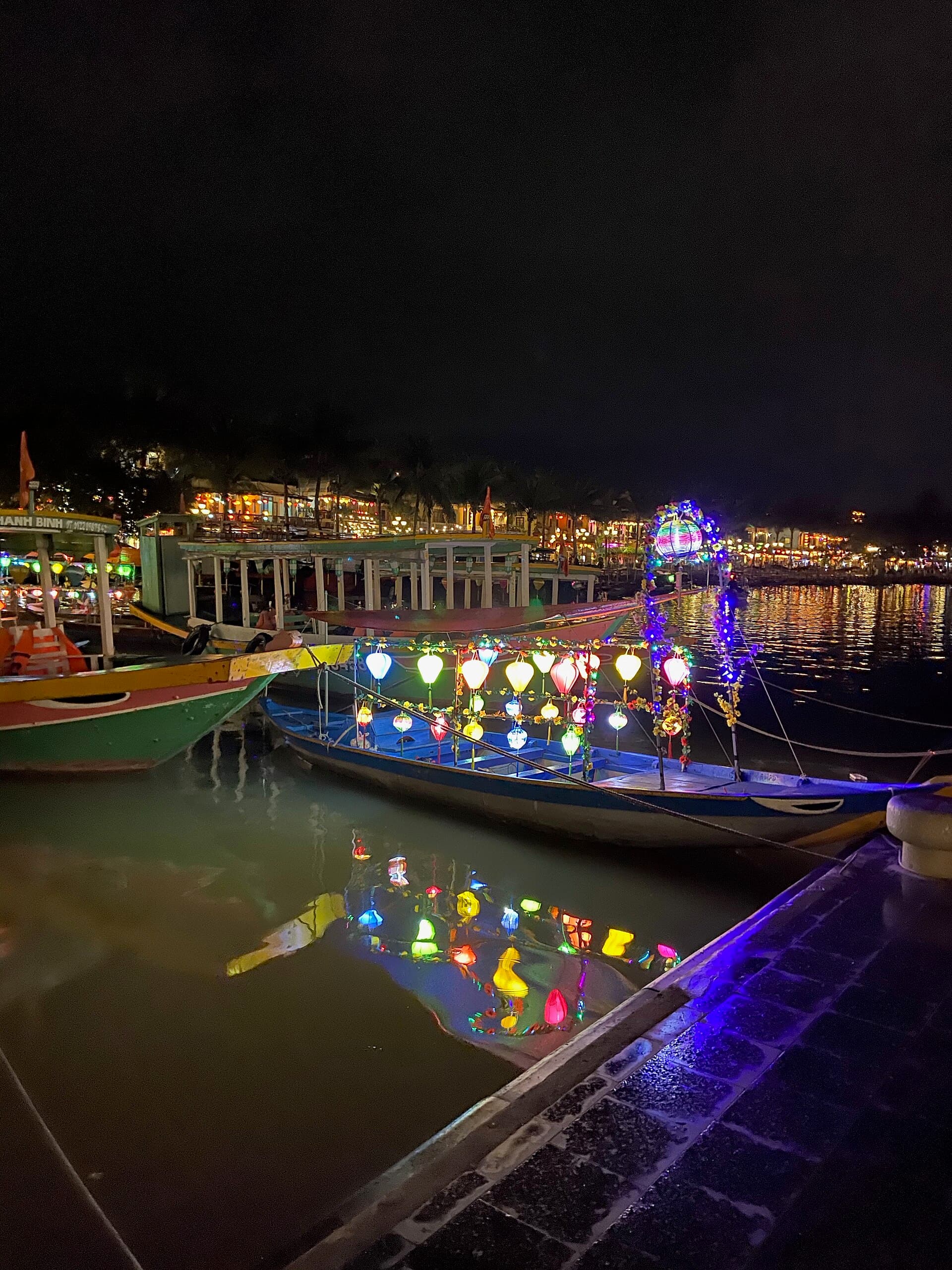
Vietnam's Mid-Autumn Festival (Tet Trung Thu) falls on Friday September 25 2026 — the 15th day of the 8th lunar month, the night the moon is considered at its fullest and brightest of the year. It is, above all, a children's and family festival: star lanterns, lion dances rattling drums outside shop fronts, streets of toys and masks, and mooncakes given in stacks. It is not a fireworks blowout, and it is not a public holiday. The places that do it best are Hanoi, where Hang Ma street becomes a lantern market for weeks; Hoi An, where the Ancient Town's monthly lantern night lands on September 24 and rolls straight into Mid-Autumn night on the 25th; and Tuyen Quang, a northern provincial city that stages Vietnam's biggest Mid-Autumn event, a parade of giant lantern floats.
The date is one night, but the celebration is not. Lantern streets fill from the start of the 8th lunar month — September 11 in 2026 — and the heaviest crowds hit the weekend of September 19–20 and festival night itself. This page is the deep planning reference for the festival; for every other 2026 date, see our Vietnam festival calendar.
What Tet Trung Thu actually is
Mid-Autumn began as a harvest-moon festival shared across East Asia, with roots in China going back to antiquity. Vietnam absorbed the tradition centuries ago and then bent it in its own direction: modern Tet Trung Thu is first and foremost a children's festival, sometimes called Tet Thieu Nhi. Adults give children toys, masks, and lanterns — the five-pointed star lantern (den ong sao) is the icon — and kids parade them through neighborhoods after dark.
The folklore is Vietnamese too. Where Chinese Mid-Autumn centers on the moon goddess Chang'e, Vietnamese children grow up with Chu Cuoi, the woodcutter who grabbed his magical banyan tree as it tore loose from the earth and now sits with it on the moon. And where Chinese celebrations often feature dragon dances, Vietnamese communities perform the lion dance (mua lan), troupes of drummers and acrobatic lion heads working shop to shop, busiest on the nights of the 14th and 15th of the lunar month — September 24 and 25 in 2026.
Families also assemble a mam co, a display tray of fruit, sweets, and mooncakes that children "destroy" (pha co) in a happy raid once the moon is up. If you are invited to join one, accept.
Where to experience it in 2026, ranked
1. Hanoi — Hang Ma street and the Old Quarter
Hang Ma, the Old Quarter's paper-goods street, transforms into a full lantern market for roughly three weeks before the festival — from mid-September 2026 the entire street is a canopy of star lanterns, carp lanterns, masks, and drums. It is the single most photogenic Mid-Autumn scene in the country and it gets intensely crowded: evenings from about 7 to 9 pm are the peak, and the weekends before the festival (especially September 19–20) approach standstill. Go on a weekday morning for photos, or a weeknight for atmosphere with room to move. Lanterns and masks are cheap — typically a dollar or two up to a few dollars — and buying one is the right way to thank a stall you have been photographing. The Old Quarter's pedestrian zones and Hoan Kiem Lake area host children's events on festival weekend; if you have three days in the city, our Hanoi itinerary slots the lantern market in naturally.
2. Hoi An — lantern nights on the Thu Bon
Hoi An celebrates a lantern night every lunar month, and in September 2026 it merges with Mid-Autumn: the monthly lantern night falls on Thursday September 24 (the 14th lunar night), with festival night proper on Friday September 25 keeping the Ancient Town in full lantern mode. Treat it as a two-night window. Electric lights are dimmed from around 6 pm, silk lanterns take over, paper boat lanterns (roughly 10,000–20,000 VND from riverside vendors) drift down the Thu Bon, and the old streets go pedestrian-only. Arrive by 5 pm to get a riverside table before the crowds; this is one of the busiest nights of Hoi An's year, so book Ancient Town accommodation weeks ahead. Pair the night with our Hoi An food guide; the Hoi An destination page covers the wider planning picture.
3. Tuyen Quang — the giant-lantern festival
Vietnam's biggest Mid-Autumn event is not in a tourist city at all. Tuyen Quang, a provincial capital roughly 130 km north-west of Hanoi (about a two-and-a-half to three hour drive), stages the Thanh Tuyen Festival: neighborhood teams spend months building giant illuminated lantern floats — carp, dragons, folk-tale scenes, some the size of a truck — and parade them through the city over multiple nights around Mid-Autumn. The 2025 edition fielded more than 70 floats and drew crowds in the tens of thousands, per Vietnam News Agency coverage, with locals reportedly spending close to 100 million VND per float. The festival is an established annual event (trademark-certified in 2024), but the official 2026 program had not been published when this guide was written — expect parades in the weeks before September 25 and confirm dates locally. Almost no foreign tourists go; if you want the version of this festival that belongs entirely to Vietnamese families, this is it.
4. Ho Chi Minh City — Luong Nhu Hoc street in Cho Lon
HCMC's Mid-Autumn heart is Luong Nhu Hoc street in District 5, the lantern-craft street of Cho Lon (the city's historic Chinese quarter), which has anchored the city's celebrations for over half a century, per SGGP's coverage. From the start of the 8th lunar month (September 11 in 2026) through festival night, its 300-plus meters hang with thousands of cellophane-and-bamboo carp, star, and butterfly lanterns alongside modern battery-lit models. Busiest from 7 to 9 pm; it is a working market, so buy a lantern rather than only photographing the stalls. Nguyen Hue walking street in District 1 also hosts family events on festival night.
Mooncakes: the banh trung thu economy
From late August, mooncake stalls appear on seemingly every corner of every Vietnamese city. The cakes come in two classic styles: banh nuong, the baked cake with a burnished golden crust, and banh deo, the soft white sticky-rice cake scented with pomelo flower. Traditional fillings are mung bean, lotus seed, and the mixed "thap cam" (candied fruit, sausage, sesame); the modern market adds salted-egg lava, matcha, and cream cheese lines aimed at younger buyers.
Prices, hedged from the 2025 season: mass-market single cakes from major brands like Kinh Do run roughly 35,000–170,000 VND each, mid-range gift boxes a few hundred thousand VND, and premium lacquered gift sets from hotels and heritage bakeries anywhere from around 1 million to 5 million VND. The gifting economy is the point — companies present boxes to partners and staff, families exchange them with elders — which is why the packaging can cost more than the cake. For travelers: buy singles from a busy branded stall, try one of each style, and note that prices drop sharply in the days right after the festival.
Practical planning
- It is not a public holiday. Vietnam's 2026 holiday calendar does not include Mid-Autumn — banks, offices, museums, and transport all run normally. The festival happens in the evenings, layered on top of ordinary life. (The National Day break, August 29 to September 2, is a separate domestic-travel peak.)
- Crowd timing. The two crush points are the weekend before (September 19–20) and festival night itself (September 25). Lantern streets are calmer on weekday mornings and manageable on early weeknights.
- Photographing children. This is a children's festival, and local kids in lantern light are the classic shot — but ask a parent first, skip the flash, and favor wide street scenes over close-ups of strangers' children.
- Book Hoi An and Hanoi Old Quarter early. Hoi An's September 24–25 window is among its busiest nights of the year. Late September is also the front edge of central Vietnam's wet season, so book with free cancellation; our Vietnam in September guide covers the weather trade-offs region by region.
Going with kids
Mid-Autumn is the rare major festival that is genuinely better with children. The entire event is aimed at them: your kids can carry a star lantern in a procession, watch lion dance troupes drum their way down a shopping street, raid a mam co fruit tray, and taste mooncakes — Vietnamese families will actively welcome them into all of it. Practical notes: go early evening (5 to 7 pm) before the densest crowds, agree on a meeting point on packed streets, and let kids choose their own lantern at a stall — the best two dollars of the trip. The official tourism board's Mid-Autumn overview has more on the customs kids will encounter.
Limitations
- The exact festival night in listings can differ by a day. The lunar date is unambiguous (15/8 = September 25 2026), but Hoi An's monthly lantern night is officially the 14th lunar night (September 24), and English-language calendars mix the two. We recommend planning around both nights rather than trusting any single listed date.
- Tuyen Quang's 2026 program was unannounced at publication. The scale claims here are from verified 2025 coverage; parade dates, float counts, and logistics for 2026 should be confirmed closer to September.
- Mooncake prices are a 2025-season baseline. Brands reset price lists each year; treat the ranges as orientation, not quotes.
- Crowd patterns shift with weather. A rainy festival night thins the lantern streets dramatically, and late-September rain is entirely possible in both Hanoi and Hoi An; Hoi An also carries early typhoon-season flood risk.
- We have not attended the Tuyen Quang festival ourselves; that section relies on Vietnamese state media coverage and official festival announcements rather than first-hand reporting.
Related reading
- Vietnam festival calendar 2026 — every 2026 festival and public holiday, sourced
- Vietnam in September 2026 — weather, crowds, and whether the month suits your route
- Hoi An — the lantern town's full destination guide
- Hoi An food guide 2026 — what to eat between lantern photos
- 3 days in Hanoi — an Old Quarter itinerary that absorbs Hang Ma naturally
The September 25 2026 date follows the standard lunar-calendar conversion — see Travel China Guide's Mid-Autumn date table.