
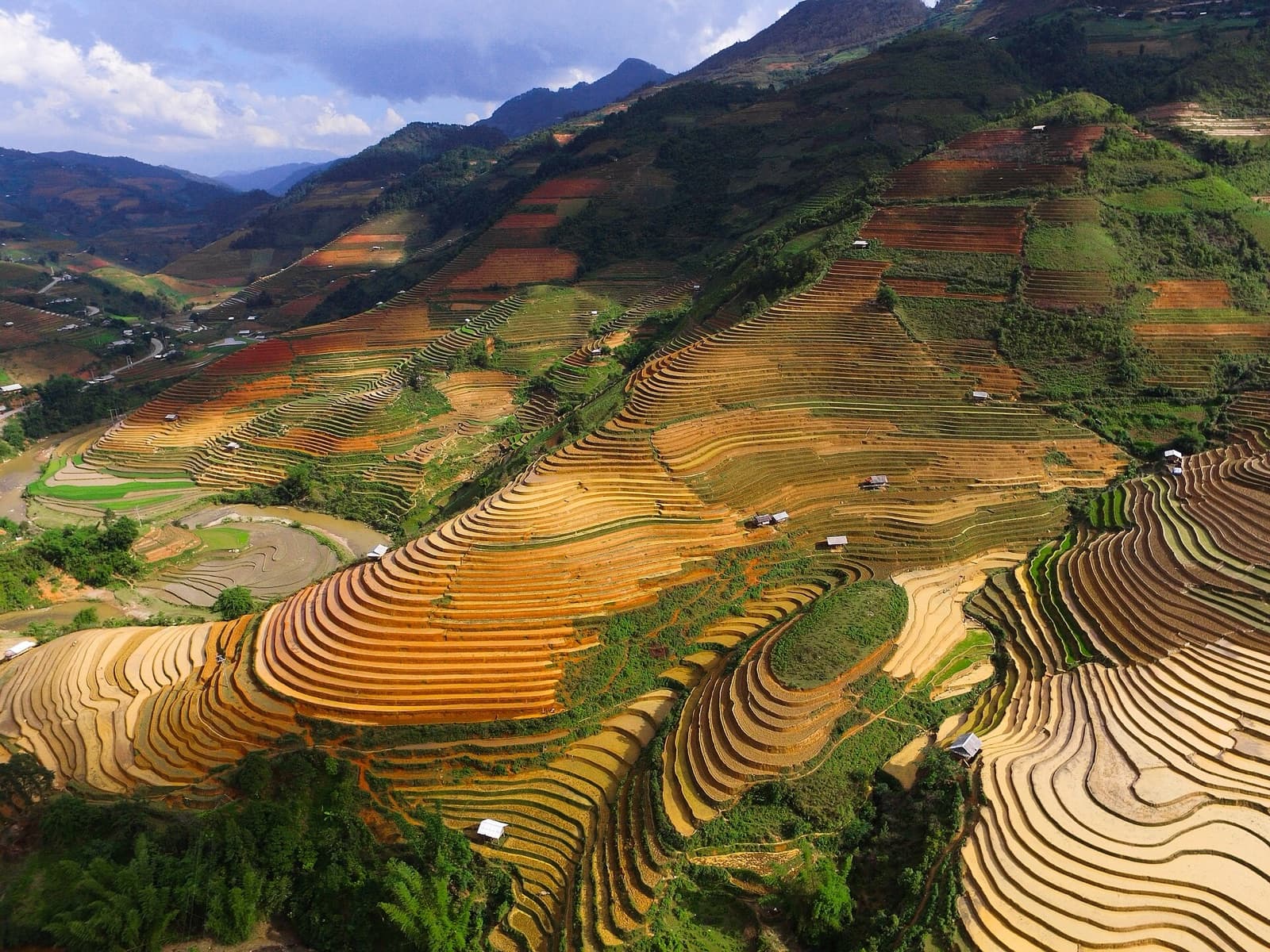
Is September a good month for Vietnam? Yes — if you point the trip north. September 2026 is the country's great transition month: Hanoi and the northern mountains spend it drying out into their best season, and by late month the rice terraces of Mu Cang Chai, Sapa, and Hoang Su Phi are turning harvest gold, the single best reason to travel now. The central coast moves the other way — September opens typhoon season for Hoi An, Hue, and Da Nang, and every booking there should be refundable. The south, meanwhile, is mid-monsoon and behaving exactly as it has since May: hot mornings, one loud afternoon downpour, a warm dry evening.
This page is the month-specific picture. For the full-year view, start with our month-by-month weather guide; for how monsoon travel actually works on the ground, the rainy-season strategy guide covers the mechanics. And if your dates can slide four weeks, Vietnam in October is when the north fully arrives — and the central coast gets worse.
September at a glance
| Region | Historical September pattern | Verdict |
|---|---|---|
| Hanoi, Ninh Binh, Ha Long | Rain easing through the month, highs around 31°C | Good — best in the second half |
| Northern mountains (Sapa, Mu Cang Chai, Ha Giang) | Tail of the rainy season; harvest begins | The month's headline |
| Central coast (Hue, Da Nang, Hoi An) | Rain roughly triples versus August; typhoon season opens | Think twice |
| Nha Trang | Own rainy season starting, still beach-hot | Fair early month, fading |
| Dalat | Among its wettest months, cool | Workable, wet |
| HCMC and the Mekong | Wettest month of the year, afternoon-shower rhythm | Fine with mornings-first planning |
Weather region by region
The figures below are historical averages, not forecasts — any individual September can run wetter or drier, and published normals vary somewhat by source.
Hanoi. Historically highs around 31°C and lows around 24°C, with roughly 250-270mm of rain over about 14 rain days. The shape matters more than the total: early September still feels like summer monsoon, while the second half of the month is noticeably drier and less humid as the autumn window opens. This is the hinge into what most locals consider Hanoi's best season.
Sapa and the northern mountains. Daytime temperatures around 18-25°C with roughly 260-270mm of rain historically — September is the tail of the mountain rainy season, so trails can still be muddy and leech-prone early in the month. The compensation is the harvest, covered below. Ha Giang behaves similarly; after multi-day rain, re-check road conditions before committing to the Loop.
Da Nang, Hoi An, and Hue. Still beach-hot — Da Nang has historically averaged highs around 32°C in September — but rainfall climbs steeply, to roughly 300-310mm over about 14 rain days, around triple August's total per historical climate normals. September is the hinge between the central coast's long dry season and its flood season: the first week is often still lovely, the last week is a coin flip.
Nha Trang. Highs around 32°C with roughly 200-220mm of rain as its own rainy season begins. Showers here have historically arrived as short afternoon or evening bursts rather than all-day rain, so early September remains a fair beach bet — it fades toward October.
Dalat. Highs around 24-26°C, nights around 16-19°C, and roughly 280-300mm of rain — historically one of the highland city's wettest stretches. It stays cool and intensely green; just plan cafe-and-museum afternoons rather than long outdoor ones.
Ho Chi Minh City and the Mekong Delta. Highs around 31-32°C and roughly 320mm over about 20 rain days — historically the wettest month of Saigon's year. The rhythm stays familiar: dry mornings, a hard 30-90 minute downpour mid-afternoon, streets that flood and drain within the hour. Delta boat trips and floating-market mornings run as normal; just book them for mornings.
The typhoon question, honestly
September is when the central coast's storm season opens in earnest. Tropical cyclones have historically affected the Da Nang stretch of coast from early September into December, and East Sea storm activity peaks between September and November. Averages hide the shape of the risk: most September weeks pass without incident, but any given week can contain a system that costs you two or three days.
What a storm actually means for a trip: the maritime authority suspends Ha Long Bay sailings ahead of tropical systems, sometimes for several days; strong storms can close Da Nang or Quy Nhon airports for 24-72 hours; and Hoi An and Hue can flood when sustained rain follows a landfall. What it does not mean is a month of danger — ordinary September rain cancels nothing.
The playbook is simple. Book central-coast hotels and Ha Long cruises with free cancellation, avoid non-refundable flights into Da Nang, keep one buffer day per central leg, carry insurance that covers weather disruption, and check the NCHMF forecast (nchmf.gov.vn) inside a week of travel — typhoon tracks only firm up a few days out. The season-level outlook for 2026 and the full storm mechanics live in our festival and events atlas and the rainy-season guide above.
What's on in September 2026
National Day, September 2. 2026 marks the 81st anniversary of Vietnam's 1945 declaration of independence, and it falls on a Wednesday. The government's announced schedule strings the holiday to the preceding weekend with a working-day swap, giving a consecutive break running roughly August 30 through September 2 — see the official 2026 holiday listing for the dates. Expect flags and fireworks in the big cities and a genuine domestic travel crunch around them: trains, flights, and sleeper buses book out ahead, and hotel rates jump in domestic favorites like Sapa, Dalat, Vung Tau, and Ha Long. Sights and restaurants largely stay open — this is a surge problem, not a closure problem. Either book that window's transport well ahead or spend it in Hanoi or Saigon enjoying the atmosphere.
Mid-Autumn Festival, September 25. Tet Trung Thu falls on Friday, September 25, 2026 — the 15th day of the eighth lunar month. It is not a public holiday, so nothing shuts; it is instead one of the best festival-travel overlaps of the year. Hanoi's Hang Ma street becomes a canyon of lanterns and toys in the weeks beforehand, and Hoi An's Ancient Town on the full-moon night is the town's signature image. Our Mid-Autumn Festival guide covers where to be, what to eat, and how the week plays out in each city.
Harvest gold in the northern terraces
This is September's headline. Across the northern mountains, the single rice crop of the high terraces ripens and is cut between mid-September and mid-October, and for a few weeks whole valleys turn the color of turmeric.
- Mu Cang Chai has historically peaked from late September into early October — the district's terraced-field festival runs in late September, and a paragliding festival sends pilots out over the golden fields at Khau Pha pass.
- Sapa's terraces are cut through September, with lower valleys like Muong Hoa often going earlier than the high villages.
- Hoang Su Phi, in Ha Giang province, runs latest — roughly late September to mid-October — and sees a fraction of Sapa's foot traffic.
Two caveats. Harvest timing moves a week or two each year with the weather, so ask locally or check recent photos before anchoring a trip to one specific valley. And accommodation in Mu Cang Chai and Hoang Su Phi is limited homestay-and-lodge stock that fills well ahead for the golden weeks — book early.
Where to go and where to think twice
Ranked for September specifically:
- Mu Cang Chai and Hoang Su Phi — the reason to pick September over any other month. Go in the last ten days for the best odds of peak gold.
- Hanoi and Ninh Binh — especially the second half of the month, when the humidity breaks and the karst landscapes come out of the summer haze. Ninh Binh's rowing-boat routes are at their green-gold best.
- Ho Chi Minh City and the Mekong Delta — the wettest month on paper, but the rain is a scheduled afternoon event and prices are at their lowest. Mornings-first planning loses almost nothing.
- The Ha Giang Loop — late September threads the needle between the worst of the summer rain and October's peak crowds. Respect the roads after multi-day rain.
- Dalat — cool, green, and very wet. Fine as a two-day stop with flexible afternoons.
Think twice about:
- Hoi An, Hue, and Da Nang — early September can still deliver excellent beach days, but the deeper into the month, the higher the odds a storm system eats part of your stay. Go refundable or go another month.
- Nha Trang — entering its own rainy season; fine early, fading fast.
- Ha Long Bay — cruises run normally most of the month, but September sits inside the storm-suspension window. Keep a buffer day and book rebook-or-refund.
Crowds and prices
September is shoulder season almost everywhere. Central-coast hotels discount as the rain builds, the south sits at low-season rates, and airfares into Vietnam have historically been among the year's softer ones — our cheapest month to fly guide has the fare-by-month picture, and the monthly price calendar maps accommodation. Two exceptions run the other way: the National Day window (roughly August 30 to September 2), when domestic transport and resort prices spike, and the harvest valleys, where Sapa and Mu Cang Chai lodges charge firm peak-season rates from mid-September.
Packing for September
Pack for three climates. A 10,000 VND disposable poncho (buy it on arrival) and quick-dry footwear handle the south and any early-month northern rain; a light fleece or shell covers Sapa, Hoang Su Phi, and Dalat evenings, which run cool once the sun drops; and a dry bag or zip-lock protects phone and passport on boat trips. Keep sun protection in the kit — September sun between showers is fierce — and insect repellent earns its space in the wet-season south and the Delta.
Limitations
Every figure here is a historical average, and published normals disagree with each other — Hanoi's September rainfall shows up as anywhere from around 225mm to 265mm depending on the dataset and reference period. Actual Septembers swing well outside those bands in both directions. Workaround: treat the numbers as priors, and check each destination's 10-day forecast a week before you travel that leg.
Typhoon behavior is the biggest single uncertainty in any September plan: seasonal outlooks say little about whether a storm crosses your specific week, and tracks are unreliable beyond about five days. Harvest timing carries the same caveat in miniature — a warm or wet summer can shift the gold by two weeks. Workaround: refundable bookings on the central coast, a buffer day in the mountains, and a willingness to swap valleys late.