
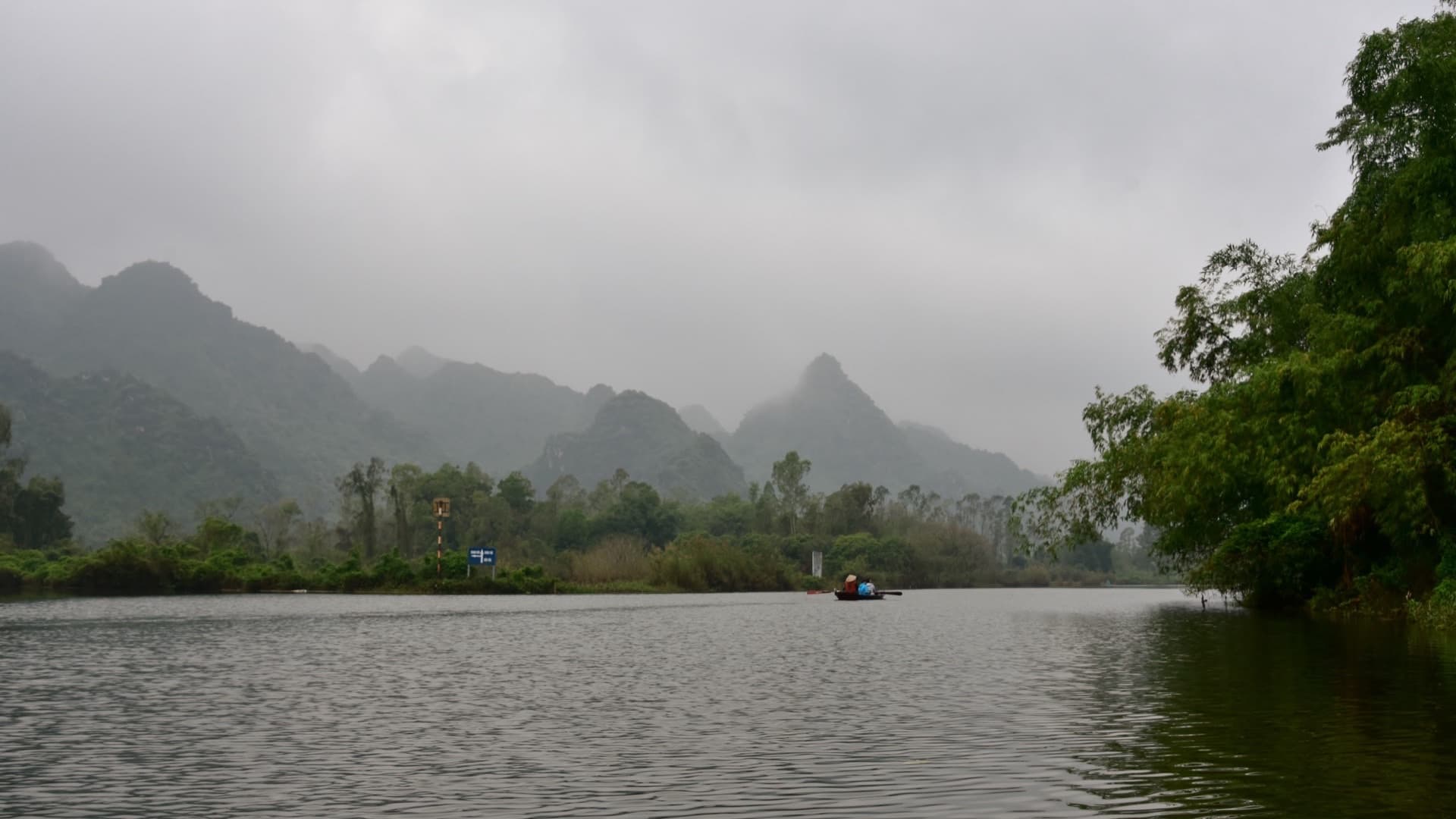
The Perfume Pagoda festival (le hoi chua Huong) opens on the sixth day of the first lunar month, which in 2027 converts to Thursday 11 February 2027, five days after Tet on Saturday 6 February. The season traditionally runs across the three spring lunar months. The close most often quoted, the fifteenth day of the third lunar month, converts to Wednesday 21 April 2027, and the third lunar month itself ends on 5 May. Both Gregorian dates are lunar-calendar conversions checked against a published 2027 Vietnamese calendar, not announcements: Hanoi's organising committee confirms the season's bracket in the weeks before Tet, and the 2026 season officially ran from 18 February to 11 May.
This is the festival-season guide. For the year-round logistics, the hour-by-hour day, the cable car versus the climb, and whether the trip is worth a whole day at all, see our Perfume Pagoda day trip guide, which this page does not repeat. For the holiday that precedes it, start with our Tet 2027 travel guide.
The 2027 dates, converted from the lunar calendar
| Lunar date | What it is | 2027 Gregorian date (converted) |
|---|---|---|
| 1st day, 1st month | Tet | Saturday 6 February |
| 6th day, 1st month | Opening ceremony (khai hoi) | Thursday 11 February |
| 15th day, 1st month | First full moon; the heaviest early weekend | Saturday 20 February |
| 15th–20th day, 2nd month | Traditional main festival (chinh hoi) | Monday 22 – Saturday 27 March |
| 19th day, 2nd month | Quan Am's day | Friday 26 March |
| 15th day, 3rd month | The close most guides quote | Wednesday 21 April |
| 29th day, 3rd month | End of the third lunar month | Wednesday 5 May |
The conversions follow the Vietnamese lunar calendar published at xemlicham.com for February 2027 and April 2027; the Vietnamese calendar is calculated on Hanoi time and can differ from the Chinese one by a day, so check a Vietnamese source rather than a generic converter. The official bracket tends to be wider than the traditional one: for 2026, Hanoi's culture department ran the season from the 2nd day of the first lunar month to the 25th of the third, 18 February to 11 May, with the opening ceremony on the 6th day, 22 February. Expect 2027 to follow the same shape: gates open from around 7 February, ceremony on 11 February, season running into mid-May.
What the pilgrimage actually is
The Perfume Pagoda is not one building but a complex of pagodas, shrines and cave temples strung through the limestone Huong Tich hills in Huong Son commune, about 60 km south-west of Hanoi. The 2026 organisers counted four routes and twenty sites. The classic one, and the only one most visitors take, starts at the pier on the Yen stream, where hand-rowed sampans carry two or three passengers for about an hour through flooded paddies and karsts to Thien Tru, the "kitchen of heaven" pagoda at the foot of the mountain. From there it is a cable car or a long climb of stone steps to Huong Tich cave, a vast grotto with a smoke-blackened shrine inside, where pilgrims pray above all for children, health and fortune. The cave is held to be a place where Quan Am, the bodhisattva of compassion, practised, and the festival is at heart a Quan Am pilgrimage. It is Vietnam's longest festival by duration and one of its largest by numbers: the 2026 organisers expected over a million visitors across the season.
When the crush hits, and when it thins
The crowd curve has two peaks. The first is the fortnight after Tet: the Ministry of Culture counted 135,895 visitors in the first five days of the 2026 lunar year, before the official opening, up 138 percent on the previous year. In 2027 that window runs 6–20 February, and it contains three problem days: the opening on Thursday 11 February, the first weekend of 13–14 February, and the full moon of the first month on Saturday 20 February, when Vietnamese Buddhists visit pagodas anyway. The second peak is the traditional main festival on the 15th to 20th days of the second lunar month, which Vietnam's tourism authority describes as the busiest stretch: 22–27 March 2027, with Quan Am's day on Friday 26 March and the weekend of 27–28 March the densest.
Between and after those peaks the pattern is simple: weekends are heavy from mid-February to the end of March, weekdays from mid-March are manageable, and almost any day in April is calm. On a festival weekend the boat queue at the pier can run 60–90 minutes by mid-morning and the cave becomes a slow shuffle; on a Tuesday in April you will share the stream with a handful of boats. Weather runs the other way, as our February and March 2027 guides set out: February is grey and drizzly at 16–22°C, late March warmer and more humid, April warm and often clearer.
Realistic timings from Hanoi
Budget 10 to 11 hours door to door on a festival day. The drive from the Old Quarter to the pier is about 60 km and two hours, plus 30 to 60 minutes of festival traffic and parking on weekends. The row is roughly an hour each way, slower when the stream is a convoy of boats. The cable car is about five minutes each way; the climb is 45 to 90 minutes on stone steps. Allow two to three hours at Thien Tru and the cave, longer if the cave queue is moving at a shuffle. The single most effective decision is to leave Hanoi by 6 am and be on the water before the coaches arrive at about 9:30.
What it costs, as of the 2026 season
The 2027 price schedule is normally published just before Tet, so treat the 2026 season, as published by the organisers in February 2026, as the floor. All figures are hedged as of mid-2026 and convert at roughly 25,000 VND to the dollar.
| Item (2026 season) | VND | About |
|---|---|---|
| Sightseeing fee, Huong Tich route | 120,000 | $5 |
| Return boat, Huong Tich route, adult | 110,000 | $4.50 |
| Combined entrance and boat, Huong Tich, adult | 230,000 | $9 |
| Return boat, Huong Tich route, child | 65,000 | $2.60 |
| Boat, Long Van or Tuyet Son routes (no sightseeing fee) | 85,000 adult / 50,000 child | $3.50 / $2 |
| Cable car return, adult / child | 260,000 / 180,000 | $10.50 / $7 |
| Cable car one way, adult / child | 180,000 / 120,000 | $7 / $5 |
| Electric shuttle boat (pilot, three routes) | 20,000 per trip | under $1 |
| Rower's tip (customary, not compulsory) | 50,000–100,000 | $2–4 |
Tickets were electronic with QR codes, sold at six fixed booths and online, and the 2026 season kept hand-rowed boats as the main service with motorised craft restricted. Our year-round day trip page still quotes the older 80,000 VND entrance and 85,000 VND boat fare; the 2026 season lifted both, and 2027 is likely to hold or raise them again. Group tours from Hanoi ran about $40–55 as of mid-2026 including transport, boat, entrance and lunch, with the cable car extra; expect festival-season tours to sit at the top of that range.
Touts and overcharging: the patterns
The Perfume Pagoda has a long reputation for solicitation (cheo keo) and price gouging (chat chem), and the 2026 organisers ran the season under the slogan "Safety – Friendliness – Quality" specifically to attack it: fixed ticket points, e-tickets, AI cameras at the pier, a published hotline, and a rule that any stall without a displayed price board could not trade. The two cases they publicised in the opening week show exactly what to watch for. According to Vietnam News Agency, one rower demanded an extra 500,000 VND (about $20) from passengers who had already paid the official fare, and another was collecting passengers outside the Chua Huong tourism services cooperative's dispatch system; both were suspended for the rest of the season.
The defences follow from that. Buy the combined ticket at a booth or online, not from anyone who approaches you in the car park or on the approach road offering a "faster" boat. Take the boat the dispatch assigns and pay nothing more on the water; a tip at the end is your choice. On land, check the price board before ordering, decline the incense and offering bundles pressed on you at Thien Tru, and ignore anyone offering to guide you, bless you or carry your bag for a fee. If a stall displays game meat, as some pier restaurants did in earlier years despite the ban, eat elsewhere. None of this is dangerous; it is simply the friction tax of a mass pilgrimage, and a tour operator's standing arrangement with the cooperative removes most of it.
What to wear
Layers, waterproofs and grip. The boat is completely open, the northern drizzle is fine but relentless in February and March, and the compulsory life jacket goes over whatever you are wearing. Dress modestly for the pagoda, with shoulders and knees covered. The stone steps and the cave floor are slick with drizzle and incense ash, and more visitors come to grief on them than on anything else, so shoes with real tread matter more than any other item. A small cross-body bag beats a backpack in the crowded cave, and small notes cover the tip and offerings.
Tour or independent
For a first festival visit, take a tour: the operator's arrangement with the boat cooperative handles tickets and dispatch, and you skip the tout layer entirely. The price is the 7:30 am pickup, which puts you at the pier at the same time as every other coach. If you can afford a private car, roughly $110–150 for the day as of mid-2026, leave at 5:30 am and you will be on the first boats with the pilgrims rather than the tour groups; buy tickets only at the booths. Ride-hailing to the pier costs around 700,000 VND one way and rarely makes sense, and a motorbike is only for riders confident on Vietnamese highways. Our best day trips from Hanoi ranking sets the Perfume Pagoda against Ninh Binh and the rest.
If you only want the pagoda, not the festival
Go between May and January instead. The stream is nearly empty, the rowers have time to talk, and the cave is quiet enough to feel like a shrine; some pier restaurants close and the intensity is gone, but the scenery is identical and the day is two hours shorter. Our Perfume Pagoda day trip guide covers that version, including the honest verdict that a first-time visitor with one spare day may prefer Ninh Binh. Come during the festival for the pilgrimage, not the pagoda.
Limitations
- The 2027 dates are conversions, not announcements. 11 February and 21 April follow from the lunar calendar; the official bracket, published by Hanoi's organising committee shortly before Tet, is normally wider, as 2026's 18 February to 11 May shows, and it can shift.
- Sources disagree on the season's end. Some quote the fifteenth day of the third lunar month, others the end of that month, 5 May in 2027; we have given both. The heaviest weeks fall in the second lunar month regardless.
- All prices are 2026-season figures, hedged as of mid-2026. The 2027 schedule may raise the sightseeing fee, boat fare or cable-car price, and tour prices vary by operator.
- Crowd figures are official and specific to 2026, a year when visitor numbers jumped sharply; a wet February or a transport disruption can change the pattern.
- The tout section describes reported 2026 cases and long-standing patterns, not the conduct of the overwhelming majority of rowers and vendors, who are honest. The organisers' controls have improved year on year.
- Distance and timing figures are approximate; official sources give the pagoda as anywhere from 60 to 70 km from central Hanoi depending on the start point.
Related reading
- Perfume Pagoda day trip — the year-round logistics page this guide complements
- Tet 2027 travel guide — the holiday that precedes the festival and reshapes travel around it
- Vietnam in February 2027 — weather and crowds in the opening weeks
- Vietnam in March 2027 — the main-festival month
- Best day trips from Hanoi — where the Perfume Pagoda ranks against Ninh Binh, Ha Long and the rest
- Vietnam festival calendar 2026 — every festival and public holiday, sourced