
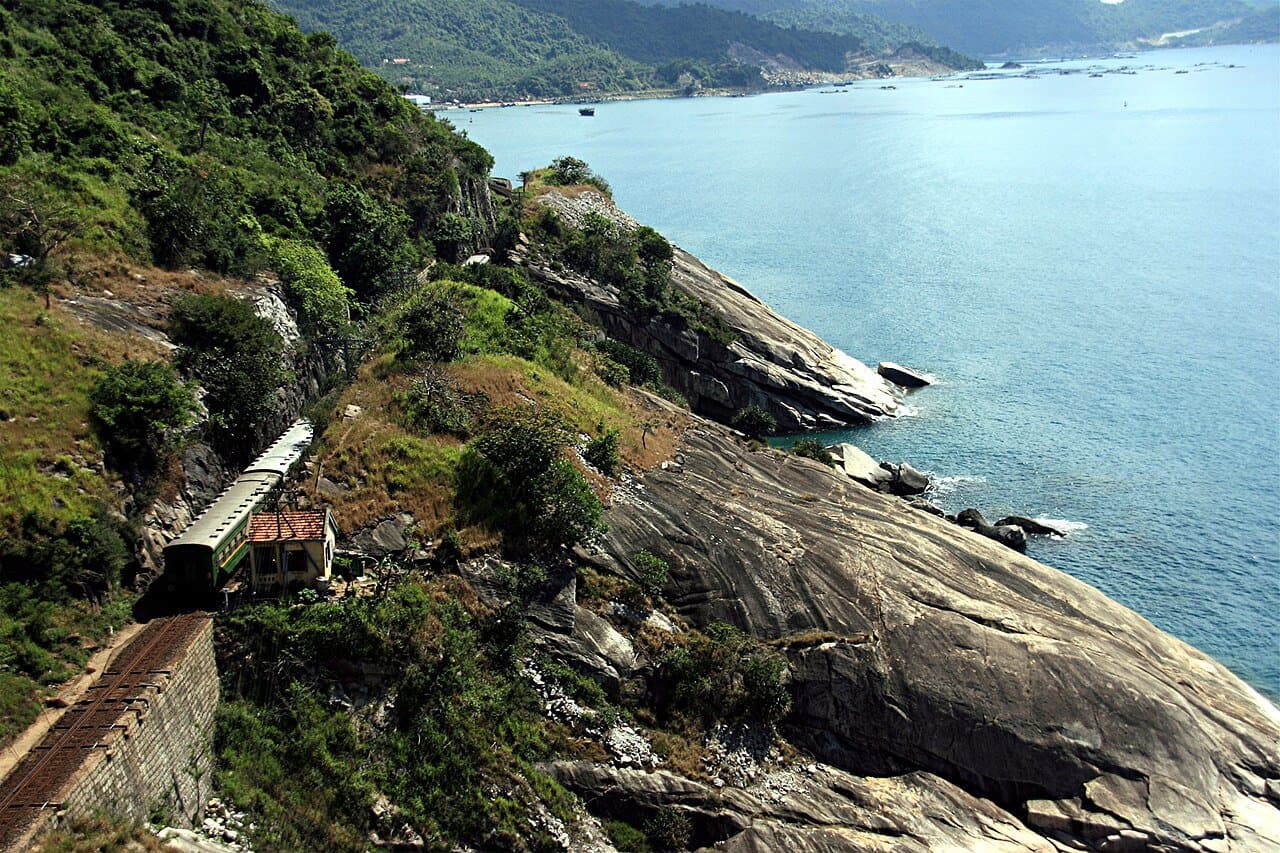
The Reunification Express is the train line that runs the length of Vietnam — Hanoi to Ho Chi Minh City, 1,726 km, completed in 1936 by the French and reconnected after the war in 1976. The route is one of the great railway journeys in Southeast Asia. For couples specifically, it's the slow-travel template that makes a Vietnam trip feel like a discrete journey rather than a checklist — three or four overnight train segments break the country into manageable pieces, each followed by a few days in a heritage city, with the cabin-privacy of a 2-berth soft sleeper turning the train rides themselves into a kind of moving hotel room.
This guide is the couples-focused version of how the Reunification Express works in 2026 — which segments to ride, where to break the journey, how to book the private 2-berth cabins, what to expect from the on-board experience, and why this is the rare transport mode that's genuinely worth choosing for the experience and not just the cost. The deeper transport context is in the Land Transport Atlas; the couples-itinerary that incorporates the train is the Vietnam honeymoon itinerary for couples.
Quick summary — what the train trip actually is
| Dimension | Reunification Express reality |
|---|---|
| Full route | Hanoi → Ho Chi Minh City, 1,726 km, 32-36 hours continuous |
| Standard couples pattern | Break at 2-3 cities; ride 4 sleeper segments across 10-14 days |
| Best couples class | 2-berth soft sleeper (private cabin), $80-120/cabin/segment |
| Alternative class | 4-berth soft sleeper (shared), $50-80/berth/segment |
| Most scenic stretch | Hai Van Pass, Lang Co → Da Nang (~30 km coastal cliff) |
| Best season | February-April, October-November |
| Booking platform | 12Go, Baolau, or Vietnam Train Booking |
| Service frequency | 4 daily trains (SE1-SE8); pick one to fit your route timing |
| Romance factor | High — slow pace, cabin privacy, shared scenery |
The fast version: book 2-berth deluxe cabins 4-6 weeks ahead through 12Go for the segments Hanoi-Hue, Da Nang-Nha Trang, and Nha Trang-HCMC; ride the day-train Hue-Da Nang specifically for the Hai Van Pass scenery; combine each city stop with a heritage stay (La Residence Hue, Anantara Hoi An, Park Hyatt Saigon).
Why the train is the couples-romantic choice
The Reunification Express isn't faster than flying — at 32-36 hours continuous, it's 6-7x slower than the 2-hour Hanoi-HCMC flight. The cost difference is small (sleeper berths $50-120 vs flights $50-120). What the train offers is the experience that flying cannot.
The cabin privacy. A 2-berth deluxe cabin is a small but private room with a door that locks from inside. For couples, this means the journey itself becomes a romantic shared space — not a public seat in an airline cabin but a hotel-room-sized cabin with two berths arranged so you can sit and talk across from each other, sleep separately or together depending on the cabin layout, and arrive at your destination feeling like you traveled together rather than alongside other passengers.
The pace. Train travel is slow in a way that's specifically valuable for couples. The 12-hour Hanoi-Hue overnight ride means you have an evening together (conversation, looking out the window, sharing a thermos of Vietnamese coffee), a night's sleep in the same private cabin, and a morning together watching the central Vietnamese coastline appear. The slow pace produces the kind of unrushed connection that 2-hour flights and busy hotel days don't.
The scenery. The Reunification Express follows the eastern coast of Vietnam for much of its length, with views that planes can't deliver — the Hai Van Pass coastal cliff, the rice paddies and karst hills of the central provinces, the fishing villages and palm groves of the south. The most-photographed Vietnam train view (Hai Van Pass, coastal mountain stretch between Lang Co and Da Nang) is genuinely beautiful and worth being awake for.
The cultural texture. Vietnamese train culture is matter-of-fact and friendly — the on-board attendants pass through regularly with coffee and instant noodles, local families share the carriages with foreign visitors, the dining car has the slightly-formal-but-warm atmosphere of a 1980s Vietnamese restaurant. The trip feels like Vietnam in a way that flying through air-conditioned airports doesn't.
The classes and what they mean
Vietnam trains have four main classes:
2-berth soft sleeper (deluxe / VIP) — Private cabin with 2 berths (one upper, one lower), lockable door, mood lighting, USB outlets, and on the newer carriages a small in-cabin TV. The couples standout class. $80-120/cabin/segment. Limited availability (sometimes 2-4 cabins per train); book 4-6 weeks ahead.
4-berth soft sleeper — Shared cabin with 4 berths (2 upper, 2 lower), shared with other passengers (typically a mix of couples, families, solo travelers). Lockable door. $50-80/berth/segment ($100-160/couple). The standard backpacker-and-budget-couples choice. Book 1-2 weeks ahead.
6-berth hard sleeper — Shared cabin with 6 berths (3 stacked on each side), no door, less private. $35-50/berth/segment. Cheap but not what couples typically choose — the privacy difference vs the soft sleeper is real.
Soft seat — Reclining seat, no berth. $20-30/segment. Daytime travel only; doesn't suit overnight routes.
Private operator tourist-class carriages — Some routes have premium private operators (Violette Express, Lotus Express, SJourney) attaching upgraded carriages to standard Vietnam Railways trains. These have boutique-hotel-style cabin interiors, better catering, and higher prices ($90-150/berth). Worth the premium for the Hanoi-Sapa segment particularly (Livitrans, Chapa Express, Sapaly Express); on the longer Reunification routes the private-operator option exists but is less common.
For couples, the 2-berth deluxe cabin is the default recommendation. The privacy difference vs the 4-berth shared cabin is significant enough to justify the $25-50 per couple per segment premium. Across a 3-segment trip, the total premium is $75-150 — small in the context of a couples trip and large in the difference it makes to the experience.
The 10-14 day couples train pattern
The standard couples train pattern breaks the Reunification Express into segments paired with city stops. The 14-day version:
Days 1-3: Hanoi. Old Quarter base, Vietnamese Women's Museum, food tours, Hoan Kiem Lake evening walks, day trip to Ninh Binh.
Day 3 (evening): Train Hanoi → Hue. Departure 19:00-22:00 from Hanoi Station; arrival Hue 07:00-10:00 next morning. Sleep in the 2-berth cabin.
Days 4-5: Hue. Imperial City, tombs of Tu Duc and Minh Mang, Thien Mu Pagoda, Perfume River boat ride. La Residence Hue Hotel is the heritage-stay pick.
Day 6: Day train Hue → Da Nang (Hai Van Pass). 14:00-18:00 departure; 4 hours including the Hai Van Pass coastal stretch. Stay overnight in Da Nang or transfer 30 minutes to Hoi An.
Days 7-10: Hoi An. Ancient Town, tailoring, cooking class, My Son Sanctuary, An Bang Beach. Anantara Hoi An Resort, Four Seasons The Nam Hai, or Almanity Hoi An for the couples-heritage stay.
Day 10 (evening): Train Da Nang → Nha Trang (or Hoi An shuttle to Da Nang station). Overnight; arrival 06:00-08:00.
Days 11-12: Nha Trang. Beach reset day, optional Bay Islands day trip. The InterContinental Nha Trang or Six Senses Ninh Van Bay for the beach-heritage stay.
Day 12 (evening): Train Nha Trang → HCMC. Overnight; arrival 05:00-07:00.
Days 13-14: HCMC. District 1 walking, Notre Dame Cathedral, War Remnants Museum (heavy but essential), Saigon Opera House evening, Park Hyatt Saigon or Hotel Continental Saigon for the heritage stay. Fly out from Tan Son Nhat.
Total train cost (3 sleeper segments, 2-berth deluxe): $240-360/couple. Total trip cost (excluding international flights): $2,200-3,800/couple for the mid-range hotel-and-train pattern; $4,500-7,500/couple for the luxury heritage-stay pattern.
Booking — how the platforms compare
12Go (12go.asia) is the most-used international booking platform for Vietnam trains. Adds $3-8 service fee per ticket; in English; accepts most international cards; reliable confirmation. The standard recommendation for couples booking from outside Vietnam.
Baolau (baolau.com) is the second major platform with similar functionality and slightly lower fees on some routes. English interface, international card support.
Vietnam Railways official (dsvn.vn) is the cheapest option but the booking interface is partially Vietnamese, some international cards fail at checkout, and the confirmation flow is less polished. Works for some couples; doesn't work for others. Worth attempting first; have a backup platform ready.
Vietnam Train Booking (vietnamtrainbooking.com) is the third-party agency option — adds higher fees ($10-15 per ticket) but offers concierge-level service for complex itineraries with multiple segments.
In-person at Hanoi or HCMC train station is the last-minute option. English limited at the ticket windows but possible; tickets are direct-priced (no third-party fee). Worth doing if you're already in Vietnam and want to book the next segment; not worth doing from outside the country.
For 2-berth deluxe cabins, book 4-6 weeks ahead. The deluxe cabins on popular routes (Hanoi-Hue, Da Nang-HCMC) sell out first. The 4-berth soft sleeper has wider availability — 1-2 weeks ahead suffices in non-peak seasons.
What to pack for the train
The packing-for-train list is short but specific:
Phone chargers + backup battery. The cabin has 1-2 power outlets shared between the berths; a small power bank gives you independent charging.
Ear plugs and eye mask. The train is rocky and the cabin lights link to corridor lights that stay on most of the night. The 2-berth deluxe cabins have better light control than the 4-berth shared cabins.
Snacks and water bottles. The on-board dining car serves basic Vietnamese food but the selection is limited and the timing is awkward (meals served at 18:00-20:00 and 07:00-08:00). Bring snacks for the in-between hours; a thermos works well for the longer overnight rides.
A small toiletries bag. The shared bathrooms have squat toilets (older carriages) or Western toilets (newer carriages); sinks have running water; bring soap and a small towel. The bathrooms get cleaner at the start of each segment and less clean by the end.
Downloaded entertainment. Train wifi is unreliable or absent on most routes; Vietnamese mobile data works intermittently. Download podcasts, audiobooks, or video before boarding.
Flip-flops for the corridor. Not strictly necessary but appreciated for the bathroom walks and the early-morning corridor stretching.
Warm layer for the air conditioning. The cabins run cool at night, especially the upper berths. Bring a light sweater or scarf.
What to skip: heavy luggage (the corridors and berths are narrow), perishable food (the cabin temperature isn't consistent), expensive items for the dining-car (the food is functional rather than special), formal clothing (the train is jeans-and-t-shirt comfortable).
The pairing — train + heritage hotels for the couples experience
The train trip alone is good; the train-plus-heritage-stay combination is what makes the Vietnam couples experience distinctive. The heritage hotels worth pairing with each train segment:
Hanoi (pre-train base): Sofitel Legend Metropole Hanoi (the 1901 colonial-heritage standout), Hotel de l'Opera Hanoi, La Siesta Premium Hang Be, Apricot Hotel (Hoan Kiem Lake view).
Hue (after Hanoi-Hue overnight): La Residence Hue Hotel & Spa (the 1930 art deco French colonial heritage hotel, $200-350/night), Pilgrimage Village (boutique resort outside city center), Saigon Morin Hotel (1901 colonial, more budget-friendly at $80-130/night).
Hoi An / Da Nang (after Hue-Da Nang day train): Four Seasons The Nam Hai (the high-end beach resort south of Da Nang, $1,200-2,500/night), Anantara Hoi An Resort (river-facing heritage, $250-450/night), Almanity Hoi An (Ancient Town quietness, $150-250/night), Vinpearl Da Nang (mid-range beach option).
Nha Trang (after Da Nang-Nha Trang overnight): InterContinental Nha Trang ($200-400/night), Six Senses Ninh Van Bay (the secluded peninsula resort accessible only by boat, $1,000-2,000/night), Mia Resort Nha Trang (mid-range, $120-200/night).
HCMC (after Nha Trang-HCMC overnight): Park Hyatt Saigon (Opera House location, $300-500/night), Hotel Continental Saigon (the 1880 colonial-heritage standout in District 1, $180-280/night), Hotel Majestic Saigon (river-facing 1925 colonial, $150-250/night).
The full couples-itinerary that pairs these stays with the train segments is in our Vietnam honeymoon itinerary for couples.
What couples consistently regret
A few patterns from couples who've ridden the Reunification Express:
Doing the train continuously without breaks. A 32-36 hour ride sounds romantic in concept; in practice it's tiring after the first 12-15 hours and the scenery doesn't compound. Break the journey at 2-3 cities.
Booking 4-berth shared cabins to save money. The privacy difference is significant; the $25-50/couple/segment premium for the 2-berth deluxe is small for the comfort upgrade.
Sleeping through the Hai Van Pass section. The overnight trains run this stretch in darkness; the day train Hue → Da Nang is the way to see it. Plan the schedule around being awake for this 90-minute window.
Skipping Hue. Hue is the slower, quieter, more contemplative Imperial City — and the natural break point between Hanoi and Hoi An. Couples who skip Hue and go Hanoi → Hoi An directly miss one of the most-romantic Vietnamese destinations.
Over-packing for the train. Heavy luggage doesn't fit well in cabin overhead storage; the train works best with backpacks or smaller wheeled bags.
Expecting dining-car romance. The dining car serves functional food, not candlelit meals. The romance is in the cabin and the scenery, not the food service.
Limitations
- Pricing is May-June 2026 USD at ~26,361 VND/USD. Couples-focused resort + cruise rates fluctuate 10-25% seasonally; Valentine's Day, Tet (Feb 17 2026), and December-January add 20-50% to honeymoon-tier properties.
- Romantic-experience claims are subjective — the "magic" of Hoi An lantern nights, Ha Long Bay sunsets, or a Six Senses Ninh Van Bay villa depends on weather, crowd density, and the couple's expectations. We describe the typical experience under good conditions; outliers happen.
- Ha Long Bay and Lan Ha Bay cruise quality varies between operators and even between sister vessels of the same operator. Confirm the specific boat name on booking and check recent (last 60 days) cruise reviews on TripAdvisor.
- Spa + private-experience bookings at top-tier properties (Capella, Anantara, Six Senses) sell out 4-8 weeks ahead during peak; book before arrival.
- Honeymoon perks (champagne, room upgrades, late checkout) depend on hotel disclosure — mention "honeymoon" on every booking and follow up at check-in.
The bigger picture
The Reunification Express works for couples because slow travel produces the kind of shared experience that fast travel doesn't. The 2-berth deluxe cabins turn the rides themselves into intimate spaces; the day-train Hai Van Pass section delivers the photographic Vietnam moment; the heritage-hotel stops between segments compound the unhurried-cultural-immersion. For honeymooners and anniversary travelers, the train-plus-heritage-stay pattern is the template that makes Vietnam feel like a journey rather than a checklist.
For related guides:
- Vietnam Land Transport Atlas — the full 8-corridor transport reference
- Vietnam honeymoon itinerary: 10 days for couples — the route-specific couples overlay
- Vietnam UNESCO Sites Atlas — the cultural-heritage context for the train-route cities
The train is slower than flying. That's exactly why it's better for couples.