
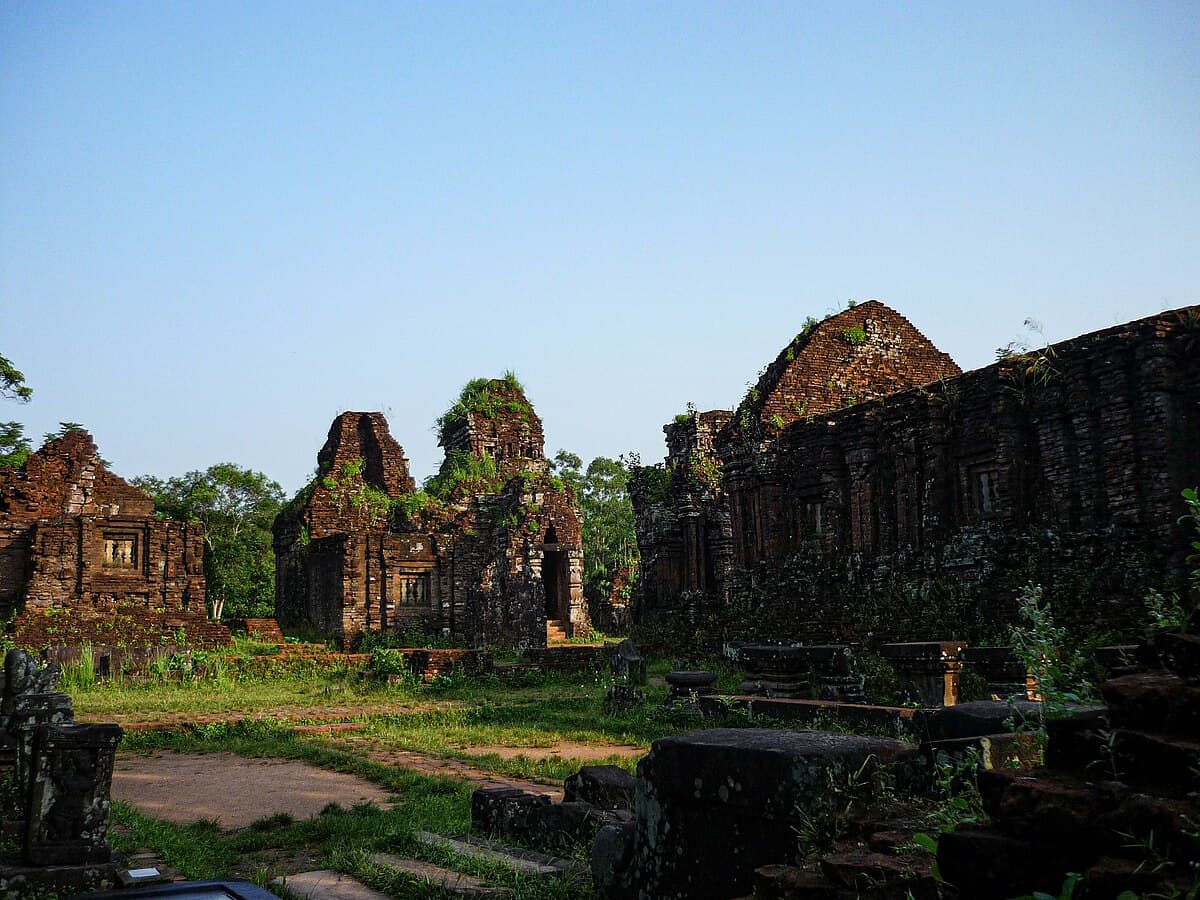
Vietnam has 8 UNESCO World Heritage Sites — 3 cultural (Hue Monuments, Hoi An Ancient Town, Citadel of the Ho Dynasty), 2 natural (Ha Long Bay-Cat Ba Archipelago, Phong Nha-Ke Bang-Hin Nam No), 1 mixed (Trang An Landscape Complex), and 2 more cultural (My Son Sanctuary, Thang Long Imperial Citadel) — plus 17 intangible heritage entries on UNESCO's Representative List and Urgent Safeguarding lists.
The atlas exists because no English-language reference aggregates all 8 sites with current visitor numbers, fee structures, conservation-status findings, and management contact in one place. Existing coverage is per-site, fragmented, operator-driven, and frequently out of date. Each figure here traces to a named source: UNESCO World Heritage Centre official records, ICOMOS state-of-conservation reports (cultural sites), IUCN World Heritage Outlook (natural sites), Vietnam National Authority of Tourism (VNAT) and provincial tourism departments, and per-site management boards. Updated annually each June, after the World Heritage Committee's annual session.
Quick summary — the headline findings
For travellers and journalists planning Vietnam UNESCO content in 2026, six findings matter most:
| Finding | Reading | Source |
|---|---|---|
| Most recent UNESCO action | Phong Nha-Ke Bang + Hin Nam No transboundary extension (July 2025, Decision 47 COM 8B.6) — Vietnam-Laos's first joint inscription; combined property 217,447 hectares | UNESCO WHC; Decision 47 COM 8B.6 |
| Visitor asymmetry | 18× difference between Hoi An (4.4 million, 2024) and Ho Dynasty Citadel (250,000, 2024); central-cluster ratio Hoi An : Hue : My Son ≈ 10 : 6 : 1 | Hoi An Creative City; Quang Nam DCST; Thanh Hoa provincial press |
| Natural sites under documented tourism pressure | Both natural sites carry IUCN "Significant Concern" rating (Outlook 2020); IUCN's 2018 Ha Long advisory mission named tourism as the #1 threat to aesthetic OUV | IUCN World Heritage Outlook |
| Trang An recovery story | Phased out of routine WHC state-of-conservation reporting from 2025 after 2019 reactive monitoring mission — Vietnam-side capacity-assessment work paid off | UNESCO Decision; State Party reports 2021, 2023 |
| Pricing-model polarity | Ho Dynasty Citadel $1.57 (cheapest) ↔ Sơn Đoòng cave expedition $3,000/person (1,000-visitor-per-year cap, Oxalis Adventure exclusive) | Site management boards; Oxalis Adventure |
| Intangible portfolio more dynamic than tangible | 17 intangible heritage entries vs 8 tangible sites; 2 new intangible inscriptions in 2024-25 (Lady of Realm Temple festival 2024; Đông Hồ folk woodblock printing 2025) vs zero new tangible sites since the 2023 Cat Ba extension | UNESCO ICH country page |
One safety event that matters for any 2026 Ha Long visit: the Wonder Sea capsizing on 19 July 2025 killed 39 people in a sudden thunderstorm — the deadliest Vietnamese maritime tourism accident in 20+ years. It has triggered tighter safety enforcement. Plan around the July-August storm window if you're considering an overnight cruise.
Why this atlas exists
The standard English-language Vietnam-UNESCO content is one of two things: a tourism-board press release that flatters every site equally, or a travel-blog round-up that conflates province-wide tourist arrivals with site-gate ticket sales. Neither distinguishes the 1993 cultural cluster (Hue, Hoi An, My Son) from the 2003-2015 natural cluster (Phong Nha) from the 2010-2014 inland-cluster (Thang Long, Ho Dynasty, Trang An). Neither tracks the 2025 transboundary extension or the 2024-25 intangible-heritage additions. Neither cross-references the IUCN "Significant Concern" rating on both natural sites with the tourism pressure that earned it.
The atlas does that work once, dates every figure, and commits to an annual June refresh. Three constituencies should find it useful:
- Travellers planning a UNESCO-anchored Vietnam trip — the master comparison table and per-site deep dives give the data to pick the right 3-5 stops for a 10-14 day itinerary
- Journalists writing on Vietnam tourism, conservation, or Southeast Asia heritage — the sourced cross-cuts and IUCN findings are quotable without re-doing the research
- Researchers and conservation practitioners — the per-site management-board contact mapping and conservation-status notes are the operational layer the UNESCO WHC official records don't provide
The atlas extends the existing daytripsvietnam corpus rather than replacing it. The Beach Atlas (Pillar #3) covers coastal water quality including the Cua Dai erosion that directly affects Hoi An's UNESCO conservation status. The Hoi An community-based tourism research covers the management response. The Ha Long Bay overtourism research is the academic synthesis behind the IUCN findings here.
Methodology — the 4-source stack
Every figure in the atlas traces to one of four English-language source layers, all publicly accessible:
- UNESCO World Heritage Centre official records —
whc.unesco.org/en/list/<id>/. Each site has a permanent record with inscription year, criteria, Outstanding Universal Value (OUV) statement, property and buffer-zone areas, state-of-conservation history, and UNESCO Committee decisions affecting the site. - ICOMOS state-of-conservation reports (cultural sites) —
icomos.org. ICOMOS is the official advisory body for cultural World Heritage. State-of-conservation reports and advisory missions document specific threats and management responses. The 2018 Trang An report and the 2023 + 2025 Thang Long joint missions are particularly load-bearing for this atlas. - IUCN World Heritage Outlook (natural sites) —
worldheritageoutlook.iucn.org. IUCN is the official advisory body for natural World Heritage. The Outlook publishes a quadrennial conservation-effectiveness assessment per site. Both Vietnamese natural sites carry "Significant Concern" ratings in the 2020 Outlook 3 cycle. - VNAT and provincial tourism departments —
vietnamtourism.gov.vn/enplus provincial DCSTs. VNAT publishes national-level tourism statistics with a 6-12 month lag; provincial Departments of Culture, Sports and Tourism (DCST) and individual site management boards publish per-site visitor counts in Vietnamese-language press releases that English-language outlets (VietnamPlus, Vietnam News, VnExpress International) translate selectively.
Plus secondary sources for specific dimensions: per-site management board websites for fee structures and English-language accessibility detail; the UNESCO Intangible Cultural Heritage country page at ich.unesco.org/en/state/viet-nam-VN for the 17 intangible heritage entries.
Hard editorial rules
- Every figure cites a named source. Where VNAT data and provincial-press numbers diverge, the atlas publishes the spread.
- No fabricated visitor numbers. Three sites (Thang Long, partly Trang An by zone, Ho Dynasty by international-share) have data gaps; the atlas reports what exists and flags what doesn't.
- Site-gate vs province-wide reporting distinguished. "Ninh Bình province had 6.6 million tourist arrivals in 2023" ≠ "Trang An site had 6.6 million visitors in 2023." The atlas labels which is which.
- OUV summaries quoted verbatim from UNESCO WHC where possible, paraphrased otherwise; never invented.
- Conservation framings reflect ICOMOS/IUCN findings, not journalistic editorialising. Where IUCN says "Significant Concern," the atlas reports that; where the agency says values are intact, the atlas reports that.
What we excluded
- Tour-operator visitor estimates — incentive-conflicted toward inflation
- Pre-2020 visitor counts — pre-COVID baseline is misleading for current planning
- Aspirational target numbers dressed as historical achievement (Ho Dynasty Citadel's "800,000 visitors by 2030" goal is a target, not a current figure)
Vietnam UNESCO in regional context
Vietnam's UNESCO portfolio sits comfortably mid-table in Southeast Asia by site count and is increasingly active in inscription velocity:
| Country | World Heritage Sites | Intangible heritage entries | First inscription | Most recent action |
|---|---|---|---|---|
| Vietnam | 8 (incl. mixed Trang An) | 17 | 1993 (Hue Monuments) | 2025 Phong Nha-Hin Nam No transboundary |
| Thailand | 8 (5 cultural, 3 natural) | ~5 | 1991 (Ayutthaya + Sukhothai) | 2023 (Si Thep Historical Park) |
| Indonesia | 10 (5 cultural, 5 natural) | ~12 | 1991 (Borobudur, Komodo) | 2024 (Caves and Karst of Maros-Pangkep) |
| Philippines | 6 | ~4 | 1993 (Tubbataha Reefs) | 2014 (Mount Hamiguitan) |
| Cambodia | 4 (incl. transboundary Preah Vihear) | ~3 | 1992 (Angkor) | 2023 (Koh Ker) |
| Laos | 3 + 2025 transboundary share with Vietnam | ~2 | 1995 (Luang Prabang) | 2025 Hin Nam No transboundary with Phong Nha |
| Myanmar | 2 | ~1 | 2014 (Pyu Ancient Cities) | 2019 (Bagan) |
Two regional patterns worth surfacing:
Vietnam's inscription velocity is accelerating. From 1993-2003 Vietnam added 3 sites; from 2003-2014 Vietnam added 4 sites; from 2014-2025 Vietnam has made 3 boundary extensions (Phong Nha 2015, Cat Ba 2023, Hin Nam No 2025) plus added 11 intangible heritage entries. The boundary-extension and intangible-heritage activity, not new tangible inscriptions, is now the dominant signal.
Regional pricing comparison favours Vietnam. Angkor's 3-day pass costs $62 USD; Borobudur foreigner ticket runs ~$25; Ayutthaya is ~$6. Vietnam's flagship-tier Hue 4-monument combo at $21 sits below Angkor and Borobudur, well above Ayutthaya. The Ho Dynasty Citadel at $1.57 is the regional bargain by a wide margin. Sơn Đoòng's $3,000 conservation-priced model is the regional outlier in the opposite direction.
Master comparison table
Eight sites, eight dimensions, scored on the most-recent verifiable data:
| # | Site | Inscribed | Criteria | Visitors 2024 | Conservation | Fee (foreigner) | Crowd peak | Mgmt EN |
|---|---|---|---|---|---|---|---|---|
| 1 | Hue Monuments | 1993 | (iv) | ~2.7M monuments-only; ~3.1M in 2025 (+14% YoY) | Climate flooding; restoration ongoing | 530,000 VND ($21) 4-monument combo | Feb-Apr + Sept-Nov | Strong |
| 2 | Hoi An Ancient Town | 1999 | (ii), (v) | 4.4M (95% city target); 3.57M international | Climate + Cua Dai erosion (linked to upstream dams) | 120,000 VND ($5) 24h pass | Full-moon lantern; Tet; summer | Strong |
| 3 | My Son Sanctuary | 1999 | (ii), (iii) | ~450K (80% international, unique skew) | Indian ASI restoration 2017-22 complete; Italian Group G 1997-13 | 150,000 VND ($6) bundled | Sunrise tour windows | Weak |
| 4 | Ha Long Bay + Cat Ba | 1994 / 2000 / 2023 | (vii), (viii) | ~3.2M site-gate (H1 majority-international first time) | IUCN "Significant Concern"; Yagi 2024; Wonder Sea 2025 | 240-290K VND ($10-12) + cruise | May-Sept (avoid Jul-Aug storms) | Strong (post-Nov 2025 restructure) |
| 5 | Phong Nha + Hin Nam No | 2003 / 2015 / 2025 | (viii), (ix), (x) | ~700-750K park (Quang Binh province 5.2M) | IUCN "Significant Concern"; buffer-zone tourism master-plan flagged | 150K-$3,000 (Sơn Đoòng) | Feb-Aug (cave access window) | Strong |
| 6 | Ho Dynasty Citadel | 2011 | (ii), (iv) | ~250K (low absolute) | Active excavation 2024-26; no reactive monitoring | 40,000 VND ($1.57) cheapest | No real crowding | Weak |
| 7 | Trang An (Mixed) | 2014 | (v), (vii), (viii) | 2.8M across property zones | Phased out of routine SOC reporting 2025 ✓ | 250,000 VND ($10) boat | Dec-Feb; late May-early Jun rice | Weak |
| 8 | Thang Long Imperial Citadel | 2010 | (ii), (iii), (vi) | data-limited (likely 600-800K) | 2023 + 2025 ICOMOS missions; SOC due Feb 2026 | 100,000 VND ($4) (tripled Jan 2025) | Spring + autumn | Strongest digital UX |
Per-site deep-dives
1. Complex of Hue Monuments (Thừa Thiên-Huế)
Vietnam's first UNESCO inscription (1993), under criterion (iv) alone — "an outstanding example of an eastern feudal capital… a remarkable example of the planning and construction of a complete defended capital city in a relatively short period in the early years of the 19th century CE." The property covers 315.47 ha + 71.93 ha buffer and includes the Imperial City, Forbidden Purple City, royal tombs (Minh Mang, Tu Duc, Khai Dinh, Gia Long), and Thien Mu Pagoda along the Perfume River.
Visitors 2024-2025: ~2.7M to the monuments specifically in 2024, rising to ~3.1M in 2025 (+14% YoY) with ticket revenue of VND 473 billion ($18M); province-wide tourist arrivals are higher and shouldn't be conflated. The Imperial City sells around 10,000 tickets per day on average.
Conservation history: 1947 French re-occupation fires and the 1968 Tet Offensive devastated the Imperial City; restoration since 1996 has run in two main phases (Phase 1 1996-2010, VND 720B / ~$30M, 80+ structures; Phase 2 2010s-2020s, VND 2.3T, 170+ structures). International partners are France, Japan, and the UNESCO/NHK Trust Fund — not Italy, which is the My Son partner. A digitisation programme launched in 2025 addresses climate-flooding risk to physical fabric. The 2030+ conservation blueprint is in final PM/Ministry approval.
Fees and management: Imperial City alone 200,000 VND; each royal tomb 150,000 VND; 4-monument combo 530,000 VND ($21) valid 2 days. Hue closed the historic foreigner-premium fee gap in 2018 — locals and foreigners pay the same. The 2026 fee reform broadens exemptions for elderly, low-income households, and students/pupils nationwide on registered school visits; up to 50% reductions during festival periods. Authority: Hue Monuments Conservation Centre (Trung tâm Bảo tồn Di tích Cố đô Huế), founded 10 June 1982, at hueworldheritage.org.vn.
Recent changes (2024-2026): VR programme rolled out 2024; heritage digitisation 2025; immersive night tour launching March 2026. Province targets 3.5M visitors and VND 8.5T revenue by 2026.
See our Hue destination guide for trip-planning context.
2. Hoi An Ancient Town (Quảng Nam)
Inscribed 1999 under criteria (ii) and (v) — "an outstanding material manifestation of the fusion of cultures over time in an international commercial port" (ii) and "an exceptionally well-preserved example of a traditional Asian trading port" (v). The property covers 30 ha + a buffer zone of ~100 ha (corrected from an erroneous 280 ha after a 2008+ re-survey). The Old Town's 15th-19th century shophouses fuse Japanese, Chinese, and Vietnamese architectural traditions.
Visitors 2024: 4.4 million, the heaviest-trafficked of Vietnam's UNESCO sites. International visitors: 3.57M. Tourism revenue: VND 5.231 trillion (~$215M). Growth trajectory: from 100,000 in 1999 (year of inscription) to 4.4M in 2024 — a 44× increase. H1 2025 alone hit 2.8M, +17.4% YoY. The academic framing has shifted from "over-tourism" to "over, over, over-tourism" (Prof Lam Thi My Dung, VNU Hanoi).
Conservation pressure is dominated by climate change and flooding. Hoi An sits on UNESCO's list of heritage sites at climate-change risk; 2017's Storm Damrey caused the worst flooding in the town's recorded history. Cua Dai Beach is losing 10-20 metres of land per year, exacerbated by upstream hydropower dams on the Vu Gia-Thu Bon river system that reduce downstream sedimentation — a direct tie to our Beach Atlas, which covers the VND 1,530 billion ($60M) engineering response in detail.
Fee structure: 120,000 VND ($5) for international visitors, valid 24 hours, admitting 5 of ~22 listed heritage attractions in the protected zone. Children under 1.4m: ~50,000 VND. Locals are exempt — making Hoi An the only Vietnamese UNESCO site with a structural foreigner-only pricing scheme. The fee has been stable through 2024-2026.
Recent changes (2024-2026): pedestrian zone expansion in 2023-2024; cars permanently banned in the Old Town; electric public transport only; motorised vehicles allowed only in 4-hour windows. Provincial authorities have launched an over-tourism dispersal strategy promoting peripheral destinations (Duy Xuyen, Dien Ban, Thang Binh, Tra Que, Cam Thanh, Cu Lao Cham) to relieve pressure on the 30-ha core.
Authority: Hoi An Centre for Cultural Heritage Management and Preservation (HACCHMP), founded 8 June 2011, at hoianheritage.net.
See our Hoi An destination guide and the Hoi An community-based tourism research for fuller context.
3. My Son Sanctuary (Quảng Nam)
Inscribed 1999 under criteria (ii) and (iii) — recognising the Champa civilisation's adaptation of Hindu temple architecture from the Indian subcontinent (ii) and the towers' unique evidence of an extinct civilisation (iii). The original property was 142 ha + 920 ha buffer (1,062 ha total), revised by the 2008 master plan to a core of 32.46 ha + buffer of 1,125.54 ha. The site's Shaiva Hindu sanctuary towers were built by Champa kings between the 4th and 14th centuries.
Visitors 2024: ~352,000 in the first 9 months, full-year likely 420-480K (data-limited on exact annual count). Q1 2024 saw 123,000 visitors (110,000 international, +50% vs Q1 2023). Foreign visitors are ~80%+ of arrivals — the most internationally-skewed profile of any Vietnamese UNESCO site. The visitor volume sits comfortably below Hue and Hoi An; in the central-cluster ratio of Hoi An : Hue : My Son ≈ 10 : 6 : 1, My Son is the "1."
Conservation history is dominated by war damage and bilateral restoration. The 1969 American bombing during the Vietnam War destroyed major Group A temples, including the cathedral-like A1 tower. Two international restoration partnerships followed:
- Italian-led UNESCO restoration of Group G: 1997-2013+, ~$1.6M Italian government-funded — established the methodology for Cham brick conservation that subsequent work has followed
- Indian ASI restoration of Groups A, H, and K: 2017-2022, $2.25M, completed 2022; 734 artefacts recovered including the largest monolithic sandstone Linga-Yoni set ever found in a Champa context (9th century). UNESCO's Director-General visited in 2022 to mark completion.
Fees: foreign adult 150,000 VND ($6); Vietnamese 100,000 VND; children 5-15 30,000 VND; under 5 free. Includes museum entry + return electric-shuttle ride + Apsara Cham dance performance in the bundle. Consistent through 2024-2026.
Crowding peaks at sunrise tour windows (5:30-7:30 a.m.) when Hoi An and Da Nang day-trippers cluster — the dawn arrival is the dominant tourism product. Midday is hot and quiet. See our My Son Sanctuary day trip guide for the practical operator detail.
Management: My Son Cultural Heritage Management Board under Duy Xuyên District People's Committee, with Quảng Nam DCST oversight. Site at Duy Phu commune, ~40 km southwest of Hoi An. The English-language web presence is limited; reliance on Quảng Nam provincial tourism for English-facing info.
4. Ha Long Bay – Cat Ba Archipelago (Quảng Ninh + Hải Phòng)
Vietnam's most-recognised natural site. Inscribed 1994 on aesthetic criterion (vii); re-inscribed with expanded boundaries 2000 adding geological criterion (viii); boundary-modified 2023 (Decision 45 COM 8B.3) to add the Cat Ba Archipelago (Hai Phong City), with the property renamed "Ha Long Bay – Cat Ba Archipelago". The property covers 65,650 hectares with 1,133 islands and islets. UNESCO's OUV statement calls it "the most extensive example of marine-invaded tower karst globally."
Visitors 2024: ~3.2 million at the bay's site-gate (1.92M international, 1.28M domestic), part of Quảng Ninh province's wider 19M tourist arrivals. H1 2024 was a structural inflection: international visitors outnumbered domestic for the first time (~1M international vs ~500K domestic at the site gate). 2025 province target: 20M.
Conservation status — IUCN "Significant Concern" (2020 Outlook 3). The 2018 IUCN advisory mission concluded that geological values are not under threat, but "continued growth in visitor numbers and ineffective management of visitors and waste" poses a significant threat to aesthetic OUV. Verbatim IUCN: "High levels of tourism and continued growth in visitor numbers represent the most significant threat to Ha Long Bay unless it is carefully planned and managed." Single-use plastic was banned on cruises in 2019; the Management Board claims 90% reduction in onboard plastic from peak. The site received the Fodor's "No List" 2024 designation for trash accumulation.
Recent safety and climate events:
- Typhoon Yagi, September 2024: 23 cruise vessels sunk; Management Board mobilised 1,127 personnel and 301 vehicles 14-23 September 2024, collecting 643 m³ of waste and 94 floating fish-farm rafts. Cruise operations resumed by mid-September.
- Wonder Sea capsizing, 19 July 2025: a tourist boat capsized in a sudden thunderstorm, killing 39 people (mostly Hanoi families, ~20 children). This is the deadliest Vietnamese maritime tourism accident in 20+ years. The accident triggered tighter safety enforcement and re-energised the carrying-capacity conversation.
Fees (2025): Routes 1, 2, 5 are 290,000 VND ($11.60); Routes 3, 4 are 240,000 VND ($9.60). Port fee was raised from 40,000 to 60,000 VND per one-way effective 1 April 2024. New tours VHL6/7/8 from May 2025 (VHL6 = 150K VND/day). Cruise operator fees are separate ($60-$500+ per night).
Management transition: through 31 October 2025, the Ha Long Bay Management Board operated independently at 166 Le Thanh Tong St, Ha Long City. From 1 November 2025, the authority was restructured into the "Ha Long Bay – Yên Tử World Heritage Management Board" through a merger of three prior units. The new hotline (effective 1 January 2026) is 0812 488 111.
See our Ha Long Bay destination guide and the Ha Long Bay overtourism research for the deeper context.
5. Phong Nha-Ke Bang + Hin Nam No National Parks (Quảng Bình + Khammouane, Laos)
The site with the most-complex inscription history. Inscribed 2003 on criterion (viii) alone for karst geology (the oldest large-scale karst in Asia, ~400 million years). Re-inscribed 2015 (Decision 39 COM 8B.6) with extended boundaries and added criteria (ix) and (x) for biodiversity — Annamite Range moist forests with 94% forest cover and 800+ vertebrate species. Extended in July 2025 (Decision 47 COM 8B.6) into a transboundary property with Hin Nam No National Park in Laos's Khammouane Province — Vietnam-Laos's first joint inscription. The combined property now covers 217,447 hectares.
OUV verbatim, criterion (ix): "One of the largest remaining areas of relatively intact moist forest on karst in Indochina, with a forest cover estimated to reach 94%, of which 84% is thought to be primary forest." Criterion (x): more than 800 vertebrate species (154 mammals, 117 reptiles, 58 amphibians, 314 birds, 170 fish) and 2,700+ vascular plants.
Visitors: 2023 park visitors 662,000+ (+6% YoY); 2024 Quang Binh province 5.2M (+15.3%), park-specific ~700-750K; 2025 January-July park 400,000+. The province targets 3 million annual park visitors by 2030 — a target IUCN has flagged as inconsistent with conservation effectiveness.
Conservation status — IUCN "Significant Concern" (2020 Outlook 3). IUCN explicitly flagged "massive tourism development in and around the site and planned urbanization of the buffer zones" including a proposed Master Plan with 2,500 ha of additional tourism site development in adjacent park communes. The 2017 SoC report noted illegal logging and wildlife trade pressures from buffer-zone communities.
Sơn Đoòng is the global conservation-pricing benchmark. The world's largest cave by volume, accessible only via Oxalis Adventure under exclusive Vietnamese government license since 2014, capped at 1,000 visitors per year. The 4-day/3-night expedition (6-day/5-night total package) costs $3,000 USD per person; maximum 10 guests + 30 staff per group. 2024 was fully booked; 2027 is fully booked; 2028 booking opened in early 2026. Access window is January-August only (closed September-December due to monsoon flooding).
Other fees (2024-2026): Phong Nha Cave 150,000 VND entry + 550,000-750,000 VND/boat (12-pax shared); Paradise Cave 250,000 VND in 2024 → 270,000 VND in 2026.
Authority: Phong Nha-Ke Bang National Park Management Board (Ban Quản lý Vườn Quốc gia Phong Nha-Kẻ Bàng), Director (2024-): Pham Hong Thai, at phongnhakebang.vn. The 2025 transboundary inscription has activated a joint Vietnam-Laos coordination protocol with the Hin Nam No National Park management.
See our Phong Nha destination guide for trip-planning context.
6. Citadel of the Ho Dynasty (Thanh Hóa)
A 14th-century citadel built in 1397 by the Hồ Dynasty, sited per feng shui principles between Tuong Son and Don Son mountains. Inscribed 2011 under criteria (ii) and (iv) — recognising the spread of Neo-Confucianism in late 14th-century Vietnam to East Asia (ii) and the architectural ensemble as "an outstanding example of a new style of south-east Asian imperial city" (iv). Property: 155.5 ha + 5,078.5 ha buffer. Composed of Inner Citadel, La Thanh Outer Wall, and Nam Giao Altar.
Visitors: ~250,000 in 2024; ~200,000 in 2023; ~1 million cumulative 2021-2025 with ~8,700 international (highest international count ever). The atlas's lowest-volume site by a wide margin. Provincial target: 800,000 visitors per year by 2030.
Conservation profile is inverted relative to the high-volume sites. No ICOMOS reactive monitoring mission has been triggered; the site is not on the Danger List or in active SOC reporting. The dominant threat is under-visitation rather than overtourism. An active conservation and excavation programme runs through 2024-2026: Nam Giao Altar excavation (Foundations 4 and 5, October 2025-July 2026, area 9,909 m², 94 holes) led by the Heritage Conservation Centre and the Institute of Archaeology; Four Gates excavation (South, North, East, West gates, total 5,000 m²).
Fees: adult (16+) 40,000 VND (~$1.57) — the cheapest of the 8 sites by a wide margin. Children 8-15: 20,000 VND. Under 8: free. Electric shuttle in-site: 200,000-300,000 VND per shuttle (max 10 passengers). Parking became free from 26 February 2026 at key Thanh Hóa heritage sites under a new provincial policy. The fee is the same for foreigners and Vietnamese.
Authority: Management Board of the Citadel of the Ho Dynasty (Trung tâm Bảo tồn Di sản Thành Nhà Hồ), established Decision 2264/QD-UBND, 30 July 2007, under the Thanh Hóa Provincial People's Committee. No verified standalone English portal; international visitors are routed through Vietnam Tourism's central site.
The structural opportunity here is the asymmetry between the site's globally-recognised significance and its tiny visitor base. A traveller seeking a quiet UNESCO experience with active archaeology won't find a better Vietnamese option.
7. Trang An Landscape Complex (Ninh Bình) — Mixed
Vietnam's only Mixed Cultural + Natural UNESCO site, inscribed 2014 under criteria (v), (vii), and (viii). The property covers 6,172 ha + 6,079 ha buffer, with ~14,000 residents living within the property. Three protected areas: Hoa Lư Ancient Capital, Tràng An-Tam Cốc-Bích Động Scenic Area, and Hoa Lư Special-Use Primary Forest.
The editorial nugget under-communicated to foreign visitors: the cultural component recognises continuous human occupation spanning more than 30,000 years through archaeological deposits in the area's caves — "the most outstanding locale within Southeast Asia for demonstrating the way early humans interacted with the natural landscape." Most foreign visitors experience Trang An as a scenic karst boat tour without ever encountering the depth of the human-landscape archaeology.
Visitors 2024: ~2.8 million across the 6 management zones (with per-zone ranges from 3,000 to 1.6M). The wider Ninh Bình province received 6.6M tourist arrivals in 2023 (+1.7× YoY, revenue 6.5T VND) and targeted 7.5M for 2024 including 900,000 international (revenue 8.25T VND / $338M). Province-wide 2026 Q1: 5.4M arrivals in first two months (+9.9% YoY).
Conservation recovery story. Following the 2014 inscription, the 2018 ICOMOS SoC report concluded "the management system for the property does not appear to be robust enough to meet the challenges affecting it in terms of tourism development." A 2019 joint UNESCO/ICOMOS/IUCN reactive monitoring mission followed an illegal concrete staircase incident. The Management Plan capped boats at 3,000; by 2020 the count had drifted to 3,865. The State Party then completed capacity assessments across all 6 management zones, which UNESCO acknowledged in 2021 and 2023 as appropriate. Trang An has been phased out of routine WHC state-of-conservation reporting from 2025 — a recovery story worth recognising.
Fees: boat tour 250,000 VND (~$10), all nationalities, including children 1m-1.3m at 120,000 VND (under 1m free). Private boat: 1,000,000 VND. Parking: ~15,000 VND for motorbikes. Tam Coc and Hoa Lư have separate ticketing.
Crowding peaks December-February (cool dry season, Tet pilgrimage) and late May-early June at Tam Coc when the rice harvest turns the valley golden — the iconic photography window. Heaviest 10 a.m.-3 p.m.; arriving before 8 a.m. or after 4 p.m. dramatically reduces crowds. Tam Coc's narrower waterway feels more congested than Trang An.
Authority: Trang An Landscape Complex Management Board (Ban Quản lý Quần thể danh thắng Tràng An) under the Ninh Bình Provincial People's Committee. No standalone English-language portal verified.
See our Ninh Binh destination guide and the dedicated Trang An boat tour guide for trip-planning context.
8. Thang Long Imperial Citadel (Hà Nội)
Inscribed 2010 under criteria (ii), (iii), and (vi) — recognising the meeting of Chinese and Champa cultural influences (ii), the stratified material evidence of Đại Việt civilisation (iii), and the site's continuity as a political seat for nearly 13 centuries (vi). Property: 18.395 ha + 108 ha buffer (total 126.395 ha). Built in the 11th century by the Ly Dynasty marking Đại Việt's independence, on a 7th-century Chinese fortress on land reclaimed from the Red River Delta.
Visitors: data-limited for comprehensive 2022-2024 annual series in English-language sources. The Hanoi People's Committee does not publish site-specific arrivals in English. A single 2024 Tet event drew ~60,000 visitors in one week; the Management Board has stated an aspirational target of 1 million annual visitors. Likely range based on contextual indicators: 600,000-800,000 annually.
Conservation status — active UNESCO monitoring. Joint UNESCO/ICOMOS advisory missions visited in July 2023 and July 2025 (the July 2025 mission report is published at unesdoc.unesco.org/ark:/48223/pf0000396783). Decision 47 COM 7B.92 (47th WHC session, July 2025) directed Vietnam to submit an updated state-of-conservation report by 1 February 2026. The key issues: scale and scope of the Kinh Thien Palace restoration (UNESCO has approved Vietnam to restore; dossier prepared early 2026); ongoing archaeological excavations clarifying foundations; resident relocation from the heritage core under Hanoi's 100-year master plan. Threats: urban encroachment in surrounding Ba Đình District; pressure from infrastructure; complexity of balancing reconstruction with archaeological integrity.
Fees: Adult (all nationalities): 100,000 VND (~$4) effective 1 January 2025 — tripled from the prior 30,000 VND. Students 16+ / seniors 60+: 50,000 VND. Children under 16 and war-merit holders: free. The fee is the same for foreigners and Vietnamese.
Authority: Thang Long-Hanoi Heritage Conservation Centre (Trung tâm Bảo tồn Di sản Thăng Long-Hà Nội) under the Hanoi People's Committee, at hoangthanhthanglong.vn/en. The strongest digital UX of the 8 sites — online ticketing in English is available at vedientu.hoangthanhthanglong.com.
Recent changes (2024-2026): ticket tripled (Jan 2025); major 2025 excavations at Kinh Thien Palace foundations (Vietnam Academy of Social Sciences + Institute of Archaeology); Hanoi to submit Kinh Thien restoration dossier to UNESCO early 2026; SOC report due Feb 2026.
See our Hanoi destination guide for trip-planning context.
The intangible heritage portfolio — Vietnam's 17 entries
Vietnam's tangible UNESCO portfolio has 8 sites; the intangible heritage portfolio has 17 entries on UNESCO's Representative List and Urgent Safeguarding List. The intangible list is the more dynamic of the two — two new inscriptions in 2024-2025 versus zero new tangible sites since the 2023 Cat Ba Archipelago boundary extension.
| Year | Element | Type | List |
|---|---|---|---|
| 2003* | Nhã Nhạc (Vietnamese court music) | Music | Representative |
| 2005* | Space of Gong Culture (Central Highlands) | Music/ritual | Representative |
| 2009 | Quan Họ Bắc Ninh folk songs | Folk music | Representative |
| 2009 | Ca Trù singing | Sung poetry | Urgent Safeguarding |
| 2010 | Gióng festival (Phù Đổng + Sóc temples) | Festival | Representative |
| 2011→2017 | Xoan singing (Phú Thọ) | Ritual music | Representative (first-ever transfer from Urgent Safeguarding back to Representative) |
| 2012 | Worship of Hùng Kings (Phú Thọ) | Belief | Representative |
| 2013 | Đờn Ca Tài Tử (southern Vietnam) | Chamber music | Representative |
| 2014 | Ví and Giặm folk songs (Nghệ Tĩnh) | Folk music | Representative |
| 2015 | Tugging rituals (multinational: VN/Cambodia/Korea/Philippines) | Ritual/games | Representative |
| 2016 | Mother Goddesses of Three Realms | Belief | Representative |
| 2017 | Bài Chòi (Central Vietnam) | Folk theatre | Representative |
| 2019 | Then practice (Tày, Nùng, Thái) | Ritual chant | Representative |
| 2021 | Xòe Thái dance | Dance | Representative |
| 2022 | Chăm pottery-making | Craft | Urgent Safeguarding |
| 2024 | Lady of Realm Temple festival (Sam Mountain) | Festival | Representative |
| 2025 | Đông Hồ folk woodblock printing | Craft | Urgent Safeguarding |
* Nhã Nhạc and the Gong Culture entries were originally inscribed as "Masterpieces of Oral and Intangible Heritage of Humanity" (a pre-2008 UNESCO designation) and transferred onto the Representative List when the 2003 Convention's Lists were operationalised.
Three patterns worth surfacing:
- The Xoan singing transfer (2011 Urgent → 2017 Representative) is the first-ever such reverse-direction transfer in UNESCO's intangible heritage system. It demonstrates that safeguarding work, when sustained, can succeed.
- Vietnam's intangible portfolio skews toward music and ritual rather than craft — 9 of 17 are musical or ritual-music elements. This reflects Vietnam's regional cultural diversity (north / centre / south traditions are distinct) and the country's deliberate inscription strategy.
- The 2024 and 2025 additions are both Mekong Delta / northern craft — broadening the portfolio away from the centre-of-mass at northern and central Vietnamese musical traditions. The Đông Hồ printing inscription on Urgent Safeguarding flags a 500-year tradition under genuine threat from declining demand and aging practitioner base.
Conservation status atlas — what ICOMOS and IUCN actually say
The atlas's most-load-bearing finding: the dominant conservation concerns at Vietnam's UNESCO sites are now tourism-pressure, not the war-damage-restoration histories that defined the 1993 and 1999 inscriptions.
IUCN "Significant Concern" — both natural sites:
- Ha Long Bay (2020 Outlook): IUCN's 2018 advisory mission concluded geological values are not threatened but continued visitor-volume growth threatens aesthetic OUV. Verbatim: "High levels of tourism and continued growth in visitor numbers represent the most significant threat to Ha Long Bay unless it is carefully planned and managed."
- Phong Nha-Ke Bang (2020 Outlook): IUCN flagged "massive tourism development in and around the site and planned urbanization of the buffer zones." The 2025 transboundary extension with Hin Nam No adds a Vietnam-Laos coordination layer but doesn't reduce the tourism-pressure baseline.
ICOMOS state-of-conservation findings — cultural sites:
- Trang An (Mixed): 2018 ICOMOS finding — "the management system for the property does not appear to be robust enough to meet the challenges affecting it in terms of tourism development." 2019 joint UNESCO/ICOMOS/IUCN reactive monitoring after the illegal concrete staircase incident. Post-2019 capacity-assessment work was acknowledged in 2021 and 2023 reports; routine SOC reporting was phased out in 2025 — the strongest single recovery story in Vietnam's UNESCO portfolio.
- Thang Long Imperial Citadel: Joint UNESCO/ICOMOS advisory missions July 2023 + July 2025; Decision 47 COM 7B.92 directs Vietnam to submit updated SOC report by 1 February 2026. The focus is the scale and scope of the proposed Kinh Thien Palace restoration.
- Hue, Hoi An, My Son: No recent reactive monitoring. Hue's pressures are climate flooding (digitisation as mitigation, 2025); Hoi An's are over-tourism + climate-driven coastal erosion (the Cua Dai 10-20m/year loss); My Son's are physical war-damage recovery (now well-served by the completed Italian + Indian restoration programmes).
- Ho Dynasty Citadel: No reactive monitoring; opposite threat profile (under-visitation rather than overtourism).
The two most consequential recent UNESCO actions on conservation framing:
- The 2023 Cat Ba inclusion at Ha Long brought the Cat Ba Archipelago under UNESCO protection alongside Ha Long Bay proper — but it also increased the area's tourism pressure exposure as the inclusion attracted international attention.
- The 2025 Phong Nha + Hin Nam No transboundary extension activated a Vietnam-Laos coordination mechanism for the first time. The conservation upside is sharing best-practice across the Annamite Range moist forests; the unknown is whether two-state coordination accelerates or slows conservation decision-making.
Fee and accessibility cross-comparison
| Site | Foreigner adult (VND) | USD | Foreigner-vs-local | EN signage | Wheelchair |
|---|---|---|---|---|---|
| Ho Dynasty Citadel | 40,000 | $1.57 | Same | Limited | Partial (shuttle) |
| Thang Long Imperial Citadel | 100,000 | $3.94 | Same | Strong | Partial (flat archaeological area) |
| Hoi An Ancient Town | 120,000 | $4.72 | Locals exempt (foreigner-only) | Strong | Limited (cobble + thresholds) |
| Phong Nha Cave | 150,000 + boat | $5.90+ | Same | Strong | Boat-dependent |
| My Son Sanctuary | 150,000 | $5.90 | 33% local discount (100K vs 150K) | Variable | Strong (shuttle + flat) |
| Hue Imperial City alone | 200,000 | $7.87 | Same (foreigner premium closed 2018) | Variable | Partial |
| Ha Long Bay routes | 240-290,000 | $9.60-11.60 | Same | Strong | Boat-dependent |
| Trang An boat tour | 250,000 | $9.84 | Same | Limited | Limited (boat-only) |
| Paradise Cave (Phong Nha) | 270,000 | $10.62 | Same | Strong | ~1 km accessible boardwalk |
| Hue 4-monument combo | 530,000 | $20.87 | Same | Variable | Combo-dependent |
| Sơn Đoòng Expedition | 79,500,000 | $3,000 | Same | n/a (expedition) | Not accessible |
The fee architecture pattern: Vietnam has mostly converged on flat pricing for foreigners and locals — only Hoi An (foreigner-only) and My Son (33% local discount) retain meaningful gaps. Hue closed its historic foreigner-premium fee gap in 2018. Compare this to Cambodia's Angkor ($62 / 3-day pass for foreigners; locals free), Indonesia's Borobudur (~$25 foreigners; 50,000 IDR locals), or India's Taj Mahal (1,100 INR foreigners / 50 INR Indians) — Vietnam's flat-rate approach is regionally distinctive.
How Vietnam compares to Cambodia, Thailand, and Laos UNESCO portfolios
Quick comparator for travellers planning a multi-country Southeast Asia heritage trip:
Vietnam vs Thailand (both 8 sites). Thailand's portfolio is older (1991 Ayutthaya + Sukhothai) and more visitor-heavy at the headline sites (Ayutthaya ~3M annually; Sukhothai ~1M); Thailand's intangible portfolio is smaller (~5 entries vs Vietnam's 17). Pricing: Ayutthaya at ~$6 vs Hue at $21 is the most-direct comparable. Thailand's natural-site footprint (Dong Phayayen-Khao Yai forest complex, Kaeng Krachan) is largely unvisited by foreign tourists; Vietnam's Ha Long Bay alone exceeds the combined visitor count of Thailand's three natural sites.
Vietnam vs Cambodia (8 vs 4 sites). Cambodia's Angkor dominates regional UNESCO traffic — ~2.5M visitors in 2024, ~$62 for the 3-day pass. Vietnam's most-trafficked site (Hoi An, 4.4M) approaches Angkor's volume but at $5 vs $62 a much lower price-per-visitor. Cambodia's intangible portfolio (3 entries) is much smaller. The 2023 Koh Ker inscription was Cambodia's most recent UNESCO action.
Vietnam vs Laos (8 vs 3 sites + 1 shared 2025 transboundary). Laos's portfolio is small but high-quality (Luang Prabang, Wat Phou, Plain of Jars); pricing is lower ($2 Wat Phou) and crowds materially smaller. The 2025 Phong Nha + Hin Nam No transboundary extension is now a shared inscription with Laos — visitors entering Hin Nam No from the Lao side experience the same property from a different management perspective.
For multi-country heritage trips: Vietnam offers more inscription density and a more dynamic intangible portfolio; Cambodia offers Angkor's scale; Thailand offers older-inscription stability; Laos offers quieter access. A 14-21 day Vietnam-Laos-Cambodia heritage circuit could cover 6-8 UNESCO sites without rushing.
Limitations and honest caveats
The atlas is one perspective on a heritage system that varies meaningfully across operators, seasons, and source-data lag. What we could not measure or could not measure cleanly:
Limitation 1 — Visitor numbers conflate site-gate with province-wide reporting. Vietnamese tourism statistics frequently mix "site visitors" with "province-wide tourist arrivals" in press releases that English-language outlets translate selectively. The atlas distinguishes where possible but several figures are best estimates from contextual indicators. Thang Long Imperial Citadel's annual visitor count is genuinely data-limited in English-language sources; the 600,000-800,000 range is contextual extrapolation, not a published figure.
Limitation 2 — ICOMOS and IUCN reports run on multi-year cycles. IUCN's most-recent published World Heritage Outlook is the 2020 third-cycle assessment; a 2025 update is expected but post-dates this atlas's source-pull window. The atlas reports the latest published findings; some site-level changes since 2020 may not be reflected in the formal documentation yet.
Limitation 3 — Hoi An's headline Numbeo-equivalent crime / safety figures aren't published. Conservation status is well-documented; per-site safety statistics aren't part of UNESCO reporting. See our Solo Safety Atlas for the per-city safety dimension.
Limitation 4 — Three sites have weak English-language management portals. Ho Dynasty Citadel, My Son, and Trang An have limited English-facing communications. Foreign visitors planning trips to these sites rely on third-party operators rather than direct site contact.
Limitation 5 — Annual refresh cycle is real. UNESCO decisions, ICOMOS reports, IUCN updates, and visitor statistics all shift on different cycles. If you're reading this atlas more than 12 months after the publish date, check the original UNESCO and IUCN sources for any subsequent decisions or assessments.
Limitation 6 — The 8 atlas grid dimensions don't capture everything. "Accessibility" is reported at coarse resolution (wheelchair / English signage / audio guide); detailed accessibility for travellers with specific mobility, sensory, or cognitive needs is beyond the atlas's scope. Specialised disability-travel resources should be consulted for trip planning at that resolution.
How to plan a UNESCO-anchored Vietnam trip
The operational decoder:
-
Pick by region first. A 10-day Vietnam UNESCO circuit cannot hit all 8 sites without compressing every stop. Realistic clusters:
- Central Vietnam cluster (Hue + Hoi An + My Son): 5-7 days; the densest UNESCO cluster in Vietnam
- Northern UNESCO loop (Hanoi/Thang Long + Trang An + Ha Long Bay + Cat Ba): 7 days
- Phong Nha + central add-on: 3-5 days for Phong Nha alone (caves require day-by-day commitment)
-
Match priorities to sites.
- Want quiet UNESCO experience with active archaeology: Ho Dynasty Citadel + Thang Long Imperial Citadel
- Want the canonical experience: Hue + Hoi An (then add My Son for depth)
- Want natural-site spectacle: Ha Long Bay overnight cruise + Phong Nha Paradise Cave day visit
- Want global-conservation-pricing experience: book Sơn Đoòng now for 2028 ($3,000 Oxalis-exclusive expedition)
-
Plan around the safety window for Ha Long. Avoid July-August storm season for overnight cruises; the Wonder Sea capsizing (July 2025) and Typhoon Yagi (September 2024) both fell in this window. Best months: late October-early December and late February-April.
-
Sequence within the day. My Son at sunrise tour windows (5:30-7:30 a.m.) is empty; the same site mid-morning is crowded. Trang An before 8 a.m. and after 4 p.m. is dramatically quieter than 10 a.m.-3 p.m. Hoi An Old Town is unrecognisable between dawn (empty) and evening (lantern-festival shoulder-to-shoulder).
-
Cross-reference the Cost Index and Best Time guides. Our Vietnam Travel Cost Index 2026 covers accommodation cost ranges per atlas city; our best time to visit guide covers seasonal framing.
-
Watch the UNESCO Committee's annual decisions if you're planning multi-year heritage travel. The July sessions can re-inscribe sites with new criteria, add boundary extensions, or add Vietnamese intangible-heritage entries — the 2024-25 cycle added 2 intangible entries (Lady of Realm, Đông Hồ) and the 2025 Phong Nha transboundary.
Annual update commitment
This page is fully refreshed each June — timed to land before the World Heritage Committee's annual session (typically July). Each refresh re-pulls every figure against the current year's UNESCO Committee decisions, ICOMOS and IUCN updates, VNAT and provincial tourism reports, and per-site management board announcements. The slug includes the year (/guides/vietnam-unesco-sites-atlas-2026/) so external citations from 2026 continue to resolve. The 2027 version will live at /guides/vietnam-unesco-sites-atlas-2027/ with this page preserved for historical reference.
Revision history:
| Date | Changes |
|---|---|
| 2026-06-05 | Initial publication. Phase 1 source-pull May 2026. ~60 of 64 data cells substantively sourced; Thang Long visitor count, parts of Trang An by zone, and Ho Dynasty international-share are data-limited. 17 intangible heritage entries documented (including 2024 Lady of Realm Temple festival and 2025 Đông Hồ folk woodblock printing). 2025 Phong Nha-Hin Nam No transboundary extension and Wonder Sea capsizing both featured. |
How to cite this
Suggested citation format for journalists, researchers, conservation practitioners, and travel publications:
Nguyen, J. (2026). Vietnam UNESCO Sites Atlas 2026: Inscription, Visitors, Conservation Status, Fees, and Crowding for All 8 World Heritage Sites. Day Trips Vietnam. Retrieved from https://daytripsvietnam.com/guides/vietnam-unesco-sites-atlas-2026/
For specific figures, citation should reference the relevant section heading and the publication date — e.g., "Day Trips Vietnam's 2026 UNESCO Sites Atlas reports Hoi An's 2024 visitor count at 4.4 million (Hoi An Creative City, 2024)." For UNESCO-decision citations, the atlas reports the decision number — e.g., "the 2025 Phong Nha + Hin Nam No transboundary extension under UNESCO Decision 47 COM 8B.6."
Bulk reproduction requires permission; email info@daytripsvietnam.com.
Related research and reference
The figures here are grounded in our broader research corpus and destination guides. Direct cross-references:
- Vietnam Beach & Coastal Water Quality Atlas 2026 — paired pillar covering Cua Dai erosion and its tie to Hoi An's UNESCO conservation
- Vietnam Solo Traveller Safety Atlas 2026 — per-city safety reference covering all 8 atlas cities + Sapa
- Ha Long Bay overtourism research 2025 — academic synthesis behind IUCN's "Significant Concern" rating
- Hoi An community-based tourism sustainability — Hoi An's management response to over-tourism
- Vietnam Travel Cost Index 2026 — accommodation + transport cost ranges per atlas city
- Best time to visit Vietnam — seasonal framing
- Per-site destination guides: Hue, Hoi An, Ha Long Bay, Phong Nha, Ninh Binh, Hanoi
- Per-site day-trip guides: My Son Sanctuary, Trang An boat tour, Hai Van Pass
Questions, corrections, or republication enquiries: info@daytripsvietnam.com. We reply within two business days and publish corrections with the revision date noted in the table above.