
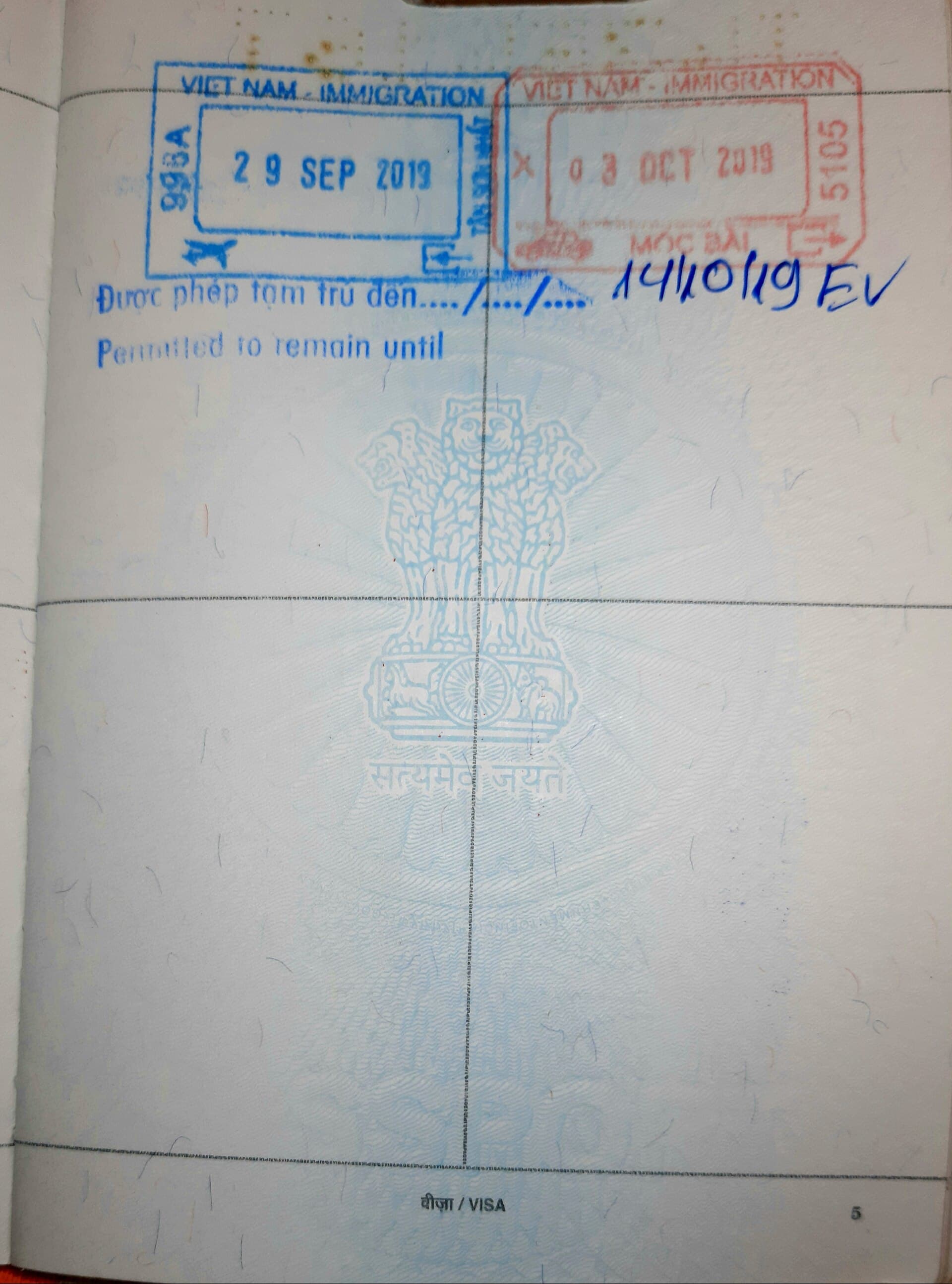
You are in Vietnam, your stamp is ticking down, and you want more time. Here is the answer up front: as of mid-2026, for most nationalities the practical "extension" is not an extension at all — it is a border run to Cambodia or Laos followed by re-entry on a fresh 90-day e-visa that you applied for before leaving. True in-country extensions still exist on paper, but approvals have been inconsistent since the 2023 reforms, outcomes depend heavily on which agent handles the paperwork, and the fee quotes vary wildly. The border run, by contrast, is predictable: $25 for the new e-visa, $40-60 in buses, one long day or one relaxed overnight, and a clean new entry.
This guide covers only the stay-longer problem. For entry visa types, the 45-day exemption list, and application steps, see the Vietnam visa guide; for the sourced reference on fines, decrees, and the full policy picture, see the visa and immigration atlas.
One hedge before anything else: Vietnamese visa practice shifts faster than almost any other travel rule in the region, and enforcement varies by office and officer. Everything below is current to mid-2026. Confirm with the Immigration Department or a licensed agent before committing money or a non-refundable flight to any of it.
The short answer
| Your situation | The practical move in 2026 |
|---|---|
| On a 90-day e-visa, want longer | Border run + fresh 90-day e-visa applied 3-5 working days ahead |
| On a 45-day exemption, want up to 90 more days | Border run + 90-day e-visa (more reliable than re-entering on the exemption) |
| On a 45-day exemption, want another 45 free days | Border run and re-enter on the exemption — usually works, officer discretion applies |
| Cannot leave the country (health, work, timing) | Agent-assisted in-country extension — possible but not guaranteed |
| Staying 6+ months per year, every year | Stop running borders; look at business, investor, or SVEC categories |
Why in-country extensions stopped being the default
Before the 2023 reforms, extending a tourist visa inside Vietnam was routine — every backpacker district had agents processing 30-day extensions in stacks. That machine still exists, but it runs less smoothly now.
On paper, the process is straightforward. The Immigration Department offices in Hanoi (44-46 Tran Phu, Ba Dinh) and HCMC (333 Nguyen Trai, District 1) accept extension applications at a $10-25 official fee with 5-7 business days of processing. In practice, three things changed:
- E-visa extensions became discretionary. Some applications are approved, others declined with no stated reason. Agents in both cities report that tourist e-visa extensions are the least predictable category they handle, and many have simply stopped offering them — quoting a border run instead.
- Exemption-entry extensions are case-by-case. A 45-day exemption stamp can sometimes be converted to a paid extension, but approval appears to depend on nationality, travel history, and the office's current posture. Treat any confident promise of approval with suspicion.
- The agent market got murkier. Realistic all-in quotes run $50-120 for a standard extension. Quotes of $150 and up usually mean a visa-category conversion, a tourist premium — or, in the worst version, an agent quietly booking you a border-run bus and calling it an extension. Ask, in writing, whether you are getting an Immigration Department stamp in your passport or a new entry. The answer changes what the service is worth.
None of this means extensions never work. It means the border run became the default because its outcome is knowable in advance, and the extension's is not.
The DIY immigration-office route
If you want to try the extension yourself: bring your passport, the original e-visa printout or entry stamp, a 4x6 cm photo, and your registered address in Vietnam to either office. Both have English-language windows; expect 30-90 minutes of queueing, and expect to leave your passport with them for the processing period. The honest assessment: DIY saves the agent margin but not the uncertainty — the same discretionary approval applies, and a declined application late in your stay leaves you with less runway to arrange the border run you should probably have started with.
Border-run mechanics: the four crossings that work
| Crossing | Route | Bus cost | Time | Notes |
|---|---|---|---|---|
| Moc Bai / Bavet | HCMC ↔ Cambodia | $20-30 each way | About 2 hours to the border | The standard run; same-day return feasible |
| Ha Tien / Prek Chak | Mekong Delta ↔ Kep/Kampot | $15-25 | 8+ hours from HCMC | Best if already in the Delta or coming off Phu Quoc |
| Lao Bao | Hue ↔ Savannakhet, Laos | $15-25 | 8-10 hours | The central-Vietnam option; overnight usually required |
| Mong Cai | Ha Long/Hai Phong ↔ China | Varies | Half day from Ha Long | Requires a Chinese visa arranged in advance; rarely worth it |
Moc Bai is the run. Buses leave Pham Ngu Lao in Ho Chi Minh City from early morning; you exit Vietnam at Moc Bai, walk across to Bavet, buy a Cambodian visa on arrival (around $30 — bring crisp USD), and either turn straight around or continue 5 more hours to Phnom Penh. The full same-day loop is routine when your new e-visa is already approved and printed.
Ha Tien suits travelers already in the Mekong Delta or ending a Phu Quoc stay — cross to Prek Chak, spend a night in Kep or Kampot, and come back. It is slower to reach from HCMC but a far more pleasant place to wait out an overnight than Bavet's casino strip.
Lao Bao is the central-Vietnam answer: buses from Hue toward Savannakhet, Lao visa on arrival for most nationalities (roughly $30-45 depending on passport — verify yours), and an overnight before returning. Budget two days.
Mong Cai exists but is a poor visa-run choice for most travelers, since China requires a visa arranged well in advance for the majority of nationalities.
Get the new e-visa before you go
This is the step that strands people. Vietnam does not hand tourist visas to unprepared arrivals at land borders — your fresh 90-day e-visa must be approved before you exit. Apply on the official portal ($25 single-entry, $50 multi-entry), listing your chosen land crossing as the entry port. Official processing is quoted at 3 working days; budget 3-5 and add margin around Vietnamese public holidays, when approvals pause entirely. Print two copies. Do not book the border bus until the approval PDF is in hand. If your current stamp expires before the e-visa can realistically arrive, deal with the overstay math honestly — the fine for a few days over (see below) may be smaller than the cost of panicking into an expensive rush service, but it still leaves a record, so the real lesson is to start the application 10 or more days before expiry.
Re-entry rules for 45-day exemption nationalities
The formal 30-day gap rule died in August 2023, and no written cooling-off period has replaced it. Most travelers from the 24 exemption countries report getting a fresh 45-day stamp after even a brief exit. But the absence of a rule is not a guarantee — re-entry on an exemption is at the officer's discretion, and discretion is where border runs go wrong. Commonly reported patterns as of mid-2026:
- One run after a first 45-day stay: almost always fine.
- Two runs inside 90 days: questions begin — expect to explain your plans, show an onward ticket, and possibly receive a shortened stamp.
- Near-continuous presence over 9-12 months on exemption stamps: real refusal risk.
Our visa atlas takes the conservative reading — if a refused entry would be catastrophic for you, treat 30 days outside Vietnam as the safe reset, or re-enter on a 90-day e-visa instead, which frames you as a documented tourist rather than a gray-zone resident.
If you overstay instead
Do not. Decree 282/2025 roughly tripled the fine schedule: $19-76 for 1-15 days over, $190-380 for 16-30 days, scaling to $1,140-1,520 near the one-year mark, all payable in VND cash at the exit desk before you are allowed to board. Overstays past 30 days risk a 3-5 year ban and future e-visa denials. A Moc Bai run costs $75-110 all-in including the new e-visa. The math is never close.
Long-stay alternatives before your third run
If you are structuring your life around a bus to Bavet every 90 days, the visa is telling you something. The established paths: a DN business visa (about 1 year, multi-entry) through a Vietnamese sponsor company; the DT investor visa via registering a local business; the SVEC talent visa (5 years, Decree 221/2025) for high-skilled workers with an employer sponsor. There is still no digital nomad visa as of mid-2026, and while officials have floated longer-stay categories, nothing has been enacted — treat any agent selling a "nomad visa" today as a red flag. The atlas compares all the categories; our digital nomad cost guide and long-stay cost guide cover what the stay itself actually costs.
Limitations
- Rules move fast. The extension posture described here reflects mid-2026 practice; a single circular from the Ministry of Public Security could reverse it. Verify within two weeks of acting.
- Agent quality varies enormously, and the same storefront can be reliable for e-visa help and unreliable for extensions. Get the service described in writing before paying.
- Officer discretion is unmeasurable. Reported patterns are aggregated traveler experience, not policy — your outcome at the booth may differ.
- Border-specific quirks exist: hours, holiday closures, and small "processing fees" at land crossings shift without notice. Carry small USD and dong, and cross before mid-afternoon.