
Stay in District 1 for a first trip to Ho Chi Minh City. It is the answer for most travelers most of the time: the walking sights, Ben Thanh Market, the day-trip pickup points, and the city's deepest stock of hotels all sit inside one walkable rectangle, with solid mid-range rooms typically running $30-120 a night. The two genuine alternatives are District 3 — the local-Saigon neighborhood ten minutes away, where similar comfort costs $25-80 — and Thao Dien in Thu Duc City (the area everyone still calls District 2), where serviced apartments at roughly $40-150 make it the default for digital nomads and anyone staying five nights or more.
This guide covers where to sleep, district by district and band by band. For what to do once you have a bed, see the Ho Chi Minh City guide; for how HCMC fits into a full-country accommodation plan, see where to stay in Vietnam.
The verdict by traveler type
| You are | Stay in | Why |
|---|---|---|
| First-time visitor, 2-4 nights | District 1, Ben Thanh-Dong Khoi blocks | Walk to the sights and day-trip pickups |
| Backpacker on a budget | District 1, one block off Bui Vien | $8-15 dorms, party access without the 3am bass |
| Food-first traveler | District 3 | The best everyday eating, ten minutes from the sights |
| Digital nomad or monthly stay | Thao Dien (Thu Duc) | Serviced apartments, cafes, coworking, metro to town |
| Family with kids | Phu My Hung (District 7) or a D1 pool hotel | Sidewalks, parks, space |
| Business traveler | District 1 Dong Khoi side, or Phu My Hung | Offices, meeting hotels, the luxury tier |
Pick District 1 if your HCMC time is short and sight-driven. Pick District 3 if you have been to the city before, care more about food than monuments, or simply want the same comfort for less. Pick Thao Dien only when the stay is long enough that neighborhood life matters more than proximity to the sights.
District 1: the default, with one honest caveat
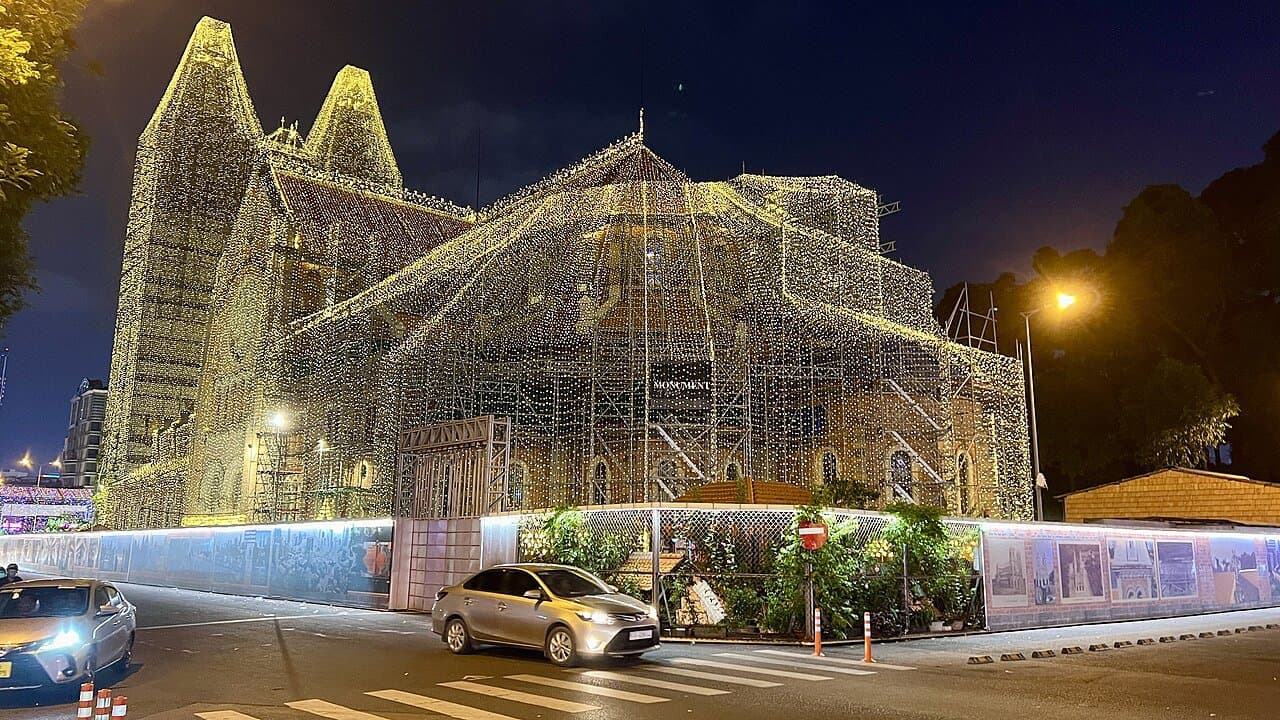
District 1 earns the default status. The Reunification Palace, the Central Post Office, Notre Dame Cathedral, the Bitexco tower, and Ben Thanh Market form a walkable circuit, and nearly every Cu Chi or Mekong day trip picks up here. Mid-range hotels — the $30-120 band — cluster between Ben Thanh and the Dong Khoi corridor, and this is where most first-timers should aim: close enough to walk everywhere, far enough from the bar strip to sleep.
The luxury tier lives here too. Park Hyatt Saigon sits on Lam Son Square by the Opera House, and The Reverie Saigon occupies the upper floors of the Times Square tower on Nguyen Hue — both typically $150-400 a night depending on season, alongside the Caravelle, the Majestic, and a growing crop of five-star newcomers. HCMC luxury remains notably cheaper than the equivalent tier in Singapore or Bangkok.
Ben Thanh vs Bui Vien, honestly
These two anchors sit ten minutes apart on foot and produce completely different stays. The Ben Thanh side gives you the market, the food stalls, and quiet-enough streets after 10pm. Bui Vien Walking Street is the backpacker bar strip — neon, buckets, and speaker stacks that run to roughly 3am on weekends. The strip is genuinely fun if that is the trip you want, but a room directly on it is a sleep-deprivation exercise; even double-glazed windows lose to the bass. The working compromise most backpackers land on: a dorm or budget room one to two blocks off the strip, which keeps the $8-15 dorm pricing and the social scene while cutting most of the noise.
District 3: local Saigon for less
District 3 is the value answer, and the one repeat visitors tend to pick. It borders District 1 to the northwest — the War Remnants Museum technically sits in it — so you are still walking distance from several major sights, but the texture changes: French-era villas, tree-lined streets, office workers at lunch instead of tour groups, and one of the city's strongest cafe scenes. Boutique hotels and minihotels here typically run $25-80, roughly 20-30% below equivalent District 1 comfort.
The eating is the real argument. District 3's com tam counters, noodle shops, and banh mi carts serve locals at local prices, and the neighborhood anchors much of our Saigon street food guide. If your HCMC plan is built around food more than monuments, base here and treat District 1 as a short Grab ride away.
Thao Dien: the long-stay and nomad base
Thao Dien is the expat quarter — leafy streets, international restaurants, and the city's densest cluster of work-friendly cafes and coworking spaces, about 6-7 km east of the centre. Administratively it belongs to Thu Duc City, created in January 2021 by merging Districts 2 and 9 with the old Thu Duc district, though everyone in daily life still says "District 2."
The accommodation logic here is different: fewer conventional hotels, more serviced apartments and apartment-hotels at roughly $40-150 a night, with monthly rates that drop the effective cost well below District 1 equivalents. That is the point — Thao Dien rewards stays measured in weeks. The old objection, that the commute to the sights kills it, has softened: Metro Line 1 opened to passengers on 22 December 2024, and the An Phu and Thao Dien stations now reach Ben Thanh in about 15 minutes. For a first two-to-three-night visit it is still the wrong base; our country-level guide says to skip it "unless you have a specific reason," and a long stay is exactly that reason.
District 5 and Cholon: food-led, not hotel-led
Cholon — the historic Chinese quarter spread across District 5 — is one of the best eating and wandering areas in the city: pagodas, wholesale markets, and dim sum houses that predate the tourism industry. As a place to sleep, it is a niche pick. Tourist-oriented hotels are thin on the ground; what exists is mostly local business hotels in the $20-50 range, functional rather than charming, and the area goes quiet early by Saigon standards. Most travelers do Cholon as a half-day food expedition from a District 1 or District 3 base rather than as a bedroom. Stay here only if you want full immersion in the market economy and do not need an English-speaking front desk.
Phu My Hung: families and business
Phu My Hung, the planned urban zone in District 7, is the opposite of central Saigon: wide sidewalks, parks, malls, international schools, and a large Korean and Japanese community. Hotels run roughly $40-100, skewing toward business and apartment-style properties. For a sightseeing trip it makes little sense — the central sights are a 25-40 minute Grab ride away — but for families settling in for a week or more, or business travelers whose meetings are in D7 itself, the calm and the space are exactly what the center lacks.
What a night costs in 2026
| Area | Budget | Mid-range | Top end |
|---|---|---|---|
| District 1 core | $8-25 dorms and minihotels | $30-120 | $150-400 (Park Hyatt, Reverie tier) |
| District 3 | $10-25 | $25-80 | $90-160 boutique |
| Thao Dien | limited | $40-150 serviced apartments | $150-250 |
| District 5 (Cholon) | $15-30 | $20-50 | few options |
| Phu My Hung (D7) | limited | $40-100 | $120-200 |
Treat the bands as typical direct-website and OTA rates, not promises — HCMC pricing moves 10-20% with season and spikes hard around Tet and the Christmas-New Year window. Booking a week or two ahead is enough outside those peaks; walk-in discounts still exist at the budget end.
Getting in from the airport
Tan Son Nhat sits only 7-8 km from District 1, but traffic stretches the run to 25-45 minutes. A Grab, Be, or Xanh SM car costs roughly 150,000-250,000 VND to any of the central districts; Thao Dien and Phu My Hung run higher and longer. The option-by-option breakdown — including the honest bus routes and the arrivals-hall touts to ignore — is in our Tan Son Nhat to District 1 guide.
Safety, briefly
Where you sleep in HCMC is safe at every band in this guide; the risk lives on the street. Ho Chi Minh City posts the lowest Numbeo safety index of Vietnam's major cities (51.8 in 2026), driven almost entirely by motorbike bag-snatching in District 1 — around Ben Thanh, Notre Dame Cathedral, and the Bui Vien strip. Cross-body bags, phones away from the curb side, and Grab instead of street taxis handle most of it. The street-by-street detail, including hostel-floor specifics for women traveling alone, is in our solo female travel HCMC guide.
Limitations
- Prices are a June-July 2026 snapshot of direct-website and OTA rates at roughly 26,300 VND per USD. Expect 10-20% seasonal movement and sharp spikes for Tet (mid-February in 2026, early February in 2027) and late December — re-check Booking.com and Agoda before committing.
- District labels are in flux. District 2 merged into Thu Duc City in 2021, and Vietnam's 2025 administrative reorganization renamed and merged wards across the city. This guide uses the everyday district names travelers and locals actually say; map apps may show newer ward names.
- Hotel standards shift fast in HCMC. Properties rebrand, change management, and drift within a season — read the most recent ten reviews rather than the aggregate score, and confirm the exact address before booking.
- The safety figure is a single crowd-sourced index (Numbeo). Treat it as directional, and pair it with the practical habits in the solo female HCMC guide rather than reading it as a verdict on the city.