
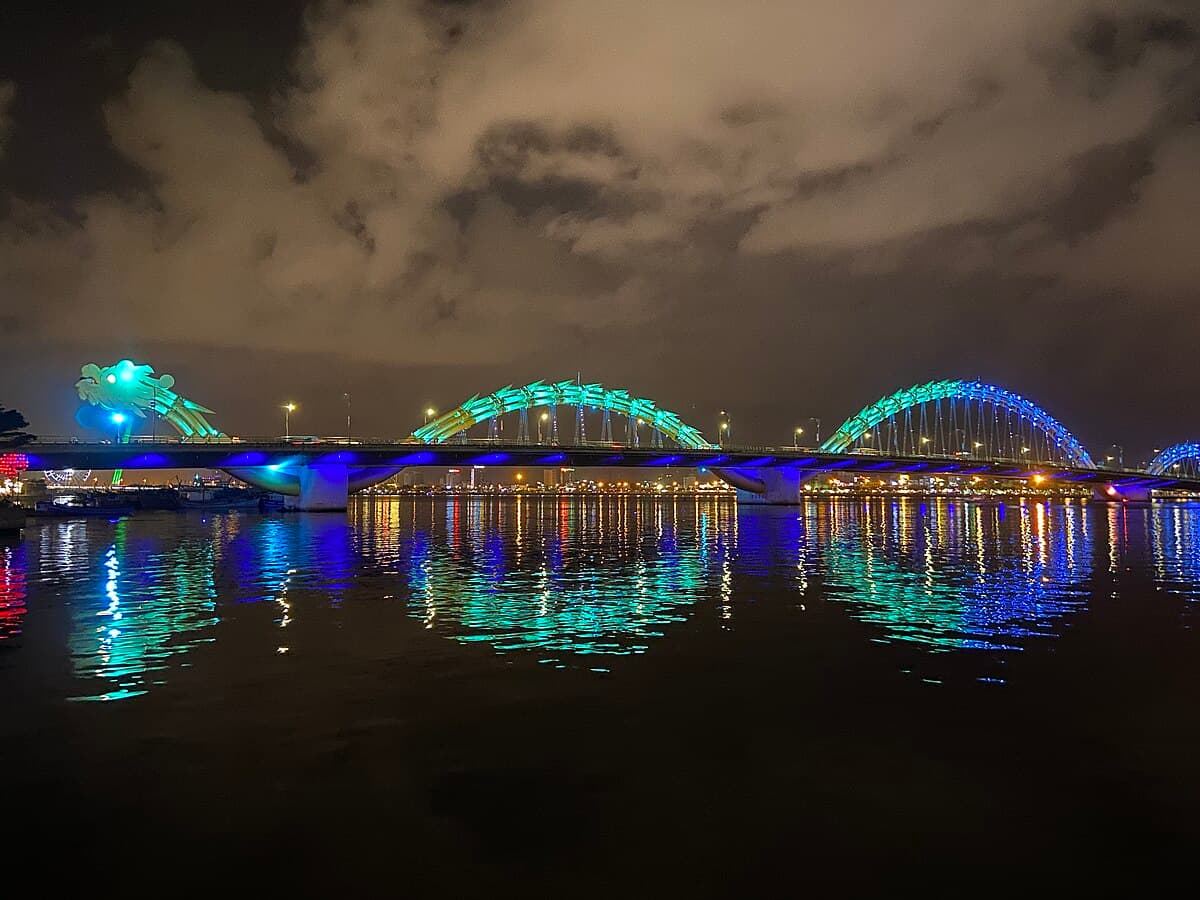
One day in Da Nang is best spent as a city-and-coast day, not a big-attraction day. The realistic version fits Marble Mountains early, My Khe beach and a seafood lunch midday, the Cham Sculpture Museum and a riverside cafe in the afternoon, and the Han River and Dragon Bridge after dark — a full, well-paced day with short hops between stops.
What does not fit: Ba Na Hills and Hoi An each eat a whole day. Ba Na Hills is a cable car, the Golden Bridge, and a 45-minute drive each way — give it its own day and see the Ba Na Hills day trip guide. Hoi An's lantern-lit Old Town is an evening experience that deserves its own night. So this itinerary keeps to Da Nang proper and cross-links the deeper attraction pages rather than cramming them in.
The plan
| Time | Where | What |
|---|---|---|
| 7:00–9:00 a.m. | Marble Mountains | Cave-temples and summit viewpoints before the heat |
| 9:30–11:30 a.m. | My Khe beach | Swim, walk the sand, coffee on the promenade |
| 11:30 a.m.–1:00 p.m. | Beachfront | Seafood lunch |
| 1:00–4:30 p.m. | City center | Cham Sculpture Museum, Han or Con Market, cafe |
| 5:00–6:30 p.m. | Han River | Bach Dang waterfront walk, sunset |
| 7:00 p.m. onward | Dragon Bridge | Dinner, then the fire-and-water show (weekends) |
Morning — Marble Mountains before the heat (7:00–9:00 a.m.)
Start at the Marble Mountains (Ngu Hanh Son), five limestone-and-marble hills about 20 minutes south of the city by Grab (roughly 80,000–120,000 VND / $3–5). Aim to arrive near the 7 a.m. opening: the marble staircases and cave-temples heat up fast and fill with tour groups by mid-morning, so the first hour buys you cooler air, softer light, and a shorter queue for the elevator up the main hill (Thuy Son).
Inside Thuy Son you get Huyen Khong Cave — a cathedral-like chamber with shafts of light from above — plus a cluster of pagodas and two summit viewpoints over the coast. Ninety minutes to two hours is enough for the highlights without a death march up every staircase. Entry is modest (around 40,000 VND, plus the elevator fee if you take it). For the cave-by-cave detail this itinerary skips, see the Marble Mountains day trip guide.
Late morning — My Khe beach (9:30–11:30 a.m.)
From the Marble Mountains, it is a short hop back up the coast to My Khe Beach, the long stretch of soft sand on the eastern edge of the city. This is the easiest swim in central Vietnam — gentle in the dry season, with sun loungers, showers, and a paved promenade — and mornings are calm compared with the late-afternoon local rush.
Swim, walk the sand, or take a coffee at one of the promenade cafes; if you skipped breakfast, an iced Vietnamese coffee (ca phe sua da) and a banh mi from a cart do the job. The sea is roughest in the September-to-December rainy months, when this stop is the first to feel weather.
Midday — seafood lunch (11:30 a.m.–1:00 p.m.)
Da Nang is a seafood city, and lunch belongs on or near the beachfront. The My Khe and Vo Nguyen Giap strip is lined with seafood houses where you pick from tanks and pay by weight — clams, prawns, grouper, and the local favorite, grilled scallops with peanuts and scallion oil. A relaxed seafood lunch runs roughly 200,000–400,000 VND ($8–16) per person.
For something lighter, look for mi quang (turmeric noodles with pork, shrimp, and a crisp rice cracker) or banh xeo (sizzling crepes) — both Da Nang–Quang Nam specialties and a fraction of the seafood price.
Afternoon — Cham Museum, a market, and a cafe (1:00–4:30 p.m.)
Head into the city center, on the western bank of the Han River. The anchor stop is the Museum of Cham Sculpture (Bao tang Dieu khac Cham) — a compact, walkable collection of sandstone Hindu sculpture from the Champa kingdom that once ruled this coast. It is the best indoor stop in Da Nang and a good hour out of the midday heat. Entry is around 60,000 VND.
After the museum, browse a city market for a sense of everyday Da Nang. Han Market (Cho Han) is central and tourist-friendly — dried fish, coffee, fruit, souvenirs. Con Market (Cho Con) is larger and more local, with a dense street-food section if you saved room. Neither needs more than 30 to 45 minutes. Close the afternoon at a riverside or rooftop cafe — an iced coconut coffee over the Han is the right way to wait out the last of the sun.
If you would rather trade the museum-and-market block for the coast, this is the natural place to swap in Son Tra Peninsula: the forested headland north of the city, home to the Lady Buddha (Linh Ung Pagoda), a 67-metre standing Buddha with a panoramic view back over Da Nang. It is a scenic loop by Grab car or motorbike and a strong alternative for a clear afternoon. See the Son Tra Peninsula day trip guide for the loop detail.
Evening — Han River and the Dragon Bridge (5:00 p.m. onward)
As the heat drops, walk the Bach Dang waterfront along the western bank of the Han River. The promenade fills with locals at sunset and the bridges begin to light up. The Dragon Bridge (Cau Rong) — a golden dragon arcing across the river — is the centerpiece, and the Han River Bridge (Cau Song Han), which swivels open late at night, is a short walk north.
Have dinner near the bridge — the eastern, beach-side end has a run of restaurants and bia hoi spots — then stake out a spot for the fire-and-water show. On weekend nights (generally Saturday and Sunday, sometimes Friday) the dragon breathes fire and then sprays water from its head at around 9 p.m. Treat that as a guide, not a guarantee: the days and times shift, so confirm locally on the day, and arrive 20 to 30 minutes early. A slow walk back along the lit waterfront is the natural end to the day.
If you only have a half day
Cut the morning or the afternoon, not the evening:
- Afternoon-and-evening arrival: skip Marble Mountains. Do My Khe beach, a seafood lunch, the Cham Museum, and the Dragon Bridge at night — the better half-day if you land on a midday flight.
- Morning-only: Marble Mountains at opening, then My Khe beach and an early seafood lunch before you move on — useful if you are passing through to Hoi An or Hue in the afternoon.
Either way, the Dragon Bridge weekend show is the one fixed point worth planning around if your half day includes a Saturday or Sunday evening.
Transport and Grab notes
- Grab is enough for one day. Both Grab car and GrabBike are cheap and cover every stop in short 5-to-20-minute hops. Most city rides are 30,000–120,000 VND ($1–5).
- From Da Nang Airport (DAD), the city center and beach are 10 to 15 minutes by Grab (around 80,000–150,000 VND / $3–6) — one of the most convenient airports in Vietnam.
- A rented motorbike ($6–10/day) is worth it only for the Son Tra coastal loop; for the core city plan it adds parking hassle without much upside.
- Walking covers the Bach Dang waterfront, the central markets, and the museum once you are downtown.
Where this fits in a bigger trip
A single Da Nang day rarely stands alone — it is usually the central hinge of a Vietnam route between the north and the south. If you are building a longer trip, treat this as one city day and add the big attractions as their own days around it: Ba Na Hills on a second day, Hoi An on a third with an overnight.
Da Nang is the natural mid-trip stop after the north — see how it follows the 5 days in North Vietnam itinerary, or where it sits inside the full country route in the 14 days in Vietnam itinerary. For more on the city itself, the Da Nang city guide has the wider context.
Limitations
This is a fair-weather, outdoor-heavy plan. The beach, the Marble Mountains climb, the waterfront walk, and the Dragon Bridge are all exposed, so a rainy day — most likely September to December, when central Vietnam sees its heaviest rain and occasional typhoons — can wash out half of it. Workaround: lean indoors (the Cham Museum, the covered markets, a long cafe afternoon) and treat the beach and bridge as optional.
The Dragon Bridge fire-and-water show is not nightly. It generally runs on weekend evenings only, and the days and start time genuinely vary through the year. Workaround: if the show is a priority, plan your Da Nang day for a Saturday or Sunday and confirm the time locally that day; if you are in town midweek, the bridge is still worth seeing lit, just without the fire.
Finally, one day cannot also be a Ba Na Hills day or a Hoi An day. Each of those is a separate full day with its own logistics, and forcing them in compresses everything. Workaround: if either matters more than the city itself, give it its own day — see the Ba Na Hills day trip guide — and run this city itinerary on a different day.