
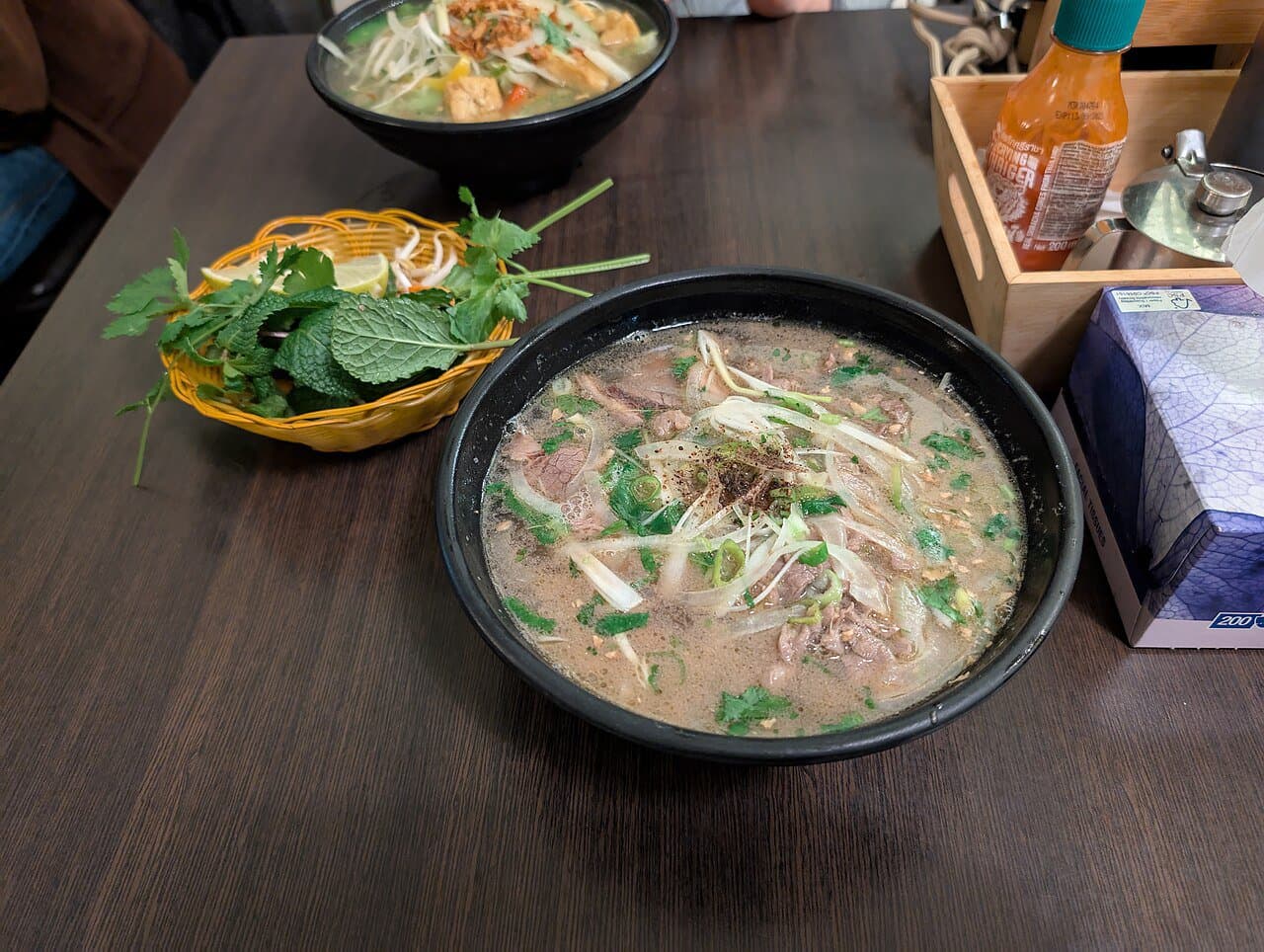
In October 2025, Hoang Thi Huong, Mai Thi Chau Lan, and Nguyen Thi Phuong Lien published "Research on the Factors Influencing Consumers' Spending on Street Food in Hanoi" in the International Journal of Research and Innovation in Social Science (IJRISS). The study is one of the most quantitatively rigorous consumer-behaviour analyses of Hanoi's street-food market we've found — and its findings have direct implications for how anyone, local or visitor, should choose which stalls to spend at.
The short version: quality wins, price matters roughly as much, income matters less than you'd think, and food safety is a threshold rather than a spending driver.
What the study did
Method
- Sample: 306 valid responses from Hanoi consumers (residents, not tourists).
- Analysis stack: Cronbach's Alpha for reliability → Exploratory Factor Analysis (EFA) → Pearson correlation → OLS regression for the final model.
- Model fit: R² = 0.551 (54.5% of variance in spending explained by the four factors).
- Diagnostic checks: VIF < 2 (no multicollinearity), Durbin-Watson = 1.693 (no serial correlation). This is a clean regression.
The four factors and their impact
The regression coefficients (standardised β) tell you the relative pull of each factor on spending:
| Rank | Factor | β (standardised) | Interpretation |
|---|---|---|---|
| 1 | Food quality | 0.343 | The strongest driver — perceived quality is worth more than any other single input |
| 2 | Price | 0.325 | Close second — value for money is nearly as strong as quality |
| 3 | Income | 0.219 | Matters, but less than quality or price — higher-income locals don't automatically spend more on street food |
| 4 | Food safety | 0.208 | Enables spending but doesn't drive it — safety is a filter, not an accelerator |
The regression equation (paraphrased from the paper):
Spending = 0.343 × Quality + 0.325 × Price + 0.219 × Income + 0.208 × Food Safety
Main conclusions
The authors' three big takeaways:
- Consumers prioritise perceived quality and value over their own income. A lower-income Hanoian will still spend meaningful money on a stall rated high on quality; conversely, a higher-income consumer won't automatically spend more on a mediocre stall.
- Food safety functions as an enabler, not a primary driver. If safety is suspect, consumers opt out of the stall entirely. Once it's met, further spending is driven by quality and price.
- Policy recommendations: vendors should emphasise fresh ingredients and menu consistency; municipal authorities should establish clearer food-safety training and pricing guidelines; street food should be promoted as cultural heritage, not tolerated as informal commerce.
What this means for your trip
1. "Best street food" lists fail because they optimise for the wrong thing
Many Hanoi street-food articles you'll read online rank stalls by novelty, media coverage, or Instagram aesthetic. The study says these inputs don't strongly predict where locals actually spend. Quality is the highest-beta factor, and quality is mostly measured by consistency and repeat-visit behaviour — things that don't photograph well.
A practical substitute: note where the same person serves the same core dish year after year. Neighborhood stalls that have been in the same spot for 10+ years with the same cook are the statistically high-quality option, even if they're not on any travel list.
2. Don't over-weight price (in either direction)
The β coefficients show price nearly as important as quality (0.325 vs 0.343). But the sign of the relationship isn't "cheaper = more spending" or "expensive = more spending" — it's about perceived value for money. Two useful applications:
- Don't default to cheapest. A stall selling pho at 60,000 VND ($2.40) in a street where comparable stalls are 85,000 VND ($3.40) is a warning — the cost has been cut somewhere visible or invisible. Match price to neighborhood.
- Don't overpay for decor. A stall with café-style tables and a menu board in English at 150,000 VND ($6) pho is usually pricing for tourists; locals aren't repeat-visiting at that tier.
3. The "locals eat here" heuristic holds — within limits
Because quality and price are the top two drivers of local spending, the stalls locals actually repeat-visit are statistically the quality-price optimum. The well-known shortcut of "watch for a stall with a line of locals" maps directly onto the study's findings.
The failure mode: a stall that gets a big social-media boost can become temporarily dominated by non-local queuers. When that happens, the stall often compromises (smaller portions at same price, rushed preparation, ingredient-cost cuts) and locals stop returning. A stall with a long line of international visitors but no visible local regulars is a warning sign, not a recommendation.
4. Food safety is a threshold; apply a simple screen
The study's β = 0.208 for food safety isn't saying food safety doesn't matter — it's saying it filters out stalls rather than differentiating between acceptable ones. Visitor-friendly threshold checks:
- High turnover. Stalls that sell out by early afternoon have cycled fresh ingredients that morning.
- Visible prep. A cook assembling the dish in front of you reveals how the meat is handled, how long the broth has been on heat, whether vegetables are fresh or pre-chopped.
- Hot food is hot. Soups at genuine boiling temperature, grilled items cooked to order. Tepid food in food-safety terms is the main risk factor.
- Water & ice. Bottled water, canned drinks, and factory-ice are all low-risk; tap water or loose ice at a very informal setup is the single most common avoidable source of travel stomach issues.
5. Hanoi street food is cultural heritage — spend like it
The paper's final policy recommendation — that street food should be promoted as cultural heritage, not tolerated as informal commerce — is worth noting as a visitor. Hanoi was named Asia's best emerging culinary city in 2023 and the world's best culinary city in 2024 by major industry awards. The street-food scene is the single biggest reason.
Practical: spend deliberately at legacy stalls (Pho Gia Truyen, Pho Thin, Bun Cha Huong Lien, Bun Bo Nam Bo on Hang Dieu). A 90,000–120,000 VND meal ($3.60–$4.80) is reasonable pricing that sustains a cook's craft. Cutting corners to find 60,000 VND versions of the same dishes mostly reaches the stalls that will not be there in five years.
Limitations & caveats
- 306 respondents is adequate for a consumer-behavior regression, but it's Hanoi residents only — not tourists. Visitor spending patterns may differ, particularly at tourist-area stalls.
- R² = 0.551 means the model explains 55% of variance — a useful model, but roughly 45% of spending variation comes from factors the survey didn't capture (habit, location proximity, weather, social context).
- "Spending" is self-reported. The study didn't do actual POS-level spending observation; it measured what consumers said they spent under surveyed conditions.
- Published in IJRISS, which is a peer-reviewed journal but not a top-tier indexed one. The methodology is sound for a consumer-behavior study; a replication in a Tier-1 journal (e.g., Food Policy, Tourism Management) would strengthen confidence.
- The study doesn't address tourist-specific behaviour. Our visitor-facing recommendations extend the findings' implications — they aren't drawn directly from the paper.
Sources & further reading
- Primary source: Hoang, T. H., Mai, T. C. L. & Nguyen, T. P. L. (2025). Research on the Factors Influencing Consumers' Spending on Street Food in Hanoi. International Journal of Research and Innovation in Social Science, published October 10, 2025.
- Related: Hoi An food-system transformation (Food, Culture & Society, peer-reviewed) — a complementary study on Vietnam's UNESCO-site food tourism.
- RMIT University — Reinventing street food safety in Vietnam — institutional commentary on safety improvements.
Related on this site:
- Hanoi destination guide — where to base, how long to stay
- Hoi An cooking class day tour — a structured way into Vietnamese cuisine
- Booking.com 2025 Vietnamese traveller survey — complementary consumer-behaviour data