
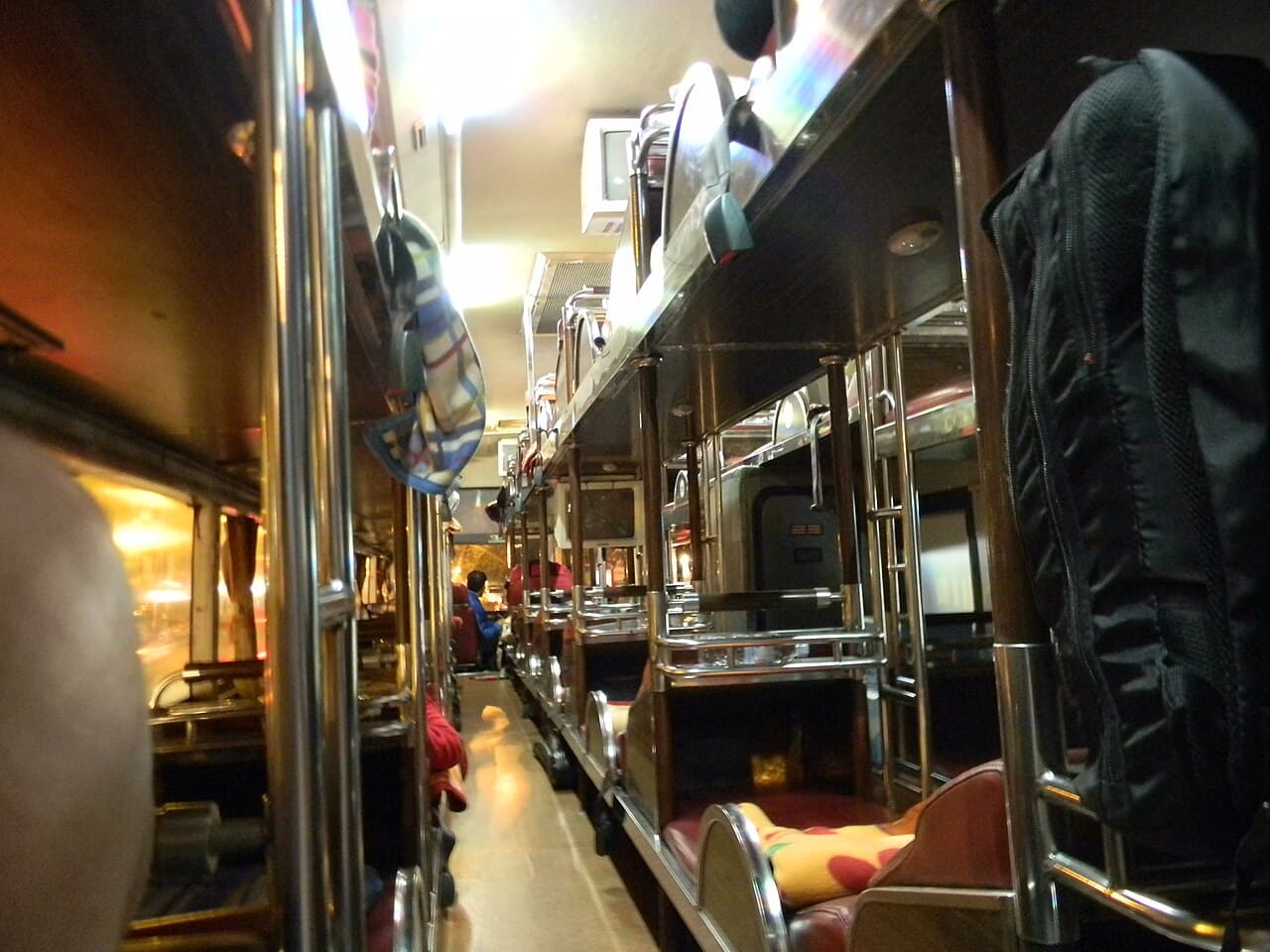
The sleeper bus is the backbone of Vietnamese long-distance travel. It's how locals move, how backpackers compress a two-week trip into reality, and how you save the cost of a hotel night. It's also the mode with the most visible downsides — petty theft, variable build quality, and a handful of imposter operators. The trick is knowing which buses to get on.
What is a Vietnamese sleeper bus?
It's a modified coach with three rows of reclining pod seats stacked in two tiers — so roughly 40 sleeping berths instead of 45 upright ones. Each pod has:
- A reclining back (to around 160 degrees)
- A footwell that tucks under the seat in front
- A small USB port
- A thin blanket and sometimes a bottle of water
Aircon is universal. Wifi is advertised but rarely works. Toilets exist on some buses but are routinely locked; rest stops every 3–4 hours are the real bathroom plan.
Which sleeper bus companies are worth using?
Two operators cover most tourist routes reliably:
- Futa Bus (Phuong Trang) — the largest operator. Orange fleet, strong on southern and central routes, punctual, and runs to its own stations rather than street pickups. The default choice in Ho Chi Minh City, Da Nang, and the Mekong.
- The Sinh Tourist — the veteran backpacker operator. Covers the Hanoi–Hue–Hoi An–Nha Trang–Ho Chi Minh City corridor with the classic "open ticket" model.
Regional operators worth knowing:
- Hanh Cafe and Queen Cafe — similar to Sinh on the tourist corridor
- Hoang Long — central Vietnam routes, including Ninh Binh
- Kumho Samco — HCMC to Cambodia (Phnom Penh) and southern domestic
How much do sleeper bus tickets cost?
Typical 2026 fares:
| Route | Duration | Typical fare (VND) |
|---|---|---|
| Hanoi to Hue | 12–14h | 400,000–550,000 |
| Hanoi to Hoi An | 15–17h | 450,000–600,000 |
| Hue to Hoi An | 4h | 150,000–200,000 |
| Nha Trang to Mui Ne | 4–5h | 180,000–250,000 |
| Ho Chi Minh City to Mui Ne | 4–5h | 200,000–280,000 |
| Ho Chi Minh City to Da Nang | 18–20h | 500,000–700,000 |
Pay in cash at the bus office or online via Vexere, 12go, or Baolau. Foreign cards work on all three.
What's the sleeper bus experience actually like?
A typical overnight:
- Arrive at the bus station 20–30 minutes before departure.
- Remove shoes at the door, hand them into a plastic bag.
- Staff directs you to a pod. Lower-tier pods are slightly roomier; upper tiers give you a window view.
- Lights go off around 10pm. A movie may play on screens above the aisle.
- Rest stops at 2–3am for 15–20 minutes — dubious noodles, decent toilets.
- Arrival 5–7am, often before dawn, sometimes at a station 15 minutes from the actual city centre.
What are the gotchas?
Theft is the number-one complaint. Phones get lifted from overhead racks, wallets from bags stashed in the hold. Mitigations that work:
- Keep your passport, cards, and phone in a small bag clipped to your body while you sleep
- Put your backpack between your feet in the footwell, not above you
- Use a cable lock on your main luggage in the hold
Fake offices exist. In Hanoi's Old Quarter, several storefronts on Hang Bac and Ma May streets imitate the Sinh Tourist branding. They sell you a ticket that's either overpriced, on a worse bus, or sometimes not honoured. Book direct on thesinhtourist.vn, or use 12go/Baolau. Our Vietnam scams guide covers the pattern in detail.
Drivers drive hard. Vietnamese highways are improving, but sleeper buses still brake and accelerate aggressively. Motion sickness is real. Avoid front-row pods if you're prone.
Pickup point confusion. "Hanoi" as a destination might mean Giap Bat station in the south of the city, My Dinh in the west, or Nuoc Ngam out east — depending on which province you're coming from. Confirm the drop-off, and open Grab before you leave the coach.
When should I take a sleeper bus versus a train or flight?
- Cheapest overnight, same result: sleeper bus beats the train on price by 30–50%.
- You want to actually sleep well: train in a soft sleeper.
- You're going more than 800 km: fly.
- Your route doesn't have a train line (e.g. Mui Ne, Dalat, or Phu Quoc's mainland connection): bus is the only overland option.
Sleeper buses are a tool, not a personality test. Used on the right legs — typically Hanoi to Hoi An or Ho Chi Minh City to Mui Ne — they're a cheap, efficient part of getting around Vietnam.
Limitations
Vietnamese sleeper buses have a documented mixed safety record — long-haul overnight services in particular have meaningful operator-quality variation, with budget operators historically the worst for both safety and punctuality. Workaround: stick to the established reputational operators (FUTA, Sapa Express, The Sinh Tourist, Inter-Bus Lines, Vietnam Backpackers' bus arm) at the mid-tier price point ($25-40 for overnight); avoid the cheapest curb-side budget buses for overnight runs. For routes where flights are cheap ($40-80), the safety and time-saving math usually favours flying.
The "VIP cabin" tier (single-passenger enclosed cabin sleeper buses, introduced from 2018 onwards) is meaningfully more comfortable than the older 3-row 40-passenger sleeper buses, but availability is limited on some routes. Workaround: check both VIP-cabin and standard-sleeper options when booking; on the Hanoi-Sapa and Hanoi-Da Nang routes, VIP-cabin availability is generally good 24-48 hours ahead; on smaller routes the older fleet may be the only option. The price premium ($10-15 extra) is worth it for any overnight run.