
Vietnam and Japan end up on the same shortlist more often than they should. They share a region, a rough flight time from Europe or North America, and a reputation for extraordinary food. Almost nothing else matches — not the price, not the pace, not the planning burden.
This page is written by a Vietnam site, so treat this as a promise: Japan wins several of these categories outright, and where it does, we say so.
The 90-second answer
- Pick Japan if you want rail that works to the second, heritage in extraordinary depth, four dramatic seasons, spotless infrastructure, the highest culinary ceiling in the world, or a first Asian trip with no friction.
- Pick Vietnam if budget is a real constraint, you want beaches attached to your cities, you prefer improvising to booking, you want a longer trip for the same money, or you would rather be somewhere not yet fighting its own visitor numbers.
The tiebreaker is almost always money. Japan costs roughly double per day, and more than double once long-distance rail is counted.
By the numbers
| Vietnam | Japan | |
|---|---|---|
| International visitors, 2025 | 21.2 million (up 20.4%) | 42.68 million (up 15.8%) |
| Backpacker budget per day | $30-50 | 8,000-12,000 yen (about $50-75) |
| Mid-range budget per day | $80-150 | 15,000-25,000 yen (about $95-155) |
| Cheap hot meal | Pho $2, banh mi $1.50 | Ramen 900-1,200 yen |
| Flagship long-distance leg | Hanoi to Da Nang berth, about $45 | Tokyo to Osaka shinkansen, 14,720 yen |
| Rail pass | none needed | JR Pass 7-day, 50,000 yen to 53,000 from 1 Oct 2026 |
| Visa | 90-day e-visa, all nationalities, $25 | 90 days visa-free, about 71 countries |
| EF English Index 2025 | 500 | 446, ranked 96th, "very low proficiency" |
| Currency, August 2026 | about 26,000 VND per USD | about 160 yen per USD |
All figures are current as of mid-2026 and the conversions move.
Cost — the single biggest differentiator
The honest framing: Japan is not expensive by developed-world standards, but Vietnam is genuinely cheap by any standard.
Vietnam's tiers, as of mid-2026: backpacker $30-50 a day, mid-range $80-150, comfort $200-350. A dorm bed is $8-15, three street-food meals plus coffee $10-18, bia hoi 8,000-15,000 VND a glass.
Japan's tiers: a frugal traveller can hold 6,000-10,000 yen a day, though 8,000-12,000 is the realistic backpacker figure; mid-range is 15,000-25,000 yen, comfortable 30,000-50,000. A hostel dorm is 2,500-4,000 yen, a business hotel 8,000-14,000, a ryokan with dinner and breakfast 15,000-35,000 per person. Convenience store food is 500-800 yen and genuinely good, ramen 900-1,200, izakaya dinner 2,500-4,500.
The weak yen has softened this — at around 160 yen to the dollar, ground costs are friendlier than a decade ago. But the gap is still close to double at every tier, and it widens on what Japan is famous for.
Long-distance rail is where a Japan budget breaks. One Tokyo to Osaka shinkansen seat is about 14,720 yen, roughly $92, and the nationwide 7-day JR Pass is 50,000 yen, rising to 53,000 on 1 October 2026. A two-week trip with real movement adds several hundred dollars of rail with no Vietnamese equivalent — the same distances cost $12-25 by sleeper bus or $25-45 for a soft-sleeper berth.
Two weeks in Vietnam at mid-range runs roughly $1,400-2,800 excluding flights; two weeks in Japan at the equivalent standard runs closer to $2,500-4,500 once rail is in. More context sits in our Southeast Asia cost comparison and the Vietnam budget guide.
Rail and getting around — Japan, decisively
Japan's railway is the best argument for the whole trip. The shinkansen runs at up to 320 km/h, delays are measured in seconds, and it turns the country into a series of day-hops: Tokyo to Kyoto in about two and a quarter hours, Kyoto to Hiroshima in under two. Stations are signposted in English, IC cards work nationwide, and an itinerary can change daily without you wondering how you will physically get there.
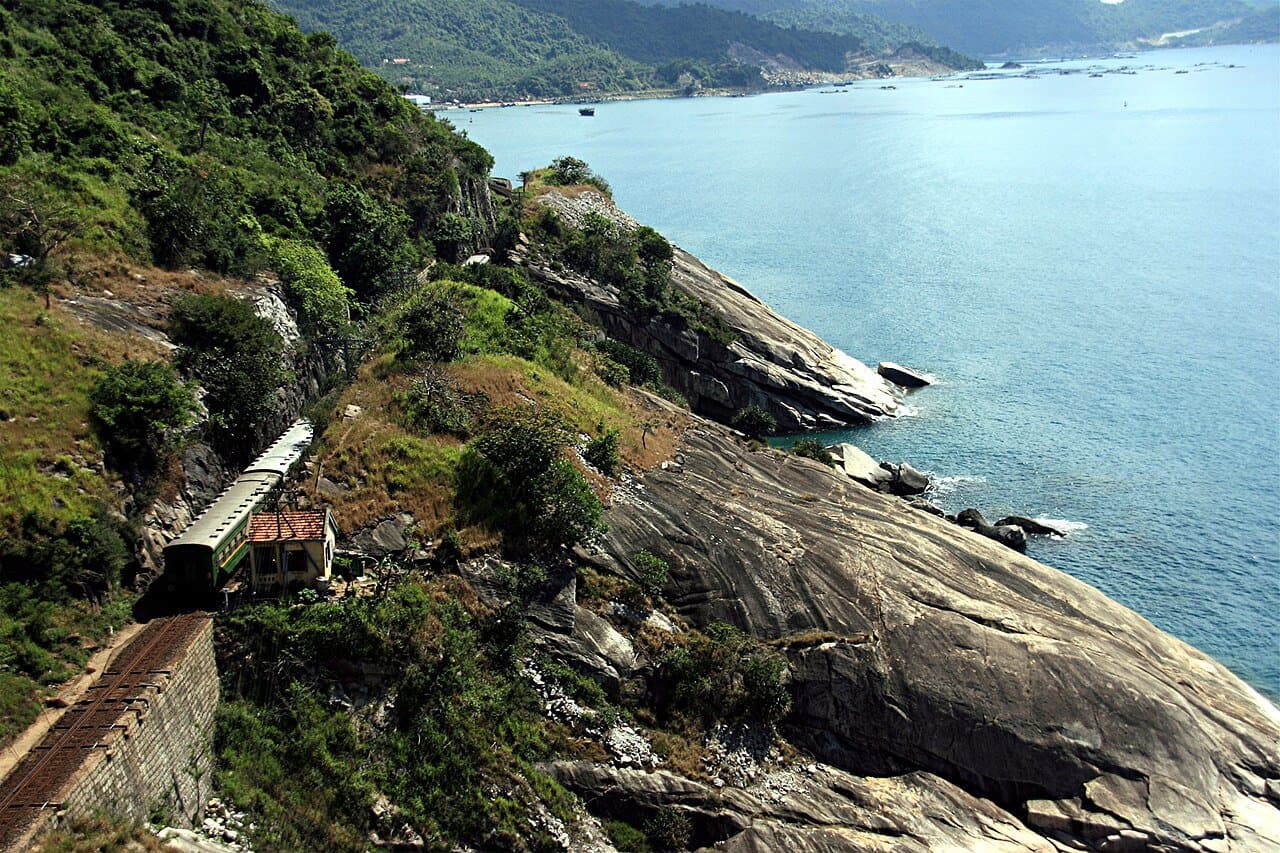
Vietnam's Reunification Express is a single 1,650 km coastal line, and it is slow — Hanoi to Ho Chi Minh City takes over thirty hours. What it has is price and scenery: the Hai Van Pass section between Hue and Da Nang is one of the great train windows in Asia. Vietnam's real network is the sleeper bus — cheap, ubiquitous, bookable the same day.
Japan's transport is a reason to go; Vietnam's is why the trip is affordable.
Food
Both are food destinations and it would be dishonest to score this as one winner.
Japan owns the ceiling. Tokyo has led the world's Michelin star count since its guide launched in 2007, and the depth of specialisation — a shop that has made one thing for four generations — is not replicated anywhere. The floor is high too: a convenience store onigiri or a 1,000-yen ramen is reliably excellent.
Vietnam owns the value and the variation. Street food is the national cuisine rather than a subculture, a full meal costs $2, and the regional shift is dramatic — northern pho, Hue's chilli-heavy court cooking, southern sweetness, inside 1,650 km. The 2026 Michelin Guide for Hanoi, Ho Chi Minh City and Da Nang listed 193 establishments with 11 stars.
For the single best meal of your life, book Japan. For three hundred very good ones at the price of ten, book Vietnam.
Seasons and when each is at its best
Japan has the more legible calendar and the more dramatic one. Late March to early April brings cherry blossom; late November delivers autumn colour; winter brings some of the best skiing in the world in Hokkaido and Nagano. Summer is hot and humid, and June carries a rainy season. The catch is that Japan's two best windows are also its most crowded and most expensive.
Vietnam has no single answer because it spans 1,650 km of latitude. The north is best October to April, the centre March to August, the south December to April. Central Vietnam's coast is unusable for swimming from September to December. That mostly is not a disadvantage — some region is always in season, so the trip fits your calendar rather than the country's.
Japan is better if you can travel in a specific window and want the country at its most spectacular. Vietnam is better if your dates are fixed.
Visas and entry
Both are straightforward for most Western passports. Japan grants visa-free entry of up to 90 days to citizens of roughly 71 countries, with no advance form as of mid-2026. JESTA, its planned electronic travel authorisation, got its legal basis in May 2026 but is targeted for fiscal 2028, so it will not affect 2026 or 2027 trips.
Vietnam is more generous on paper: a 90-day e-visa open to all nationalities at $25 single-entry or $50 multiple-entry, plus 45-day visa-free entry for a long list of nationalities including many Europeans as well as Japan and South Korea. The overhead is slightly higher — a digital arrival card requirement has been rolling out at major airports. Detail sits in our Vietnam visa atlas. For a two-week trip this is close to a tie; past 90 days, Vietnam is easier.
English and ease of navigation
This is the result that catches people out. On the 2025 EF English Proficiency Index, Vietnam scored 500. Japan scored 446, ranking 96th globally — its lowest placing since the index began, its eleventh consecutive slide, and inside EF's bottom "very low proficiency" band.
That does not make Japan hard to navigate, because Japan solves the problem structurally: bilingual signage, English rail apps, ticket machines with language toggles. Vietnam solves it socially — younger urban Vietnamese in tourism speak workable English and will engage directly.
In Japan you rarely have a conversation but never get lost. In Vietnam you get lost and someone talks you out of it.
Crowds and overtourism
Japan's numbers have gone somewhere new. It received 42.68 million international visitors in 2025, up 15.8 percent on 2024 and more than ten million above the 2019 peak, with foreign spending at a record 9.5 trillion yen. Kyoto alone absorbed 12.68 million, up 17 percent.
The city is responding fiscally: from 1 March 2026 Kyoto's lodging tax rises steeply, reaching 10,000 yen a night on rooms priced above 100,000 yen, roughly a tenfold increase at the top end. Mount Fuji has moved to entry fees and timed slots. Sensible measures, but they signal a destination managing demand rather than courting it.
Vietnam's 21.2 million arrivals were a record too, and Hoi An, Ha Long Bay and Sapa are crowded in season. But the pressure is nothing like Kyoto's, and one province sideways still finds quiet.
Nature, beaches and heritage
Beaches and coast go to Vietnam on the mainland comparison. Around 3,260 km of coastline puts swimmable water beside most major cities, and Phu Quoc, Con Dao, Quy Nhon and Da Nang are all real beach destinations. Add Ha Long Bay's karst seascape and Phong Nha's caves, including the largest known cave passage on earth.
The honest caveat: Okinawa beats all of it. Japan's southern islands have clearer water and better reefs than anything in Vietnam. They are also a separate flight and budget, and not part of a standard Japan itinerary.
Heritage goes to Japan. Its UNESCO World Heritage list runs into the mid-twenties against Vietnam's nine, and Kyoto and Nara hold more preserved historical architecture than any Vietnamese city. Vietnam's heritage — Hue's citadel, Hoi An, My Son — is genuine and often more atmospheric for being less polished, but the depth is not comparable.
Mountains and forest are closer than people assume. Japan's Alps, Nikko and Yakushima are world-class; Ha Giang and Sapa are less developed and cheaper to explore.
Pick each if
Pick Japan if: it is your first Asian trip and you want zero friction; rail is central to how you travel; you want the highest culinary ceiling on earth; cherry blossom or autumn colour is the point; you want deep heritage; or you can absorb roughly double the daily cost.
Pick Vietnam if: budget is the binding constraint; you want a longer trip for the same money; beaches matter; you would rather improvise than book; you want somewhere short of Kyoto's crowd pressure; you plan to stay past 90 days; or you want street food as the daily default. Our 14-day Vietnam itinerary shows what that looks like.
Still stuck? Ask what would ruin the trip. Running out of money halfway, take Vietnam. Heat, chaos or a bad night on a bus, take Japan.
Limitations
Cost comparisons across two currencies are the weakest part of any page like this. Japanese figures here are in yen and Vietnamese ones in dollars, converted at roughly 160 yen and 26,000 dong to the dollar as of mid-2026. Both rates move, and the yen has swung widely — a stronger yen would narrow the gap materially.
Daily-budget tiers are ranges built from typical spending patterns, not measured averages, and they exclude international flights and insurance. Japan's rail costs are most likely to change: the JR Pass increase on 1 October 2026 is confirmed, but regional passes and reservation rules have changed more than once recently.
Arrival figures are annual national statistics and say nothing about the week you travel. Visa rules are the fastest-moving item here and the one with the highest cost of being wrong — verify both countries' current requirements with an official source before booking, rather than trusting any published summary, this one included.