
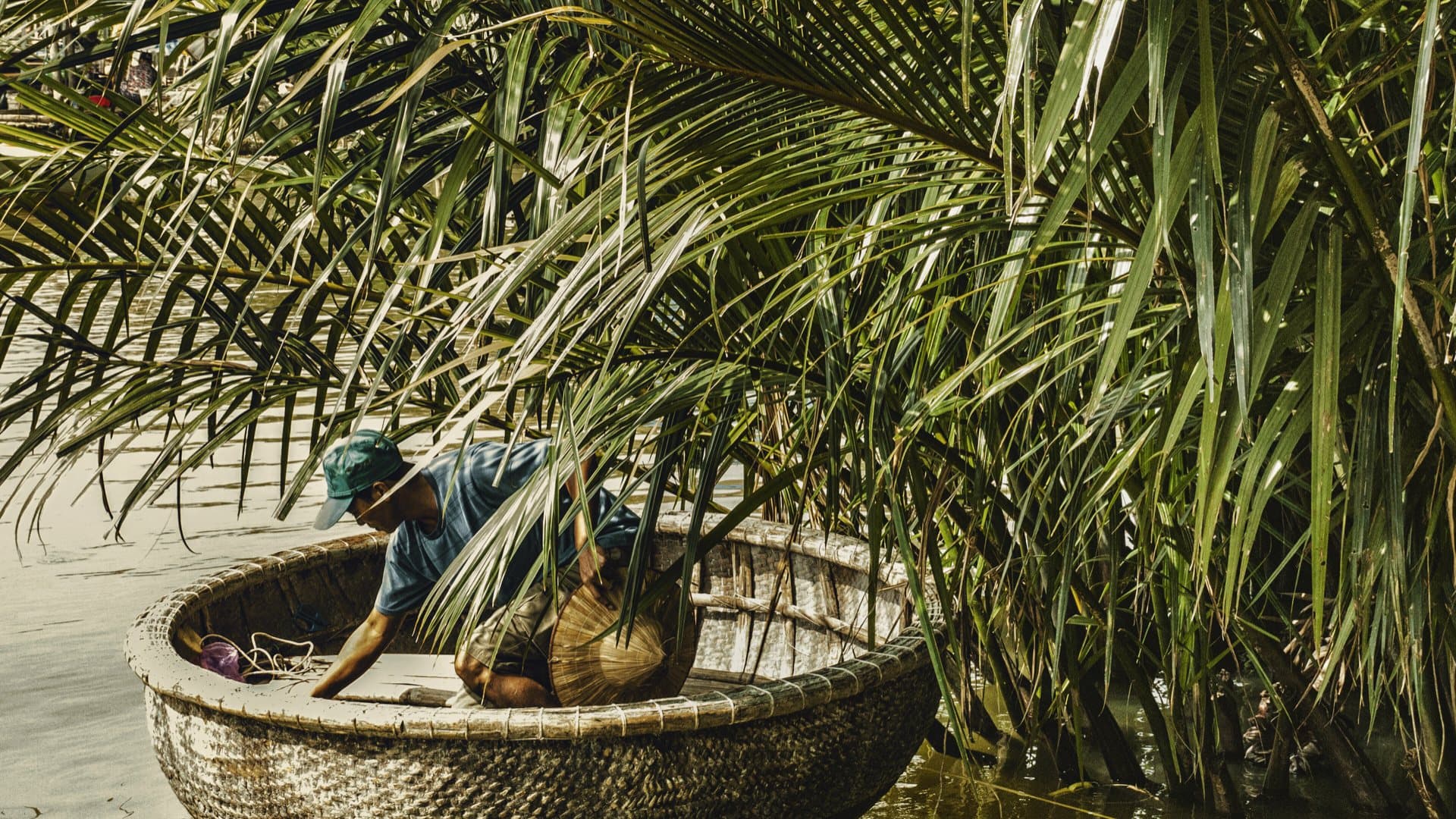
The Bay Mau coconut forest at Cam Thanh, 3 to 5 km from Hoi An's old town, is a wetland of nipa palms threaded with narrow channels, where local boatmen take visitors out in round basket boats, called thung chai, and spin them in the water. It is one of the most popular half-day trips from Hoi An: fun, cheap and genuinely local, but also crowded and noisy at peak times. Go early or late, and ask for a quiet route.
The forest lies in the buffer zone of the Cu Lao Cham-Hoi An UNESCO biosphere reserve and covers roughly 80 to 100 ha, depending on the source. Since the 2025 reforms, when Quang Nam province merged into Da Nang, it has been part of Hoi An Dong ward, Da Nang city.
Getting there from Hoi An
- By bicycle: about 5 km on flat roads from the old town, heading towards the Cua Dai bridge.
- By Grab or taxi: about 10 to 15 minutes. Agents quote private cars at about 250,000 VND one way for a 4-seater.
- By boat: boats leave from Bach Dang wharf in the old town and follow the Hoai River about 5 km east. A new state-built boat landing, Thanh Tam wharf, opened in October 2025.
- On a tour: agents and booking sites sell the basket boat with a transfer from Hoi An or Da Nang, often combined with a cooking class.
What it costs
Entry. Visitors pay a fee of 30,000 VND per person, charged since December 2017 under a Hoi An city decision. In May 2026, Da Nang published a draft resolution to keep the fee at the same level; two extra ticket booths opened in June 2026 to cut queues.
The basket boat. Boat prices are not officially regulated. When Da Nang's tourism department inspected the site in May 2026, it found boats charging about 150,000 VND for two people for a ride of about 40 minutes, and no unreasonable pricing, as Tuoi Tre reported, but many operators did not post price lists, and some higher prices came from hotel and agent mark-ups. Booking sites and agents quote about 150,000 to 280,000 VND per boat, and one charges foreigners more than Vietnamese. Filming on the boat can cost extra, about 100,000 VND per person.
Agree the price, the length of the ride and what is included before you get in.
What you'll see
A boatman paddles your basket boat through the water-palm channels, stopping for demonstrations along the way:
- The spin. The boatman rocks and spins the round boat in the water, fast enough to make most passengers shriek.
- Net casting and crab catching. A demonstration of throwing a fishing net, and a chance to catch crabs in the palm roots.
- Coconut-leaf crafts. Small toys, rings and grasshoppers woven from palm leaves.
- Performances. On some routes, groups of boatmen sing traditional songs and dance in their boats, often amplified.
Rides last about 40 to 60 minutes. Wear the life jacket and conical hat provided, keep phones in a waterproof pouch, and expect to get a little wet.
The crowds and the noise
The forest's popularity has soared since it appeared on Korean television. It receives about a million visitors a year; by 20 May 2026 it had already recorded nearly 700,000, 80% of them foreign, and on 30 April-1 May 2026 it sold 8,000 tickets in a single day, about twice as many as Hoi An's old town at times. In 2022, about 1,200 basket boats were registered for tourists.
The main complaint is noise: portable karaoke speakers on boats and at gathering points. In May 2026, the authorities told operators to turn down the amplified singing and hold performances at set spots away from homes, and they now deploy staff for crowd control and anti-fraud patrols. A plan approved in February 2025 created 17 official routes, including 7 through the lively central area and 6 for visitors who want quiet. Ask for a quiet route when you book.
History
The forest stands where the Thu Bon, Truong Giang and Co Co rivers meet, and its dense palms made it a base for local guerrillas in both the war against the French and the war against the Americans, who called them the Viet Cong. Hoi An's heritage centre records battles there in 1948, 1966 and 1967, and it was recognised as a provincial historic relic in 2007.
When to go
- Time of day: between about 7:00 and 9:00, or after 15:00, for cooler air, softer light and fewer groups. The site is open from about 7:00 to 17:00.
- Season: the dry season, from about February to August, is best. From October to December, Hoi An's flood season, boats may not run in storms and high water; our Da Nang and Hoi An weather guide explains the seasons.
- Days: avoid weekends and Vietnamese holidays if you can.
Who it's for
The coconut forest suits families, first-time visitors and anyone looking for a light, fun half-day. It pairs well with a morning cooking class; our cooking class day tour covers the options. For more ideas, see our day trips from Hoi An guide, and for the old town at night, our Hoi An lantern festival guide. Our 3 days in Hoi An itinerary shows how it fits a longer stay.
Limitations
The entry fee is official, but basket boat prices are not regulated and vary by operator and agent; the May 2026 inspection figure is a guide, not a fixed price. We could not confirm whether Da Nang adopted its 2026 fee resolution. Visitor numbers and the noise situation change with the season and enforcement.
Workaround: agree the boat price and length before boarding, ask for a quiet route, and go early or late in the day.