
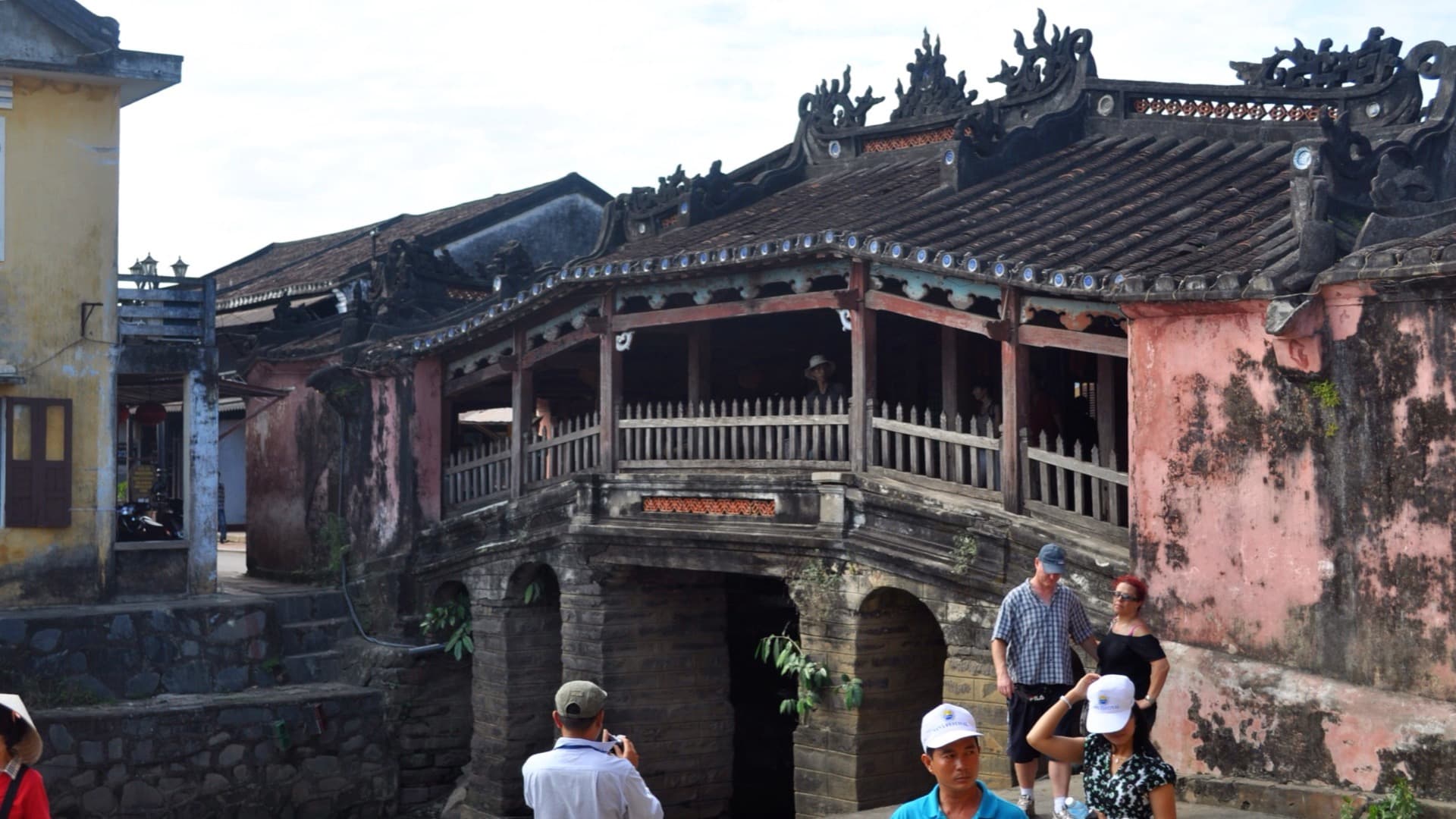
Three days is the right length for Hoi An. Two days covers the Old Town and one beach afternoon but forces a straight choice between My Son and the craft villages. Four days is pleasant and starts to become a beach holiday with a heritage town attached. Three gives you the Old Town properly, a full day split between sand and rice paddies, and one early morning at the Cham ruins — and it is the shortest trip on which a tailor order actually works.
This plan is for couples, pairs of friends and solo travellers, and it assumes a bicycle on the middle day. If you are coming with children, our family-friendly Hoi An itinerary runs a slower shape built around workshops, pool time and family hotels; this one does not repeat it.
Day 1 — The Old Town
Buy the ticket, but understand what it is. The Old Town heritage ticket costs 120,000 VND, about $5 as of mid-2026, is valid for 24 hours, and admits you to five ticketed sites chosen from a longer list of museum-houses, Chinese assembly halls, small museums and the Japanese Covered Bridge. Booths sit at the main entrances. You do not need it to walk the streets, eat, shop, or stand on the riverfront — only to go inside the ticketed buildings, and only five of them.
Spend the five well and then stop. The Japanese Covered Bridge (Chua Cau) is the town's emblem and reopened after a major restoration completed in 2024. Tan Ky House is the best of the merchant houses — a 200-year-old trading home still held by descendants, with old flood marks recorded on an interior post. The Phuc Kien (Fukian) Assembly Hall is the largest and most theatrical of the Chinese halls. Add one small museum if you like, then stop. Two houses and two assembly halls back to back start to blur, and nothing obliges you to use all five.
Timing is the whole day. Coaches from Da Nang land roughly between 9 a.m. and 3 p.m. Walk the lanes from about 7 a.m., while the shutters are still going up along Tran Phu and Nguyen Thai Hoc. Take a long lunch and a coffee through the middle of the day, and come back around 4 p.m. for the second, better half.
Evening. From late afternoon the Old Town closes to motorbikes and the silk lanterns come on along Bach Dang and the Thu Bon. Cross the An Hoi footbridge to the night market on Nguyen Hoang, roughly 5 p.m. to 10.30 p.m.; floating paper lanterns on the bank are 20,000-40,000 VND. The atmosphere peaks on the full-moon night of each lunar month, when some streets are lit by lantern only. Eat cao lau, which is genuinely local to this town — our Hoi An food guide has the dish-by-dish detail.
Day 2 — A beach, the villages, and a fitting
Which beach. An Bang, for almost everyone. It sits about 4 km east of the Old Town, roughly 10 minutes by taxi or Grab at 60,000-90,000 VND or a flat 15-20 minutes by bicycle, and it is Hoi An's reliable swimming beach — a strip of beach clubs where a lounger usually comes free with an order rather than a separate fee. Mornings are calmest. Cua Dai needs a caveat: erosion accelerated around 2014 and stripped most of its width, and although a restored stretch of roughly 2.3 km near the resort strip has held through recent storms, the rest sits behind sandbags and breakwaters. Choose it only if your hotel is already on it.
The village loop. Rent a bicycle for 30,000-50,000 VND a day, or take the one your guesthouse lends. Tra Que herb village is about 3 km northeast, some 15 minutes' ride, entry around 35,000 VND — a working market garden whose beds are fertilised with river weed from the lagoon and whose herbs reach Old Town plates the same day. Thanh Ha pottery village sits about the same distance west along the river, also around 35,000 VND, and is a real working kiln village rather than a demonstration. Both plus a beach afternoon makes a full, flat day; ride early or late, because the lanes have almost no shade.
A tailor fitting, if you want clothes made. This is why the order goes in on day 1: the working pattern is order on arrival, first fitting the next afternoon, collection on day 3. Three days is the practical floor, and it stretches only to shirts, trousers and simple dresses. Anything structured, a jacket especially, wants four or five days and two or three fittings. Our Hoi An tailors guide covers prices by garment and how to judge construction.
Day 3 — My Son, or a half-day instead
My Son at dawn. The Cham temple ruins sit 40 km west, built between the 4th and 13th centuries and inscribed by UNESCO in 1999. Sunrise tours collect you around 5 a.m. and have you back for breakfast by about 9.30 a.m.; the gates open at 6.30 a.m. Entry is 150,000 VND (about $6) and usually included. A standard group tour runs $18-30, a sunrise group tour $25-35, and a private car with driver $60-80 return, as of mid-2026.
Why the hour matters more than the operator. The site is a forested basin with very little shade. At dawn it is near 22 °C and essentially empty; by 10 a.m. the coaches have arrived, the main temple groups carry 80-plus visitors at peak, and the bowl is around 32 °C. Same ruins, different trip. Detail is on our My Son day trip page. Take mid-morning instead if it is raining, if day 2 ran late, or if you fly out in the evening and want the sleep; the 8 a.m. departures are cheaper and easier to book last-minute.
Two alternatives, if ruins are not your thing. The Cham Islands (Cu Lao Cham) are a marine biosphere reserve 15-20 km offshore; a round-trip speedboat from Cua Dai harbour is roughly 500,000-600,000 VND (about $20-25), 20-30 minutes each way, most easily booked as a bundled day tour. They run best March to September and are frequently closed from about October to February in rough seas. The Marble Mountains are a half-day: five limestone hills about 19 km away, roughly 30 minutes, entry around 40,000 VND with an optional lift at about 15,000 VND one way. They sit on the Da Nang road, which makes them the obvious stop to fold into a departure transfer. More in our day trips from Hoi An guide.
What three days costs
| Item, per person | Backpacker | Mid-range |
|---|---|---|
| Bed, 3 nights | $30-48 (dorm or fan room) | $120-225 (3-star or boutique) |
| Food, 3 days | $27-39 | $75-120 |
| Coffee, drinks | $9-18 | $24-42 |
| Bicycle hire and Grab hops | $3-6 | $12-20 |
| Old Town heritage ticket | $5 | $5 |
| Day 3 trip (My Son) | $18-30 (standard group) | $25-35 (sunrise group) |
| DAD transfers, both ways | $12-16 (shuttle) | $30-44 (private car) |
| 3-day total | $104-162 | $291-491 |
That is roughly $35-55 a day backpacker and $95-165 a day mid-range, all-in, as of mid-2026 at about 26,361 VND to the dollar. Tailoring, a cooking class (600,000-1,100,000 VND, roughly $25-45) and the Cham Islands sit on top — wider context in our Vietnam budget guide.
Getting in and out
Da Nang International Airport (DAD) is about 30 km and 40-45 minutes away, and the road is the only option — no train reaches Hoi An.
- Pre-booked private car or hotel transfer: $15-22 (350,000-500,000 VND). The default after a flight.
- Grab car: 300,000-450,000 VND. Fine in daylight; pickup at DAD uses a designated zone rather than the arrivals curb, and finding a Grab back out of Hoi An is harder than getting one in.
- Metered taxi (Tien Sa, Mai Linh): roughly 350,000-500,000 VND.
- Seat-in-coach shuttle: $6-8 per person, if you are travelling light.
Full comparison on our Da Nang airport to Hoi An page. If this is one leg of a longer trip, the 7-day central Vietnam itinerary links it to Hue and Da Nang, and our Da Nang or Hoi An comparison covers which makes the better base.
The flooding, plainly
Hoi An floods in October and November in most years. The Thu Bon rises into the lowest Old Town streets — Bach Dang and the blocks near the market go first — and the water sometimes sits for two or three days. It is an annual pattern the town is practised at, not a disaster: cafes a block uphill stay open and shopkeepers move stock upstairs. But a ground-floor riverside room in those weeks is a real gamble, and the beach is grey and windy in the same period. Book An Bang or an upper floor set back from the river, per our where to stay in Hoi An guide. The compensation is that these are the cheapest weeks of the year, commonly 20-40% below peak.
What to skip
- All five ticketed sites in one morning. Three is the point of diminishing returns.
- The Old Town between 10 a.m. and 3 p.m. Not because it is bad, but because it is somebody else's tour at that hour.
- A tailored suit on a three-day trip. Order shirts instead and enjoy them.
- Cua Dai as your swimming beach, unless you are already staying there.
- Cham Islands bookings between October and February. Cancellation risk is high and the sea is poor.
- The "eco-tour plus cooking plus buffalo ride" combos. They herd you through three half-experiences; pick one and do it properly.
Limitations
Prices here are mid-2026 bands converted at roughly 26,361 VND to the dollar, and they move. Workaround: treat the totals as ratios rather than quotes — the roughly threefold gap between backpacker and mid-range holds even when absolute numbers drift — and re-check tour prices in the week you book.
The heritage-ticket scheme has changed scope and enforcement more than once. Workaround: buy at a booth on the day and ask which sites are currently open; individual houses close for restoration without much notice, and the Japanese Covered Bridge itself was shut for renovation until 2024.
Flood timing is a pattern, not a schedule, and the Cham Islands closure window shifts with the sea state rather than the calendar. Workaround: if your dates are fixed in October or November, put the beach or ruins day first and keep the Old Town evening flexible.