
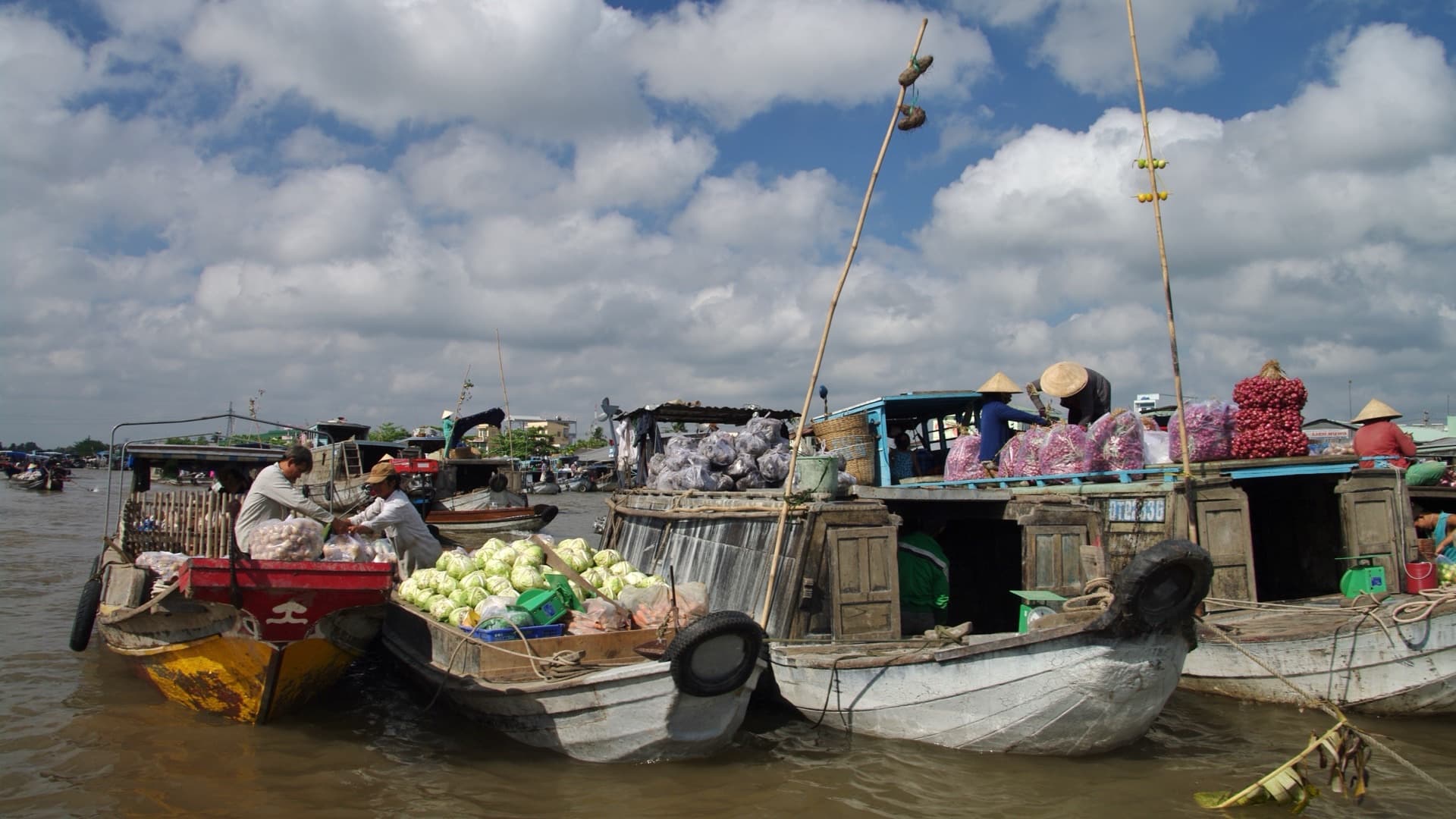
Can Tho is where the Mekong Delta stops being a day trip and starts being a destination. It is the delta's largest city, it has the last big working floating market on its doorstep, and it is increasingly where travellers base themselves for two or three nights instead of buying a coach tour out of Saigon. That matters, because almost everything good in the delta happens before 7am or two hours down a provincial road, and neither is reachable from Ho Chi Minh City.
These are the seven worth your time. Distances are from central Can Tho, prices are mid-2026 bands, and conversions use roughly 26,400 VND to the dollar. One note first: under the reorganisation effective 1 July 2025, Soc Trang and Hau Giang merged into Can Tho city, An Giang absorbed Kien Giang, and Vinh Long absorbed Ben Tre and Tra Vinh. Half the province names in older guidebooks no longer exist.
The seven at a glance
| Day trip | Distance | Hours | Cost band (mid-2026) | Pick this if |
|---|---|---|---|---|
| Cai Rang floating market | 6 km by river | 2.5 to 3 | 200,000 to 400,000 VND per sampan | You do one thing here |
| Tra Su cajuput forest | 120 to 135 km | 10 to 12 | 190,000 to 260,000 VND plus transport | It is flood season |
| Binh Thuy house and city circuit | 6 to 12 km | 4 to 5 | Under 5 dollars solo | You have a spare afternoon |
| Chau Doc and Sam Mountain | 115 to 120 km | 10 to 12 | Free entry plus transport | Pilgrimage and border views |
| Soc Trang Khmer pagodas | 60 to 80 km | 6 to 8 | Donation plus transport | You want a different Vietnam |
| Vinh Long and An Binh island | 34 km plus ferry | 5 to 7 | Ferry a few thousand VND | You can stay the night |
| Phong Dien market | 20 km | 3 to 4 | Sampan hire, as Cai Rang | You are up at 4am anyway |
Cai Rang floating market at dawn
Wholesalers moor mid-channel about 6 km downstream of Ninh Kieu wharf, holds full of a single crop — watermelon, pineapple, pumpkin, taro — and retailers come alongside to buy in bulk. Each boat flies a cay beo, a bamboo pole three to five metres tall with a sample of the cargo tied to the top, because engine noise makes shouting useless over open water.
The timing is the whole trip. Trading peaks between roughly 5:30am and 6:30am, thins after 7am and is finished by 8am, so leave your hotel at 4:45am. A small private sampan for two to four people runs 200,000 to 400,000 VND (about 8 to 15 dollars) for the whole boat as of mid-2026; a shared seat is roughly 50,000 to 100,000 VND, and organised sunrise tours sit around 30 to 80 dollars per person. Our floating markets guide has the boat-hire detail.
Cai Rang floating market culture was recognised as national intangible cultural heritage by the Ministry of Culture, Sports and Tourism in June 2016. It has also shrunk from more than 400 boats at its 1990s peak to roughly 200, as bridges made truck haulage cheaper than river. Go early, not never.
Pick this if you do exactly one thing from Can Tho.
Tra Su cajuput forest
The delta's best landscape day, and a genuinely long one. Tra Su is a flooded melaleuca wetland roughly 120 to 135 km west, about 20 km from Chau Doc, close to three hours of driving each way. You take an electric boat down the main channel, transfer to a rowed sampan for the narrow corridors, and finish at a canopy watchtower.
Season decides everything. From September to November the water carries an unbroken carpet of bright green duckweed and the channels become the tunnel the photographs promise. Outside it, Tra Su is a good birding site and a lot of driving. Ticketing is quoted inconsistently: the combined entrance-plus-boat ticket sits between roughly 190,000 and 260,000 VND (about 7 to 10 dollars) per person as of mid-2026, sold either as one combination or as separate entrance, motorboat and rowing-boat components. Buy at the gate.
Pick this if your dates fall between September and November. Otherwise give the day to Chau Doc.
The Binh Thuy house and a Can Tho half day
The cheapest good half day in the delta, and the one everyone skips because they leave at noon. The Binh Thuy ancient house at 144 Bui Huu Nghia, about 6 km from the centre, is a French-Vietnamese hybrid held by one family for generations, open roughly 8am to noon and 2pm to 6pm. The grounds are free; going inside costs about 15,000 VND, under a dollar.
Build the afternoon around it: the Ong Pagoda on the riverfront, the Khmer Munirangsyaram pagoda, the covered Can Tho market, and the Can Tho Bridge, best seen from the water at dusk. A scooter at roughly 120,000 VND a day as of mid-2026 covers all of it.
Pick this if you have an afternoon and no appetite for a three-hour drive.
Chau Doc and Sam Mountain
Chau Doc is 115 to 120 km northwest on the Hau River, near the Cambodian border, and the drive is realistically two and a half to three hours each way, not the ninety minutes a mapping app suggests. Six kilometres outside town, Sam Mountain rises abruptly out of a dead-flat floodplain, and the view from the top runs into Cambodia.
At its base is the Ba Chua Xu temple, the most visited pilgrimage site in the delta, free to enter and busy year-round. Its festival, on the 22nd to 27th days of the fourth lunar month, was inscribed on UNESCO's Representative List of the Intangible Cultural Heritage of Humanity in 2024 as the Festival of Bà Chúa Xứ Goddess at Sam Mountain — the delta's only entry. Add the Chau Giang Cham villages and the floating fish farms and there is a full day here.
Pick this if you want the delta's religious and border culture, or you are going on to Phnom Penh.
Soc Trang's Khmer pagodas
Sixty to eighty kilometres south, about an hour and forty minutes by bus, and part of Can Tho since July 2025. Soc Trang has the densest concentration of Khmer Theravada temple architecture in Vietnam: naga balustrades, gold-tipped stupas and roofs closer to Cambodia than Hanoi.
Three carry the day. Chua Doi, the Bat Pagoda, is a Khmer monastery 3 km outside town whose old trees hold a colony of flying foxes that stream out at dusk. Chua Dat Set, the Clay Pagoda, is a family-built shrine where almost every statue was hand-sculpted from clay by one monk. Kh'leang is the oldest and the architectural benchmark. None charges admission; a donation is welcome. Dress covered, go on a weekday.
Pick this if you want the delta's Khmer half rather than another boat.
Vinh Long and the An Binh island belt
Thirty-four kilometres northeast, about an hour by bus for roughly 50,000 VND, then a fifteen-minute ferry to An Binh island for a few thousand dong. An Binh and its neighbouring islets are the delta's orchard-and-homestay belt: fruit gardens, brick kilns, bonsai nurseries, lanes that flood at high water, and family homestays at roughly 250,000 to 600,000 VND (about 9 to 23 dollars) a night as of mid-2026, meals usually included at the top of the band.
The honest framing: this day trip wants to be an overnight. As a day you see orchards at midday, the island's least interesting hour. Staying buys dinner with a family and a canal ride at first light. Our Mekong without a tour guide covers the independent version.
Pick this if you can turn it into a night. As a round trip it is forgettable.
Phong Dien, and the honest state of the markets
Phong Dien is 20 km southwest, starts around 4:30am, and is still worked partly by rowed sampans rather than engines — which is why it has been recommended for two decades as the quiet alternative. It has also been reported down to fewer than a dozen trading boats.
Treat it as an add-on, not a substitute. If you are on the water at 5am, some boatmen will run Cai Rang first and then push up the smaller channels toward Phong Dien, and that canal ride is the best part. What fails is skipping Cai Rang on the promise of authenticity and finding eight boats and a coffee seller.
Pick this if you have a second morning and have already done Cai Rang.
What each mode costs
Independent travel is far cheaper here than on the coast. Rough bands as of mid-2026:
- Scooter: around 120,000 VND a day (about 4.50 dollars) plus fuel. Covers Cai Rang, Binh Thuy, the city circuit and Phong Dien.
- Private car with driver: roughly 1,000,000 to 1,500,000 VND (about 38 to 57 dollars) for a full day within 60 km, and 1,800,000 to 2,500,000 VND (about 68 to 95 dollars) for a Tra Su or Chau Doc round trip. Confirm tolls, parking and the driver's meal first.
- Public bus: cheapest and slowest, and the sensible way to Vinh Long.
For how these rates sit nationally, see the Vietnam tour price index and the budget guide.
When to go
The delta has two useful seasons rather than four. September to November is the floating season, when the Mekong rises slowly and predictably — locals call it high water, not flooding — the landscape is green, the canals are deep and Tra Su peaks. December to April is drier and better for long road days, with March and April historically near 35°C and uncomfortable away from the water. May to August brings a hard afternoon downpour rather than a lost day. Cai Rang works year-round; everything else is better at high water, which is the opposite of the advice most travellers arrive with. Wider picture: the Mekong Delta guide.
Limitations
Every figure here is a mid-2026 band, not a quote. Sampan hire and private-car rates are negotiated rather than posted, Tra Su's ticket structure is reported inconsistently — we give the 190,000 to 260,000 VND spread rather than pick one number — and bus fares move with fuel and class. Workaround: confirm fees at the gate and get any car or boat rate itemised first.
Two things we could not close remotely. Boat counts at Cai Rang and Phong Dien change by season and by source, and the Phong Dien figure is reported rather than counted by us. And the July 2025 reorganisation is still working through signage and operator listings, so a site may be filed under a province that no longer exists. Workaround: search by place name, not province. This guide also leaves out multi-day routes — the Chau Doc to Phnom Penh crossing, Ca Mau, the far south.