
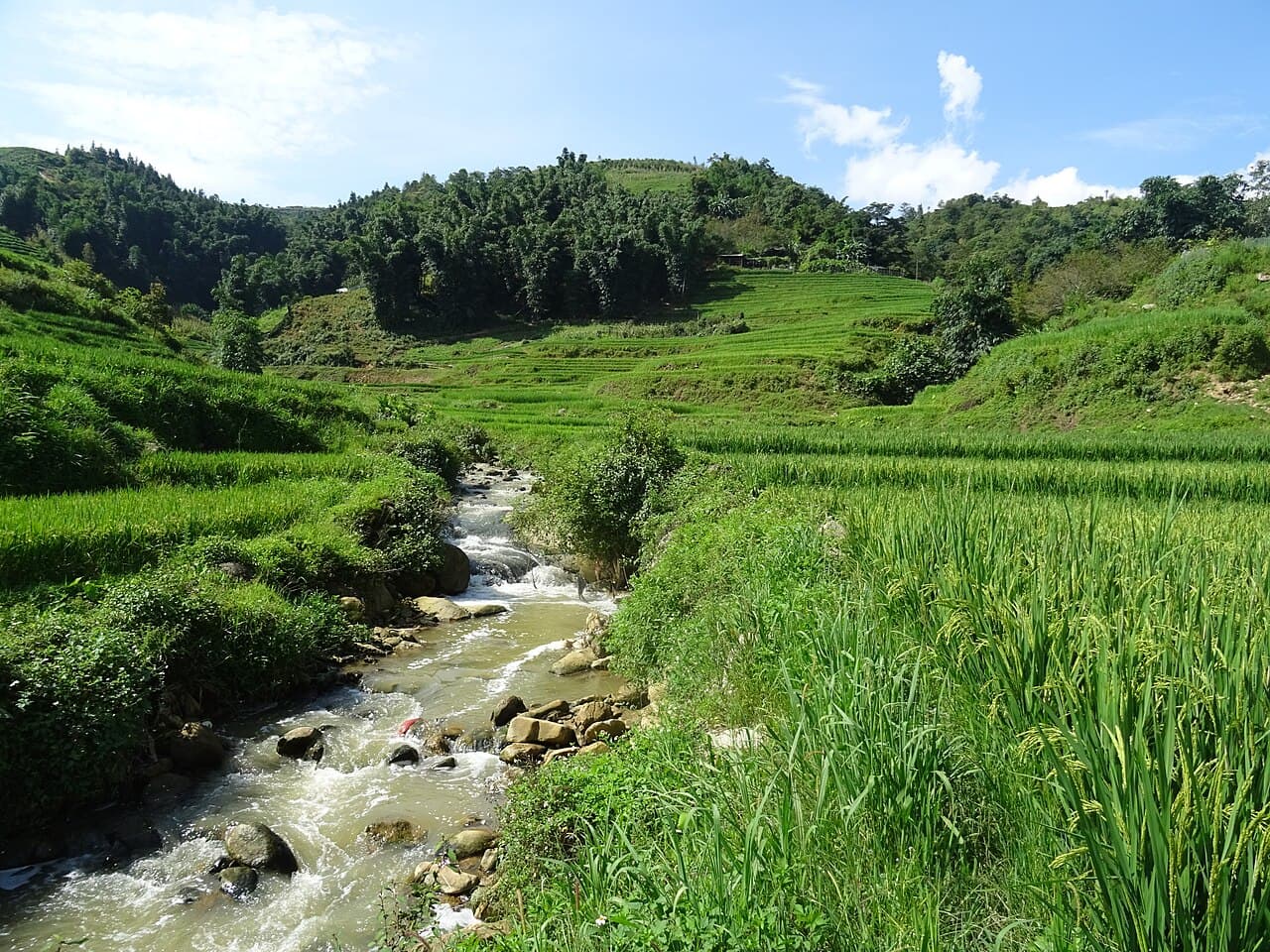
Sapa is a rare thing in Vietnam: a base where the day trips are the destination. The town is a construction site with a lake in it, honest about neither its French hill-station past nor its H'mong present. Ten minutes downhill it stops mattering, because the Muong Hoa valley opens out below.
Distances are from central Sapa, prices are mid-2026 bands, and conversions use 26,400 VND to the dollar.
The eight at a glance
| Day trip | Distance | Hours | Cost (mid-2026) | Pick this if |
|---|---|---|---|---|
| Muong Hoa villages | 3 to 10 km | 5 to 7 | 75,000 VND entry, guide $15 to $25 | You have one day |
| Fansipan cable car | 3 km | 4 to 5 | 850,000 to 1,250,000 VND | The forecast is clear |
| Bac Ha Sunday market | 110 km | 9 to 10 | $15 to $30 group | You are here Sunday |
| Ta Phin village and cave | 12 to 17 km | 4 to 6 | Under 200,000 VND alone | You want craft |
| Cat Cat village | 2 km | 2 to 3 | 70,000 VND | You go before 8 am |
| Silver Falls and the pass | 12 to 18 km | 3 to 5 | 20,000 to 120,000 VND | You have a scooter |
| Hau Thao and Sa Seng | 6 to 9 km | 5 to 6 | Guide 400,000 to 650,000 VND | Crowds are the problem |
| Lao Cai and the border | 35 km | 4 to 6 | 50,000 VND each way | You have hours to fill |
Muong Hoa valley: Y Linh Ho, Lao Chai and Ta Van
This is the one. The valley runs southeast along provincial road 152, and the standard line drops from Sapa to Y Linh Ho at about 3 km, follows the Muong Hoa stream through Lao Chai, and finishes at Ta Van roughly 10 km out: 10 to 12 km of walking, four to six hours with stops and lunch.
A checkpoint on the road in charges 75,000 VND for adults and 30,000 VND for children as of mid-2026, cash only; enforcement is loose and in bad weather there is sometimes nobody there.
Alone, the day costs the ticket, a bowl of noodles and a 50,000 to 100,000 VND motorbike ride back up from Ta Van. A local H'mong or Red Dao guide adds 400,000 to 650,000 VND; a group tour with lunch and drop-off is $20 to $40. The guided version is the one we would pay for, and our Sapa trekking day trip page breaks down the sections. Start by 8:30 am; the valley collects cloud after lunch.
Pick this if you only have one day in Sapa.
Fansipan by cable car
Fansipan is 3,143 m, the highest point in Indochina, and since 2016 you have reached it in about 20 minutes from the valley floor. The station is roughly 3 km from town.
Pricing effective 1 January 2026 is 850,000 VND round trip for adults and 550,000 VND for children between 1.0 m and 1.4 m, with under-1 m free; some sources report a weekend premium. The Muong Hoa monorail from town is 200,000 VND return. From the upper station there are more than 600 steps to the summit marker, or a funicular at 170,000 VND up and 150,000 VND down. The combo covering all three is 1,250,000 VND for adults — about $47, and the most expensive thing most people do in northern Vietnam.
You are buying a view, and roughly half the time it is not there. Take the first cars of the morning and dress for 5°C to 10°C colder than town. Our Fansipan cable car day trip page covers the summit complex.
Pick this if you wake up and can see the mountains from your window.
Bac Ha Sunday market
Bac Ha is about 110 km east, past Lao Cai and up into a different set of hills, 2.5 hours each way. The market runs Sunday only, roughly 6 am to 2 pm, and it is the largest ethnic-minority market in the northwest: Flower H'mong, Tay, Nung and Phu La traders, a livestock section that is genuinely a livestock section, and rows of embroidered fabric.
Tours leave Sapa around 7 to 7:30 am and return by 5 to 5:30 pm. Group seats run about $15 at the budget end and $25 to $30 for smaller operators including lunch as of mid-2026. Some add a Tet surcharge and most suspend the trip during the February Lunar New Year window.
Bac Ha has been on the circuit for thirty years and the fabric aisles know exactly who you are; the buffalo market and the back streets are where it stays real. Detail on our Bac Ha market day trip page.
Pick this if your Sapa nights happen to include a Saturday.
Ta Phin village and cave
Ta Phin sits 12 to 17 km northeast depending on the route, in a bowl of terraces below Hoang Lien Son. It is the Red Dao heartland, and the draw is craft and medicine rather than scenery: indigo brocade embroidery, and the herbal bath made from a leaf mixture that can run to more than a hundred plants. A bath costs 80,000 to 300,000 VND depending on whether you take it at a family house or a spa, as of mid-2026.
Ta Phin cave is about 1 km north of the commune centre, entry in the 50,000 to 75,000 VND range with the lighting switched on for a small extra fee, and visitors kept to roughly the first 300 m. It is rough, wet and genuinely dark, not a boardwalk attraction.
Pick this if you would rather sit in a tub of hot leaf water than climb anything.
Cat Cat village, and the honest verdict
Cat Cat is 2 km from town, a 30 to 40 minute walk down and 45 to 60 minutes back up, and the most commercialised thing near Sapa by a wide margin. Entry is 70,000 VND as of mid-2026, with some reporting of higher tiers. It opens at 6 am and the coaches arrive between 8:30 and 9 am.
You get a paved loop through a former Black H'mong hamlet: a 30 m waterfall, a French-era hydro station, weaving and indigo-dyeing demonstrations, costume hire, dance shows and a long run of stalls. It is a stage set, and reviews calling it artificial are not wrong. It is also pleasant at 7 am with nobody in it.
Pick this if you have a spare morning and can be at the gate before 8 am. Skip it if you are already doing Muong Hoa.
Silver Falls, Love Waterfall and the Tram Ton Pass
Northwest of Sapa, Highway 4D climbs toward O Quy Ho, also called the Tram Ton Pass, which tops out near 2,073 m and is the highest road pass in Vietnam. An easy half day on two wheels.
Silver Falls (Thac Bac) is about 12 km out, right beside the road, a 200 m cascade with a stair up to a bridge across the face. Entry is 20,000 VND for adults and 10,000 for children, open roughly 8:30 am to 5 pm, and it takes 20 minutes. Love Waterfall (Thac Tinh Yeu) is roughly 14 km out inside Hoang Lien National Park, ticketed separately and reached by a short forest walk — quieter and prettier. The Heaven's Gate viewpoint at the top of the pass is a private platform, around 120,000 VND per adult as of mid-2026; the pass itself is free to ride.
One seasonal warning most guides omit: these are rain-fed falls, most dramatic from June to September and thin by February. The pass is best on the cold clear days of late autumn.
Pick this if you have a scooter and half a day. All three fit one loop.
Hau Thao, Sa Seng and the quiet side of the valley
The same valley, one ridge over. Routes running Sapa to Sa Seng to Hau Thao, and down to Giang Ta Chai and Su Pan, cover the eastern side of Muong Hoa and see a fraction of the traffic. Hau Thao is Black H'mong; Giang Ta Chai is Red Dao, beside a rattan suspension bridge and a waterfall. Distances are similar at 6 to 9 km, but this is trail, not road.
It needs a guide: the paths are unsigned, they braid through fields, and the clay is dangerous after rain. Rates sit in the same 400,000 to 650,000 VND band. If crowds were your worry about coming north, this is the answer, and it pairs with our Sapa without the crowds guide.
Pick this if you have two days and did the main valley on the first.
Lao Cai and the Chinese border
Lao Cai is 35 km down the hill, about an hour, and where the overnight train from Hanoi terminates. Minibuses run roughly 50,000 VND each way; a private car is around 750,000 VND. The international border gate faces Hekou in Yunnan across the Nam Thi river, about 3 km from the station, open in the region of 7 am to 10 pm.
Set expectations low. This is a working frontier town, not a sight: a view across a river into China, a border-trade market, and the oddity of standing at the far edge of Vietnam. Crossing needs a Chinese visa arranged well in advance.
Pick this if you have a late train and hours to fill.
When to go, and the fog problem
September to November is the best window: the harvest turns the terraces gold through late September and early October, and autumn brings the clearest air of the year. March to May is second, green and mild. The rains run May to September, July and August wettest.
December to February is the gamble. Highs sit near 10°C, thick fog settles for days, and there is a real chance of seeing very little; cold snaps below freezing bring occasional snow and the sharpest views of the year. In winter, weight the plan toward Ta Phin, Bac Ha and the villages, which work in cloud.
Limitations
Every price here is a mid-2026 band, not a quote. Sun World sets Fansipan pricing centrally and changed it on 1 January 2026; village and checkpoint fees are local and reported inconsistently, which is why Cat Cat appears in sources at both 70,000 and 150,000 VND. Workaround: treat these as planning numbers, carry cash, and read the board at the gate.
Two gaps we could not close from a distance. Love Waterfall's ticket price could not be verified to our standard, so it appears without a figure; and group tour prices move with season and group size, with no audit of individual operators behind them.
The guide also leaves out multi-day treks toward Ban Ho, homestays in Ta Van, and the Fansipan climb on foot. For how Sapa compares with the emptier alternative east of here, see Sapa vs Ha Giang.