
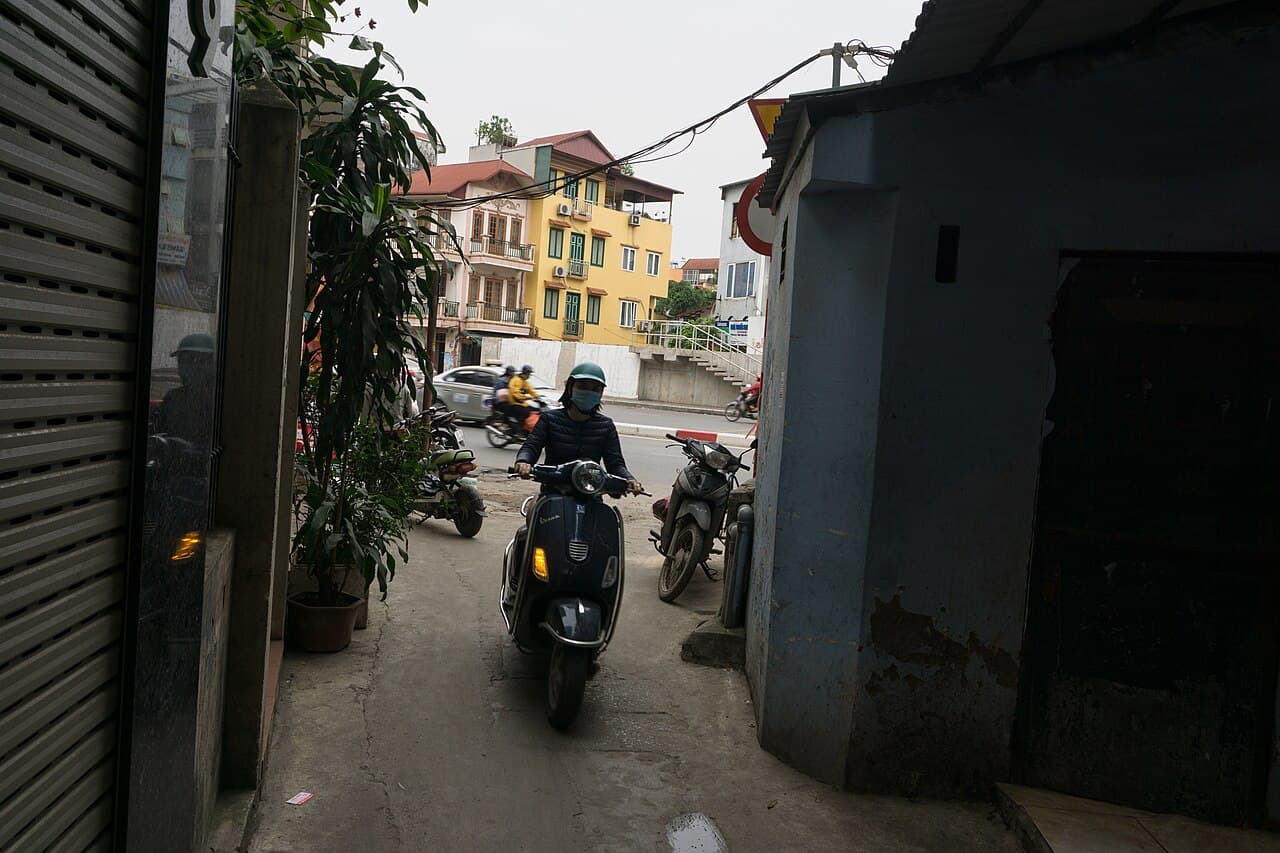
Whether you can legally drive or ride in Vietnam comes down to a technicality most travelers have never heard of: which international driving permit treaty your home country signed. Vietnam recognizes only IDPs issued under the 1968 Vienna Convention on Road Traffic. If your country issues the older 1949 Geneva Convention IDP — the United States, Canada, Australia, New Zealand, and Japan among them — the permit your automobile club sold you is not legally valid in Vietnam, and driving anything that requires a license puts you on the wrong side of Vietnamese law. UK and most EU license holders can drive legally, but only with a 1968 IDP in hand, and only for the vehicle categories printed on their home license — which for most people means a car, not a motorbike.
This guide covers the legal layer only. For rental prices, operators, and pre-ride checks, see our motorbike rental guide; for the accident data and the full Decree 168 fine schedule, see our road safety research.
The verdict by nationality
| Where your license is from | IDP convention issued | Legal to drive in Vietnam? | Your realistic options |
|---|---|---|---|
| UK, most EU countries | 1968 Vienna | Yes — with a 1968 IDP carried alongside your home license, for the classes you hold | Get the IDP before you fly; a motorbike needs a motorcycle category on both documents |
| US, Canada, Australia, New Zealand, Japan | 1949 Geneva only | No — the IDP is not recognized | Convert your license (residents), pass the A1 test, or do not self-drive |
| Ireland, China, India | 1949 Geneva only | No | Same as above |
| Long-stay residents, any nationality | — | Yes, after conversion | Convert an equivalent home license at a provincial licensing office |
Two rules sit underneath this table. First, an IDP is never a standalone document — it is essentially a certified translation of your home license and must be carried together with it. Second, an IDP only covers the vehicle categories you already hold at home. A British driver with a car-only license and a valid 1968 IDP can legally rent a car in Vietnam, but is exactly as unlicensed on a rented Honda Wave as an American with no valid IDP at all.
Why the 1968 vs 1949 split exists
Vietnam acceded to the 1968 Vienna Convention on Road Traffic in 2014, and it entered into force for the country in 2015. Vietnam never joined the 1949 Geneva Convention, so it has no treaty obligation to honor permits issued under it. The confusion persists because 1949 IDPs are perfectly genuine documents — the AAA in the United States or the CAA in Canada will sell you one with no warning that it carries no legal weight in Vietnam. Travelers arrive holding an official-looking booklet and assume it works everywhere. In Vietnam it does not, and as of mid-2026 there is no public sign of that changing. If you are unsure which convention your country follows, verify with the issuing automobile association or your embassy in Hanoi before building a self-drive trip around the assumption.
License classes: the 50cc myth and the A1 requirement
Vietnamese license classes matter because the IDP only mirrors what you hold at home, and because the rental fleet is almost entirely made of bikes that need a motorcycle class.
- Under 50cc. Adults could historically ride sub-50cc mopeds without any license, and this still circulates as a loophole. Treat it with caution: the road-traffic law overhaul that took effect in January 2025 has been tightening this gray zone, and genuinely sub-50cc machines are rare in tourist rental fleets anyway. Do not plan a trip around it without checking the current rule.
- A1 — small motorbikes. The class that covers the scooters tourists actually rent. Under the license classes in force since January 2025, A1 covers motorbikes up to about 125cc, with a separate class A for larger machines — meaning a 150cc Ha Giang bike sits above A1. Class definitions were restructured recently, so verify the current thresholds if you are converting or testing.
- B — cars. The standard car class. A car license, and the IDP built on it, does not authorize any motorbike over 50cc.
The practical trap is the gap between B and A1. Most travelers hold a car license, so even the ones with a valid 1968 IDP are licensed for a rental car — not the Honda Wave or XR150 they actually plan to ride. Riding a motorbike on a car-only IDP is riding unlicensed under Vietnamese law.
Decree 168 fines and the checkpoint reality
Decree 168/2024/NĐ-CP took effect on January 1, 2025 and raised traffic fines dramatically — up to 30 times the previous schedule for some offenses. For unlicensed riding, reported figures run to several million VND: amounts around VND 5,000,000 are commonly cited for motorbikes, with higher bands for larger engines, plus vehicle impoundment of roughly 10-15 days. The fine schedules are published in Vietnamese and English translations vary, so treat exact amounts as indicative and expect them to change; our road safety research tracks the schedule and the enforcement statistics behind it.
The impoundment is often the sharper cost. The bike you lose for two weeks is a rental, and the contract makes you liable to the owner for the lost rental days — and sometimes recovery fees — on top of the fine.
Enforcement is not theoretical. Traffic police run checkpoints in exactly the places tourists ride: the Ha Giang Loop, where the April 2026 death of a British tourist triggered new provincial rules on motorbike tour operators; the Da Lat highlands; and the coastal riding roads around the Hai Van Pass and Mui Ne. Checkpoint intensity varies by province and season, but the direction of travel since Decree 168 has been more enforcement, not less. A crash brings the same scrutiny without the checkpoint: embassies warn that foreigners involved in accidents can face police investigation, compensation demands, and in serious cases restrictions on leaving Vietnam while a case is open.
The insurance domino
The fine is the smallest number in this chain. The expensive one arrives after a crash.
Most travel-insurance policies pay motorbike-accident claims only if you were riding legally — a license valid in Vietnam for that engine size, plus a helmet. Ride on a 1949 IDP, or on a car-only 1968 IDP, and you fail that condition. The insurer does not need to argue about road conditions or fault; the claim is denied on the license clause alone, and unlicensed riding is the single most common reason serious claims are denied in Vietnam.
The amounts at stake: a broken collarbone treated at an international hospital runs roughly USD 5,000-15,000, and an air evacuation to Bangkok, Singapore, or home runs roughly USD 15,000-50,000. Without a valid claim, those bills are yours. Our Vietnam travel insurance guide covers this trap in detail, including how to read the motorbike clause before you buy — the short version is that for many Western travelers, the motorbike cover they are paying for cannot pay out.
The legal alternatives
Not being able to self-drive does not lock you out of the good roads.
- Easy-rider tours. You ride pillion behind a local driver whose license, bike, and paperwork are their own. This is the standard legal-and-insured way to do the Ha Giang Loop, where operators must now work under licensed agencies with written contracts — see our Ha Giang Loop cost breakdown and route guide for how the easy-rider option compares to self-driving on price.
- Private car with driver. For day trips and multi-day itineraries, a car with driver costs more than a scooter and less than most people expect, and it keeps mountain routes like the Hai Van Pass fully available to you.
- Ride-hail. Grab and Xanh SM cover cities and their surroundings cheaply, including motorbike-taxi options where you are the passenger, not the rider.
Converting your license if you are staying longer
For expats, students, and long-stay visa holders, converting a home license to a Vietnamese one closes both the legal gap and the insurance gap.
The process runs through the provincial licensing office (historically the Department of Transport). Commonly reported requirements: your passport with a long-stay visa or residence card, the original home license with a notarized translation, photos, and in some provinces a basic health certificate. Fees are typically quoted around VND 500,000-800,000 with processing of roughly 5-7 working days. Two caveats matter. Conversion mirrors your existing classes — a car-only license converts to class B, not to a motorbike class, so riders without a home motorcycle entitlement still need to pass the Vietnamese A1 test. And tourists on short-stay e-visas generally cannot convert at all; the process assumes residence paperwork. Provincial practice varies and requirements shift, so verify with the licensing office where you live, or with your embassy, before you rely on any of this.
Limitations
We are a travel-content team, not lawyers, and nothing here is legal advice. Vietnamese traffic law is published in Vietnamese; fine amounts, license-class thresholds, and conversion requirements in this guide are drawn from official schedules and reputable translations, but translations vary and provincial practice differs from the letter of the law. The license-class structure was restructured as recently as January 2025 and may shift again, and enforcement intensity under Decree 168 varies by province and season. Figures are accurate to the best of our research as of mid-2026 and are deliberately hedged — before making decisions that depend on them, verify with your embassy in Hanoi, the issuing automobile association for your IDP, or the licensing office in the province where you are staying. For the rental mechanics see our motorbike rental guide; for the underlying safety data see the road safety research; for the coverage side see the insurance guide.