
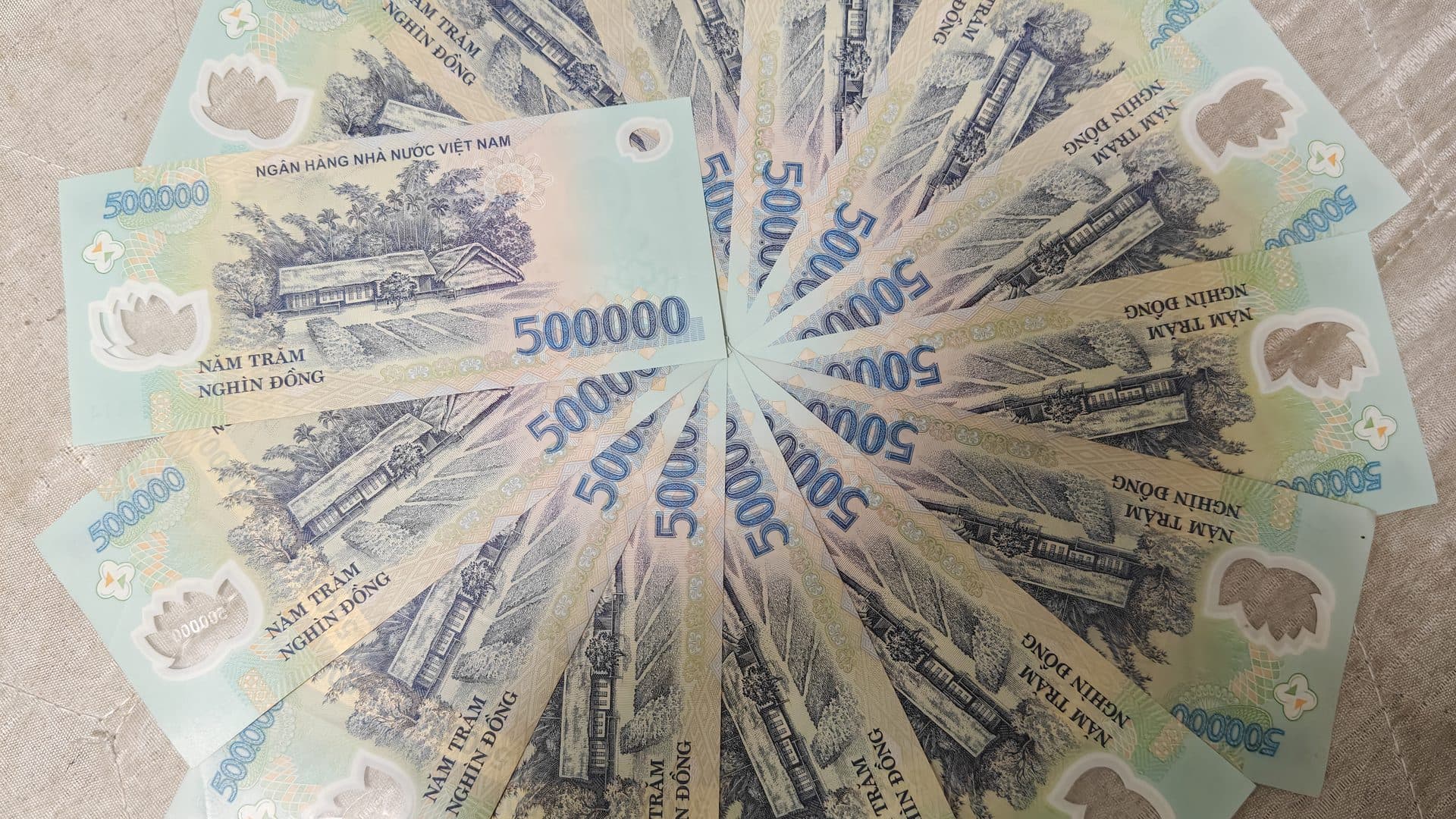
For most trips to Vietnam you need less physical cash than you think: about 450,000 to 1,000,000 VND a day on a backpacker budget and 850,000 to 1,500,000 VND a day mid-range, drawn from ATMs as you go, plus a small reserve of US dollars from home. The border limit is far above that. You only have to declare cash to customs if you carry more than $5,000 in foreign currency or more than 15 million VND, whether you are arriving or leaving, under Circular 15/2011/TT-NHNN of the State Bank of Vietnam. Since 1 July 2026, failing to declare costs up to 20 million VND on arrival and 50 million VND on departure.
This page answers two questions only: how much cash to carry, and when the border rule applies. For the fees on each withdrawal, see the Vietnam ATM fees guide. For where cards work, see card vs cash in Vietnam. For exchange rates and the dong itself, see the Vietnam currency guide. Dollar conversions below use about 25,600 VND to the dollar, Vietcombank's rate on 30 October 2026.
How much cash do you need each day?
The useful number is not your whole budget but the part of it that only cash can pay. I built the table below from the line items in this site's Vietnam travel budget guide, counting only the things that are usually paid in notes: street food, neighbourhood cafes, local transport and ticket windows. Hotels, booked tours and flights go on a card.
| Travel style | Daily budget | Usually paid in cash | Cash a day |
|---|---|---|---|
| Backpacker | $30-50 | Street food $10-18, local transport $3-8, one paid sight $5-12 | About 450,000-1,000,000 VND ($18-38) |
| Mid-range | $80-150 | Casual meals $25-45, Grab or taxi $8-15 | About 850,000-1,500,000 VND ($33-60) |
| Comfort and luxury | $200 and up | Street snacks, markets, entry fees, small extras | About the mid-range figure |
Two things change these numbers. If your hostel or guesthouse wants cash rather than a card, add the bed: $8-15 a night for a dorm in the budget guide. If you pay Grab in the app with a card, take the transport line out. The comfort row stays close to the mid-range figure because the extra money at that level goes on hotels, restaurants and private transfers, which take cards.
These ranges line up with the 500,000 to 1,500,000 VND a day that the card vs cash guide suggests. That guide is about where cards work; this one is about how much paper to carry.
What that means over a whole trip
Multiply by your days and the totals stay modest. Over 14 days, a backpacker needs about 6 to 14 million VND in cash ($250 to $530) and a mid-range traveller about 12 to 21 million VND ($460 to $840). Foreign cards can usually take out 2 to 5 million VND per transaction, according to the ATM fees guide, so that is roughly 2 to 7 withdrawals for a backpacker and 3 to 11 for a mid-range trip. Pulling the maximum each time spreads the fixed fee over more cash.
None of these totals comes close to the customs limits. The only traveller who needs to think about the border is the one carrying a large sum on purpose: savings for a long stay, cash for a big purchase, or a lot of dong left over from a previous visit.
Where you still need cash in 2026
Cash is still the default for the small, daily layer of a trip. Plan on notes for:
- Street food, cafes and markets, from a bowl of pho to fruit at a morning market.
- Ticket windows at heritage sites. Hoi An's old town now charges 20,000 VND per site, as the budget guide explains, and small notes make that easy.
- Local buses, xe om and many taxis, and sleeper bus tickets bought at the counter.
- Small guesthouses and homestays, which often settle in cash even when they list online.
- Fines at the airport. Overstay fines are paid in dong at the immigration desk, as the visa and immigration atlas explains.
Cards work at mid-range hotels and up, malls, chain restaurants, supermarkets, airlines and booked tours. QR payment is the part that is changing. By August 2026, Vietnam's national NAPAS network had cross-border QR links with China, South Korea, Thailand, Laos, Cambodia and Singapore, so some visitors from those countries can pay Vietnamese QR codes with apps from home, Tuoi Tre reported. If your home app is not on that list, plan on cash for anything small.
Dollars or dong: what to bring from home
Bring a reserve, not your budget. A few hundred US dollars in good condition, as the currency guide suggests, covers a card that stops working or an ATM network that is down. I would keep it between $100 and $300 and draw everything else in dong.
Which notes exchange best
Vietnamese banks publish their buying rates daily, and the gaps show which notes to pack. On 30 October 2026 the rate tables of Vietcombank and BIDV showed:
| Cash you bring | Bank buys cash at | Bank's transfer rate | Cash discount |
|---|---|---|---|
| US dollar (Vietcombank) | 25,580 VND | 25,610 VND | About 0.1% |
| Euro (Vietcombank) | 28,141 VND | 28,425 VND | About 1% |
| British pound (Vietcombank) | 33,752 VND | 34,093 VND | About 1% |
| Australian dollar (Vietcombank) | 17,678 VND | 17,857 VND | About 1% |
| Thai baht (Vietcombank) | 676 VND | 751 VND | About 10% |
| US $1 to $20 notes (BIDV) | 24,576 VND | 25,600 VND (BIDV main US dollar rate) | About 4% |
The lesson is simple. US dollars in $50 and $100 notes, the ones BIDV does not list separately, get almost the full rate. BIDV lists $1, $2 and $5 notes, and $10 and $20 notes, on separate lines at about 4% less than its main US dollar rate. Euros, pounds and Australian dollars lose about 1% as cash, which is fine for a reserve. Thai baht notes lose about 10%. Whatever you bring, bring clean notes without tears or pen marks; the currency guide explains why damaged notes get refused.
Where to change it
Change money at a bank or at a licensed exchange agent. A gold shop can legally change your dollars only if the State Bank has registered it as an exchange agent of one credit institution, and it must display its exchange rates and a sign naming that bank, Phap Luat TP.HCM explained in October 2025. The rule has teeth for both sides of the counter. Under Decree 340/2025/ND-CP, in force since 9 February 2026, buying or selling foreign currency at an unlicensed place brings a warning below $1,000 and a fine of 10 to 20 million VND from $1,000 to $10,000, with the money confiscated, as Lawyers of Vietnam magazine summarised. Look for the sign before you hand anything over.
When do you have to declare cash at the border?
The rule is Circular 15/2011/TT-NHNN, issued by the State Bank of Vietnam on 12 August 2011 and in force since 1 September 2011. It applies to anyone entering or leaving Vietnam on a passport through an international border gate, including the airports.
| Cash you carry | Declare to customs if it is more than | Roughly |
|---|---|---|
| Foreign currency | US$5,000, or the equivalent in other currencies | 128 million VND |
| Vietnamese dong | 15,000,000 VND | $580 |
Only cash counts. The circular's text excludes traveller's cheques, bank cards, savings books and securities. There is no upper limit on bringing cash in: above the threshold you declare it, and there is no tax or charge on declared cash, as Vietnam Law Magazine explains.
Has it changed since 2011? Not the limits. I checked for a replacement circular and found none. Legal databases record a 2022 amendment by Circular 20/2022/TT-NHNN, but the 2026 sources still give the same two numbers: the UK government's entry requirements for Vietnam list $5,000 and 15 million VND, and Bao Dau Tu described them as the current rule in May 2026. What did change in 2026 is the penalty, below.
How to declare
Tell customs at the border gate and fill in the customs declaration for passengers, going through the goods-to-declare lane rather than the green one. Most arrivals never need to, as the airport fast-track guide notes. Keep the declaration once customs has certified it. You will need it if you want to take that money out again.
Leaving Vietnam with cash
The exit rule is stricter. If you leave with more than $5,000 in foreign cash or more than 15 million VND, or with more than you declared when you arrived, you must declare it and show either a certificate from a licensed bank or written approval from the State Bank of Vietnam. If you are taking out no more than you brought in and declared, the customs-certified arrival declaration is enough, and it stays valid for your next departure within 12 months of its date, as Vietnam Law Magazine sets out.
The dong limit is the one that surprises people. 15 million VND is only about $580, so a traveller flying home with a thick envelope of leftover dong can cross it without noticing.
What happens if you do not declare
From 1 July 2026, the fines come from Decree 169/2026/ND-CP on customs penalties, issued on 15 May 2026, which replaced the 2020 rules. Leaving is fined more heavily than arriving. According to Tap chi Cong Thuong's summary of the decree:
| Undeclared value above the limit | Fine on arrival | Fine on departure |
|---|---|---|
| 5 to under 30 million VND | 1-2 million VND | 1-3 million VND |
| 30 to under 50 million VND | 1-2 million VND | 5-15 million VND |
| 50 to under 70 million VND | 5-10 million VND | 5-15 million VND |
| 70 to under 100 million VND | 5-10 million VND | 15-25 million VND |
| 100 million VND or more | 10-20 million VND | 30-50 million VND |
The value counted is the amount above the free limit, not the whole sum, according to the Ha Tinh provincial portal's summary. As I read it, someone arriving with $8,000 undeclared is $3,000 over, about 77 million VND, which falls in the 5 to 10 million VND band; leaving with the same sum undeclared falls in the 15 to 25 million VND band. Declaring more than you actually carry on arrival is also fined, at 2 to 25 million VND. The fines apply only where the case is not prosecuted as a crime; Vietnam Law Magazine's 2023 summary put the criminal line for moving cash across the border illegally at 100 million VND under Article 189 of the Penal Code.
How to carry and split your cash
Vietnam is not a dangerous place to carry money, but snatch theft from passing motorbikes is the most cited risk in Ho Chi Minh City, as the Vietnam safety guide explains. A few habits keep a bad moment small:
- Carry one day's cash in a front pocket, using the daily figures above, and nothing more.
- Split the rest. Keep the bulk of your dong and your dollar reserve in the room safe, and a second, smaller stash somewhere else, so one lost bag never takes everything.
- Keep cash and cards apart. If a wallet goes, a card in a different pocket still gets you to an ATM.
- Break big notes early. Small vendors rarely have change for 500,000 VND; supermarkets and hotels do.
- Check the zeros. The 500,000 and 20,000 VND notes are both blue and easy to confuse.
- Keep any customs declaration with your passport, flat and dry, until you leave.
Your first withdrawal is the moment to start this routine. The first 24 hours guide suggests 2 to 3 million VND from a bank ATM in the arrival hall, which on the figures above is about one to three days of cash-only spending mid-range, or two to six on a backpacker budget.
Limitations
The daily cash figures are my arithmetic from the line items in this site's budget guide, not a survey of what travellers spend in cash. Workaround: after two days, check what you actually paid in notes and resize your next withdrawal to match.
I read the declaration rule and the 2026 fines from Vietnamese legal summaries and news reports, not from the official gazette, and I could not see which clauses the 2022 amendment to Circular 15/2011 changed. The circular also does not spell out how mixed currencies are added up, and I did not check whether the 2025 changes to the Penal Code altered Article 189. Workaround: if your cash is anywhere near $5,000 or 15 million VND, declare it. Declaring costs nothing and settles the question.
Exchange rates and bank spreads are a snapshot from 30 October 2026 and move daily. Workaround: check the rate tables on the Vietcombank or BIDV websites on the day you change money, and compare the cash rate with the transfer rate.
The QR network is expanding fast, and I could not test which home apps work at which shops. Workaround: ask your bank or e-wallet before you travel whether it supports Vietnam's VietQR codes, and keep cash as the fallback.