
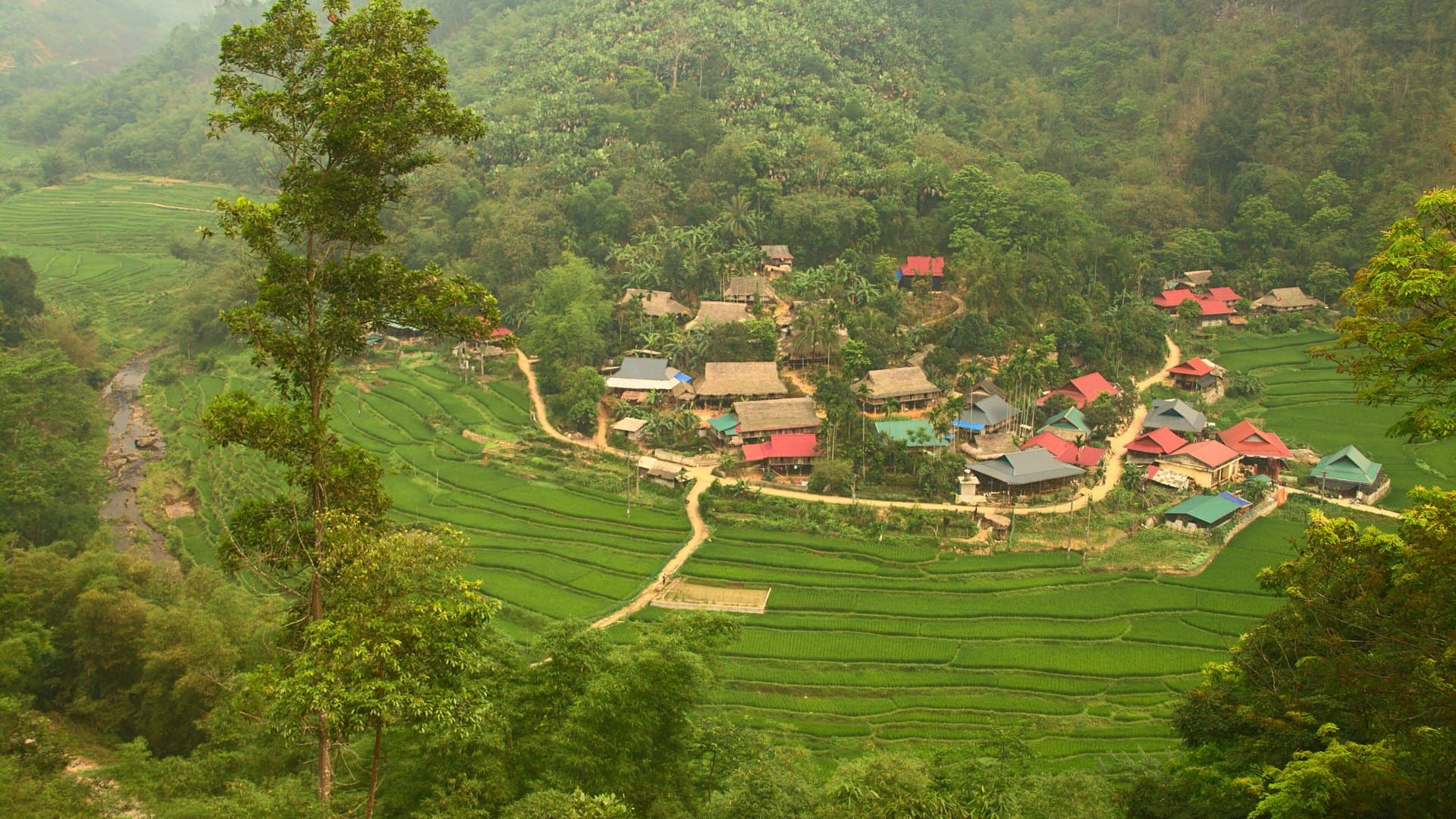
Pu Luong is a nature reserve of terraced valleys, forested limestone ridges and Thai stilt-house villages in Thanh Hoa province, about 160 km south-west of Hanoi. It is the quiet alternative to Sapa: smaller terraces, far fewer visitors, bamboo water wheels on the rivers and easy walks between villages, with a tough climb to the 1,700 m peak for the energetic. The rice turns gold twice a year, in May-June and from late September to mid-October. Plan on two or three nights, because the drive takes four to five hours each way.
The reserve was created in 1999 and covers 17,662 ha. Since the 2025 reforms, "Pu Luong" is also the name of a commune covering the main tourist villages, including Don and Kho Muong. Our comparison of Sapa, Mai Chau and Pu Luong helps you decide which valley suits you.
Getting there from Hanoi
| Option | Time | Price (2026) | Notes |
|---|---|---|---|
| Limousine van | ~4.5-5 hours | ~328,000-350,000 VND | About 4 departures a day, 06:40-13:30 |
| Private car, 4 seats | ~4 hours | ~1.5 million VND one way | 7-seater about 1.7 million |
| From Mai Chau | ~1.5-2 hours | private car, about $35-48 | About 46 km; no public transport |
Limousine vans pick up in the Old Quarter and around the Opera House and drop off along the main road through the reserve and at Ban Don, the village with the densest terraces. Tell the driver the name of your homestay; many will drop you close to it. Our limousine van guide explains how the vans work.
Many travellers combine Pu Luong with Mai Chau: Don village is about 46 km from Mai Chau, 1.5 to 2 hours by car, but there is no public transport between them, so you need a private car.
When to go: the rice calendar
- Late September to mid-October: the main golden season, when the terraces ripen and are harvested, later and longer than elsewhere in the north, with rice still in the fields into late October.
- May to June: the second golden season, with the harvest from around mid-May. It is hotter, and the rainy season is starting.
- January-February and June: after each harvest, the fields are ploughed and flooded for planting, and the water-filled terraces reflect the sky.
- July and August: the wettest months, with heavy rain, muddy paths and a risk of landslides on the roads.
- December to February: dry but cool and often misty; nights can be cold in the villages.
The nearest official weather station, in the valley at Hoi Xuan, records about 1,780 mm of rain a year, with 220 to 333 mm a month from May to September and only 15-17 mm a month from December to February. The villages, at about 500 to 1,000 m, are cooler than the valley station suggests. Our Hanoi weather guide shows the northern seasons for the rest of your trip.
What to do
Walk the villages and terraces. The heart of Pu Luong is Ban Don, a Thai village of stilt houses among the most concentrated terraces, and the paths between it and the neighbouring villages make easy half-day walks. Son-Ba-Muoi, three remote villages in a small valley at about 1,180 m, is a harder hike, often called a miniature Sapa.
See the bamboo water wheels. Big bamboo water wheels lift water from the river into the fields, especially around Chieng Lau village, about 5 km from Canh Nang, and Ban Cong. A bamboo raft ride on the river costs about 50,000 VND per person.
Hieu waterfall. A multi-tiered stream with five falls over nearly a kilometre, near Pho Doan, reached by a walk and wade of about an hour to the top. It is at its fullest after the rains.
Pho Doan market. A local ethnic-minority market held on Thursday and Sunday mornings, from about 6:00 to 10:00.
Climb Pu Luong peak. The summit at about 1,700 m is a steep 6 to 8 hour climb from Don village on rocky paths with little water. Go with a guide, in the dry season.
Kho Muong village. Deep in the reserve, Kho Muong is a Thai village of about 60 households, reached on multi-day treks. Its Bat Cave (Hang Doi) has been closed since 12 September 2026, after the reserve's management board stopped visits because of falling rocks, as Tuoi Tre reported. Check locally before planning around it.
Where to stay: homestays and eco-lodges
Pu Luong commune alone had about 67 places to stay in late 2025, 32 of them run by local families, with room for about 2,800 guests a night, according to the provincial newspaper Bao Thanh Hoa. They range from simple stilt-house homestays, where you sleep on a mattress in a shared room, to boutique eco-resorts with pools overlooking the terraces.
- Homestays: about 100,000 to 300,000 VND a night for a bed or simple room, according to local reports, usually with dinner available for an extra charge.
- Eco-lodges and resorts: about 500,000 to 2,000,000 VND a night or more.
Stay around Ban Don for the terraces and easy walks, or in the quieter villages further in for more solitude. Book ahead for weekends, public holidays and the golden season, when Hanoi residents fill the homestays. For food, try the local Co Lung duck, about 450,000 VND for a bird that feeds three or four, along with hill chicken, wild greens and five-colour sticky rice.
Practical tips
- Cash. Bring enough cash for homestays, drivers and the market.
- Roads. Many village roads are still dirt and slippery after rain, and a storm in late 2025 damaged the road to Don village, with repairs scheduled for early 2026. Ask your homestay about current conditions.
- Guides. No official rule requires one for village walks, but hire a local guide for the peak and longer treks.
- Getting around. Ask your homestay to help arrange transport between villages.
How Pu Luong fits a northern trip
Pu Luong works as a two- or three-night break from Hanoi, or as part of a loop with Mai Chau. Our Vietnam trekking guide compares it with Sapa, Ha Giang and Cuc Phuong, and our best day trips from Hanoi guide covers shorter escapes if you have less time.
Limitations
Prices come from local news reports and booking platforms, and we found no reliable 2026 survey of per-person homestay rates with meals. The weather figures come from a valley station and overstate how warm the villages are. Trail conditions, closures such as the Bat Cave, and road repairs change after storms, and we could not confirm that the 2025 storm damage had been fully repaired.
Workaround: book a homestay that can advise on current trails and roads, bring cash and a warm layer, and hire a local guide for anything beyond the easy village walks.