
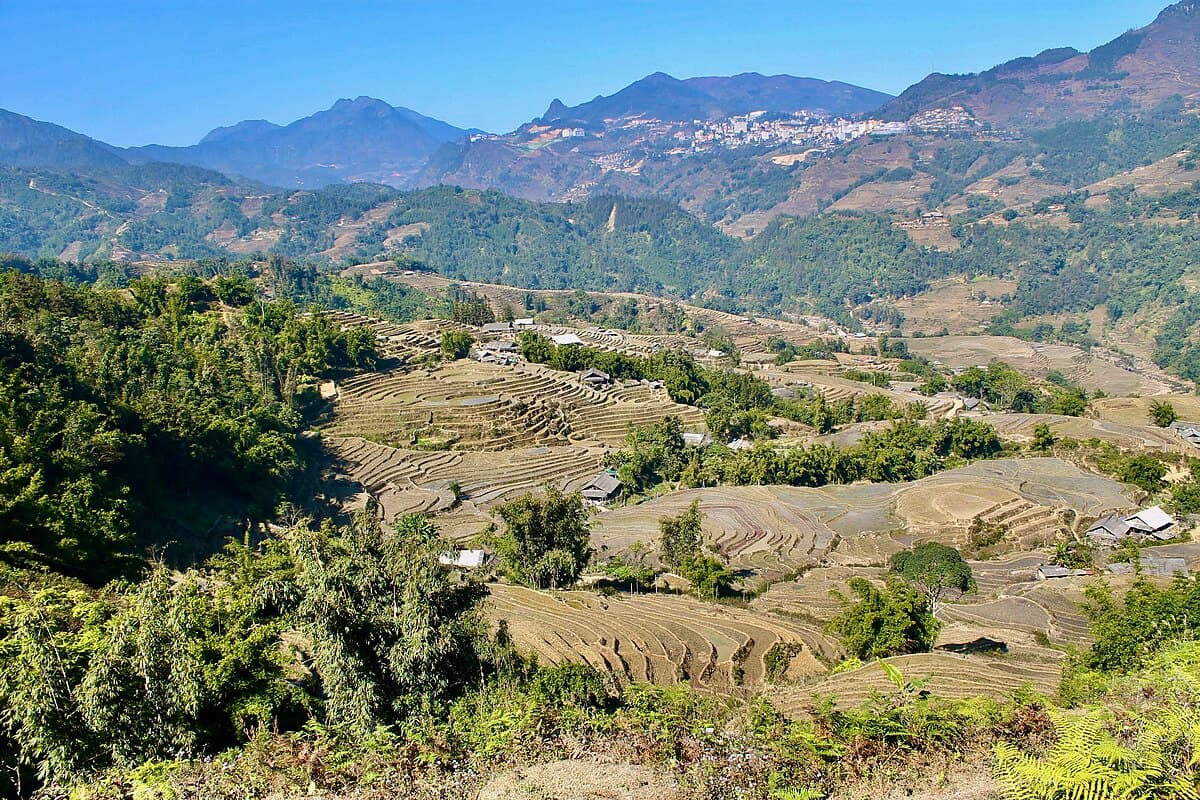
The best trekking in Vietnam is concentrated in the north, and the regions are genuinely different from one another — picking the right one matters more than any single trail choice. If you only know the name Sapa, you are likely to either over-crowd yourself or pick scenery that does not match what you came for. This is a trekking-only roundup: a comparison of the country's walkable regions by difficulty, season, scenery, and homestay model. For caving, motorbiking, diving and the rest of the adventure picture, see our broader Vietnam Adventure & Outdoor Atlas 2026; this guide goes narrower and deeper on trekking alone.
The trekking regions, compared
| Region | Difficulty | Typical days | Best season | Scenery | Homestay model |
|---|---|---|---|---|---|
| Sapa / Muong Hoa valley | Easy–moderate | 1–3 | Sep–Nov, Mar–May | Terraced rice, H'mong & Red Dao villages | Village homestays, women's collectives |
| Pu Luong (Thanh Hoa) | Easy–moderate | 2–3 | Sep–Apr | Terraced rice, nature reserve, quieter | White Thai & Muong stilt houses, eco-lodges |
| Ha Giang | Moderate (but ride it) | 1–2 walking | Sep–Nov, Mar–May | High karst plateau, switchback passes | Limited; better as a motorbike base |
| Cat Ba National Park | Moderate | 0.5–1 | Mar–Nov | Jungle, limestone, Lan Ha Bay views | Island guesthouses, not village homestays |
| Cuc Phuong | Easy | 0.5–1 | Oct–Apr (dry) | Oldest national park, primate centre, old-growth forest | Park lodging, nearby Muong homestays |
| Bach Ma (near Hue) | Easy–moderate | 0.5–1 | Feb–Sep | Central cloud forest, waterfalls, summit views | Park guesthouse, summit villa |
| Mai Chau (Hoa Binh) | Easy | 0.5–1 | Sep–Apr | Gentle valley, paddy, easy cycling | White Thai stilt-house homestays |
| Fansipan | Hard (or cable car) | 2 (trek) | Sep–Nov, Mar–May | Indochina's roof at 3,143 m | Mountain camp on the trek |
Sapa and the Muong Hoa valley is the classic, and for good reason — the terraces drop nearly a thousand metres across a string of H'mong and Red Dao villages, and it is the single best place in the country to actually walk among ethnic-minority communities rather than view them from a bus. It is also the busiest, with the headline Lao Chai–Ta Van route now carrying hundreds of trekkers a day in peak months. If you want a single-day plan with specific routes, distances and how to book a village guide, our dedicated Sapa trekking day trip guide covers it trail by trail.
Pu Luong, in Thanh Hoa province, is the quiet answer to Sapa. The 17,662-hectare nature reserve holds the same terraced-rice scenery on gentler gradients, with White Thai and Muong stilt-house villages and a fraction of the foot traffic. Homestays sit on floor mats in family stilt houses, and a few marquee eco-lodges have opened on the ridges. It typically works as a two- to three-day trip from Hanoi rather than a day walk, which is part of why it stays quieter.
Ha Giang is trek-able but is fundamentally a riding region. You can walk village-to-village sections around Dong Van and Lung Cu, but the scale of the karst plateau and the switchback passes reward a motorbike far more than boots — the famous loop is a riding experience first. If trekking is the priority, spend the days in Sapa or Pu Luong instead; our Sapa versus Ha Giang comparison lays out the trade-off in detail.
Cat Ba National Park swaps rice terraces for jungle and limestone. Trails range from a short Kim Giao forest walk to a longer traverse toward Viet Hai village, often combined with kayaking out into Lan Ha Bay. It is a national-park trek with island-guesthouse lodging rather than the village-homestay culture of the northern valleys.
Cuc Phuong is Vietnam's oldest national park, established in 1962, and the gentlest entry on this list. The draw is old-growth forest — including a thousand-year-old tree at the end of a short trail — and the Endangered Primate Rescue Centre, which cares for langurs and doucs you will not see in the wild. Trails are short and easy, which makes it a strong family choice.
Bach Ma, between Hue and Da Nang, is the main trekking option in central Vietnam: a cloud-forest national park climbing to a roughly 1,444 m summit, with waterfall trails and ladder-and-rope sections on the Five Lakes route. It suits travellers who are based in the centre and do not want to commit to a northern detour.
Mai Chau, in Hoa Binh, is the gentle option — a flat White Thai valley of paddy and stilt houses, walkable or cyclable in easy loops, close enough to Hanoi for a short trip. It is the place to send anyone who wants the homestay-and-paddy experience without a demanding walk.
Fansipan is the outlier. Indochina's highest peak at 3,143 m can be summited on a hard two-day hike through Hoang Lien National Park, or reached in minutes by cable car. Most visitors take the cable car; the trek is for fit, experienced walkers only.
Guided versus independent
The signed valley-floor routes around Sapa and the marked national-park trails at Cat Ba and Cuc Phuong can be walked independently. Almost everything else is better — and some nature-reserve trails require — with a guide, who handles route-finding, the homestay arrangement, and the transport back at the end of a one-way descent. Some parks also ask you to register at the gate or be accompanied on longer routes.
The model that defines northern Vietnam trekking is the homestay trek with a local guide: you walk village to village with someone who lives there, eat and sleep in a family home, and ride back rather than retrace your steps. Hiring an ethnic-minority guide — H'mong or Red Dao in Sapa, White Thai in Pu Luong and Mai Chau — is not only better company; it keeps the money in the community rather than with a town agency. The sustainability case for walking with a village-based guide is real, and we make it more fully in our off-the-beaten-path atlas.
Season, fitness, and what to pack
For the northern regions the two reliable windows are mid-September to November and March to May. The rice harvest turns the terraces gold from roughly late September — the most photographed moment of the trekking year. June to August is hot, humid and prone to afternoon storms that turn the red-clay trails slick; December to February is cold and often fogged in, atmospheric but less rewarding underfoot. Lower, jungle-led parks like Cat Ba and Cuc Phuong tolerate a wider window but are still wettest in summer. For the full regional weather picture, our best time to visit Vietnam guide breaks it down month by month.
Fitness tiers sort the regions cleanly. Gentle: Mai Chau, the short Cuc Phuong trails, Bach Ma's easier walks. Moderate full days: the classic Sapa routes, Pu Luong, Cat Ba. Hard: the Fansipan summit hike, and the longer Sapa loops with real climbs.
Pack trail shoes with grip — waterproof from June to September — long trousers for leech protection in wet undergrowth, a light wind or rain layer, sun protection, at least 1.5 litres of water, and cash for homestay meals. Add a warm layer in the northern winter, when dawn temperatures can sit in the low single digits.
How to choose your trek
- You want the iconic terraced-rice photos and the cultural depth — Sapa, with a village guide and ideally a longer or quieter route than the default.
- You want that same scenery without the crowds — Pu Luong, two or three days from Hanoi.
- You are short on time near Hanoi and want it gentle — Mai Chau.
- You want jungle and bay views, not rice terraces — Cat Ba.
- You are travelling with family or want the easiest day — Cuc Phuong.
- You are based in central Vietnam — Bach Ma from Hue.
- You want a summit — Fansipan on foot if you are fit, or the cable car if not.
Limitations
This is a regional comparison, not a turn-by-turn trail guide — distances, homestay prices and exact route conditions shift year to year and after heavy rain, so treat the difficulty and season columns as a planning prior rather than a guarantee. Workaround: confirm current trail conditions and one-way transport with a village-based guide or homestay the day before you set out, especially in the June–September wet season. We have also kept this to established, regularly walked regions; Vietnam has emerging trekking areas (Ba Be, parts of the northeast) that are worth watching but thinner on reliable guiding.