
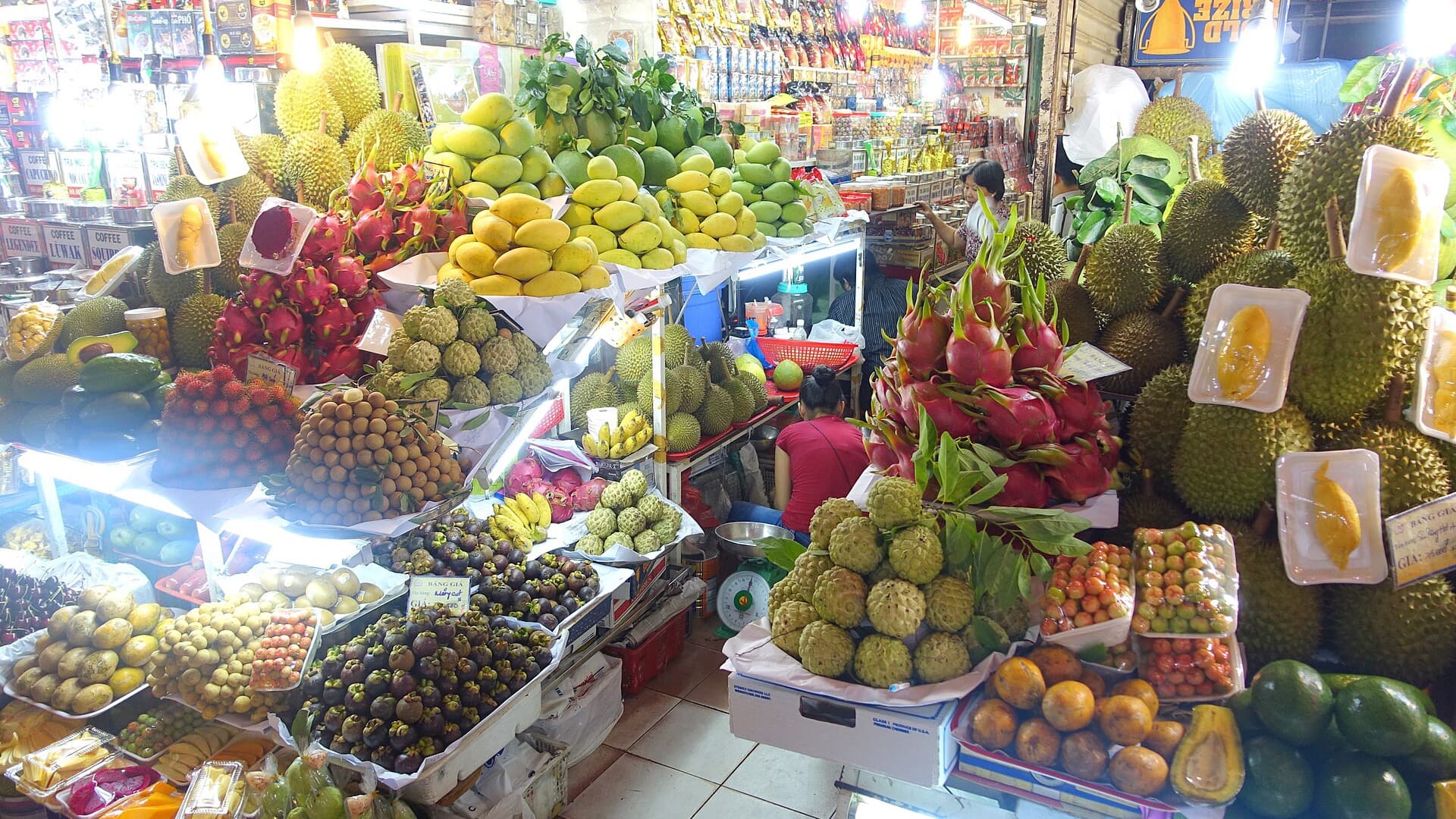
Most bargaining advice for Vietnam is a single sentence about offering half the asking price, which is both the least useful thing you can be told and frequently wrong. The genuinely useful information is narrower: which situations involve bargaining at all, and roughly what a thing should cost before you open your mouth.
Prices are quoted in Vietnamese dong with US dollars at roughly 26,000 VND to the dollar, and every figure describes a band observed as of mid-2026 rather than a quote.
Where bargaining is expected, and where it is not
| Setting | Bargain? | What to expect |
|---|---|---|
| Tourist market stalls (Ben Thanh, Dong Xuan, Hoi An cloth market) | Yes, firmly | Opening quotes often 2-3x the local price |
| Souvenir and craft stalls generally | Yes | Roughly 20-40% off the first number |
| Hoi An tailors | Yes, on the package | Room on quantity and extras, less on quality |
| Cyclos | Yes, and settle it before you sit down | Agree the exact figure and the duration |
| Unmetered xe om flagged on the street | Yes | Check the Grab price first, then match it |
| Hotel walk-in rate, low season | Politely, yes | Often 10-20% off the rack rate |
| Independent boat and day-trip operators booked in person | Sometimes | More room in low season and for groups |
| Restaurants and street-food stalls with posted prices | No | Prices are fixed and inclusive |
| Supermarkets and convenience stores | No | Scanned, fixed, receipted |
| Grab and metered taxis | No | The fare is quoted or metered |
| Pharmacies | No | Fixed pricing, often labelled |
| Museum and heritage site entry | No | Published ticket prices |
| Cafes and specialist roasters | No | Menu prices |
| Train and bus tickets at official counters | No | Fixed by the operator |
The simple test, which covers almost every case: if the price is posted, it is fixed. Bargaining where a price is displayed is not offensive so much as slightly baffling, in the way that haggling over a supermarket receipt would be at home. Where no price is displayed and the seller names a number out loud, you have been invited into a negotiation whether you wanted one or not.
The opening-offer maths, and why halving is often wrong
The right counter depends entirely on how tourist-facing the stall is, and this is the part the half-the-price rule flattens away.
In a heavily tourist market — Ben Thanh, the Dong Xuan surrounds, the souvenir rows of Hoi An — opening quotes to a visibly foreign buyer commonly run two to three times what a local would pay. Counter at roughly 40-50% of the first price, move in small steps, and expect to settle near 60-70% of the opening number. Half of a three-times quote still leaves you paying fifty percent over the local price, which is where the rule of thumb quietly fails.
In a neighbourhood market away from the tourist streets, the first quote may already sit within 10-30% of fair. Expect 10-20% off at most, and quite often nothing. Halving a nearly fair price is not a negotiation, it is an implicit accusation, and it usually closes the conversation rather than opening it.
Two smaller effects. The opening quote scales with how obviously foreign you look and how you arrived, which is ordinary market behaviour rather than a scam. And many sellers hold that the first sale of the day sets their luck, so the morning price is frequently the softest on offer.
Know the local price before you start
The single highest-leverage move is not a technique, it is arriving with a number in your head. These are realistic bands as of mid-2026 and align with the fuller inventory in our Vietnamese souvenirs guide.
| Item | Realistic price band (mid-2026) | Bargaining room |
|---|---|---|
| Fridge magnet or keyring | 20,000-40,000 VND ($0.75-1.50) | Some, buy in threes |
| Tourist-market T-shirt | 80,000-150,000 VND ($3-6) | Yes, meaningful |
| Plain conical hat (non la) | 40,000-80,000 VND ($1.50-3) | Some |
| Silk scarf, market grade | 130,000-260,000 VND ($5-10) | Yes |
| Lacquer bowl or tray | 200,000-1,000,000 VND ($8-38) | Yes, hard |
| Copy-brand jacket, Sapa or Ben Thanh | 300,000-700,000 VND ($12-27) | Yes, hard |
| Aluminium phin coffee filter | 15,000-40,000 VND ($0.60-1.50) | Little |
| Whole-bean coffee, 250 g | 100,000-300,000 VND ($4-12) | None at roasters |
| Cyclo, 30 minutes in the Old Quarter | 150,000-250,000 VND ($6-10) | Agree before boarding |
| Short xe om hop, 2-3 km | 20,000-40,000 VND ($0.75-1.50) | Match the Grab quote |
| Tailored shirt, Hoi An | $25-45 | Yes, on quantity |
| Tailored suit, Hoi An | $150-400 | Yes, on quantity |
How to bargain well
- Decide your walk-away number before you speak. Everything after that is arithmetic rather than nerve.
- Let them name the first price. Asking bao nhieu tien and then pausing is stronger than opening with a number of your own.
- Keep the tone warm and unhurried. Smiling works, mock outrage does not, and a raised voice loses the deal outright. This is a social exchange with a transaction attached, not a contest.
- Counter once, meaningfully, then move in small increments. Three tiny concessions read as more serious than one large capitulation.
- Walking away is legitimate and often produces the real price before you reach the next stall. Do it once and genuinely; a theatrical exit convinces nobody.
- Buy multiples. Three scarves is a far stronger lever than one, and sellers would rather move stock than defend a unit price.
- Have the cash ready, close to the exact amount. Producing a 500,000 VND note for a 120,000 VND item invites a change problem and weakens your hand. Watch the pair everyone confuses, the 20,000 and the 500,000, and count the change; the currency exchange guide covers this properly.
- If you name a price and they accept it, you have bought it. Backing out after agreement is the one move here that is genuinely rude.
When to stop grinding
There is a point in most market negotiations where the remaining gap is 20,000 to 50,000 VND, which is under two dollars to a visitor and a real fraction of a stallholder's margin on the day. Getting to a fair price is the objective. Getting to the last note is not, and it turns a pleasant exchange into something that leaves both people slightly worse off.
It is also worth being honest about what a tourist premium is. Paying somewhat more than a local pays for a souvenir is not a scam, it is a market responding to what it knows about you. The etiquette guide has more on the tone that keeps these interactions warm, and the tipping guide covers where extra money is genuinely welcome.
Being overcharged is not the same as being bargained with
The distinction decides how you should react. Bargaining means a number is quoted before anything happens, you are free to decline, and both sides agree before money moves. Overcharging means the price arrives after the fact: the cyclo ride that ends with a figure nobody mentioned at the start, the taxi meter running at several times the normal rate, the wrong change handed back, the item swapped for a lesser one while it is being wrapped.
One habit converts most of the second category into the first: agree the number out loud, or typed on a phone screen, before the ride or the service begins. For the specific patterns and where they run, see our Vietnam scams guide and the broader hidden costs guide. The boundary is what matters: a hard opening quote in a market is ordinary commerce, and a price demanded after you are already committed is not.
Words and numbers that help
Four phrases cover nearly every market exchange:
- Bao nhieu tien — how much does it cost
- Dat qua — too expensive
- Bot chut duoc khong — can you come down a little
- Khong, cam on — no thank you, and how you leave politely
The numbers are worth ten minutes: mot, hai, ba, bon, nam, sau, bay, tam, chin, muoi for one through ten, and tram for hundred. What trips visitors up is that market prices are spoken in thousands with the thousand dropped, so a seller saying hai tram, two hundred, means 200,000 VND. When the arithmetic gets complicated, both sides type into a phone calculator and hold up the screen, which is understood everywhere and costs nobody any face.
Limitations
- Every price band here is an observed range as of mid-2026, not a quote, and craft and souvenir prices vary by workshop, city, season and stall. Dollar figures use roughly 26,000 VND to the dollar and will drift.
- The counter-offer percentages are heuristics, not measurements. They describe common market behaviour in tourist-facing districts, and a specific stall can sit well outside them.
- Where bargaining is expected shifts over time. Fixed-price shops, card payments and app-based transport have all narrowed the territory in recent years.
- Nothing here overrides your own read of a situation. If a negotiation stops feeling good-natured, the correct move is to stop, not to win.
How to cite this
Nguyen, J. (2026). Bargaining in Vietnam 2026: Where to Haggle and How Much. Day Trips Vietnam. Retrieved from https://daytripsvietnam.com/guides/vietnam-bargaining-guide-2026/
Published under Creative Commons BY 4.0. Editorial enquiries: info@daytripsvietnam.com.
Related research and reference
- Vietnam Scams to Avoid — where a hard price stops being a negotiation
- Hidden Costs in Vietnam 2026 — the surprise-charge inventory
- Vietnamese Souvenirs Guide 2026 — what each item should cost
- Vietnam Tipping Guide 2026 — where extra money is welcome
- Vietnam Etiquette Guide 2026 — the tone that keeps exchanges warm
- Vietnam Currency Exchange 2026 — notes, change and the confusable pair
- Vietnam Travel Budget 2026 — where shopping sits in a trip budget