
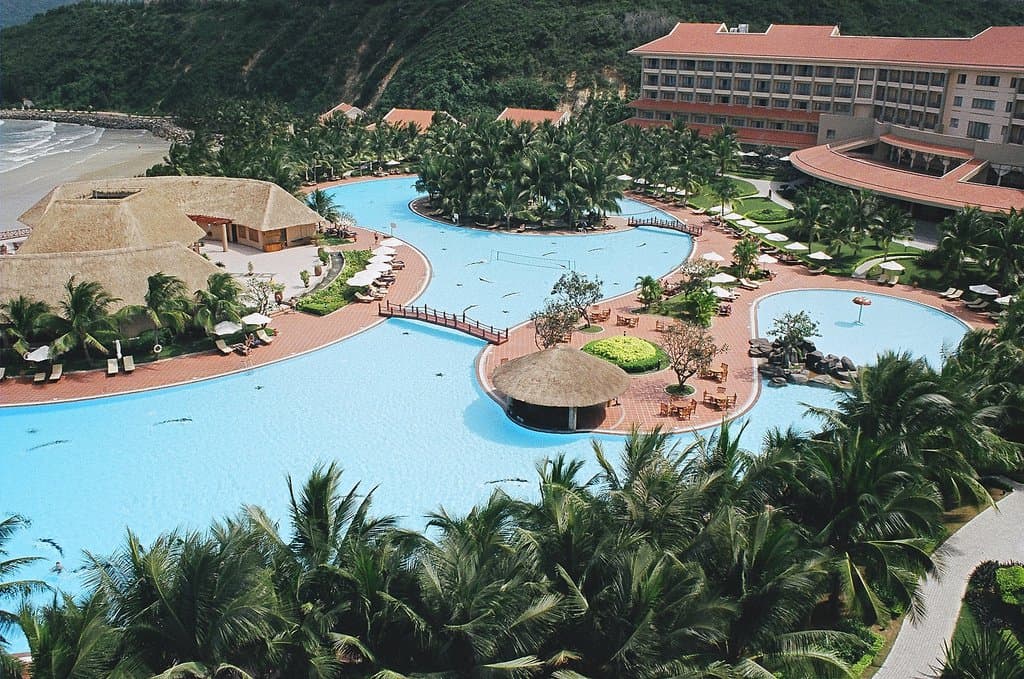
If you searched for average hotel prices in Vietnam, most results hand you a single national number that is nearly useless — a Hue guesthouse and a Phu Quoc beach villa differ by a factor of fifty. This page is the dedicated rate reference: what a night actually costs in 2026, city by city and tier by tier. Every figure below is a typical online rate as of mid-2026 (the kind you see on Booking.com or Agoda booked about 60 days out), with a seasonal swing of roughly ±30% in either direction.
The headline answer:
- Hostel dorm bed — $7–18 per person. Most cities sit at $7–14; central Hanoi and Ho Chi Minh City top out near $18. Ninh Binh and Da Lat dip to $6.
- Budget private room (guesthouse, mini-hotel) — $15–55 for a double. $15–30 covers most of the country; the tourist cores of the two big cities run $25–55.
- Mid-range 3-star — $25–100. Hue, Ninh Binh, and Da Lat sit around $25–50; central Hanoi and HCMC at $55–100.
- 4-star — $60–260. Nha Trang's high-rise supply keeps its 4-stars near $60–130; boutique 4-stars in Hanoi's Old Quarter or HCMC's District 1 run $130–240.
- 5-star hotel — $120–650. Secondary cities like Hue and Da Lat start around $120–150; the international flagships in Hanoi and HCMC run $260–650.
- Luxury resort tier — $250–600 and up, with Phu Quoc's flagship cluster reaching $900 a night.
The pattern holds across every tier: Hanoi and HCMC anchor the top of each band, Hue and the smaller inland cities the bottom, usually 25–40% apart for an equivalent property.
Two companion pages cover what this one deliberately does not. Our Vietnam travel cost index rolls these room rates into full daily budgets — food, transport, and activities included — and is the source these bands are aligned with. Our where to stay in Vietnam guide answers the which-city, which-neighborhood question these prices attach to. This page does one job: the nightly rate.
Nightly rates by city and tier
All figures are typical online rates for a standard double room (dorm rates per bed), observed in a roughly 60-day advance booking window as of mid-2026. Treat every number as the midpoint of a moving market — seasonal swing runs about ±30%, and Tet week can exceed even that.
| City | Dorm bed | Budget private | 3-star | 4-star | 5-star / resort |
|---|---|---|---|---|---|
| Hanoi | $10–18 | $25–50 | $55–100 | $130–230 | $260–600 |
| Ho Chi Minh City | $10–18 | $28–55 | $55–100 | $140–240 | $280–650 |
| Da Nang | $9–15 | $22–40 | $40–75 | $90–180 | $180–450 |
| Hoi An | $8–14 | $20–35 | $35–70 | $80–170 | $200–500 |
| Hue | $7–12 | $18–30 | $28–50 | $70–130 | $150–350 |
| Nha Trang | $7–14 | $18–35 | $30–60 | $60–130 | $140–350 |
| Phu Quoc | $9–16 | $30–55 | $50–90 | $130–260 | $300–900 |
| Sapa | $7–14 | $18–32 | $30–60 | $75–150 | $150–400 |
| Ninh Binh | $6–12 | $15–30 | $25–50 | $60–120 | $120–280 |
| Da Lat | $6–12 | $15–30 | $25–55 | $60–130 | $120–300 |
How to read the spread:
- Hanoi and HCMC carry a structural premium. Old Quarter and District 1 rates ride on business-traveler demand and have grown 5–12% annually for years — boutique 4-stars that charged $80 in 2023 are commonly $120–160 in 2026. Step one ward outside the tourist core and rates drop sharply for equal or better rooms.
- Phu Quoc sets the national ceiling, not the national average. The flagship resort cluster (JW Marriott Emerald Bay, Premier Village, Salinda) explains the $900 top; mid-range Phu Quoc is mid-pack, though rates are up 10–20% on 2024.
- Hoi An charges for the postcard. Ancient Town addresses carry a heritage-zone premium; staying one or two blocks outside it is typically 20–30% cheaper for comparable quality.
- Nha Trang is the underpriced beach tier. Years of high-rise construction and package-tour economics mean its 4-star and 5-star stock is the cheapest branded beach inventory in the country.
- Hue, Ninh Binh, and Da Lat are the floor. Hue is consistently the cheapest of the major destinations, and Ninh Binh's top end is thin — its "5-star" column is really a handful of premium boutique resorts rather than a deep market.
These bands match the accommodation lines in the cost index — same observation window, same tier definitions — extended here to ten cities and kept in per-night form.
What each tier actually gets you
Vietnamese star ratings are self-declared, with no independent audit behind them, so the label needs translation.
The $40 Vietnamese 3-star is a clean, air-conditioned ensuite double, usually with a reasonable included breakfast and sometimes a balcony. What it is not: spacious. Rooms run smaller than Western travelers expect, mattresses are firm, walls are thin, and the elevator — if there is one — fits two people and a backpack. Calibrate it as a Western 2-star with notably better service and it will keep exceeding expectations.
4-star is the fuzziest label in the market. The band covers everything from a genuinely polished boutique with a rooftop pool to a tired 200-room package property last renovated a decade ago. This is the one tier where recent reviews and real guest photos matter more than the price.
International 5-star brands are the honest bargain. A night that costs $500–700 under the same flag in Paris or Sydney runs $180–350 in Da Nang or Hue, and staffing ratios are among the most generous anywhere the brands operate. If you ever intend to try the top tier, Vietnam is where it costs least. Families weighing this tier should see our family resorts guide.
"Homestay" usually means a small guesthouse with hosts on site, not a bed in someone's living room — private rooms at $15–35, shared common spaces, hosts who cook. The exception is Sapa's villages and parts of the Mekong Delta, where a homestay can still be a mattress in a stilt-house common room for $8–15 with meals included. A guesthouse (nhà nghỉ) is the family-run building of 5–15 basic rooms; the mini-hotel is its urban cousin — narrow, vertical, and often the best value in the big cities.
Seasonality, weekends, and when to book
The ±30% hedge on the table is not decoration; it is the shape of the year.
Tet is the single biggest spike. In the week around Lunar New Year (late January to mid-February depending on the year), domestic travel peaks and beach resorts, Da Lat, and anywhere warm can double their rates — when rooms are available at all. The counter-trade: some Hanoi and HCMC hotels soften over Tet as residents leave town and business travel stops.
Summer is domestic beach season. June through August, school holidays send Vietnamese families to Da Nang, Nha Trang, and Phu Quoc, lifting beach rates 20–40% while Hanoi, HCMC, and Hue stay roughly flat — it is the hot low season for Western visitors.
Weekends move beach cities, not big cities. Friday and Saturday nights in Da Nang, Nha Trang, and Phu Quoc commonly run 20–50% above midweek, because the marginal guest is a domestic weekender. Hanoi and HCMC hotels lean on weekday business demand, so their weekend rates hold flat or dip. A flexible itinerary that hits beaches midweek and cities at weekends quietly saves real money.
October–November is the value shoulder. Good weather across most of the country, post-summer domestic lull, pre-Christmas international lull — the best weather-to-price ratio of the year in the center and south.
Booking window: two to four weeks is enough most of the year. The table reflects roughly 60-day-advance pricing; inside two weeks, the well-reviewed mid-range stock in Hoi An and the Old Quarter sells down first. For Tet, the April 30–May 1 block, and the September 2 National Day weekend, book two to three months out. For the month-by-month picture, see the monthly price calendar.
Taxes and fees: reading the ++ fine print
Vietnamese hotel pricing has a small honesty problem at the top end. Upper-mid-range and luxury properties often quote "++" (plus-plus) rates — the room price excluding a 5% service charge and VAT, which is 10% standard but frequently reduced to 8% under the rolling stimulus cuts in effect as of mid-2026. A quoted $200 villa can settle around $228–230 at checkout. Online travel agencies usually fold both into the total by the payment page; direct quotes from hotels are the most likely to be ++ without flagging it. Below 3-star this mostly disappears: guesthouse and mini-hotel prices are net, and the number on the sign is the number you pay. When comparing a direct rate against an online rate, compare final checkout figures, never the headlines.
Prices in AUD, GBP and EUR
Australian and British readers are among this site's largest audiences. The headline figures above, converted:
| Tier (national range) | USD / night | AUD / night | GBP / night | EUR / night |
|---|---|---|---|---|
| Dorm bed | $7–18 | A$9.5–25 | £5–13 | €6–16 |
| Budget private | $15–55 | A$21–76 | £11–41 | €13–47 |
| 3-star | $25–100 | A$35–140 | £18–74 | €22–86 |
| 4-star | $60–260 | A$83–360 | £44–190 | €52–225 |
| 5-star / resort | $120–650 | A$165–900 | £89–480 | €105–560 |
Phu Quoc's flagship resorts run to about $900 a night at the top of the band, roughly A$1,250, £665 or €775.
Rates as of 5 September 2026: 1 USD = 1.39 AUD = 0.74 GBP = 0.86 EUR = 26,025 VND (Exchange Rate API open endpoint). The underlying prices are the mid-2026 figures on this page; they were not re-collected for this conversion, and exchange rates move a few percent a quarter, so treat the converted columns as planning ranges rather than quotes.
Limitations
- These are planning bands, not quotes. Figures are typical online rates observed in mid-2026 in a roughly 60-day booking window. The market moves, and the ±30% seasonal swing — more at Tet — applies to everything above.
- Star ratings are self-declared. A good 3-star and a weak 4-star overlap heavily; no table can fix that — recent reviews can.
- Ranges cover standard doubles, midweek. Suites, family rooms, and single-night weekend beach stays sit above the printed bands.
- Supply is shifting fast. Phu Quoc and Da Nang keep adding rooms, and a new tower can soften local rates within months, while renovations and rebrands push individual properties out of band.
- Long-stay pricing is out of scope. Monthly serviced-apartment and extended-stay rates follow different math and are not covered here.
Related reading
- Vietnam travel cost index 2026 — these room rates rolled into full daily budgets, with sources
- Where to stay in Vietnam — which city and which neighborhood, once you know the price
- Best Vietnam family resorts 2026 — the upper tiers of this table, chosen for kids
- Cheapest time to visit Vietnam: monthly price calendar 2026 — the seasonality section, month by month
- Vietnam travel budget guide — daily budgets by traveler tier