
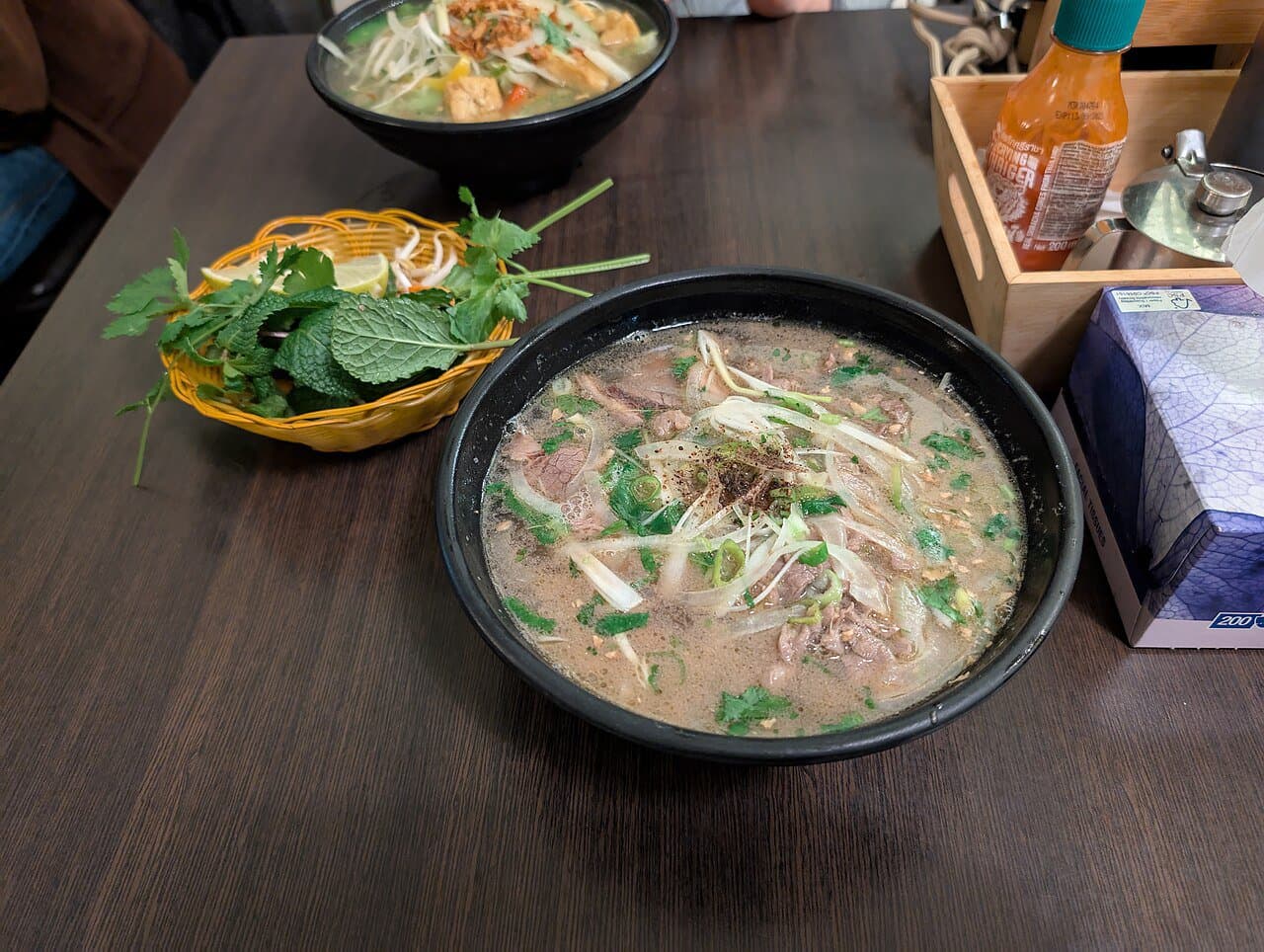
Between 2020 and 2026, the cost of a day of travel in Vietnam rose roughly 25–35% in dong terms — and roughly 10–20% in dollar terms. The gap between those two numbers is the story of this tracker: the dong slid about 13% against the dollar over the same six years, quietly absorbing about half of the inflation that foreign travelers would otherwise have felt. A trip that cost $50 a day in 2020 costs roughly $55–60 a day in mid-2026.
This page is the six-year backward extension of our Vietnam travel cost index 2026, which is the current-year endpoint of the series. Every row below names a documented source — a GSO release, a provincial resolution, a dated press report — and where the 2020 base is patchy, the row says so rather than pretending. The machine-readable dataset lives at /data/vietnam-trip-inflation-2020-2026.json.
The headline: a $50 day in 2020 is a $55–60 day in 2026
Run the arithmetic in both currencies and the picture splits.
In dong terms: $50 exchanged in 2020 bought roughly 1,160,000 VND at that year's average rate of about 23,200 VND/USD (World Bank period average). Buying the equivalent day of travel in mid-2026 — the same meals, the same room tier, the same rides and one entry fee — costs roughly 1,450,000–1,570,000 VND by our travel-weighted estimate. That is a 25–35% increase, meaningfully above the general CPI, because the items tourists buy disproportionately (entry fees, flights, mid-range hotel nights) rose faster than the overall index.
In dollar terms: that 1,450,000–1,570,000 VND converts at mid-2026's rate of roughly 26,300 VND/USD to $55–60. The traveler's felt inflation is 10–20% over six years — modest by post-2020 global standards, and considerably gentler than what Vietnamese residents experienced in their own currency.
The offset is worth stating plainly because most coverage gets it wrong in one of two directions: either "Vietnam is getting expensive" (true in dong, overstated in dollars) or "Vietnam is still as cheap as ever" (roughly true for street food, false for fees and flights). Both currencies are reported in every row below.
For context, the general price level per the GSO's annual CPI averages compounded to roughly +16% from 2020 through 2025 (3.23%, 1.84%, 3.15%, 3.25%, 3.63%, 3.31%) — and then accelerated, with April 2026 printing +5.46% year-on-year and May +5.6%, the hottest readings since January 2020. The 2026 endpoint of this series sits in a rising-inflation environment, which is one reason we timestamp everything.
Category by category, 2020 → 2026
| Category | 2020 (documented/reported) | 2026 | VND change | Source and hedge |
|---|---|---|---|---|
| Pho, everyday Hanoi shop | 30,000–35,000 VND ($1.30–1.50) | 40,000–50,000 VND ($1.50–1.90) | +25–45% | Vietnamnet documented the 30,000→35,000→40,000 steps; 2026 range per our street food price guide |
| Banh mi, standard street | 15,000–25,000 VND (reported) | 20,000–35,000 VND ($0.80–1.40) | +25–40% | Vietnamnet documented 20,000→25,000 and 30,000→35,000 steps; 2020 low end reported, not surveyed |
| Mid-range restaurant main | 60,000–150,000 VND (reported) | 80,000–200,000 VND ($3.50–8.50) | roughly +30% | 2026 per cost index menu observations; 2020 base is the weakest in this table — see Limitations |
| Hotel, city ADR (Hanoi) | 2020–21 artificially discounted; 2019 peak ~$111 | $124 YTD-Aug 2025, $112 in 2024 | above pre-COVID | TTG Asia industry reporting; anchored to 2019, not 2020 — see the COVID note |
| Hotel, 3-star Hanoi/HCMC nightly | no clean 2020 base | $55–100 | 5–12%/yr since 2023 | Hotel price guide and cost index (Booking.com/Agoda observations) |
| Heritage entry fees | Trang An 250,000; Ha Long day route 240,000–290,000; Hue 200,000 VND | Trang An 300,000; Ha Long 260,000–310,000 plus 600,000 premium route; Hue 200,000 VND | 0 to +20% base, menu expanded | Trang An board notice (Jan 1, 2026); Quang Ninh Resolution 51/2025/NQ-HDND; Hue Monuments Conservation Centre |
| Domestic flight, booked ahead | fare-war lows (reported promos under 1,000,000 VND return) | $40–80 one-way major routes | caps +3.75% avg (Mar 2024); market fares up more | Ministry of Transport cap instrument; VnEconomy/VIR on the 2024 fare surge |
| Grab, short city ride | GrabBike Hanoi base 12,000 VND first 2 km | 13,500 VND base step (2022); typical ride 20,000–50,000 VND | +12.5% documented step | VnExpress, March 10, 2022 fare revision citing record petrol prices |
Two currencies, one caution: the USD conversions in the 2020 column use ~23,200 VND/USD and the 2026 column uses ~26,300. Comparing the dollar figures directly is exactly the point — that is what a dollar-carrying traveler experienced.
What rose fastest: entry fees and domestic flights
Entry fees are the clearest documented risers, because they change by published decree. Trang An's boat ticket went from 250,000 to 300,000 VND on January 1, 2026 — a 20% single-step increase, with the child ticket up from 120,000 to 150,000 VND, announced by the site's management board and reported across the Vietnamese travel trade. Ha Long Bay took a different route to the same destination: the base day-route fee barely moved nominally (240,000–290,000 VND in 2020 under the 2017 fee schedule versus 260,000–310,000 in 2026), but Quang Ninh's Resolution 51/2025/NQ-HDND added new fee-bearing routes from May 1, 2025, topped by the 600,000 VND combined route VHL7 — the fee menu expanded upward rather than the base price rising. Our Ha Long entrance-fee economics research covers why further increases have an evidence base: surveyed visitors would accept roughly $4 more per trip if revenue funds environmental protection.
Flights rose through two documented mechanisms. First, the regulatory one: from March 1, 2024, the Ministry of Transport lifted domestic fare ceilings by an average of 3.75% — the longest band (1,280 km and above, which covers Hanoi–HCMC) went from a 3.75 to a 4 million VND cap, per baochinhphu.vn. Second, the market one: 2024 fares rose well beyond the cap adjustment as Pratt & Whitney engine inspections grounded part of the domestic fleet and carriers cut capacity, a squeeze documented at the time by VnEconomy and VIR. Against 2020's fare-war promos — airlines dumping seats into a domestic-only market — the swing from trough to 2024 peak was the sharpest of any category here, though booked-ahead 2026 fares ($40–80 on major routes) have settled.
What barely moved: street food in dollars, and Hue
A bowl of pho is the best-documented price series in Vietnamese journalism, and it tells the gentlest story. Vietnamnet chronicled the disappearance of the 30,000 VND Hanoi bowl as shops stepped to 35,000 and then 40,000 — owners citing beef, broth bones, gas, and wages. That is real 25–45% dong inflation. Convert it, though, and the 2020 bowl cost about $1.30–1.50 while the 2026 bowl costs about $1.50–1.90. For a dollar traveler, six years of pho inflation amounts to roughly the price of the accompanying iced tea. The same pattern holds for banh mi (documented 20,000→25,000 steps at budget stalls) and for street food across the country.
Hue is the outlier on the fee side: the Imperial City ticket has held at 200,000 VND since at least 2023 through 2026 — flat in dong and, given the depreciation, cheaper in dollars than it used to be. Combined with Hue's lowest-in-class hotel rates, it is the destination where 2026 most resembles 2020 on price, a point our daily costs reality check makes from the current-day side.
Hotels sit between the extremes. Hanoi's average daily rate reached $124 by August 2025 year-to-date (from $112 across 2024), and HCMC $121 (from $115), per TTG Asia's industry reporting — both now above their pre-pandemic 2019 peaks. Traveler-facing mid-range rates in central Hanoi and HCMC have grown a documented 5–12% annually in recent years, while dorm beds and budget rooms barely moved.
The COVID discontinuity: why 2020 is a treacherous base year
Any 2020-based travel-price comparison inherits a distortion, and honest tracking means separating categories by how distorted their base is.
Artificially low in 2020–21: Ha Long Bay ran a documented 50% ticket discount from September 9 to December 31, 2020 to stimulate domestic visits. Hotels discounted deeply or closed; the 2020 "rate" for a Hanoi 4-star is a stimulus artifact, not a market price, which is why our hotel rows anchor to 2019 ADR peaks instead. Airlines fought a fare war for a domestic-only market. Measuring cruise, hotel, or flight inflation from those lows produces impressive-looking percentages that mean little — a trap much of the "Vietnam prices doubled" commentary falls into.
Reasonably clean in 2020: street food and local services, because domestic demand held through most of 2020 outside lockdown weeks. The pho and banh mi series are the most trustworthy long baselines in this dataset, which is why they anchor the headline math.
Structurally new since 2020: fee lines that did not exist — premium sightseeing routes, port-ticket adjustments (a 40,000→60,000 VND Ha Long port-ticket rise was proposed for June 2024, then paused by the province), and the environmental-fund fee increases that research suggests are coming.
Methodology
The series takes the 2026 cost index as its current-year endpoint — those figures were observed in April 2026 and refreshed in May — and extends backward to 2020 using only traceable evidence: GSO/NSO CPI releases for the macro path, World Bank and Trading Economics series for exchange rates, provincial resolutions and management-board notices for entry fees, the Ministry of Transport's March 2024 instrument for fare caps, and dated Vietnamese press reporting (VnExpress, Vietnamnet, VnEconomy) for street-food and ride-hailing steps.
The headline "travel-weighted" 25–35% VND estimate weights the categories roughly as a mid-range traveler spends: accommodation heaviest, then food, transport, and activities. It is our synthesis, not a GSO series, and we label it an estimate everywhere it appears. Currency conversions use ~23,200 VND/USD for 2020 and ~26,300 for mid-2026; the dataset's fx_note field records both.
Limitations
This is the section that matters most, because a six-year backward series over a pandemic is inherently patchy.
- The 2020 base is uneven. Street-food prices are well documented; mid-range restaurant mains and guesthouse rates are reported ranges, not systematic surveys. The mid-range meal row is the weakest in the table and is flagged as such in the dataset.
- 2020–21 stimulus pricing contaminates several categories. We anchor hotels to 2019 and flag the Ha Long discount window, but any figure a reader finds from those months will sit below our stated bases — both are "true" and neither is a market price.
- The travel-weighted estimate is ours. A backpacker's basket (street food, dorms, buses — the stable lines) inflated less than the headline; a comfort traveler's basket (4-star rooms, cruises, flights) inflated more. The cost index tiers show the 2026 spread.
- Exchange-rate timing matters. A traveler who exchanged in September 2025 near the 26,394 VND/USD peak did a little better than these mid-2026 conversions; one who exchanged in 2023 around 24,000 did worse. We use period averages and say which.
- Entry-fee histories are inconsistently archived. The Trang An and Ha Long changes are decree-documented; Cu Chi's 2020 base (90,000–110,000 VND depending on site, versus 125,000 in 2026 listings) rests on operator and guide archives, so we grade it low-medium confidence.
- Cruise pricing is deliberately excluded from the headline math. The Ha Long cruise market's 2020 collapse and premium-heavy 2026 recovery make a single inflation number misleading; see the cruise cost guide for the current tier map.
How to cite this
Nguyen, J. (2026). Vietnam Trip Inflation 2020–2026: The Six-Year Tracker. Day Trips Vietnam. Retrieved from https://daytripsvietnam.com/guides/vietnam-trip-inflation-2020-2026/
Published under Creative Commons BY 4.0 — quote freely with attribution and a working link. Machine-readable distribution: /data/vietnam-trip-inflation-2020-2026.json. The series updates annually alongside the cost index; corrections are published with revision dates. Editorial enquiries: info@daytripsvietnam.com.