
The short answer: for most first trips, base on the My Khe or My An beachfront near An Thuong. You get the beach out the door, cafes and restaurants a short walk back, and a compact, flat city where Grab reaches everywhere for pocket change. Choose the An Thuong grid itself if nightlife and Western food matter more than a sea view, the Han River side of Hai Chau if you want cheaper rooms and city convenience, and the Son Tra foothills or the southern resort beaches if you want a quieter, pool-first stay.
This guide is only about where to sleep — for the sights themselves, see the Da Nang destination guide; for the country-wide picture, the where to stay in Vietnam overview covers every major base.
How the areas fit together
Da Nang's map is forgiving. The tourist core hugs a single long beach on the east bank of the Han River, the city center sits across the river to the west, and the resort beaches trail north onto the Son Tra peninsula and south toward the Marble Mountains. The whole thing is flat and well-served by Grab, so no base locks you out of anything — a car across the central span runs roughly 30,000-70,000 VND, and the Vietnam Grab prices guide has the current fares. The airport sits inside the city on its south side, 10-15 minutes from the central bases.
So the decision is not about access; it is about what you want the first and last hours of the day to feel like: sand, a bar street, a river promenade, or a resort pool.
| Area | Typical nightly price | Feels like | Best for |
|---|---|---|---|
| My Khe / My An beachfront | $40-150 | Sea views, quiet nights | Beach-first first visits |
| An Thuong tourist area | $25-80 | Cafes, bars, dinner on foot | Nightlife, long-stay, solo |
| Han River / Hai Chau | $20-60 | Local city, cheaper rooms | Budget, convenience |
| Near the Dragon Bridge | $30-90 | Riverside bars, weekend crowds | Short city stays |
| Son Tra / southern resorts | $150-400+ | Pools, seclusion, shuttles | Families, couples splurging |
My Khe and My An: the beachfront default
My Khe is the long central beach that made Da Nang a resort city, and the avenue behind it — Vo Nguyen Giap, which becomes Truong Sa to the south — is lined with hotels facing the sand. This is the easiest first-visit base: a room here means a swim before breakfast, a flat walk to a hundred restaurants, and Grab to everything else. The beachfront tier runs a wide band, from mid-range towers a little back from the sand at roughly $40-90 to genuine ocean-view rooms and small resorts above that.
The trade-off is that the beach is a busy public one, filling with local families in the late afternoon, and the strip closest to the water can feel like a wall of hotels rather than a neighborhood. It is also exposed: from about September into December the sea turns rough and grey. For pure beach-first stays in the calm April-August months, though, nothing beats waking up on it.
An Thuong: Western food, cafes, and nightlife
A few blocks back from My An beach, the An Thuong grid is the neighborhood travelers mean when they say the tourist quarter or the Western quarter. It is Da Nang's densest run of cafes, co-working spots, and international kitchens — Italian, Korean, Indian, and burger joints side by side — plus the An Thuong night market and a cluster of open-fronted bars and rooftops that make up most of the city's nightlife. Rooms skew smaller and cheaper than the beachfront, roughly $25-80, with plenty of guesthouses and apartment-style stays that long-term visitors favor.
This is the base for anyone who wants dinner and drinks on foot, for solo travelers who like a bit of buzz, and for digital nomads settling in for weeks. The trade-off is noise on the bar streets until late and no sea view — but the beach is still only a five-minute walk away, which is the whole appeal.
Han River and the city center: budget and convenience
Across the river on the west bank, Hai Chau is the working city: markets, the cathedral, cheaper hotels, and a riverside promenade rather than a beach. Rooms here are the best value in Da Nang, often $20-60 for a solid mid-range room, and you are central for city errands, onward transport, and the downtown sights. The trade-off is obvious: no beach at the door, and a 5-10 minute Grab to reach the sand.
This side suits budget travelers, anyone passing through for a night or two, and those who care more about a lived-in city feel than a resort routine. It is also the natural base for the river itself, which brings us to the bridge.
Near the Dragon Bridge: the weekend fire show
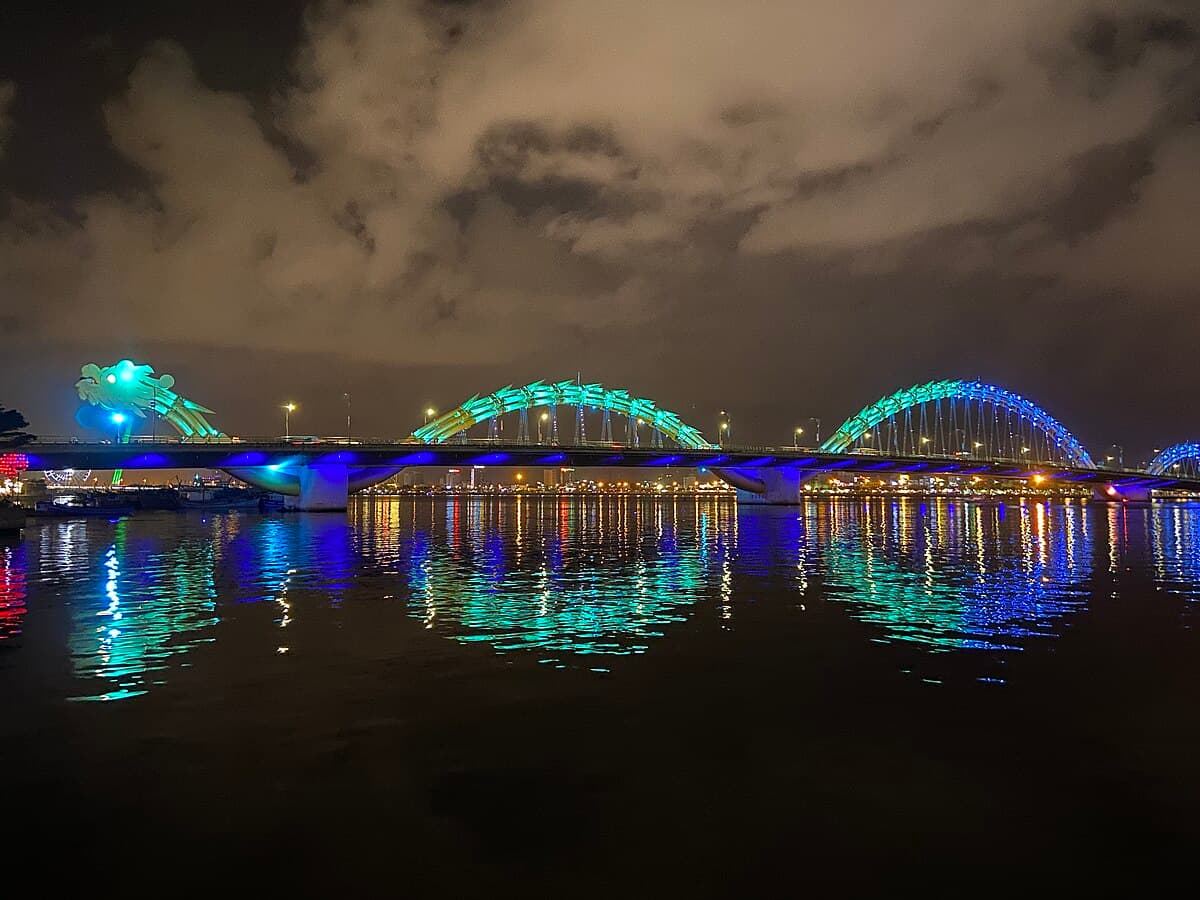
The Dragon Bridge is Da Nang's signature landmark, a 666-metre span shaped like a dragon that breathes fire and water on Saturday and Sunday nights at 9pm, when the bridge closes to traffic and the crowds gather on both banks. Staying near it — on either the Hai Chau or the eastern approach — puts you in the middle of the weekend spectacle and a small strip of riverside bars, at roughly $30-90 for a mid-range room.
It is a fun short-stay base if the show and the river energy are what you want, and it is walkable to the city center. Be honest with yourself about the weekend, though: the streets around the bridge get loud and packed until late on show nights, so light sleepers should book a room set back from the waterfront or on a higher floor.
Son Tra foothills and the resort beaches
North of the city, the road climbs onto the forested Son Tra peninsula, where the beach turns secluded and the big resorts sit on private coves. This is the quiet, scenic, pool-first end of Da Nang, home to the five-star names — the kind of self-contained resorts that keep restaurants, spas, and beach clubs inside the gate. The southern beaches toward Non Nuoc, below the Marble Mountains, play a similar role with calmer, wider sand that suits families with young children.
Prices here start around $150 and climb steeply — the top peninsula resorts run into many hundreds of dollars a night — and the tier is covered property by property in the best Vietnam family resorts guide. The trade-off is isolation: you are 20-30 minutes and a Grab or shuttle from the city and the An Thuong restaurants, so this base rewards travelers who mostly want to stay put.
Prices and seasons: what to actually budget
At about 26,000 VND to the US dollar in mid-2026, the rough shoulder-season bands are: hostel dorms $6-10, private budget rooms $15-30, mid-range three- and four-star hotels $30-70, upper mid-range and near-beachfront $70-150, and five-star resorts $150-400 and beyond. The Vietnam hotel prices guide has the fuller national picture.
Season matters more than area. High season runs roughly January to May, when the weather is dry and rates sit 30-50% above the bands above, and holiday weeks — Tet, the April 30 long weekend, and the summer domestic peak — spike higher still. The wet, rougher months from October into December are the cheapest, with the beach often too choppy to swim but the city as walkable as ever.
Decision table: pick by traveler type
Match the base to the trip, not the other way around — every row assumes the compact, Grab-friendly city where nothing central is more than 15 minutes away.
| You are | Stay | Why |
|---|---|---|
| First visit, beach matters | My Khe / My An beachfront | Swim before breakfast, walk to dinner |
| Here for food and nightlife | An Thuong tourist area | Cafes and bars on foot, cheaper rooms |
| On a budget | Han River / Hai Chau | Best-value rooms, central for errands |
| Short city stay, love the river | Near the Dragon Bridge | Weekend fire show at the door |
| Family with young kids | Southern resort beach (Non Nuoc) | Calm water, pools, kids' clubs inside the gate |
| Couple splurging | Son Tra peninsula resort | Seclusion, private coves, pools |
| Long-stay or digital nomad | An Thuong | Apartments, co-working, walkable everything |
Limitations
Price bands are shoulder-season ballparks compiled in mid-2026 from cross-platform listing checks and converted at about 26,000 VND to the dollar; the January-May high season and holiday weeks push 30-50% above them, while October-December midweeks fall below. Workaround: compare Booking.com and Agoda for the same property and message smaller An Thuong guesthouses directly on WhatsApp or Zalo for multi-night rates.
Area names in Da Nang overlap and shift: My An, An Thuong, and the beachfront blur into one another, and locals use the ward names differently than booking sites do. Workaround: ignore the label and check the map pin — distance to the beach and to the An Thuong restaurants is what actually shapes the stay.
Beach conditions are seasonal, not fixed: the same room that opens onto calm blue water in May faces rough grey surf and red-flag days from September into December. Workaround: if your dates fall in the monsoon months, book a hotel with a pool and treat a swimmable sea as a bonus rather than the plan.