
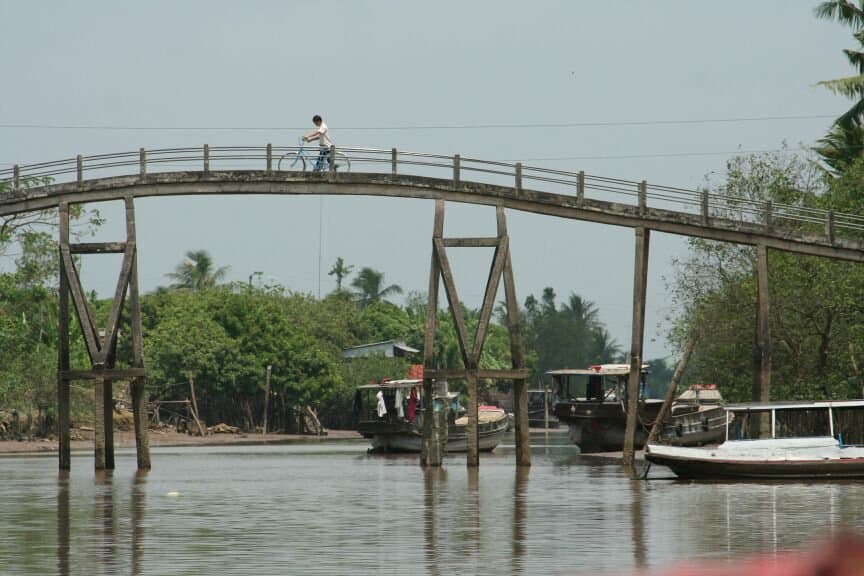
In September 2022, Thi Huong Ngo and Sibylle Creutz published "Assessing the sustainability of community-based tourism: a case study in rural areas of Hoi An, Vietnam" in Cogent Social Sciences (Vol. 8, Issue 1). It's one of the more methodologically rigorous academic assessments of a Vietnamese tourism format that travellers increasingly want to support — community-based tourism (CBT) — and its findings have direct implications for how you plan a Hoi An trip.
The headline: Hoi An's rural CBT has overall potential sustainability, with Culture-Society benefits exceeding the threshold and Economic benefits lagging. That gap — strong cultural value, uneven financial distribution — is the single most actionable finding for a visitor.
What the study did
Methodology
Ngo and Creutz combined two established frameworks:
- Fuzzy Analytic Hierarchy Process (AHP) — a structured method for weighting criteria when human judgment has inherent uncertainty. Fuzzy AHP lets residents score criteria across a range (not just a single number), which captures how people actually evaluate complex tradeoffs.
- Barometer of Sustainability — a four-dimension framework (Economy, Culture-Society, Environment, Management) that produces a single composite "potential sustainability" score.
They then selected 21 indicators across the four dimensions and interviewed local residents in rural Hoi An communes to score each one.
The 21 indicators (summarised)
The paper groups the 21 indicators into four families. We haven't reproduced the full list here (read the paper), but the shape is:
| Dimension | Indicator family |
|---|---|
| Economy | Tourism income to community, income distribution, employment, local product sales |
| Culture-Society | Cultural preservation, community participation, skills transfer, women's empowerment |
| Environment | Waste management, water quality, protected-area conservation |
| Management | Planning capacity, governance, policy support, stakeholder coordination |
Headline results
| Dimension | Rank (among 4) | Outcome |
|---|---|---|
| Culture-Society | 1st | Exceeded potential-sustainability threshold |
| Environment | 2nd | Within potential-sustainability range |
| Economy | 3rd | Within potential-sustainability range, but weakest of the four |
| Management | 4th | Requires strengthening |
The Culture-Society result is the happy surprise: Hoi An's CBT isn't hollowing out community identity — the community scores above the sustainability threshold on culture and social outcomes. Women's empowerment, skills transfer, and cultural preservation are all working.
The Economy result is the sober warning: tourism revenue flows into rural Hoi An, but distribution isn't even. A smaller number of local actors capture a disproportionate share. The study's recommendation is that community-development policies need strengthening to broaden who benefits.
What this means for your trip
1. Prioritise community-run experiences — it's where your money reaches the community
The paper's Economy finding has a direct translation: who you book with matters more than whether you book at all. A homestay directly owned by a village family captures a fundamentally different share of your spend than the same nominal price paid to a mid-sized operator in central Hoi An that sub-contracts to a rural family.
Practical rules of thumb:
- Book direct where possible. Village homestay owners increasingly have WhatsApp, Instagram DMs, or an email listed in their Google Business profile. A direct booking means no 10–30% commission split.
- Pay in cash at community-run stays and workshops. Not every rural operator has a bank account wired into card-payment infrastructure; cash lands fully with the host.
- Buy from the maker. Hoi An's craft villages (Thanh Ha pottery, Kim Bong carpentry, Tra Que vegetable village) have on-site workshops. Items bought there support the artisan; identical pieces sold in Hoi An Old Town's shops have been resold with a margin.
2. Consider a rural homestay over (or alongside) an Old Town hotel
The Old Town is genuinely beautiful and worth experiencing. But a 1–2 night rural homestay — in a village like Cam Kim (accessed by a short boat ride across the Thu Bon River) or further out near Tra Que — delivers the Culture-Society value the study measured. You cook with the host family, work in the garden or rice fields for an afternoon, learn how a household actually lives. It's slower, cheaper, and (per the study) benefits a broader slice of the community.
For planning, see our Hoi An destination guide.
3. The craft villages are not a detour — they are the point
Hoi An's UNESCO listing is for the Old Town merchant architecture, but the surrounding villages are where the living craft traditions actually happen. A half-day at Thanh Ha pottery or Kim Bong carpentry is a far more substantive CBT experience than browsing tailor shops on Nguyen Thai Hoc. Many villages accept small contributions for a 30–60 minute demonstration; pay these.
4. Take a cooking class run by a host at their home
Hoi An has dozens of cooking classes. The CBT-aligned ones are hosted by a single family or small cooperative, usually include a trip to a local market, and happen at the host's home or garden. They're typically cheaper than restaurant-operated classes ($25–$40 vs $50–$80) and deliver the Economy and Culture-Society benefits the study attributes to properly structured CBT.
5. Understand the limits — CBT is not a panacea
The study's Management finding (lowest of the four dimensions) is honest about where rural CBT in Hoi An still struggles: planning capacity, governance, stakeholder coordination. Don't romanticise the format. Some community-run offerings are genuinely excellent; others are amateur or inconsistent. Read recent reviews. Ask explicit questions before booking (who cooks? where does the class happen? what's included?). The study's point isn't "CBT solves tourism"; it's "CBT is potentially sustainable if it's properly designed and managed."
Limitations & caveats
- The study is from 2022 — published in September 2022 with fieldwork preceding it. Conditions in specific villages may have evolved since, and 2024 follow-up research (e.g., on Cam Kim commune specifically) extends and refines the findings.
- "Potential sustainability" is a threshold framework — it assesses whether a destination could sustain current tourism levels, not whether it will without intervention. Results don't equal a guarantee of long-term sustainability.
- The resident-interview methodology captures local perceptions, which can diverge from external measurement. A village that perceives environmental impacts as low may, under air-quality or water-quality measurement, show a different picture.
- The scope is rural Hoi An, not the Old Town. The UNESCO-listed Old Town has its own overtourism research and different dynamics — don't extend the findings of this paper to the whole city.
- Open-access on Taylor & Francis. The article is free to read without a paywall — we'd recommend reading the methodology section in particular before drawing policy conclusions.
Sources & further reading
- Primary source: Ngo, T. H. & Creutz, S. (2022). Assessing the sustainability of community-based tourism: a case study in rural areas of Hoi An, Vietnam. Cogent Social Sciences, 8(1), 2116812. DOI: 10.1080/23311886.2022.2116812
- Follow-up research on Cam Kim commune: Sustainable Community-Based Tourism Development: Capacity Building for Community; The Case Study in Cam Kim, Hoi An, Vietnam.
- Broader CBT literature review: Research on sustainability in community-based tourism: a bibliometric review and future directions.
Related on this site:
- Hoi An destination guide — Old Town, craft villages, and where to stay
- 14 days in Vietnam — how to fit rural Hoi An into a wider itinerary
- Ha Long Bay overtourism research — a complementary sustainability study