
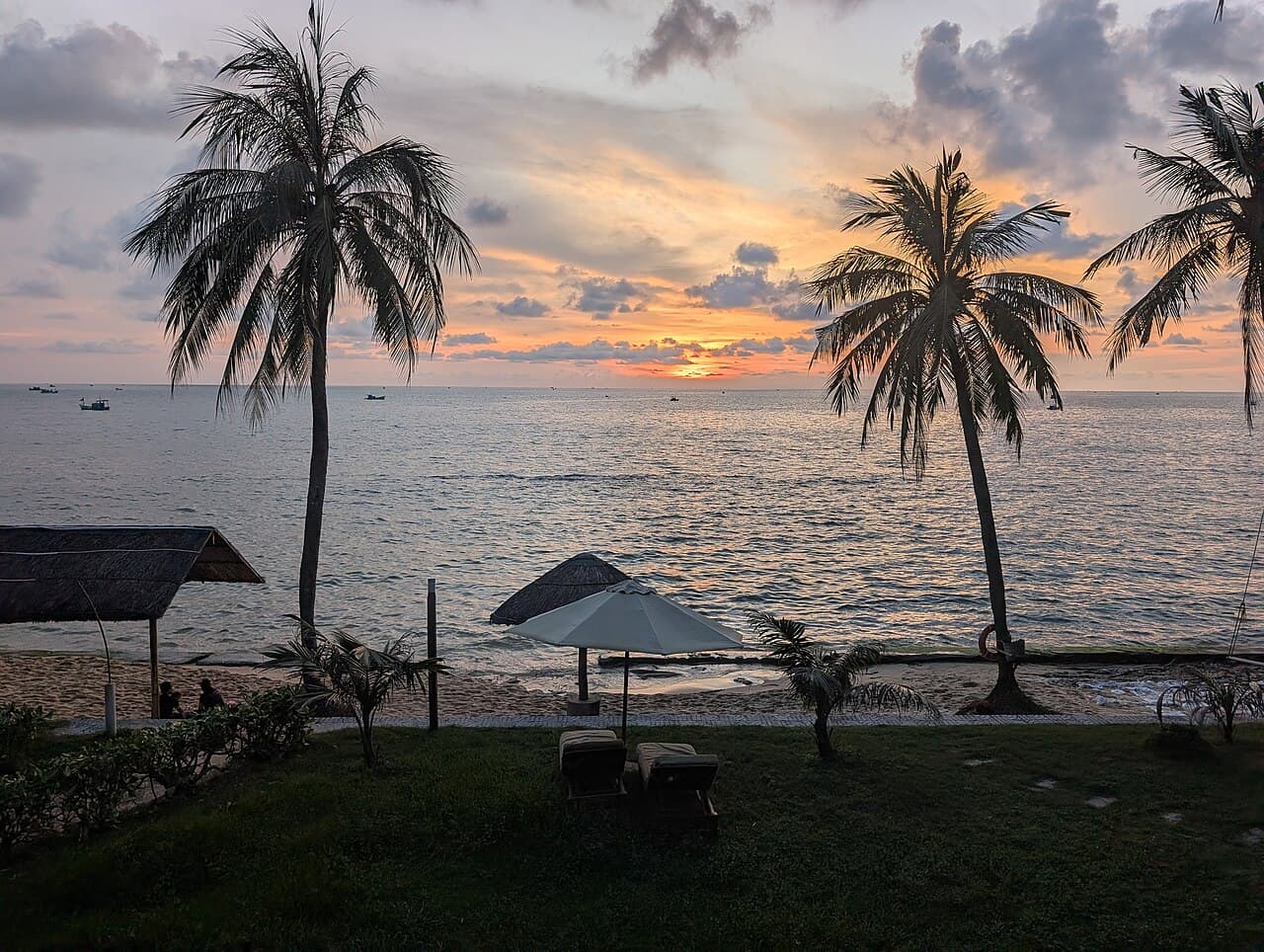
Vietnam's two southern islands get bracketed together constantly, and they should not be. Phu Quoc is a 590-square-kilometre island 45 minutes from Ho Chi Minh City with two dozen airlines flying in, a cable car, waterparks and a construction programme running to APEC 2027. Con Dao is a 16-island archipelago 230 kilometres offshore, most of it national park, served by one airline flying turboprops, where the biggest attraction is a former prison and the second biggest is sea turtles.
They are not competing for the same traveller. Here is the honest split.
The short answer
- Pick Phu Quoc if you want convenience, resorts, family-friendly logistics, low fares and a 30-day visa waiver. It is the right island for a beach week that needs to work without effort.
- Pick Con Dao if you want quiet, protected nature, coastal hiking, historical depth and diving that leans on fish, wrecks and turtles. Accept that it costs more and is easier to get stuck on.
Side by side
| Phu Quoc | Con Dao | |
|---|---|---|
| Getting there | 20-plus airlines, frequent cheap flights, several ferries | One scheduled carrier on ATR-72s, plus ferries |
| Typical one-way air fare (as of mid-2026) | Often 700,000 to 1,500,000 VND from HCMC | Commonly 959,000 to 1,137,000 VND from HCMC |
| Ferry cost (as of mid-2026) | Ha Tien around 230,000 VND, Rach Gia around 330,000 VND | Tran De 390,000 to 590,000 VND, Vung Tau 790,000 to 1,200,000 VND |
| Ferry duration | About 1h15m to 2h30m | About 2 to 3 hours (Tran De), about 4 hours (Vung Tau) |
| Visa | 30-day exemption for direct international arrivals | Standard mainland rules |
| Development | Heavy and ongoing, APEC 2027 build-out | Protected, national park across most land and sea |
| Nightlife | Night markets, beach clubs, Sunset Town | Almost none |
| Best months | November to April | Diving March to June, turtles April to September |
| Minimum days | 3 to 4 nights | 4 to 5 nights plus a buffer day |
Getting there, honestly
Phu Quoc is one of the easiest islands in Southeast Asia to reach. As of mid-2026 more than 20 airlines serve it from roughly two dozen airports, and in February 2026 the airport handled 50 international flights in a single day, its highest since opening. Superdong runs fast ferries from Ha Tien (around 230,000 VND, roughly $9, about 1h15m to 1h30m) and from Rach Gia (around 330,000 VND, roughly $13, longer). Our Vietnam ferry price guide has the full route list.
Con Dao is the opposite problem. As of mid-2026 the route is flown by VASCO, Vietnam Airlines' regional subsidiary, using ATR-72 turboprops from Ho Chi Minh City and Can Tho. The runway at Co Ong (VCS) is 1,830 metres, too short for A320-family jets, and an expansion has been proposed for years without transforming capacity. Small aircraft plus limited frequency equals fares that stay high for a 50-minute hop: 959,000 to 1,137,000 VND one way is a normal quote, and peak months from around March to September book out weeks ahead.
By sea, Con Dao Express runs the Thang Long from Cau Da Port in Vung Tau to Ben Dam on Con Son, about four hours, at roughly 790,000 VND midweek rising to about 1,200,000 VND for VIP seats. It sails on alternate days, not daily, and the crossing has a reputation for being rough. The Tran De route near Can Tho is shorter, about two to three hours, and cheaper at 390,000 to 590,000 VND. Both cancel in bad weather from roughly November to February. See our domestic flight price guide for how these compare with mainland routes.
Development: built out versus deliberately not
Phu Quoc has changed faster than almost anywhere in Vietnam. Sun Group's Hon Thom cable car, Sunset Town, VinWonders and Vinpearl Safari have turned the south and northwest into an entertainment economy, and the APEC 2027 summit has triggered another wave: a multifunctional complex sized for around 15,000 people, thousands of new five-star rooms, an international cruise port and an airport expansion. That is good for choice and flight prices. It is not good for quiet. Parts of the coast, particularly around Hon Thom, have activity zones closed for construction, and the honest expectation through 2026 and 2027 is site hoardings somewhere in your view.
Con Dao is protected in a way that constrains building. Con Dao National Park covers the great majority of the archipelago's land and a large marine area, and Con Son town remains a low-rise grid of French-colonial administrative buildings, a seafront promenade and a modest set of hotels. The high end is Six Senses Con Dao, which frequently sits above $700 to $870 a night. There is no cable car and no waterpark, which is the point.
Beaches and water
Phu Quoc's beaches are the easy ones: Sao Beach and Khem Beach in the south for fine white sand and calm shallow water, Long Beach for sunsets and the bulk of the resorts, Ong Lang for a quieter middle ground. Water clarity is best in the dry season and drops noticeably during the southwest monsoon.
Con Dao's beaches are emptier and less curated. Dam Trau, beneath the airport approach, is the one most visitors photograph. Others sit inside the national park and need a permit, a boat or a walk. Sea conditions swing harder across the year, and some beaches are seasonally unswimmable.
Diving, snorkelling and the 2024 reef damage
This is where you need honesty rather than brochure copy. Con Dao was long considered Vietnam's best diving, with visibility that could reach around 30 metres from March to June. Then the 2024 marine heatwave hit. Surveys in June 2024 recorded mean bleaching of about 97.5 percent of coral cover at 2 to 5 metres and about 85.7 percent at 10 to 12 metres. Acroporidae, which made up more than 60 percent of cover on reef flats and upper slopes, bleached at 98.5 percent, and by October 2024 acroporid mortality at survey sites was complete.
What that means practically: the branching-coral scenery is largely gone at surveyed depths, and recovery on that scale takes years to decades. What remains is still worth diving — reef structure, fish life, wrecks, turtles and the emptiness of the sites themselves. Con Dao operators including Con Dao Dive Center and Amadive run daily trips, with snorkelling days around 1,000,000 VND (roughly $38) and wreck trips around 3,400,000 VND (roughly $130) as of mid-2026.
Phu Quoc's snorkelling in the An Thoi archipelago was never in Con Dao's class, and it too was affected by the same heatwave. Day boats run around $15 to $40 per person, dives from roughly $55, and it functions best as a pleasant boat day rather than a serious dive destination. Its high season, October to April, is the inverse of Con Dao's best visibility window.
Turtles
Con Dao has Vietnam's most significant sea-turtle nesting programme. Eighteen park beaches are nesting grounds across roughly 24 hectares, and five see more than 150 nesting arrivals a year, with Bay Canh Island the densest site in the country. Nesting runs roughly April to September, peaking June to September. Trips are run under national park permits in small groups, usually staying overnight on Bay Canh, and they sell out. Phu Quoc has no comparable programme.
The prison sites, and how heavy they are
Con Dao was a penal colony from 1862 under the French and remained a prison through the American-backed period. The preserved camps, the tiger-cage cells, the Con Dao Museum and Hang Duong Cemetery are the reason a large share of domestic visitors come. Vo Thi Sau, executed here in 1952 at 19, is venerated nationally, and Vietnamese visitors often come to her grave after midnight with offerings.
This is not a light morning's sightseeing. Allow half a day, go quietly, and expect the mood of your trip to shift. Phu Quoc's Coconut Tree Prison covers related history at a much smaller scale.
Food
Phu Quoc has the deeper food scene: Duong Dong night market, Ham Ninh fishing village crab, the island's fish sauce and pepper production, sim wine, and an increasingly capable restaurant layer serving resort guests. Con Dao's eating is small and local — seafood on the seafront, a handful of good Vietnamese kitchens in Con Son town, and very little open late. If dinner variety matters to your holiday, that is a real point for Phu Quoc.
What you will pay to sleep
As of mid-2026, Phu Quoc runs roughly $12 to $30 for hostels and simple guesthouses, $30 to $70 for solid mid-range, $80 to $200 for good four-star, and $180-plus for the luxury tier, with peak December to March rates commonly 40 to 80 percent above the July to September low. Our Phu Quoc accommodation guide breaks that down by area.
Con Dao is thinner and pricier for what you get. Budget guesthouses in Con Son town start around 300,000 VND, mid-range boutique properties sit roughly $45 to $95, and the jump to Six Senses is severe. There is far less competition to push rates down.
Best months, which differ
Phu Quoc is a dry-season island: November to April is reliably good, and May to October brings the southwest monsoon with afternoon rain and murkier water.
Con Dao is more nuanced. The dry season, roughly November to April, is calm and sunny overall, but the early stretch from about November to February is windy enough to dent dive visibility and cancel ferries. March to June is the sweet spot for water clarity. May to October brings short heavy showers, thinner crowds, lower prices and the turtle peak, in exchange for more transport disruption.
Who each island suits
Phu Quoc suits families with young children, couples wanting a resort week, travellers on a tight budget, anyone arriving on an international flight who wants the visa waiver, and anyone who needs the trip to work without contingency planning. Compare it with the mainland beach options in our Phu Quoc, Nha Trang and Da Nang comparison, and see the island hub at Phu Quoc.
Con Dao suits divers who care more about fish and wrecks than coral, hikers, history-minded travellers, photographers, and returning visitors who have already done the standard Vietnam circuit. Our Con Dao guide covers the practicalities in more depth.
Limitations
This comparison does not cover accessibility for travellers with reduced mobility, and Con Dao in particular has limited step-free infrastructure. Prices are indicative for mid-2026 and move fast: domestic air fares swing sharply around Tet and school holidays, ferry tariffs are revised without notice, and Phu Quoc hotel rates are volatile because of the APEC 2027 construction cycle. We have not re-dived Con Dao since the 2024 bleaching surveys, so our account of current conditions relies on published survey data and operator reporting rather than first-hand assessment of recovery. Schedules quoted were current at the time of writing, Con Dao sailings cancel routinely in rough weather, and we have not verified whether further carriers have added the route since mid-2026.