
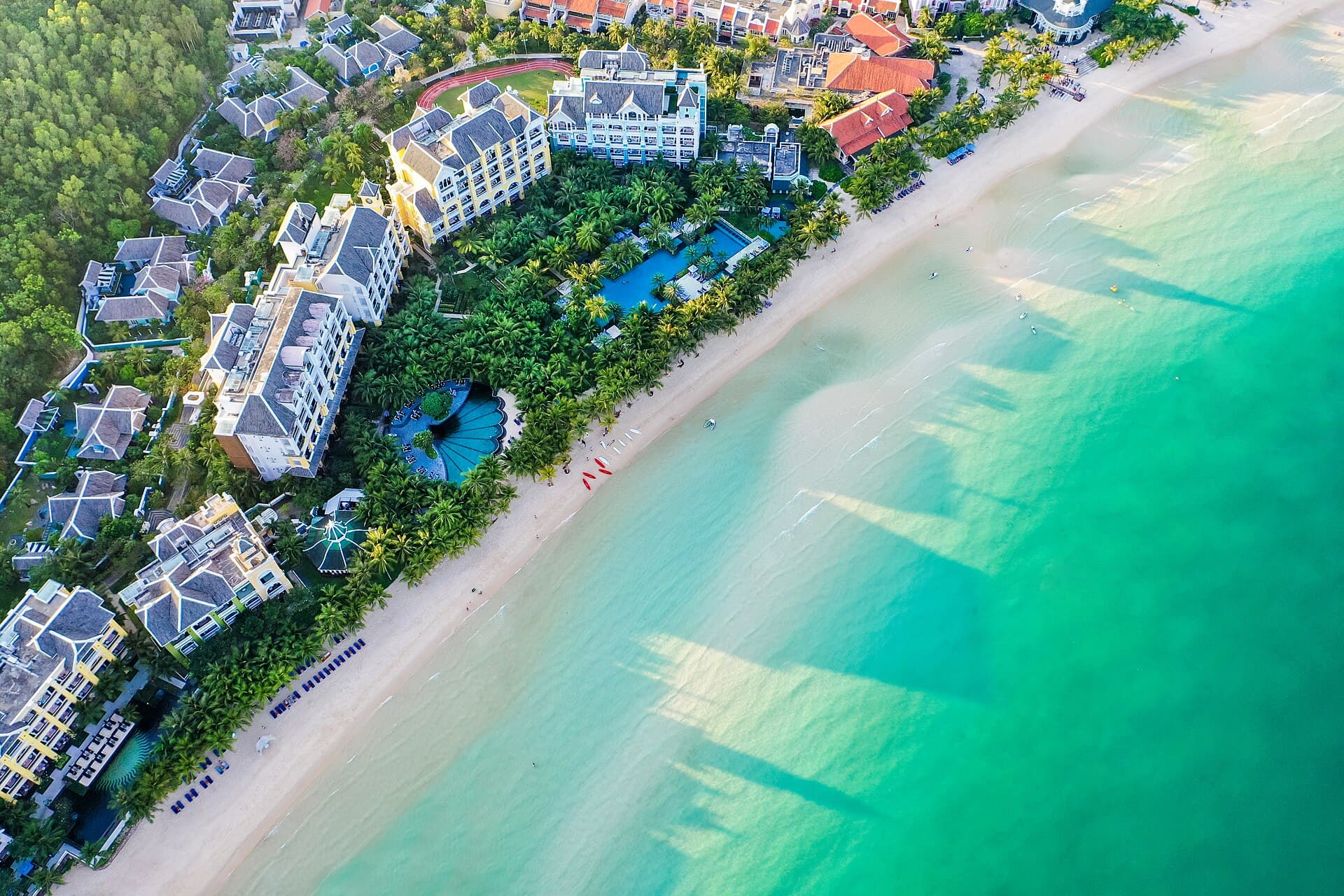
The short answer: for a first trip to Phu Quoc, base on Long Beach around Duong Dong town — central, walkable, sunset-facing, close to the airport, and stocked with every price point from mini-hotels to five-star resorts. Choose the south around Khem Beach, An Thoi, and Sunset Town if you want a luxury-resort holiday and the cable car; pick Ong Lang for a quieter mid-range boutique stay under the trees; and consider the far north around Vinpearl and Grand World only if you want a self-contained integrated-resort bubble. Bai Sao and the east are for day trips, not for sleeping.
This guide is only about where to base yourself. For the beaches, the snorkelling, and the sights, see the Phu Quoc destination guide; for whether the island is right for you at all, the is Phu Quoc worth it review takes the honest view. For the country-wide picture, the where to stay in Vietnam overview covers every major base.
How the choice breaks down
Phu Quoc is large — a 574 square-kilometre island off the Cambodian coast — so where you sleep shapes the trip more than on a compact beach town. The airport sits in the center-south, which makes the west-coast strip around Duong Dong the natural hub and the far north a genuine commitment. The island of Phu Quoc has developed fast and unevenly, so the coasts now feel like different holidays rather than different postcodes.
The real decision is not distance but character: a walkable resort town with the widest choice, a luxury cluster in the south, a quiet boutique coast, or a purpose-built entertainment bubble in the north. Here is the shape of it.
| Base | Typical nightly price | Airport transfer | Best for |
|---|---|---|---|
| Long Beach / Duong Dong | $12-70 | 10-15 min | First-timers, walkable dining, sunsets |
| The south (An Thoi / Sunset Town) | $180+ luxury, mid tiers too | 25-40 min | Resort holidays, the cable car |
| Ong Lang | $40-90 | 20-35 min | Quiet, mid-range boutique stays |
| Far north (Vinpearl / Grand World) | $80-200 | 45-60 min | Theme parks, integrated-resort bubble |
| Bai Sao / east | Day trip, not a base | 30-40 min | A morning visit, not sleeping |
Long Beach and Duong Dong: the convenient default
This is where most first-time visitors should sleep. Long Beach (Bai Truong) runs for around 20 kilometres down the west coast, and its northern end meets Duong Dong, the island's main town. You get the widest range of rooms anywhere on Phu Quoc — budget mini-hotels back from the sand, mid-range beachfront places, and a genuine five-star tier — plus walkable restaurants, the Dinh Cau night market, and the island's clearest sunsets straight off the beach.
Two long-standing names anchor the quality end here: La Veranda Resort, an MGallery property in colonial style near the town center, and Salinda Resort, a boutique five-star on the same stretch. Below them sit dozens of comfortable three- and four-star beachfront resorts, with mid-range rooms roughly $30-70 and town mini-hotels from about $12.
The honest caveat is the central strip is dense and, on its fringes, still under construction — the beach quality varies sharply along its length, with the quieter, cleaner stretches away from the busy middle. Read recent reviews for the exact property, and ask for a room facing the sea rather than the road.
The south: An Thoi, Sunset Town, and the luxury cluster
The southern tip is Phu Quoc's showpiece resort zone, about 25 to 40 minutes from the airport. Around Khem Beach — a groomed, calm, east-facing cove — sits the island's densest luxury cluster: the JW Marriott Emerald Bay, a Bill Bensley-designed resort themed as a fictional French university, and the villa-only Premier Village Phu Quoc on the nearby promontory. Rates at this tier start around $180 and climb into the many hundreds.
Just west, around An Thoi town and Sunset Town, you get the Mediterranean-styled development at the base of the Hon Thom cable car — the world's longest over-sea span — plus mid-range options such as New World Phu Quoc near the Sunset Town build. This area suits people who want to stay largely inside one resort, use the pool and private beach, and dip into the cable car and An Thoi snorkelling trips. It is a poor base if you want to walk to independent restaurants or feel the working island. The southern beaches feature in our Vietnam beach water quality atlas, and the couples angle is covered in the Vietnam beach honeymoon guide.
Ong Lang: the quieter mid-range coast
Ong Lang, on the northwest coast roughly 20 to 35 minutes from the airport, is where the older, calmer island survives best. The beach is a series of small coves rather than one long sweep, backed by trees, with boutique and eco-style resorts and a scattering of relaxed beachfront restaurants. Working fishing boats still sit offshore, and on a weekday morning stretches of sand can be nearly empty.
This is the mid-range sweet spot — expect roughly $40-90 for a comfortable boutique room or bungalow, with a handful of higher-end places above that. The trade-off is you lose the walkable dining and nightlife of Long Beach; most Ong Lang stays are car- or scooter-dependent for anything beyond the resort. Quiet here is also a moving target, as new projects arrive quickly, so treat any "secluded" listing with fresh scepticism and check reviews from the last few months. The far northwest around Cua Can is quieter still, and more isolated again.
The far north: the integrated-resort bubble
The northern end around Bai Dai and Ganh Dau is a purpose-built entertainment enclave rather than a beach neighbourhood. This is where Vinpearl runs its resorts alongside VinWonders theme park, Vinpearl Safari, and Grand World — a canal-front retail development with a nightly show and a casino. International brands sit inside the complex too: the Radisson Blu Resort is built within the surrounding Corona resort zone on Bai Dai beach. Rates across the north run roughly $80-200 depending on the property and season.
The appeal is convenience and family logistics: everything — pools, parks, dining, entertainment — is inside one managed bubble, and the free VinBus links the pieces. The cost is character and distance. It is a 45-to-60 minute transfer from the airport, largely detached from the rest of the island, and has almost nothing to do with a traditional tropical-island stay. Families using the theme parks as their main activity get real value; independent travellers usually feel penned in. Our best Vietnam family resorts guide covers the family case in detail.
Bai Sao and the east: a day beach, not a base
Bai Sao (Sao Beach) on the southeast coast is the white-sand postcard, and it is worth a morning — but it is not a place to sleep. Accommodation is sparse, dining is limited to beach shacks, and the beach picks up jet skis, vendors, and post-storm litter as the day goes on. The upside is the east coast often stays swimmable when wind churns the west coast in wet season. Base yourself on Long Beach or in the south, then visit Bai Sao early in the dry season as a half-day trip rather than building your stay around it.
Prices and seasons: what to budget
At about 26,000 VND to the US dollar in mid-2026, the rough shoulder-season bands are: Duong Dong town mini-hotels 300,000-780,000 VND (about $12-30); beachfront mid-range on Long Beach and Ong Lang 780,000-1,800,000 VND (about $30-70); north integrated resorts $80-200; and the southern luxury names from about $180 into the many hundreds. The Vietnam hotel prices guide has the fuller national context.
Season matters as much as area. November to April is the dry season, with December to March the clearest, calmest water and the highest rates. May to October is wet, with afternoon storms, wind-churned west-coast seas, and seaweed wash-ins on Long Beach — though the southeast around Bai Sao often stays swimmable. Wet-season rates drop 30 to 40 percent for a reason. If a specific month is fixed, the best time to visit Vietnam guide sets the regional picture.
Decision table: pick by traveler type
Match the base to the trip — every south and north row assumes you are happy inside a resort, and every Long Beach row assumes you want to walk to dinner.
| You are | Stay | Why |
|---|---|---|
| A first-timer wanting balance | Long Beach / Duong Dong | Walkable dining, night market, sunsets, short transfer |
| After a pure resort holiday | The south (Khem Beach, An Thoi) | Luxury cluster, private beaches, the cable car |
| On a tighter budget | Duong Dong town mini-hotels | Cheapest beds within a walk of the beach and food |
| A family using theme parks | Far north (Vinpearl / Grand World) | Parks, all-in convenience, kids' facilities |
| After the quietest mid-range stay | Ong Lang | Boutique resorts under trees, calmer coves |
| Chasing the postcard beach | Long Beach base, day trip to Bai Sao | Sao is best as a morning visit, not a base |
Limitations
Price bands are shoulder-season ballparks compiled in mid-2026 from cross-platform listing checks and converted at about 26,000 VND to the dollar; the dry-season peak from December to March and holidays push above them, while quiet wet-season midweeks fall well below. Workaround: compare Booking.com and Agoda for the same property, and message resorts directly for multi-night and meal-inclusive rates.
Phu Quoc changes faster than anywhere else in Vietnam, so a "quiet" or "secluded" area this season can gain a building site next season, and properties open, rebrand, and close between updates. Workaround: for anything sold as tranquil, read guest reviews from the past 60 days rather than older articles or listing photos, and confirm there is no active construction next door before booking.
Airport transfer times are typical drive estimates and vary with traffic and your exact hotel; the far north in particular can run longer than an hour at busy times. Workaround: ask your hotel for its own transfer time and arrange a pickup in advance, especially for northern and southern properties well away from the airport.