
Hanoi's street food is best understood as a map, not a menu. The dishes themselves — what phở is, where bún chả comes from, why chả cá is its own thing — are covered in our Vietnam street food atlas and the city-by-city Vietnamese food guide. This guide answers a narrower question for someone standing in the Old Quarter at 7:00 a.m.: where do I actually go, on which street, and in what order?
The short answer: base yourself in the Old Quarter, eat by time of day rather than by distance, and let the single-dish specialists do the work. Hanoi's food culture runs on stalls that make one thing — one phở recipe, one bún chả grill, one bánh cuốn steamer — and the good ones cluster within a few minutes' walk of each other inside the historic core. A full crawl is genuinely walkable; only a couple of southern institutions need a short Grab ride. For per-dish prices, see our street food prices guide.
The neighborhoods, and what each is known for
Hanoi's street food clusters into four practical zones. Three are walkable from one another inside or just beside the historic core; the fourth needs a short ride.
| Zone | Known for | Best time |
|---|---|---|
| Old Quarter (the dense core) | Phở on Bát Đàn, chả cá on its named street, bún chả lunch counters, egg coffee off Nguyễn Hữu Huân | Breakfast through evening |
| Around Hoàn Kiếm | Bánh cuốn, bún riêu, lakeside cafés, the Lý Quốc Sư phở block | Morning to mid-afternoon |
| Trúc Bạch / Tây Hồ (West Lake) | Bún ốc, snails, quieter lakeside coffee | Late morning to evening |
| Hai Bà Trưng / southern streets | Phở Thìn on Lò Đúc, the Obama-Bourdain bún chả on Lê Văn Hưu | Breakfast and lunch |
Old Quarter — the dense core
This is where you base a crawl. The historic 36-street district is maybe a kilometer across, and the single-dish specialists sit a few minutes apart.
- Phở on Bát Đàn street. Phở Gia Truyền at 49 Bát Đàn is the Old Quarter's queue-out-the-door phở, a Michelin Bib Gourmand spot where you line up, pay, carry your own bowl to a low stool, and eat fast. It is a morning operation and can sell out well before lunch. Order phở bò — beef.
- Chả cá on Chả Cá street. The street is literally named for the dish. Chả Cá Lã Vọng, at number 14, has been run by the same family since 1871 and gave the street its name — turmeric-marinated fish pan-fried at your table with dill and spring onion. It is a sit-down, pricier-than-a-stall experience rather than a counter, so slot it in as a dinner rather than a crawl snack.
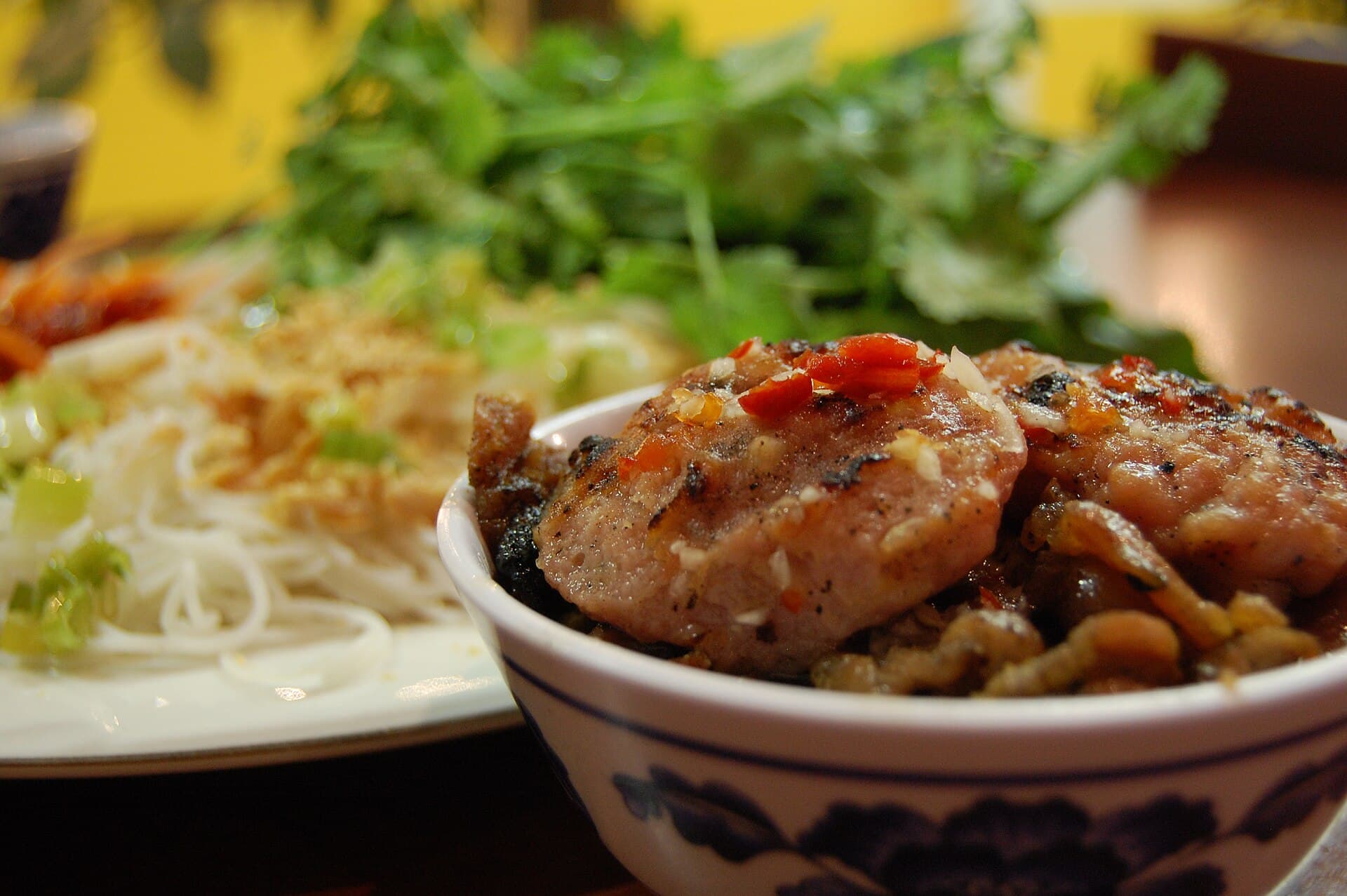
- Bún chả lunch counters. The Old Quarter's lunchtime air carries charcoal smoke from bún chả grills. Bún Chả Đắc Kim, around Hàng Mành, is a long-running Michelin-Selected spot; smaller no-name counters all over the quarter are just as good at the noon peak. Follow the smoke and the stools.
- Egg coffee off Nguyễn Hữu Huân. Café Giảng, down a narrow corridor near the eastern edge of the quarter, is the birthplace of cà phê trứng (1946). An afternoon stop, not a meal.
Rough hours: phở counters run early morning into late morning; bún chả grills fire up late morning and fade after the lunch rush; cafés stay open into the evening. Treat all posted hours as optimistic and go at the meal-time peak.
Around Hoàn Kiếm — bánh cuốn, bún riêu, and the lake cafés
Just south and east of the densest streets, toward Hoàn Kiếm Lake, the mix shifts toward morning-to-midday dishes and café culture.
- Bánh cuốn toward the To Hien Thanh area. Bánh Cuốn Bà Hoành, on Tô Hiến Thanh street (south of the lake, a short ride from the core), is a long-standing spot for the steamed rice-flour rolls filled with pork and wood-ear mushroom. For a walkable version, ask your hotel for the nearest bánh cuốn counter — they are common across the central districts and best in the morning.
- The Lý Quốc Sư phở block. Phở 10 Lý Quốc Sư, near St. Joseph's Cathedral, is another Bib Gourmand phở within walking distance of the lake — a good fallback if Bát Đàn has sold out.
- Bún riêu — the crab-paste noodle soup. Bún riêu (tomato-and-crab-paste broth) turns up at morning stalls around the Old Quarter fringes and toward Hàng Lược; it is a lighter, tangier alternative to phở for a second breakfast. Ask locally rather than chasing one address.
- Lakeside cafés. Café Phố Cổ, tucked off the lake's north-west with a rooftop view, is the classic spot to sit with an egg coffee and look down on Hoàn Kiếm.
Trúc Bạch and Tây Hồ (West Lake) — bún ốc and the slower pace
North-west of the core, around the smaller Trúc Bạch lake and the larger West Lake, the pace drops and the specialty shifts to snails.
- Bún ốc — snail noodle soup. The Trúc Bạch area is the traditional home of bún ốc, a sharp, tomato-tinged broth with freshwater snails. There is a long-running cluster of bún ốc and snail stalls here; ask for "bún ốc Trúc Bạch" and follow locals at lunchtime. Bún Ốc Bà Lương, on Lương Ngọc Quyến back in the Old Quarter, is the more central option.
- West Lake cafés. Tây Hồ is where Hanoi slows down — lakeside coffee, a calmer atmosphere, fewer motorbikes. It suits an afternoon rather than a dense crawl.
This zone is a short Grab ride from the Old Quarter, not a walk — treat it as a deliberate half-day excursion.
Hai Bà Trưng and the southern streets — the institutions
A few of Hanoi's most famous names sit just south of the historic core, in the Hai Bà Trưng district. These need a short ride but reward the detour.
- Phở Thìn on Lò Đúc. Phở Thìn at 13 Lò Đúc has been a Hanoi institution since 1979, known for its distinctive stir-flashed beef before it goes into the bowl — a different style from the clear-broth Bát Đàn version. A breakfast or early-lunch stop.
- The Obama-Bourdain bún chả. Bún Chả Hương Liên, on Lê Văn Hưu, is where Barack Obama and Anthony Bourdain shared a meal in 2016. The food is genuinely good, but it is now a landmark — the original table is glass-encased and there is a "Combo Obama" on the menu. Go for the pilgrimage, not because it is meaningfully better than the Old Quarter counters.
The walkable crawl — one route, by time of day
Here is the logic: eat each dish when it is at its peak, walk between stops inside the core, and use a short Grab ride only for the southern institutions or the Trúc Bạch snails if you want them.
- Morning (around 7:00–8:30 a.m.) — phở. Start with a beef phở at Phở Gia Truyền on Bát Đàn, or Phở 10 Lý Quốc Sư near the cathedral if you want to be closer to the lake. This is the dish that sells out, so do it first.
- Mid-morning (around 9:30–10:30 a.m.) — bánh cuốn or bún riêu. A lighter second course while the bún chả grills are still warming up. Find a bánh cuốn steamer or bún riêu stall on the Old Quarter fringes, or ride south to Bà Hoành on Tô Hiến Thanh.
- Lunch (around 11:30 a.m.–1:00 p.m.) — bún chả. Follow the charcoal smoke to a grill — Đắc Kim near Hàng Mành, a no-name counter in the quarter, or a deliberate detour to the Obama-Bourdain spot on Lê Văn Hưu.
- Afternoon (around 2:00–4:00 p.m.) — egg coffee. Wind down with a cà phê trứng at Café Giảng off Nguyễn Hữu Huân, or Café Phố Cổ overlooking the lake. The afternoon lull is exactly when these are best.
- Dusk into evening — bia hơi. End at the Tạ Hiện and Lương Ngọc Quyến crossroads, the Old Quarter's bia hơi corner, where the fresh draft beer is poured by the glass and the plastic stools fill the intersection. If you still have room, chả cá on Chả Cá street works as a sit-down dinner.
For a half day, run phở → bún chả lunch → egg coffee and skip the rest. With a full day, add the southern institutions or the Trúc Bạch bún ốc as a mid-route Grab hop.
Practical notes for eating on the street
- Cash, in small notes. Assume the counters are cash-only; many have no card reader. Carry 10,000–50,000 VND notes so you are not trying to break a large bill at a tiny stall. For current prices, see our street food prices guide.
- Go at the peak. The queue of locals at the right hour is both the quality signal and the freshness signal. A busy stall turns food over fast; a quiet one at the wrong time may be reheating.
- Point and hold up fingers. Single-dish stalls make ordering easy — gesture at what a neighbor has, or hold up fingers for how many bowls. A translation app helps for the few stalls with variations.
- Sit on the tiny stools. Hanoi street food is eaten low, on knee-high plastic stools with a slightly taller one as your table, often spilling onto the pavement. Do not wait to be seated.
- Stalls sell out. Many of the best places cook a fixed quantity and close when it is gone. Breakfast and lunch dishes especially — go early, and treat posted hours as optimistic.
- Mind the traffic. Many of these stalls sit on busy corners; cross slowly and predictably and let the motorbikes flow around you. The solo female travel in Hanoi guide covers the street-crossing technique.
Limitations
Specific stalls and streets here reflect mid-2026 observations and recent visits, but Hanoi's food scene cycles quickly — owners retire, counters move a few doors down, and a queue migrates to a newer place on the next block. Workaround: treat the named stalls as anchors for the right neighborhood and meal time, then ask your hotel or homestay host where they ate breakfast — neighborhood word-of-mouth is the most current signal you will get.
For a few spots I have hedged the exact address on purpose. Bún riêu stalls, bánh cuốn steamers, and the Trúc Bạch bún ốc cluster shift enough that pinning one precise doorway would mislead more than it helps; I have described the street or area instead. The dish-level detail and the vendor map for the rest of Vietnam live in the Vietnam street food atlas, and the data behind the queue heuristic is in the Hanoi street food spending research.