
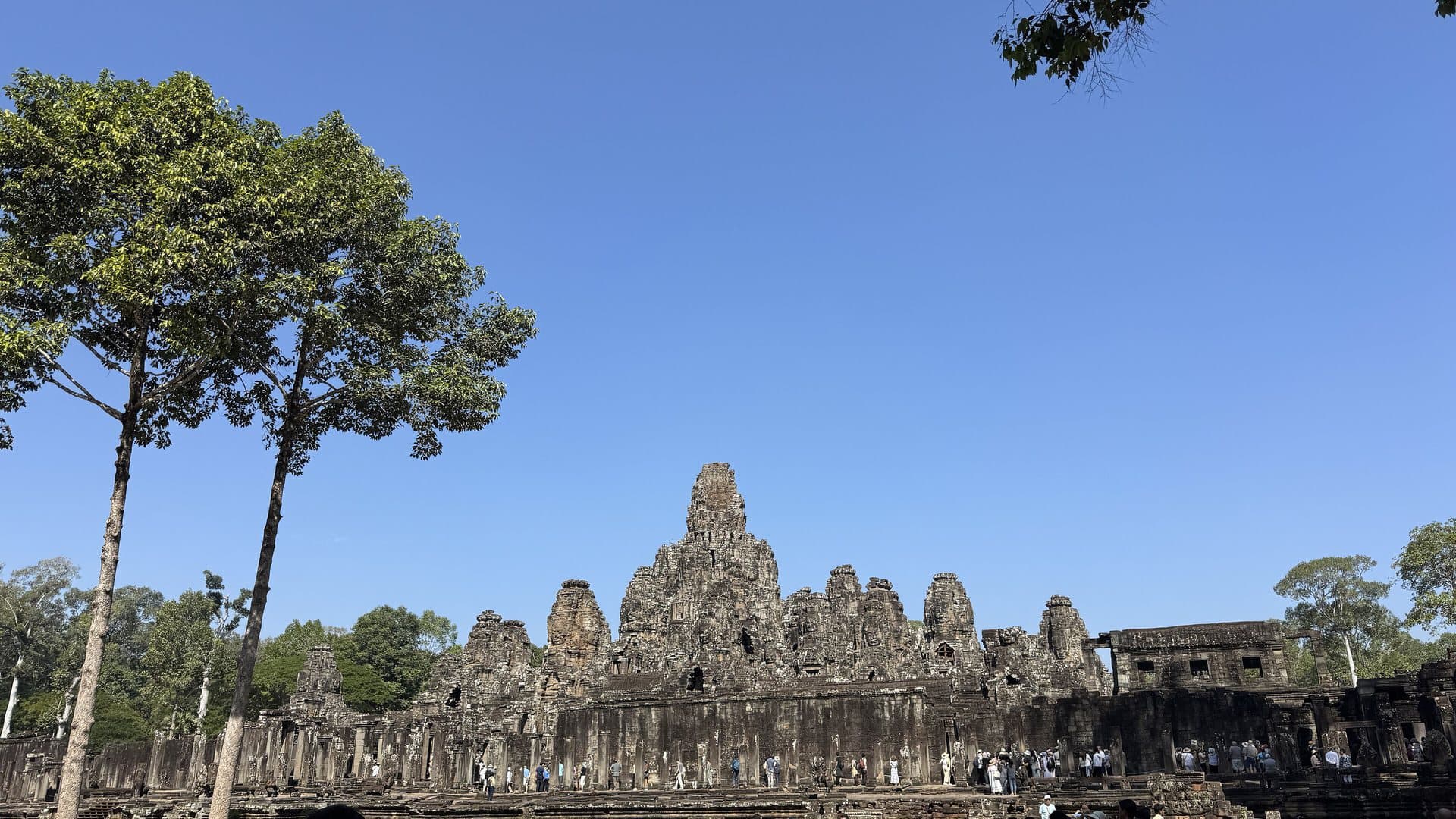
The best time to combine Vietnam and Cambodia in one trip is December to February. Cambodia is at its coolest, driest and sunniest (Phnom Penh averages only 5-45 mm of rain a month), southern Vietnam is dry, and Hanoi is cool and dry, if grey. The one region out of step is Vietnam's central coast, which is still wet in December and dries through January, so a route that includes Hue and Hoi An works best from late January to March. March to May stays dry but turns very hot, with Cambodia near 35°C in April, and May to October is Cambodia's rainy season, wettest in September and October.
The complication is that Vietnam is three climates, not one. The north, the central coast and the south each have their own wet season, and only one of them lines up neatly with Cambodia's. The month table below shows where they overlap.
The short answer, month by month
All figures are long-run averages from Climates to Travel for Phnom Penh, Hanoi, Hue, Da Nang and Ho Chi Minh City: average daily high, then monthly rainfall.
| Month | Cambodia (Phnom Penh) | North Vietnam (Hanoi) | Central coast (Hue / Da Nang) | South Vietnam (HCMC) | Verdict |
|---|---|---|---|---|---|
| January | 31°C, 5 mm, dry, cool | 20°C, 20 mm, cool, grey | 125 / 85 mm, drying | 32°C, 15 mm, dry | Very good; centre damp |
| February | 33°C, 10 mm, dry | 21.5°C, 20 mm, drizzle | 65 / 25 mm, dry | 33°C, 5 mm, dry | Best overall; mind Tet |
| March | 34°C, 40 mm, hot | 24°C, 35 mm, grey | 45 / 20 mm, dry, mild | 34°C, 10 mm, hot, dry | Very good if heat is fine |
| April | 35°C, 75 mm, hottest | 28°C, 105 mm, warming | 60 / 35 mm, dry | 35°C, 50 mm, hottest | Hot everywhere |
| May | 35°C, 135 mm, rains start | 32°C, 165 mm, hot, wet | 100 / 85 mm, hot, dry | 35°C, 220 mm, rains start | Centre only |
| June-August | 33°C, 155-170 mm, rainy | 33-34°C, 255-275 mm, wet | 85-115 mm, dry, hot | 33°C, 270-310 mm, rainy | Centre only |
| September | 32°C, 225 mm, wet | 32°C, 245 mm, wet | 395 / 310 mm, wet begins | 32°C, 325 mm, wettest | Poor |
| October | 31°C, 255 mm, wettest | 30°C, 155 mm, drying | 755 / 650 mm, floods | 32°C, 265 mm, wet | North only |
| November | 31°C, 125 mm, drying | 26°C, 60 mm, excellent | 620 / 430 mm, very wet | 32°C, 115 mm, drying | Good if you skip the centre |
| December | 30°C, 45 mm, dry, best | 22°C, 20 mm, cool, dry | 310 / 215 mm, wet | 32°C, 50 mm, dry | Very good; centre wet |
Siem Reap, near Angkor, follows the same pattern as Phnom Penh, but its monsoon peaks earlier (about 290 mm in September) and retreats sooner, usually in early November.
Why December to February is the window
Three of the four regions are at or near their best at the same time. Cambodia's best months, by its own dry-season pattern, run from December to mid-February: the coolest, driest and sunniest of the year, with Phnom Penh at 30-33°C by day and Siem Reap averaging about 5 mm of rain in December and January. Southern Vietnam's dry season runs from December to April, with Ho Chi Minh City at 5-50 mm a month. Hanoi is at its driest, about 20 mm a month, though cool at 20-22°C and often grey. See our Hanoi weather guide.
That makes a route through northern Vietnam, the south and Cambodia straightforward in these months. The only question is the centre.
The central coast problem, and how to route around it
Vietnam's central coast (Hue, Da Nang and Hoi An) runs on a different calendar. Its wet season runs from September to December, it is still wet in December (about 310 mm in Hue, 215 mm in Da Nang), and it dries through January. By February it is dry. That leaves three sensible approaches:
- Travel late January to March if the central coast is essential. Cambodia is still dry, though warming from mid-February, and the whole of Vietnam is broadly dry.
- Travel in December and treat the centre as optional, with refundable bookings, or skip it for this trip.
- Put the centre last on a December-to-January route, giving it the most time to dry out.
Our guides to Hue weather and Da Nang and Hoi An weather have the month-by-month detail, including flood and typhoon timing.
March to May: dry but hot
From March the rain is still low across most of the route, but the heat builds. Cambodia's hot season runs from mid-February to May, peaking in April and May at around 35°C in both Phnom Penh and Siem Reap, and Ho Chi Minh City reaches 35°C in April. The central coast is at its most comfortable in March and April, and Hanoi's grey spring gives way to warmth in April. It is a good season for travellers who handle heat well and want the central coast dry; it is a hard one for long days at Angkor.
May to October: the green season
Cambodia's rainy season runs from May to mid-November. Phnom Penh averages 135 mm in May and 155-170 mm from June to August before peaking at about 225 mm in September and 255 mm in October; Siem Reap peaks earlier, at about 290 mm in September. Southern Vietnam is wet over the same months. The temples and countryside are at their greenest, but rain days run at 14-19 a month in Phnom Penh, and paths around Angkor can turn muddy.
Vietnam has one bright spot in these months: the central coast is in its dry season from May to August, with long hot days and the calmest sea of the year. A summer trip therefore works best as central Vietnam plus Angkor, accepting some rain in Cambodia. By October, northern Vietnam is at its best but the centre is flooding and Cambodia is at its wettest.
Crossing between the two countries
The main overland link runs between Ho Chi Minh City and Phnom Penh, which is why Cambodia pairs most easily with southern Vietnam. Details below are from our land border crossings guide, as of mid-2026:
| Route | Crossing | Time | Cost |
|---|---|---|---|
| Ho Chi Minh City to Phnom Penh, bus | Moc Bai-Bavet | 6-7 hours with formalities | About $12-35 |
| Chau Doc to Phnom Penh, speedboat | Vinh Xuong-Ka'am Samnor | 6-6.5 hours | About $60 |
| Ha Tien or Phu Quoc to Kampot and Kep | Xa Xia-Prek Chak | Slower, coastal | Varies |
On paperwork: Cambodia's 30-day tourist visa costs 30 dollars, in advance or on arrival at airports and the main land gates. Vietnam's e-visa costs 25 dollars single-entry or 50 multiple-entry for up to 90 days, and works only at designated ports, including Moc Bai. Our visa and immigration atlas has the full rules. At Angkor, passes cost 37 dollars for one day, 62 for three and 72 for seven, per the Angkor Enterprise. If you are still deciding whether to include Cambodia at all, our Vietnam vs Cambodia comparison sets the two side by side.
Holidays that change the plan
- Tet, 6 February 2027. Vietnam's Lunar New Year fills trains, buses and flights and closes many shops for several days. Our Tet 2027 guide and Tet effect guide cover what to expect.
- Khmer New Year, mid-April. Cambodia's biggest holiday, in the hottest part of the year, with domestic travel busy around it.
- Water Festival, at the November full moon. A major celebration in Phnom Penh, arriving just as the dry season begins.
For Vietnam on its own, our month-by-month guide covers every region, and our 5 days in South Vietnam and 3 weeks in Vietnam itineraries show how the southern leg fits a longer route.
Limitations
The month table uses long-run averages from one source for five cities, and single years vary: the central coast set flood records in October 2025, and monsoon onset in Cambodia can come weeks early or late. Averages for Phnom Penh stand in for most of Cambodia; Siem Reap's rainy season peaks earlier and ends sooner, and the coast around Kampot and Kep differs again. Border times, fares, visa prices and the Angkor pass were accurate as of mid-2026 and change periodically.
Holiday dates for Khmer New Year and the Water Festival shift slightly from year to year. Workaround: use this page to choose the season, then confirm visa rules, border hours and festival dates with official sources, and check both countries' forecasts in the week you travel.