
Tet Nguyen Dan 2027 falls on Saturday 6 February 2027 — the first day of Dinh Mui, the Year of the Goat. New Year's Eve, giao thua, is the night of Friday 5 February; the Tet 2027 travel guide covers the dates, what Tet is and how to behave. The one-line verdict on travelling during it: come deliberately or not at all. Tet week is the most culturally extraordinary fortnight in the Vietnamese year and the worst week to improvise a trip.
That verdict usually arrives as vibes. This page replaces the vibes with numbers. The open dataset behind it records 17 categories of Vietnamese travel infrastructure, each with its normal state, its Tet state, the direction and typical size of the change, the window relative to Tet day, and a source. Several of those changes are not bad for visitors at all, and those are the most useful.
One caveat first. Vietnam's official public-holiday dates for Tet 2027 had not been announced when this was published. Article 112 of the 2019 Labour Code sets a statutory five-day break; recent practice stretches it with substitute days, and both Tet 2025 and 2026 ran nine. The 2026 schedule was notified in mid-October 2025, so expect the 2027 decision around October 2026. Assume a core of Friday 5 to Tuesday 9 February, possibly extended to Sunday 14 February — an estimate, not a date.
The Tet effect, category by category
| Category | Direction | Typical magnitude | Window |
|---|---|---|---|
| Domestic flight fares | Up | Roughly 2-3x off-peak | 5 days before; mung 4-7 |
| Domestic flight seats | Down | Sales open 5-6 months out; cheap buckets go first | From 5 months out |
| International inbound fares | Up, mildly | Least-affected transport row; regional legs up 10-20 percent | 2 weeks before |
| North-south trains | Down | Fares up only 5-10 percent; peak days sold out | 7-10 days before; mung 3-7 |
| Intercity buses | Up | Surcharges 20-40 percent, 40-60 long-haul | 23 thang Chap; mung 4-8 |
| Resort and beach hotels | Up | Rates up 30-50 percent; Phu Quoc 95 percent full | 29 Tet to mung 6 |
| City hotels | Mixed | Occupancy about 55-60 percent nationally; Hanoi 66.8 | Softest mung 1-3 |
| Independent restaurants | Closed | 3-7 days; 60 percent trading by mung 6 | 29 Tet to mung 5 |
| Street food stalls | Closed | 7 or more days — the longest closure here | 29 Tet to mung 7 |
| Wet markets and shops | Closed | About 3 days; chains on reduced hours | Mung 1 to mung 3 |
| Museums and heritage sites | Closed, briefly | Usually 1-2 days; some never close | 29 Tet and mung 1 |
| Banks and offices | Closed | 5-9 days, exactly as declared | Full public holiday |
| ATMs and cash | Down | Tourist-district machines drain in 2 days | 2 days before to holiday end |
| Grab and taxis | Up | Surcharges plus surge; waits of up to 20 minutes | 29 Tet to mung 4 |
| Tour operators | Mixed | Big operators surcharge; small ones pause 3-5 days | 29 Tet to mung 4 |
| City traffic | Better for visitors | Central districts walkable | Mung 1 and mung 2 |
| Attraction visitors | Up | About 14 million nationwide over Tet 2026 | Mung 1 to ram thang gieng |
Notes, confidence ratings and per-row sources sit in the JSON dataset.
The biggest price shock is a domestic seat
Nothing in the table moves like a domestic flight. For Tet 2026, airlines scheduled 36,900 flights and 7.8 million seats — up 27 percent year on year — and fares climbed anyway. Ho Chi Minh City to Vinh hit about 5 million VND one way on peak dates, and Ho Chi Minh City to Hanoi round trips ran 6.36 to 7.3 million depending on the lunar departure day, per Viet Nam News in January 2026. Against an off-peak Hanoi run of 1.5 to 2.5 million, that is a two-to-threefold move.
Rail behaves completely differently, and the contrast is the most instructive thing in the dataset. Vietnam Railways raised Tet 2026 fares only about 5-10 percent and rationed by supply instead: 906 services, roughly 384,000 north-south seats, and peak-day departures out of Ho Chi Minh City sold out well before the holiday. Tickets went on sale five months ahead, on 20 September 2025. So for 2027: book internal transport when the schedule opens, around September 2026. Our train fares and cheapest month to fly guides assume ordinary weeks.
Arrive before or after, never during
The migration is symmetrical. Roughly a week before Lunar New Year's Day, tens of millions of people move from Hanoi and Ho Chi Minh City toward their home provinces; from mung 4 they move back. That is why fares and sell-outs cluster in two bands rather than one.
For Tet 2027 that gives a concrete rule. Be in position by Tuesday 2 February, four days before Tet day — or arrive from Wednesday 10 February, mung 5. Avoid moving between cities on 3 to 5 February and 9 to 11 February. Landing at Noi Bai or Tan Son Nhat on 4 February with an unbooked onward leg is the most expensive mistake in the Vietnamese travel calendar, and Grab supply is at its annual low right then.
Where Tet is not bad news
Three rows run the other way, and they deserve as much weight as the closures.
Cities do not sell out. National occupancy across the nine-day Tet 2026 holiday was about 55-60 percent and Hanoi averaged 66.8, with four- and five-star hotels just over 72, while Phu Quoc ran at about 95 percent and Sapa at 90-95. City hotels lose their corporate base and cannot replace it, so a well-located urban room over mung 1 to mung 3 is often among the softer rates of the year. The tradeoff is that the neighbourhood is shut.
Museums and temples stay open. Hanoi's National Museum of History closed on 29 Tet and mung 1 in 2026 and reopened the next day; the War Remnants Museum never closed; and Hanoi waived admission at 17 heritage sites from mung 4 to mung 6. Pagodas are open and at their most alive.
The traffic vanishes. On mung 1 and mung 2, normally uncrossable intersections become walkable — the two best mornings of the year for anyone who finds Vietnamese traffic tiring.
And Tet is not a low season. Vietnam served an estimated 14 million visitors over the nine-day Tet 2026 holiday, up 12 percent year on year. The holiday empties the workplaces and fills the pagodas, beaches and hill towns.
Tet week 2027, day by day
| Date | Lunar day | What it means on the ground |
|---|---|---|
| Sat 30 Jan | 23 thang Chap | Kitchen Gods festival, carp released. All open. |
| Mon 1 - Thu 4 Feb | 25-28 thang Chap | Peak flower markets, peak migration, peak fares. Still open. |
| Fri 5 Feb | 29 Tet, giao thua | Last service at most kitchens. Banks shut. Midnight fireworks. |
| Sat 6 Feb | Mung 1 | Quietest day of the Vietnamese year. Family only. |
| Sun 7 Feb | Mung 2 | Still very quiet. Pagoda visits build. Chains and hotels only. |
| Mon 8 Feb | Mung 3 | First movement. A few kitchens reopen; markets partly trade. |
| Tue 9 Feb | Mung 4 | Reopening in earnest. Return-migration transport saturates. |
| Wed 10 Feb | Mung 5 | About a third of independents trading. Cities near normal. |
| Thu 11 Feb | Mung 6 | Perfume Pagoda festival opens. Day-tripping peaks. |
| Fri 12 Feb | Mung 7 | Ha neu, the ceremonial end of Tet. Most businesses back. |
| Sat 20 Feb | Ram thang gieng | First full moon. Temple crowds again, briefly. |
The reopening curve is the part most guides skip. Recovery is a slope, not a switch: it starts on mung 3, steepens on mung 4 and 5, and is complete by mung 7. If your trip must overlap Tet, overlap the back half.
Who should actually come during Tet
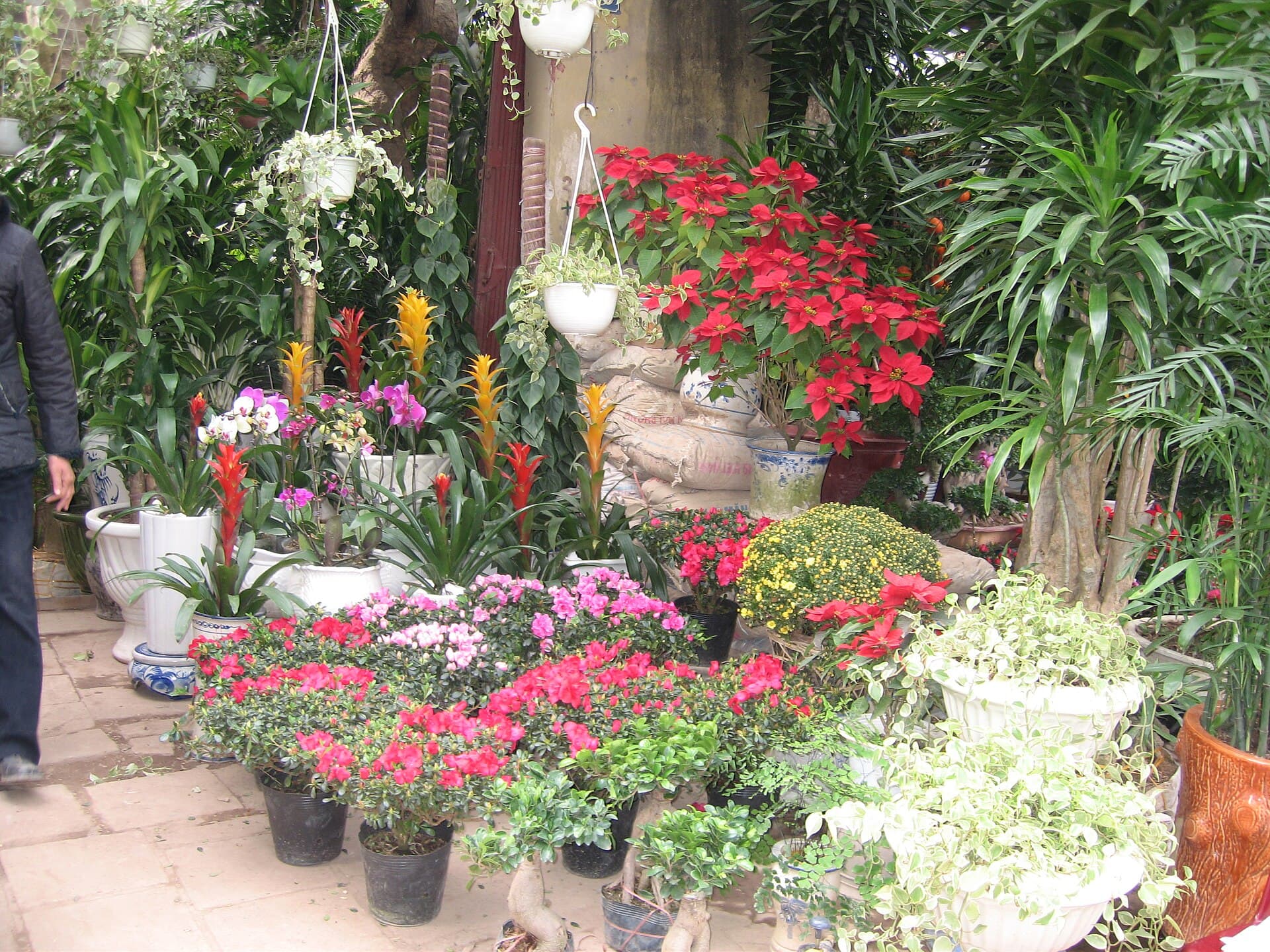
Come if you want the ritual. Tet is ancestor altars, peach blossom carried home on motorbikes, five-fruit trays, li xi envelopes, incense smoke at midnight and streets that belong to families rather than commerce. The flower markets in the four days before New Year's Eve are among the finest street scenes in Southeast Asia, and everything else still trades then.
Come if you can commit to one base. A single city or resort, booked six months out, with a hotel that has its own restaurant, is a workable Tet. Phu Quoc and the other resorts are expensive but entirely functional. Cities work too, on softer rates, if you accept hotels and chains for three days.
Do not come if the trip depends on movement, street food or spontaneity — four internal legs, no bookings and a plan to eat at whatever looks good is what Tet punishes hardest. Carry cash, per our card versus cash guide; for the wider calendar see our festival atlas and best time to visit Vietnam.
Methodology
What a row measures. One traveller-facing category: the ordinary non-holiday state, the Tet state, the direction of the change from a visitor's point of view, a typical magnitude, the window relative to Tet day, and a source and confidence rating.
How the figures were gathered. Desk research in July and August 2026 across Vietnamese and English-language reporting, ministry and museum notices, operator schedules and fare declarations, and national tourism statistics. Most magnitudes come from Tet 2025 and 2026; the Grab figures date from Tet 2023, the last published flat surcharges.
Magnitudes are typical ranges, not guarantees. They describe how a category has behaved and are not forecasts. A percentage here means "the band reporting has repeatedly landed in", never "what you will pay". Where public data is thin, the row is marked low confidence.
Date verification. Tet 2027 was confirmed as Saturday 6 February, lunar year Dinh Mui, against Vietnamese perpetual-calendar sources including Thu Vien Phap Luat's 2027 lunar-solar calendar, Vietnamese press coverage and English-language reference material. The twelfth lunar month has 29 days this cycle, so the eve is 29 Tet, not 30 Tet.
Holiday-schedule caveat. The official 2027 window was unannounced at publication. Rows tied to office closures — banks, ATM refills, visa administration — shift with the October 2026 decision.
Limitations
- Two holidays are not a trend. Most magnitudes rest on Tet 2025 and 2026, both nine-day breaks; a five-day 2027 holiday would compress several windows.
- The public-holiday dates are unconfirmed, so every window tied to the official break is provisional.
- Closure lengths vary by household, not by rule. "Three to seven days" covers a real distribution; no source counts shutters.
- City versus countryside is a spectrum. A district town in Nghe An and central Hanoi behave nothing alike.
- Fare figures are examples, not indices. One route's 2-3x is not every route's.
- Some rows are only directionally supported — inbound long-haul pricing, tour operators and traffic volumes are widely reported but poorly quantified.
- Resort occupancy is self-reported by provincial tourism departments.
How to cite this
Nguyen, J. (2026). The Tet Effect 2027: What Lunar New Year Does to Vietnam Travel. Day Trips Vietnam. Retrieved from https://daytripsvietnam.com/guides/vietnam-tet-effect-2027/
For specific figures, cite the category row and publication date — e.g., "Day Trips Vietnam's Tet Effect 2027 puts national occupancy over Tet 2026 at about 55-60 percent, against roughly 95 percent in Phu Quoc."
Published under Creative Commons BY 4.0. Full grid and sources: vietnam-tet-effect-2027.json. Enquiries: info@daytripsvietnam.com.
Related research and reference
- Vietnam festival and public holiday atlas 2026 — every national holiday, sourced
- Cheapest month to fly to Vietnam 2026 — February in the annual fare cycle
- Vietnam travel cost index 2026 — the ordinary-week baseline
- Vietnam train fares 2026 — fares that barely move, seats that vanish
- Grab and taxis in Vietnam — normal-week supply and pricing
- Card versus cash in Vietnam 2026 — why Tet is the week to hold dong