
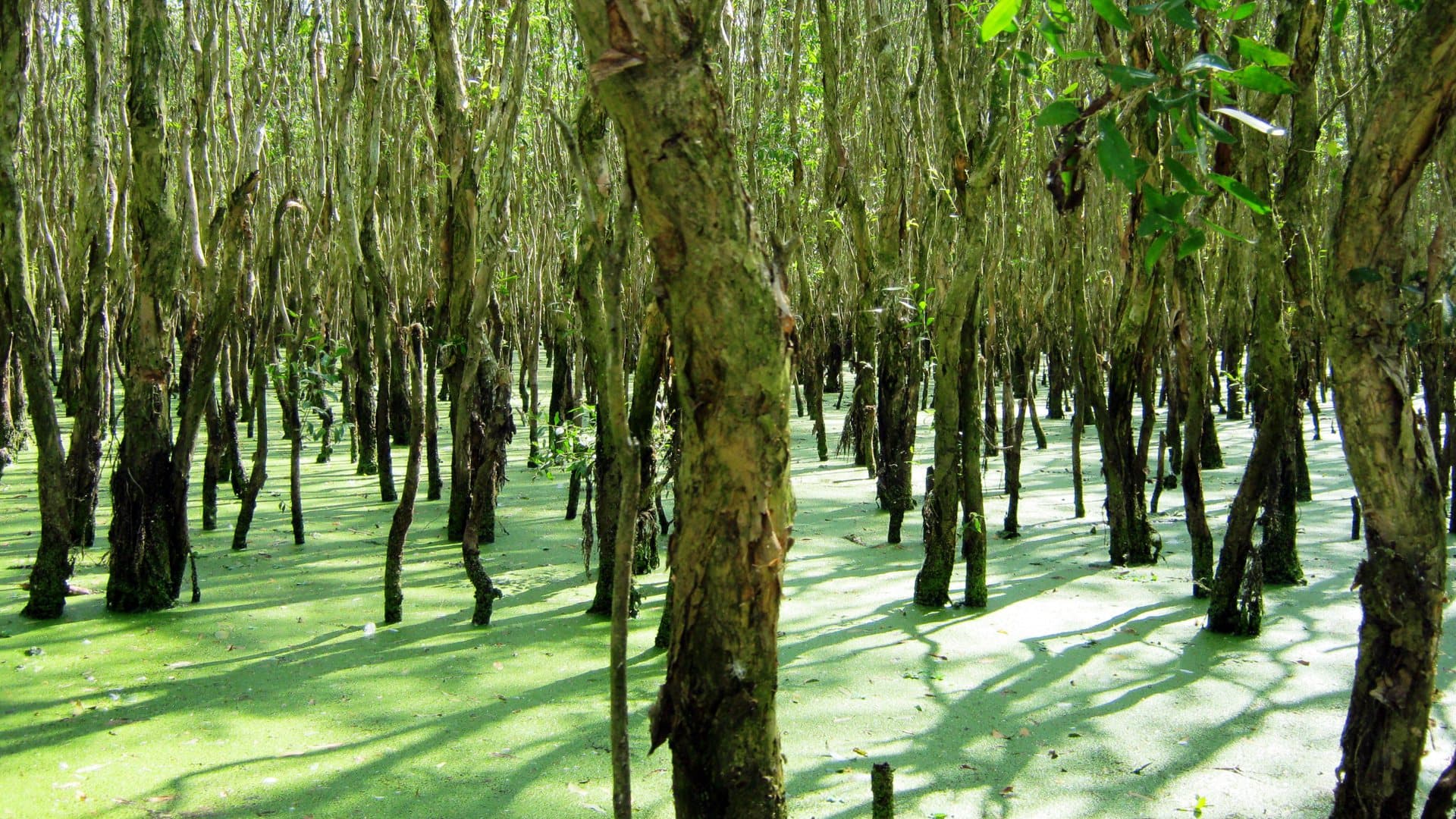
Chau Doc is the Mekong Delta's border town, on the Hau River about 250 km west of Ho Chi Minh City and a few kilometres from Cambodia. It has more variety than most delta towns: Sam Mountain, crowned by the Ba Chua Xu temple, one of southern Vietnam's great pilgrimage sites; the flooded melaleuca forest of Tra Su, best from September to November; floating fish-farm houses and Cham Muslim villages across the river; and the speedboat to Phnom Penh, which leaves every morning. Give it one or two nights.
Most travellers reach Chau Doc at the end of a trip through the Mekong Delta, after a night in Can Tho for the floating market. Since the 2025 reforms, An Giang province has absorbed Kien Giang, with its capital at Rach Gia, and the former Chau Doc city is now divided into Chau Doc and Vinh Te wards.
Getting there
| From | Time | Price (2026) | Notes |
|---|---|---|---|
| Ho Chi Minh City | ~6-6.5 hours by bus | ~210,000-265,000 VND | Futa from Mien Tay station, frequent departures |
| Can Tho | ~3 hours by bus | from ~150,000 VND | About 125 km |
| Phnom Penh | ~6-6.5 hours by speedboat | 1,580,000 VND | Hang Chau, 12:30 from Sisowath Quay |
Futa, also known as Phuong Trang, runs sleeper coaches from Mien Tay bus station in Binh Tan, with extra pickup points in District 1, to Chau Doc bus station, roughly every 30 to 60 minutes. From Can Tho, the drive is about 125 km. A new expressway linking Chau Doc, Can Tho and Soc Trang has been opening in sections since late 2025. Our Ho Chi Minh City to Can Tho guide covers the first leg of a delta trip.
Sam Mountain and the Ba Chua Xu temple
Sam Mountain rises out of the rice plain a few kilometres west of the town centre, about 284 m high according to Vietnamese sources, although some guides give a lower figure. At its foot is the Ba Chua Xu temple, dedicated to the Lady of the Realm, whose statue is said to have been found on the summit about 200 years ago. The shrine's management board says it receives more than 5 million visitors a year, busiest from just before Tet to the fifth lunar month, and it recorded nearly 1.8 million visits from January to mid-March 2026 alone.
Around it are the Tay An pagoda, built in 1847, with its mix of Vietnamese and Indian-influenced architecture; the tomb of Thoai Ngoc Hau, the official who dug the nearby Vinh Te canal in the 1820s; and the Hang pagoda halfway up the slope. Together they form a national heritage site. You can climb the stepped path past shrines to the summit, take a motorbike taxi up the road, or ride the cable car, about 900 m long; recent sources give return fares from about 90,000 to 150,000 VND, so check at the base. The view from the top stretches over the rice fields into Cambodia. The best plan is to ride up and walk down.
The Ba Chua Xu festival runs from the 22nd to the 27th day of the fourth lunar month and was inscribed by UNESCO as intangible cultural heritage in December 2024. Its rituals include a procession bringing the Lady's statue down the mountain and the midnight bathing of the statue. In 2026 the extended programme ran from 31 May to 12 June; on our own calculation from the lunar calendar, the core festival in 2027 falls from 27 May to 1 June. Expect huge crowds and full hotels.
Tra Su forest
The Tra Su melaleuca forest is a protected wetland of about 845 ha, roughly 20 to 30 km south-west of Chau Doc, with around 70 bird species, including storks and darters. You travel through it by motorboat and then by small rowing boat along canals carpeted with green duckweed, and a long bamboo bridge crosses part of the forest. It is at its best in the flood season, from September to November, when the water is high, and in the early morning, when the birds are most active.
As of 2026, entry costs about 100,000 to 120,000 VND, with the 120,000 VND fare on the site's price list, and the boats about 60,000 VND per person. Allow half a day, including the drive. Our day trips from Can Tho guide covers visiting it from further afield.
The river: fish farms and Cham villages
The Hau River at Chau Doc is lined with floating fish-farm houses, where families raise catfish in cages beneath their homes. Since 2024, about 160 of them have been painted in bright colour blocks as a "colourful raft village", and boat trips from the riverfront visit them.
Across the river are the Cham Muslim villages of Chau Phong and Da Phuoc, about 3 km from the centre, with mosques including the Mubarak mosque and a tradition of brocade weaving, recognised as national heritage in 2023. Villagers now run small community tours, and a boat trip usually combines the fish farms with a village visit. Dress modestly, and ask before photographing people.
Food and the market
Chau Doc's market is known for its stalls of salted and dried fish and above all for mam, fish fermented with salt, palm sugar, chilli and garlic, sold by the tub. The dish to eat is bun ca Chau Doc, a turmeric-yellow noodle soup with snakehead fish, shaped by Khmer cooking; try lau mam, a fermented-fish hotpot, if you are with a group. The Khmer villages of the surrounding Bay Nui hills make thot not, palm sugar, recognised as national intangible heritage in 2024, and you will find it in sweets and drinks across town.
The border: the boat to Phnom Penh
The speedboat. Hang Chau's speedboat leaves Chau Doc at 07:00 daily from the riverside pier on Le Loi street; be there 30 minutes early. It takes about four hours on the water, plus up to two hours at the border posts, Vinh Xuong on the Vietnamese side and Kaam Samnor on the Cambodian side, arriving in Phnom Penh around 13:30. From 1 June 2026 to 31 May 2027 the fare is 1,640,000 VND per person, raised by 35% for fuel costs, as the operator announced. It includes snacks, water and a guide, and it is cash only, in dollars or dong.
The visa. The Cambodian e-visa is not accepted for entry at Kaam Samnor, or at the Phnom Den land crossing near Tinh Bien, according to the boat operator's 2026 guidance; e-visas work only at Bavet among the crossings from Vietnam. Use the visa on arrival instead, which costs 30 dollars officially; Hang Chau arranges it for 37 dollars including its fee, with the form filled in on the boat. Make sure your Vietnamese visa or visa-free stay covers the day you leave.
Our Ho Chi Minh City to Phnom Penh guide compares the boat with the bus, and our border crossings guide covers the rules at each checkpoint. For the whole route, see our Vietnam and Cambodia itinerary.
Where to stay
There are two practical bases. Central Chau Doc, by the market and the riverfront, is closest to the speedboat pier, the fish farms and the restaurants. The Sam Mountain area, about 5 to 6 km out, suits pilgrims and is busiest around the festival. Rooms are cheap: booking sites list simple hotels from a little over 100,000 VND a night, and mid-range rooms near the temple commonly cost about 300,000 to 500,000 VND, rising at weekends and selling out during the festival.
When to go
The flood season, from September to November, is the most beautiful time for Tra Su and the surrounding fields, and the dry season, from December to April, is the most comfortable for walking. Avoid the Ba Chua Xu festival unless you want the crowds. Our Mekong Delta weather guide has the month-by-month picture, and our Mekong Delta without a tour guide explains how to travel the delta independently.
Limitations
Several figures differ between sources, including Sam Mountain's height, the cable car and Tra Su prices, and the distance to Tra Su, so we give ranges. The 2027 festival dates are our own calculation from the lunar calendar, not an official announcement. Visa rules at the border and the boat fare can change, and the operator says it may lower the fuel surcharge if fuel prices fall.
Workaround: confirm the boat fare and visa arrangements with the operator when you book, carry cash in dollars and dong, and check Tra Su and cable car prices on arrival.