
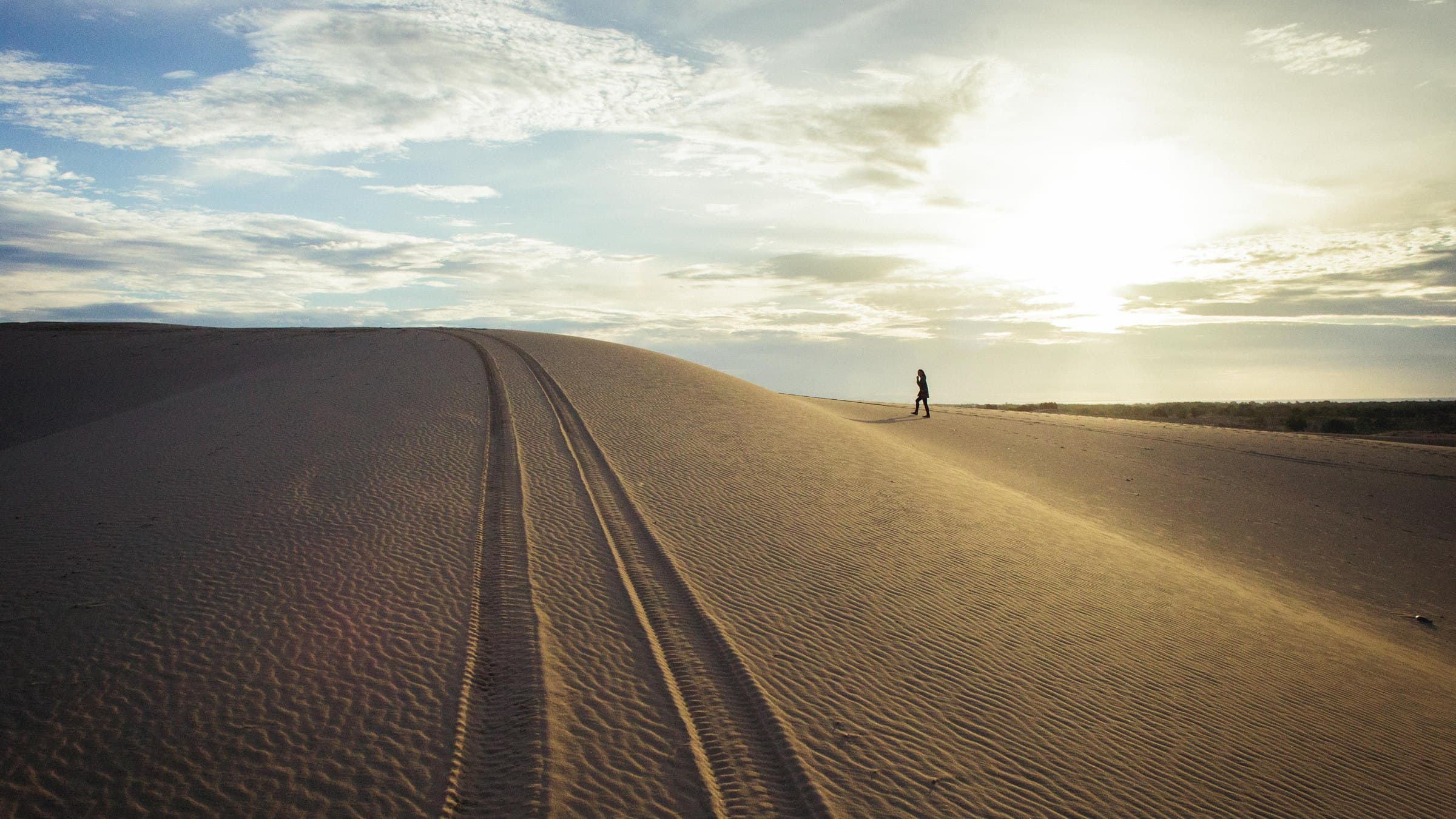
Mui Ne is a strange base for day trips, because most of what you would leave the strip for is barely a trip at all. The fishing harbour is five kilometres away, the Fairy Stream starts behind a hotel, and the Red Dunes are a twenty-minute ride. The whole set fits inside a 55 km radius of a 10 km beach road.
So timing matters far more than distance here. The dunes are transformed by light and ruined by midday glare; the harbour is an event that ends by eight. This ranks the seven worth taking as of mid-2026, with distances, costs across jeep, car and scooter, and a line on who each suits. The Mui Ne guide covers the town, and the transfer guide from Ho Chi Minh City covers getting here.
The seven, compared
| Day trip | Distance / time | Best time of day | Typical cost |
|---|---|---|---|
| 1. White and Red Dunes by jeep | 40 km / 40-50 min | 4:30 a.m. pickup | 150,000 VND seat, 550,000-800,000 VND jeep |
| 2. Mui Ne fishing village | 5 km / 15 min | 05:00-06:30 | Free |
| 3. Ke Ga lighthouse | 50 km / 1 hr 15 | 07:00-09:00 or late afternoon | 50,000-100,000 VND boat |
| 4. Ta Cu mountain | 55 km / 1 hr 15 | Cable car from 06:00 | 250,000 VND combo |
| 5. Po Shanu Cham towers | 12 km / 25 min | Late afternoon | 10,000-15,000 VND |
| 6. Fairy Stream | On the strip / 1 hr | 07:00-09:00 | 15,000 VND |
| 7. Phan Thiet town | 22 km / 30 min | Morning | Under 50,000 VND |
Prices are indicative as of mid-2026, at roughly 26,200 VND to the dollar. Entrance fees here are small and change often; transport is where the money goes.
1. The White and Red Dunes, by jeep, at sunrise
This is the reason people come, and the reason they leave disappointed when they go at the wrong hour. The White Dunes at Bau Trang sit roughly 40 km north of the Ham Tien strip, about 40 to 50 minutes away: a genuine dune field of pale, fine-grained sand above two freshwater lakes, Bau Ong and Bau Ba, which flower with lotus between roughly June and September. Entry is around 15,000 VND plus about 10,000 VND for motorbike parking as of mid-2026.
The Red Dunes, Doi Hong, are the other half of the circuit and a different scale entirely: smaller, rust-orange, close enough to the strip to walk. Entry is free and the local business model is plastic sleds at roughly 20,000-50,000 VND. They are best at sunset, and they are also where crowds, vendors and litter concentrate near the easiest access points, so walk two minutes further than everyone else.
What the jeep tour actually costs
A shared seat on the standard circuit — White Dunes, Red Dunes, Fairy Stream, fishing harbour, four to five hours — starts from around 150,000 VND per person as of mid-2026. A private jeep for four to six runs roughly 550,000-800,000 VND for the vehicle. Split three or four ways that is barely more per head, and it buys the freedom to skip a stop or sit on a crest for another twenty minutes. Sunrise departures leave between 4:00 and 4:30 a.m.; sunset tours leave around 2 to 3 p.m. and are busier.
The quad-bike hard sell, honestly
Quad-bike operators meet you at the White Dunes, and the pressure is real rather than imagined. Published rates as of mid-2026 run around 300,000 VND per person for a guided ride where the operator drives, and roughly 600,000-800,000 VND to drive yourself for 20 to 30 minutes. Travellers are routinely quoted more than locals pay, and Tripadvisor reviews of the site carry repeated complaints about inflated on-the-spot pricing near the gates. Decide before you arrive whether you want an ATV, and if you do, agree price and duration out loud before anyone starts an engine.
Pick this if: you only do one thing from this list. Take the sunrise version.
2. Mui Ne fishing village and the coracle fleet
The best free hour in Mui Ne, and the one most visitors sleep through. The harbour sits about 5 km west of the middle of the strip, and between roughly 5:00 and 6:30 a.m. the night boats come in and the beach becomes a wholesale market: coracles shuttling catch from the anchored fleet, ice broken by hand, fish sorted into baskets and sold on the sand. The bay full of round basket boats is the postcard; the trading is the event.
Two honest warnings: the smell is strong — this is a working landing point, not a viewpoint — and the ground is wet and slippery. Stand clear of the working lines and be done by eight.
Pick this if: you want the one thing here that is not priced for you.
3. Ke Ga lighthouse
About 50 km southwest along the coast from the strip, a little over an hour by car, and around 30 km from Phan Thiet. The lighthouse is French, built between 1897 and 1899: a granite tower of roughly 35 m on a rocky islet, lifting its light to over 65 m above the sea, with 183 spiral steps inside. It is commonly described as Vietnam's oldest surviving lighthouse.
The islet sits 300 to 500 m offshore, and boats and basket boats cross for roughly 50,000-100,000 VND per person return as of mid-2026; at low tide in the dry months people walk. Sources disagree on whether a small island fee applies, usually quoted at 10,000 VND. Go early or late — there is no shade.
Pick this if: you like ruins, boats and empty coastline more than organised attractions.
4. Ta Cu mountain and the reclining Buddha
Roughly 55 km southwest of the strip, about an hour and a quarter along QL1A. The draw is the Linh Son Truong Tho pagoda complex and its 49 m reclining Buddha, the longest statue of its kind in Vietnam, set in forest near the summit. A cable car runs about 1,600 m up the flank in roughly ten minutes each way, from around 6:00 a.m. As of mid-2026 site entry is around 50,000 VND and the combined ticket with the return cable car about 250,000 VND, roughly $9.50. You can walk up in two hours instead if you start early. Allow half a day with the drive.
Pick this if: you want one properly Vietnamese sight on a trip otherwise made of sand and seafood.
5. Po Shanu Cham towers
Twelve kilometres from the strip toward Phan Thiet, on Ba Nai hill, about 25 minutes. Three brick towers from the 8th and 9th centuries, built by the Champa kingdom for Shiva and later associated with the princess Po Sah Inu. They are small — this is not My Son — but among the oldest surviving Cham structures anywhere, and the hill carries a French-era tower and wartime bunkers above a wide view of Phan Thiet bay. Entry is around 10,000-15,000 VND as of mid-2026, open roughly 7:00 a.m. to 5:30 p.m. Allow 45 minutes, late in the afternoon when the brick warms up.
Pick this if: you have an afternoon spare and any interest in what stood here before the resorts.
6. The Fairy Stream, with a warning
Suoi Tien is a shallow stream through a canyon of red and white clay, and the walk is a barefoot wade of about twenty minutes upstream and twenty back, ankle-deep almost throughout. The formations are strange and the water is warm. Entry is around 15,000 VND for adults and 7,000 VND for children as of mid-2026, open roughly 6:30 a.m. to 5:30 p.m.
The warning is the entrance. Reviewers describe the first stretch consistently and unflatteringly: litter, standing smell, karaoke from the businesses backing onto it, and men who drape a snake over you and then ask for money. The same reviews agree it improves as you walk. Go early and keep going past the noise.
Pick this if: it is already on your jeep circuit, or you want a shaded hour for almost nothing.
7. Phan Thiet town
Twenty-two kilometres west, about half an hour, and the least-visited item here. Phan Thiet is a working fishing city with three things worth an hour each. Van Thuy Tu temple, founded in 1762, holds more than a hundred whale skeletons and 24 Nguyen-dynasty royal decrees, including one of about 22 m and 65 tonnes described as the largest in Southeast Asia. Duc Thanh School, built in 1907, is where the young Nguyen Tat Thanh taught in 1910 and 1911 before leaving Vietnam and becoming Ho Chi Minh. And the 1934 water tower on the Ca Ty river, designed by Prince Souphanouvong of Laos while working as an engineer here, is the town's emblem.
Pick this if: you have three or more days and the beach has stopped being interesting.
Getting around, and what it costs
Private car with driver. The right tool for Ke Ga and Ta Cu, especially combined. Roughly $50-85 a day for a sedan and $70-110 for a seven-seater as of mid-2026, priced per vehicle, fees and lunch excluded.
Scooter. 100,000-200,000 VND ($4-8) a day, covering the harbour, Po Shanu, the Fairy Stream, Phan Thiet and the Red Dunes. You need a licence Vietnam recognises, and police checks along Nguyen Dinh Chieu are routine.
Taxi. Fine for hops into Phan Thiet, but ride-hailing coverage is thin here, so agree a meter or a fixed price. For wider context see the tour price index and the Vietnam budget guide.
Seasonality
November to April is dry, sunny and windy — the best half of the year for the dunes, and the reason Mui Ne is a kitesurfing town. May to October is the southern wet season, which here means workable mornings and a heavy afternoon downpour rather than washed-out days; the rainy season guide explains the pattern. Because everything on this list is a morning trip anyway, the wet season costs you less in Mui Ne than elsewhere. Water clarity is moderate year-round — see the beach water quality atlas and the best time to visit guide.
Limitations
Prices here are indicative rather than fixed. Binh Thuan entrance fees are revised often, published figures for the same site disagree — Ke Ga is reported both as free and as 10,000 VND, and quad-bike rates vary by a factor of two between sources — and on-site quotes to foreign visitors routinely exceed the published rate. Workaround: treat every number above as an anchor for negotiation rather than a tariff, and agree prices out loud before the service starts.
Distances are softer than they look, too. Published figures for the White Dunes range from about 30 km to about 40 km depending on which end of Mui Ne is used as the start point. Workaround: ask your accommodation for the current drive time on the morning you go, and build fifteen minutes of slack into any sunrise departure.