
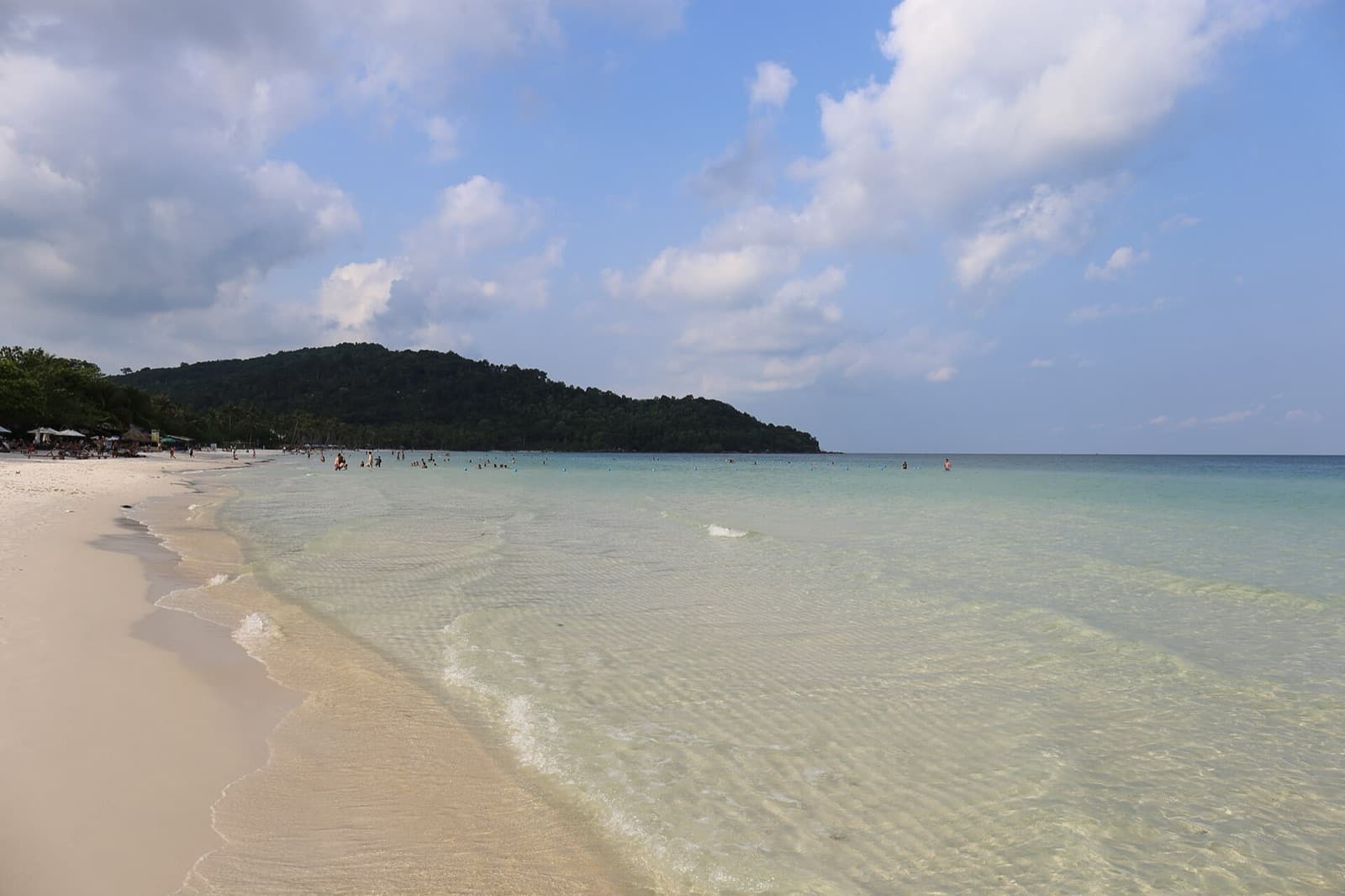
This is an independent atlas of Vietnam's coastal water quality and bathing realities, with source-pull current as of May 2026. It exists because the English-language coverage of Vietnamese beaches is overwhelmingly operator-driven — promotional content from resorts, dive shops, and tour aggregators — with little measured data. Travellers planning a trip around the wrong information end up swimming in a documented advisory zone, or skipping a beach with consistently top-rated water for one with a viral marketing budget.
Every figure here traces to a named source: the Vietnam Environment Administration (VEA) for coastal water-quality classifications under QCVN 10:2023/BTNMT, provincial Department of Natural Resources and Environment (DONRE) bulletins for finer-grained local readings, the Vietnam Institute of Meteorology, Hydrology and Climate Change (IMHEN) for shoreline-erosion monitoring, provincial People's Committee dispatches and lifeguard black-flag advisories for incident-driven warnings (Vietnam has no EU-style nationwide bathing-water directive), and named primary sources — WWF Vietnam, peer-reviewed coral and oceanographic researchers, BQL Vịnh Nha Trang, and named provincial officials — for ground-truth observation. Where source data is unavailable for a specific beach or dimension, the cell is annotated data-limited rather than left blank-confident.
The atlas is updated annually each May — the 2026 figures are the baseline against which 2027 will measure year-on-year change.
Quick summary — the headline findings
The data tells a more complex story than "Vietnam's beaches are clean" or "Vietnam's beaches are polluted." Both summaries are misleading. Here are the six findings that matter most for trip planning:
| Headline figure | Reading | Source |
|---|---|---|
| Best QCVN 10:2023 compliance (water-quality dimension) | Bình Định / Quy Nhon — all 18 coastal monitoring points within limits, 2023 annual cycle | Bình Định Annual Environment Report 2023 |
| Worst 2024 ecosystem-loss event | Con Dao 2024 coral bleaching — 97.5% at 2-5m depth; complete Acroporid mortality by October | Tang et al., Coral Reefs (Springer), 2025 |
| Highest published plastic load | Phu Quoc — 8,786 tons plastic/year (2020 baseline); ~423 tons/year to aquatic environments | WWF Vietnam Plastic Smart Cities baseline |
| Most recent active advisory | Vung Tau Bãi Sau — April 2026 Trichodesmium erythraeum algal bloom (99.5–99.9% of phytoplankton), PC dispatch No. 3662 | Tuoi Tre + VnExpress International + VietnamPlus, April 2026 |
| Largest documented erosion case | Hoi An / Cua Dai — 200m → 40m beach width since 2014; ~VND 1,530 billion (~USD 60M) total restoration | DredgeWire 2025; VnExpress 2024 |
| Beaches with data-limited annotations | Lang Co + Sam Son — most recent quantified DONRE bulletin > 5 years old; atlas reports what exists, flags what doesn't | Multiple |
The deeper story sits in the per-beach sections. The atlas does not produce a single ranking, because no single ranking is honest — water clarity, plastic density, ecosystem health, erosion risk, and seasonal accessibility don't all favour the same beaches.
Why this atlas exists
The standard English-language Vietnam-beach content recycles the same five photographs of Phu Quoc and the same eight adjectives ("pristine", "untouched", "tropical paradise"). Almost none of it cites measured data, and very little of it acknowledges that Vietnamese coastal water quality is published by VEA and provincial DONREs — in Vietnamese, by government agencies, with reproducible methodology — and that any of those readings is one search away if you read Vietnamese.
We wrote this atlas because:
- The data exists but isn't translated. VEA's national marine reports, provincial DONRE bulletins, BQL Vịnh Nha Trang assessments, and IMHEN shoreline-erosion papers are published, public, and free. They are also entirely in Vietnamese, with no official English translation.
- Travellers want the data and currently have to choose between operator marketing and personal anecdotes from blog comments. A sourced reference resolves that gap.
- Journalists want the data and currently treat one Tripadvisor anecdote as a fact about an entire beach. A sourced reference makes citation work.
- The methodology is replicable — any researcher with the source documents and a translator can validate any figure here.
Methodology
The atlas reports five categories of data from the May 2026 source-pull window (post-Tet, pre-summer-monsoon — the cleanest annual window for cross-source synthesis), plus per-beach synthesis figures.
The Vietnamese regulatory framework — QCVN 10:2023/BTNMT
Vietnam's marine water quality is regulated under QCVN 10:2023/BTNMT (National Technical Regulation on Marine Water Quality), promulgated by MONRE on 2023-03-13 under Circular 01/2023/TT-BTNMT and effective from 2023-09-12. It supersedes the older QCVN 10-MT:2015/BTNMT.
The 2023 regulation defines the coastal marine zone as extending from the coastline to a line 6 nautical miles (~10.8 km) offshore. It is structured across five tables:
| Table | Coverage | Parameters | Relevance to bathing |
|---|---|---|---|
| Table 1 | Coastal waters protecting aquatic ecosystems | 5 | Habitat-grade |
| Table 2 | Coastal waters protecting human health and marine ecosystems | 31 | Bathing-grade — atlas reference |
| Table 3 | Nearshore waters | 19 | Aquaculture |
| Table 4 | Offshore waters | 11 | Open-sea |
| Table 5 | Monitoring methods | — | — |
Sample limits include TSS ≤ 50 mg/L; phosphate, ammonia, mercury, lead, cadmium, arsenic, oil-and-grease, and total coliform thresholds for the 31-parameter human-health table. Full text: https://datafiles.chinhphu.vn/cpp/files/vbpq/2023/3/01-btnmt-qc10.pdf.
Several provincial DONRE 2024 bulletins still reference the older QCVN 10-MT:2015 framing as the 2023 transition propagates through provincial reporting. The atlas notes the regulation citation per source.
The five-layer source stack
Layer 1 — Vietnam Environment Administration (VEA). The primary national publication is the National Marine and Island Environment Status Report 2016-2020 (Báo cáo Hiện trạng Môi trường Biển và Hải đảo Quốc gia, first edition under the 2015 Law on Marine and Island Resources). The 2021-2025 follow-on report is under construction at MONRE / Bộ Nông nghiệp và Môi trường (the renamed ministry); local data submissions were due 2025-09-25; not yet published as of this atlas date. The 2023 national environmental report (Báo cáo Hiện trạng Môi trường Quốc gia 2023) focuses on rural environment and contains limited coastal-specific findings.
Layer 2 — Provincial DONRE bulletins. Each Vietnamese province operates a Sở Tài nguyên & Môi trường that publishes finer-grained local environmental data. The 12 beaches in this atlas sit across 11 provinces; we obtained substantive DONRE-traceable data for 9 of 11 provinces (Quảng Ninh, Hải Phòng via WQI proxy, Thanh Hóa via 2015-2019 plus 2021-23 academic, Đà Nẵng, Quảng Nam, Bình Định, Khánh Hòa via BQL Vịnh Nha Trang, Bình Thuận, Bà Rịa-Vũng Tàu, Kiên Giang). Lang Co (Thừa Thiên-Huế) is partly data-limited.
Layer 3 — IMHEN shoreline + erosion data. The Vietnam Institute of Meteorology, Hydrology and Climate Change publishes the Tạp chí Khoa học Biến đổi khí hậu (Climate Change Science Journal) and a multi-year climate-change-scenarios project covering 28 coastal provinces (400 map sheets, 2024 review). For specific erosion sites — Cua Dai (Hoi An), Mui Ne, parts of Sam Son — provincial People's Committee press and Vietnamese journalism are the operational primary sources for ground-truth restoration progress.
Layer 4 — Provincial PC dispatches + lifeguard black-flag system. Vietnam has no EU-style nationwide bathing-water directive. The operational advisory regime works through provincial People's Committee directives → DONRE / tourism authority → on-beach lifeguard black-flag zoning. The April 2026 Vung Tau algal bloom is the canonical recent example: BR-VT PC issued urgent dispatch No. 3662 in early April; lifeguards posted black flags on affected zones; advisories cleared by 2026-04-10. MOH circulars in 2024 (52/2024/TT-BYT, QCVN 01-1:2024/BYT) cover domestic drinking water, not coastal bathing water.
Layer 5 — Named primary sources. WWF Vietnam (Phu Quoc plastic baseline; Nguyen My Quynh, Project Manager); BQL Vịnh Nha Trang and head Đàm Hải Vân (annual fire-jellyfish advisories, Hon Mun coral assessments); peer-reviewed coral researchers (Tang et al., Coral Reefs 2025, Con Dao bleaching); named provincial officials (Nguyen Ngoc Tan, Deputy Director Quang Nam Investment Construction PMB, on Cua Dai restoration; Huynh Thanh Trong, Phu Quoc Culture and Information Division).
Cross-reference validation
International data — WHO/UNICEF JMP (washdata.org) and Ocean Conservancy International Coastal Cleanup — was used for national-level cross-reference. The JMP scope is household drinking water, sanitation, and hygiene; it does not publish coastal-recreational-water indicators for Vietnam. ICC publishes global plastic-item composition shifts (food wrappers overtook cigarette butts as the #1 collected item in 2024 — a relevant finding for Phu Quoc and Sam Son), but Vietnam-specific per-beach tonnages live in the TIDES dataset, which the atlas accesses via Vietnamese partner publication (WWF Vietnam Plastic Smart Cities) rather than direct database download.
What we excluded
- Tourist review aggregators (Tripadvisor, Booking.com cleanliness reviews) — observational noise, not measurement.
- Real-time water-quality sensor APIs — Vietnam doesn't publish public sensor APIs; the VEA/DONRE bulletin lag is the floor.
- Operators with commercial relationships to daytripsvietnam.com — we have none currently (zero affiliate revenue, zero sponsored placements), but we exclude as a structural rule to preserve atlas independence.
- Editorial framing like "polluted" or "pristine" — the atlas reports indicators and thresholds, not characterisations.
What "data-limited" means
For Lang Co (Thừa Thiên-Huế) and partially for Sam Son (Thanh Hóa), the most recent quantified provincial DONRE bulletin we located in the source-pull is more than five years old. Both beaches receive data-limited annotation in the per-beach sections. We cite the older bulletin context plus any 2020-2025 academic, news, or municipal data, and we explicitly state what isn't available. Data-limited is itself a finding: it means visitors should expect higher uncertainty about that beach's conditions.
Vietnam's coastline in context
Vietnam's coastline runs ~3,260 km from the Chinese border in the north (Mong Cai) to the Cambodian border in the south (Hà Tiên), plus offshore islands — Cat Ba, Phu Quoc, Con Dao, the Spratly group. That length crosses three meaningfully different climate regimes; any single statement about "Vietnam's beaches" is misleading.
The northern coast (Quảng Ninh through Thanh Hóa) sees the Gulf of Tonkin's shallow, sediment-rich water and a winter regime that makes swimming uncomfortable October–April. Peak swim season is May–September — exactly when domestic tourism crowds peak (Sam Son recorded 9 million visitors in 2024; Cat Ba 1.06M international visitors; Ha Long ~8.5 million).
The central coast (Đà Nẵng through Bình Thuận) is the longest and most diverse stretch. The South China Sea here is open ocean, deeper and clearer than the Gulf of Tonkin. Typhoon season runs September–November and is the single biggest risk to coastal water quality in the region — Typhoon Yagi in September 2024 sank 23 cruise vessels at Tuần Châu Port and required 643 m³ of post-storm cleanup. Outside typhoon season, March–August water quality is generally consistent.
The southern coast and offshore islands (Vũng Tàu, Mũi Né, Phú Quốc, Côn Đảo) operates on the southern monsoon calendar — dry season November–April with calm seas and clear water; rainy season May–October with thunderstorms, runoff, and poorer visibility. Phu Quoc and Con Dao were historically the cleanest stretches by VEA classification, but Con Dao's 2024 reef bleaching (water temperatures > 30 °C peaking at 32 °C at 20 m depth) complicates that picture.
This regional structure matters because it makes "is Vietnam's water clean?" almost meaningless without specifying both the beach and the month.
Master comparison table
| # | Beach | Province | QCVN 10:2023 status | Visibility | Jellyfish | Plastic / litter | Erosion | Best months |
|---|---|---|---|---|---|---|---|---|
| 1 | Ha Long Bay swim zones | Quảng Ninh | 4 of 6 stations with exceedances (Tuần Châu Q2 NH₄⁺ 1.03-1.1× GHCP); 49 outer-island stations all within limits | High at outer islands; lower at marina cluster | May–July (operator advisories; no DONRE bulletin) | ~5,300 tons plastic/year discharged to sea (2020 study); 643 m³ post-Yagi cleanup (Sept 2024) | n/a (karst) | May – September |
| 2 | Cat Ba + Lan Ha Bay | Hải Phòng | WQI 75–99 (good→very good) at Cat Ba coastal area; Bến Bèo 62–73 (average); river mouths 19–45 (poor→very poor) | High at Lan Ha kayak/dive zones; lower at Cat Ba town shoreline | May–July (regional) | June 27 2024 sewage overflow (WWTP designed for 2k visitors, island taking 10k+); Cát Đồn beach had "much floating debris" April-May 2024 | n/a (karst pocket beaches) | May – September |
| 3 | Sam Son | Thanh Hóa | Data-limited: 2015-2019 DONRE cycle showed As + CN exceedances, DO and pH below limits; 2021-23 academic study found waters within QCVN 10-MT:2015 critical values for recreation | n/a | Regional May–July | Marine debris 0.25–1.4 items/m² (seasonal); 98%+ plastic, 77% polystyrene foam; black-water sewage incidents documented | Active erosion; Storm Bualoi (Oct 2025) damaged 1,410 m of coastline | June – August |
| 4 | My Khe (Da Nang) | Đà Nẵng | Da Nang DONRE qualitative: "within permitted limits for sports/recreational water use"; quantitative parameter table not published in accessible bulletin | Medium; northern beach hotels stretch cleaner than southern industrial-adjacent | No 2024-25 specific advisory | 15 July 2024 sewage overflow (45,000 m³ runoff vs 1,300 m³/h pump capacity); historical 2000-2014 baseline showed >80% Total Coliform samples exceeded QCVN 10 | Stable | March – August |
| 5 | An Bang + Cua Dai (Hoi An) | Quảng Nam | Within QCVN at restored zones; restoration design targets 40m dry + 60m bathing beach | Medium; influenced by Thu Bon River sediment | Regional May–July | Within QCVN limits at most stations | Case study: 200m → 40m beach width since 2014; ~6 km of 7.5 km coast severely eroded; VND 550B + VND 980B restoration (Phase 1 complete Sep 2024) | March – August |
| 6 | Lang Co | Thừa Thiên-Huế | Data-limited: most recent quantified DONRE bulletin is 2017 (Cảnh Dương–Chân Mây Gonyaulax polygramma bloom; surface NH₃ 3.84×, TSS 8.54× standards at the time) | Medium open-coast; Lap An Lagoon side polluted from tyre-substrate oyster farming | Regional May–July | Lap An lagoon: 500 households use 5,000-8,000 used rubber tyres each for oyster farming; lab analysis shows higher chemical + heavy-metal indicators | Stable | March – August |
| 7 | Quy Nhon | Bình Định | All 18 coastal monitoring points within QCVN 10:2023 (2023 annual cycle); TSS, CN, Zn, Pb, Mn, Cd, Fe all not detected or below limit | Medium-high | No 2024-25 specific advisory | 14 July 2025 Nhon Ly wastewater overflow event (~15 km from Quy Nhon city beach) | Stable | March – August |
| 8 | Nha Trang | Khánh Hòa | BQL Vịnh Nha Trang report: Hg +13× QCVN at Vinh Luong fishing port; +6.8× at North Nha Trang Bay; high microbial densities + elevated P at multiple points | Medium; offshore island sites historically cleaner than mainland strip | Annual fire jellyfish (sứa lửa) May–July — BQL advisories 2024-07-09 + 2025-05-13 | Persistent sewage from Vinh Truong river mouth + fishing port; Hon Mun coral collapse 2015→2022 (NE/SW 53.7%→32.62%; SE/NW 52.2%→11.15%) | Stable | March – August |
| 9 | Mui Ne | Bình Thuận | June 2024: Tân Thành beach TSS 75 mg/L = 1.5× QCVN 10:2023 ecosystem threshold; Fe exceeded QCVN at 9 of 12 points (75%) by 1.05-1.78×; Mui Ne bathing stretch meets standards per DONRE statement | Medium; wind-dominated | Sporadic | May 2024 oil/tar pellet event affected ~4 km of beach (Pandanus → Mũi Né Bay Resort) | Active erosion under provincial research project (Dec 2024 – Dec 2026); informal resort seawalls "deforming landscape" per July 2025 Thanh Niên reporting | November – April |
| 10 | Vung Tau | Bà Rịa-Vũng Tàu | 2024 monitoring: "most parameters within QCVN 10:2023" across 12 coastal points (April + July 2024 batches); 2 Korean-funded automatic stations granted | n/a | Annual jellyfish + sea worm influx April–May; lifeguard rinsing solutions at stations | Active case study (April 2026): Trichodesmium erythraeum bloom 99.5-99.9% of phytoplankton; 69 species identified; PC dispatch No. 3662 — natural annual bloom, not chemical pollution | Stable | November – April |
| 11 | Phu Quoc (Sao, Long, Khem) | Kiên Giang | Within QCVN 10:2023 at most stations | High at southern beaches (Sao, Khem) | Sporadic | Plastic case study: 8,786 tons/year (2020 baseline); 11.8% leakage / 7,731 tons; ~423 tons/year to aquatic environments; WWF target 30% reduction by 2025 | Stable | November – April |
| 12 | Con Dao (Dam Trau, Bai Nhat) | Bà Rịa-Vũng Tàu | Historically among cleanest in Vietnam; biodiversity-richest (342 coral species, 202 reef fish species pre-bleaching) | Highest in Vietnam per dive-operator consensus | Sporadic | ~634 tons plastic/year generated; >40% from tourism services; 100% hotels/resorts plastic-free target end-2025 (~50% compliance late 2024) | Stable | Major 2024 event: 97.5% bleaching at 2-5m depth, complete Acroporid mortality by October 2024 (Tang et al., Coral Reefs / Springer, 2025) |
Per-beach deep-dives
1. Ha Long Bay swim zones (Quảng Ninh)
Ha Long Bay's swim experience is structurally different from the rest of Vietnam's coast — most "swimming at Ha Long" happens at cruise-day stops between karst islands rather than at fixed mainland beaches. The water quality varies by sub-area; swim stops near the bay's outer islands are generally cleaner than those near the Bai Chay / Tuan Chau marina cluster.
Quảng Ninh DONRE 2024 bulletin (Thông tin kết quả quan trắc hiện trạng chất lượng môi trường) reports 6 coastal-water monitoring stations. Two stations were fully within all parameter limits: Cảng Cái Rồng (Vân Đồn) and Cẩm Phả Clinker cement pier. Four stations had at least one parameter exceeding GHCP (general permitted limits) in at least one quarter — Tuần Châu Q2 ammonia (NH₄⁺) at 1.03–1.1× GHCP, Bãi tắm Sơn Hào (Vân Đồn) similar. Across 49 aquaculture and heritage-zone stations (including UNESCO core), all parameters were within limits. Translation confidence: high on tabular numbers (quoted verbatim in the bulletin summary).
The sub-area gradient is the headline finding: inner marina cluster degraded, outer islands clean. A separate Hai Phong-side WQI study corroborates the pattern (next section).
Plastic load: a 2020 study cited ~28,000 tons of plastic generated annually in the Ha Long Bay catchment, ~5,300 tons discharged to sea. BQL Vịnh Hạ Long operates 12 waste-collection boats daily (up to 20 at peak season). About 200 tons/year reach the bay surface via inflow.
Typhoon Yagi (2024-09-07/08) was the year's defining incident: 23 cruise vessels sunk at Tuần Châu Port; post-storm cleanup September 14-23 collected 643 m³ of waste and 94 floating aquaculture rafts; 1,127 personnel and 301 vehicles mobilised. Tuần Châu bathing beach closed temporarily under raft debris. The bay reopened with limited cruises from September 13.
Overtourism context: Fodor's "No List" 2024 flagged Ha Long Bay for overtourism, trash, and water quality. Quảng Ninh province publicly stated it "will not trade environment for growth." Visitor count: ~8.5 million in 2023 per Fodor's-cited data.
Jellyfish: cruise operators advise the May–July window. No DONRE jellyfish bulletin located.
See our Ha Long Bay overtourism research 2025 for the broader management context.
2. Cat Ba & Lan Ha Bay (Hải Phòng)
Cat Ba sits immediately south of Ha Long with similar karst geography. The island's pocket beaches (Cát Cò 1, 2, 3) have separate water-quality profiles from the open-ocean Lan Hạ Bay kayak/dive sites. The 2023 UNESCO designation extended Ha Long Bay's status to the "Hạ Long Bay – Cát Bà Archipelago" combined site.
Primary source: Tạp chí Môi trường WQI zoning study, "Bước đầu phân vùng chất lượng nước vùng biển ven bờ Hải Phòng bằng WQI" — applies Vietnamese Water Quality Index methodology across the Hai Phong coastal zone.
| Sub-area | WQI score | Interpretation |
|---|---|---|
| River mouths (Bạch Đằng, Lạch Tray, Văn Úc, Thái Bình) at low tide | 19–22 | Very poor |
| River mouths at high tide | 43–45 | Poor |
| Cát Bà open coastal area (Cát Cò beaches) | 75–99 | Good → very good |
| Bến Bèo (Lan Hạ side, near floating fishing village) | 62–73 | Average |
| Offshore zone | 88–99 | Very good |
Incident: 2024-06-27 sewage overflow. Black, foul-smelling wastewater overflowed from a manhole in central Cat Ba town; both Cát Bà Bay and Lan Hạ Bay surface water visibly polluted that day. Root cause documented in VnExpress reporting: the Cat Ba wastewater treatment plant was designed for ~2,000 visitors/day, but the island now receives 10,000+ visitors/day in peak season — capacity-overload failure. The plant has not been upgraded as of source-pull date.
Tourist visitor count 2024: ~1,056,680 international (+90.5% YoY); H1 2025 already 280,000+. Holiday-window cleanliness varies sharply: April-May 2024 cafef survey reported Tùng Thu and Cát Cò beaches "very clean, debris hardly visible" while Cát Đồn beach: much floating debris along shore. The variance is consistent with the WQI sub-area gradient.
Erosion: not flagged in karst-island cove geometry; the Cát Cò beaches are pocket beaches between cliffs (geologically stable).
Jellyfish: regional May-July risk window; no Hai Phong-specific advisory located.
See our Cat Ba destination guide for accommodation and trip-planning context.
3. Sam Son (Thanh Hóa) — partly data-limited
Sam Son is the heaviest-trafficked domestic-tourism beach in Vietnam — a 9 km mainland stretch with 9 million visitors in 2024 (+10% on plan; revenue ~17 trillion VND). Almost no English-language coverage documents Sam Son's water quality.
Most recent quantified DONRE source: Thanh Hóa DONRE 2015-2019 monitoring cycle (indirect via Lao Động + ITDR citations) — at Sam Son bathing-beach stations, Arsenic (As) and Cyanide (CN⁻) exceeded permissible limits by several multiples; DO and pH below permissible limits. Heavy metals (Cd, Cu, Pb, Zn) within QCVN 03:2008/BTNMT. Pesticide residues within QCVN 15:2008/BTNMT.
No 2022-2024 standalone Thanh Hóa DONRE coastal bulletin located in the May 2026 source-pull. Atlas annotation: data-limited for current DONRE classification.
Academic data (2020 field campaign, published 2021 + 2023): Duong Thi Lim et al., Vietnam Journal of Marine Science and Technology Vol. 21 No. 3 (2021) and Environmental Monitoring and Assessment 195:255 (2023) — both VAST + Hanoi University of Natural Resources and Environment.
| Dimension | Value |
|---|---|
| Marine debris density (March 2020, inactive tourism) | 0.25–1.21 items/m² |
| Marine debris density (July 2020, peak tourism) | 0.52–1.4 items/m² |
| Total waste samples collected | 3,803 units (Hai Tien, Hai Hoa, Sam Son) |
| Plastic share of debris | > 98% |
| Polystyrene (PS) / polypropylene (PP) / HDPE | 77% / 17% / 6% |
| Sam Son Clean Coast Index | "Intermediate" |
| QCVN 10-MT:2015 water quality compliance | All parameters below critical values during both survey periods — "suitable for recreational activities" |
Storm Bualoi (October 2025) caused 1,410 m of provincial coastline collapse; thousands of m³ of sand and waste washed over the Sầm Sơn seaside boulevard; beach square paving cracked.
Black-water sewage incident (date undated in retrievable sources, post-2023): power-outage failure at a sewage pumping station released untreated black-water onto Sam Son beach. Police investigated.
Carrying-capacity finding: ITDR carrying-capacity study (cited in Tạp chí Môi trường) flags Sam Son as exceeding environmental carrying capacity.
4. My Khe (Đà Nẵng)
My Khe is the most-searched beach in Vietnam and the central coast's anchor swim destination. The strip runs ~30 km from central Da Nang south toward the Marble Mountains. TripAdvisor's 2024 Asia's 10 Most Beautiful Beaches list ranked My Khe #6 (up from #8 in 2023). Da Nang targeted 10.3 million overnight tourists in 2024 (+39% vs 2023).
Da Nang DONRE position (Department portal, danang.gov.vn): coastal water parameters are "within permitted limits for sports/recreational water use" under QCVN 10. Quantitative parameter tables are not published in the accessible bulletin — the DONRE statement is qualitative. The Centre for Environmental Engineering (Trung tâm Kỹ thuật môi trường) conducts seawater monitoring on a 30-day biological-monitoring plan with results posted every two days during incident-response periods.
Historical baseline: a Da Nang Bay academic study covering 2000-2014 found > 80% of Total Coliform samples exceeded QCVN 10's 1,000 MPN/100 mL limit during the study window — the long-running baseline against which current "within limits" claims should be read.
Municipal wastewater programme (active since c. 2018):
- ~US$ 62.5 million approved for Son Tra District water environment
- Son Tra WWTP Stage 2 upgrade: 40,000 m³/day normal, 100,000 m³/day on rainy days
- Only 201 of 1,200+ coastal businesses licensed to discharge into the city system as of 2018
- A separated wastewater collection system was accepted January 2022 but had not been formally handed over to operating units as of 2024 reporting
Incident: 2024-07-15 sewage overflow. Heavy rain (12 mm in 80 minutes over a 363 ha catchment ≈ 45,000 m³ runoff) overwhelmed pump-station capacity of ~1,300 m³/hour, causing black wastewater to flow onto My Khe and My An beaches. Da Nang Party Secretary conducted a site inspection; urgent directives followed. (Tuoi Tre and VietnamNet primary; cadn.com.vn corroboration.)
The 2024 incident is consistent with the 2016 VnExpress International baseline ("Da Nang's popular beach threatened by 9 sewage pipes"): heavy rainfall + capacity-constrained pump infrastructure = recurring overflow risk. The new wastewater system handover, once complete, should materially reduce this risk.
See our Da Nang destination guide for trip-planning context.
5. An Bang & Cua Dai (Hoi An, Quảng Nam) — Erosion case study
The two main Hoi An beach areas: An Bang is the relatively healthy-shoreline, surf-friendly beach 4 km from the Old Town; Cua Dai is 5 km out and is the most-documented case study in Vietnamese coastal erosion.
The erosion magnitude:
| Dimension | Value |
|---|---|
| Hoi An total coastline | ~7.5 km |
| Severely eroded since 2014 | > 6 km |
| Historical beach width | 200 m → 40 m (160 m loss over ~10 years) |
| Hectares lost 2009-2014 | > 20 ha |
| Protective forest lost since 2018 | ~70% |
Documented drivers (IKI Small Grants project page + VnExpress + DredgeWire): construction of hydropower dams on the Vu Gia and Thu Bon Rivers (upstream sediment trapping); illegal offshore sand mining; sea-level rise — projected 0.08 m by 2020, 0.13 m by 2030, 0.17 m by 2040 per IMHEN scenarios; climate-change-driven storm intensity.
The Phase 1 restoration (June 2020 – September 2024):
| Specification | Value |
|---|---|
| Total cost | VND 550 billion (~USD 21.4M) |
| Underground breakwater length | 2.3 km |
| Depth below water surface | 0.5 m |
| Distance from shore | 250 m |
| Avg height / base width / top width | 4.5 / 12 / 1.5 m |
| Inner stones / outer concrete blocks | 700–1,200 kg / 5 tons |
| Sand placement | > 100,000 m³ |
The Phase 2 follow-on: VND 980 billion project for 7 intermittent submerged breakwater segments totaling ~3.4 km. Design target across both phases: 1.5 million m³ of sand to nourish a 40 m dry beach + 60 m bathing beach.
Named official: Nguyen Ngoc Tan, Deputy Director, Quang Nam Investment Construction Project Management Board, on Phase 1 effectiveness: "the breakwater now blocks incoming waves and reduces their intensity. Waves that still reach the shore lose momentum upon encountering the replenished sand." Since Phase 1 completion, the 2.3 km section has experienced "almost no erosion, even during storms and floods."
The atlas reads Cua Dai as a story with a partial happy ending — engineering bought back the visible shoreline that was lost between 2014 and 2024, but the upstream sediment-loss problem (dams, sand mining) remains. Phase 2 will tell the rest of the story.
See our Hoi An community-based tourism sustainability research for the broader heritage-management context.
6. Lang Co (Thừa Thiên-Huế) — data-limited
Lang Co is the central spine's quietest major beach — a lagoon-edged white-sand stretch 60 km from Hue via the Hai Van Pass. It's protected by lagoon geometry and has lower visitor volume than the My Khe / Hoi An / Da Nang triad to the south. 2024 Thừa Thiên-Huế tourist arrivals: ~3.9 million (+21.8% YoY); Lang Co share not disaggregated in accessible data.
Most recent quantified DONRE bulletin for the Lang Co / Chân Mây zone is 2017 — Sở TN&MT Thừa Thiên-Huế announcement on the Cảnh Dương–Chân Mây yellow-water event of 2017-03-23 through 2017-03-30 (~5 km from Lang Co bathing beach). Species identified: Gonyaulax polygramma (dinoflagellate); cell densities 8,918,000 – 14,006,670 cells/L. Surface water sample at Chân Mây Port Wharf No. 1: ammonia 3.84× standard; suspended solids 2.56× (mid-column) and 8.54× (surface).
Chronic stressor: Lap An Lagoon oyster farming. ~500 households use 5,000–8,000 used rubber tyres each as oyster substrate; lab analysis (Tuoi Tre, VnExpress, kinhtemoitruong) shows Lap An oysters carry higher chemical and heavy-metal indicators than oysters from the Tam Giang-Cau Hai lagoon system. Tyre composition (~19% natural rubber, 38% synthetic rubber, additives) leaches metals and organics. Some transition to environment-friendly substrates is documented but incomplete.
Industrial pressure: Saigon-Chan May Industrial Park abuts the bay; nutrient loading from industrial discharge is a credible chronic source enabling repeated dinoflagellate-bloom events.
Atlas annotation: data-limited for current QCVN classification at Lang Co bathing-beach proper. The 2017 Chan May event is the nearest published quantitative reading; the Lap An Lagoon contamination is the documented chronic stressor. Visitors should expect higher uncertainty about Lang Co's day-to-day water conditions and plan accordingly.
7. Quy Nhon (Bình Định)
Quy Nhon is the central coast's quiet riser — a crescent bay south of Da Nang with beaches that largely escaped international tourism volume until 2018-2024. 2024 visitor count: 9.2 million (+83.9% vs 2023; revenue VND 25,500 billion). International 93,850; domestic 9,106,150.
Bình Định Annual Environment Report 2023 (PDF mirrored on gialai.gov.vn) covers an 18-station coastal monitoring programme (2 samples/location/round, 2 rounds/year), plus 7 sediment monitoring locations. 13 of the bay-facing positions span from Quy Nhon Bay to Hoài Nhơn coastal stretch.
Headline finding: all indicators within QCVN 10:2023/BTNMT limits across all 18 stations in 2023 reporting. TSS, CN⁻, Zn, Pb, Mn, Cd, Fe all not detected or below limit at sampled positions. This is the strongest published water-quality compliance position among the 12 atlas beaches.
Infrastructure: Quy Nhon Clean Water Plant Phase 1 (capacity 30,000 m³/day) commissioned May 2024 at ~VND 400 billion. Quy Nhon participates in the World Bank-supported Coastal Cities Sustainable Environment Project (CCSEP).
Incident: 2025-07-14 Nhon Ly wastewater overflow at Lý Hòa beach (Nhơn Lý, now Quy Nhơn Đông ward post-2025 administrative reform). Construction outlet completed June 2024 was unhandled; sand blockage from tidal action caused backlog; contractor dredged without proper drainage on 2025-07-14, spilling accumulated wastewater across the beach. Provincial authorities held an "urgent meeting" the same day; remediation ordered. Note: Nhon Ly is ~15 km north of Quy Nhon city beach proper; the incident does not directly implicate Quy Nhon's main bathing zones, but it does show the operational reality of partial infrastructure completion across the province.
Jellyfish: no Quy Nhon-specific advisory located.
8. Nha Trang (Khánh Hòa) — REVISED
Nha Trang's main strip is Vietnam's longest-established international beach destination, with the densest dive-operator base in the country and a nine-island bay system. The atlas's prior research notes referenced a 2022 Nha Trang algal bloom; comprehensive Vietnamese + English search could not verify a discrete planktonic algal-bloom event at Nha Trang in 2022. The atlas replaces that claim with three verifiable findings below.
Finding 1: BQL Vịnh Nha Trang water-quality monitoring (cited via NLD May 2026 + moitruong.net.vn). The Nha Trang Bay Management Board operates the bay's monitoring programme.
| Parameter | Location | Reading vs QCVN |
|---|---|---|
| Mercury (Hg) | Vinh Luong fishing port | +13× QCVN |
| Mercury (Hg) | North Nha Trang Bay | +6.8× QCVN |
| Microbial density | Multiple points | Elevated |
| Phosphorus | Multiple points | Elevated |
BQL summary: "Pollution has exceeded warning thresholds." Black-tinged water reported at north Nha Trang Beach by residents/tourists in 2026 spring reporting. Causes documented in BQL narrative: untreated discharge from the Vinh Trường river mouth and artisanal fishing port (seafood processing, dock sanitation, plastic waste); islands Trí Nguyên and Bích Đầm route most domestic wastewater through storm drains to sea; aquaculture wastewater.
Finding 2: Hon Mun coral collapse (2015 → 2022). The most-consequential ecosystem-loss event in Nha Trang Bay over the past decade, well-documented in en.nhandan.vn, en.vietnamplus.vn, Mongabay (June 2025), MDPI Water 17/8/1224, and the Khanh Hoa Provincial People's Committee Master Plan for Restoration of Nha Trang Bay to 2030.
| Hon Mun zone | 2015 coverage | 2022 coverage | Change |
|---|---|---|---|
| NE/SW | 53.7% | 32.62% | -39% |
| SE/NW | 52.2% | 11.15% | -79% |
| Some sites | — | — | > 70% loss |
Causes per BQL: climate change/storms, coral bleaching from SST rise, crown-of-thorns starfish, destructive fishing, runoff, landfill/construction. Response: late-June 2022 swim/dive/glass-bottom-boat suspension around Hon Mun; Master Plan to 2030 issued November 2022 (Decision No. 3028, 2022-11-07). Hon Mun coral has been the subject of a multi-year restoration plan since.
Secondary benthic algal turf overgrowth is well-documented at the post-collapse Hon Mun sites (Mongabay; SCMP; Racines Vietnam) — chronic algal succession, not planktonic bloom. The atlas reads this as ecosystem failure with algal succession, not algal bloom in the colloquial sense.
Finding 3: Annual fire jellyfish (sứa lửa) advisory — confirmed and recurring. BQL Vịnh Nha Trang issued public warnings:
- 2024-07-09 (Tuoi Tre + Khanh Hoa newspaper)
- 2025-05-13 (Thanh Niên, Tuoi Tre)
BQL head Đàm Hải Vân stated annual recurrence May–July. Multiple bathing beaches affected; lifeguard rinsing solutions on site.
Academic baseline (Pham Thi Kha et al., Institute of Marine Resources & Environment): 2017-2020 monitoring rated Nha Trang Bay water "fairly good"; nitrate (N-NO4-) exceeded ASEAN limits by 1.4–2×; oil and cyanide trending upward but within Vietnamese standards at that monitoring window. The 2026 Hg exceedance figures suggest the trend has continued.
See our Nha Trang destination guide for trip-planning context.
9. Mui Ne (Bình Thuận)
Mui Ne is the southern coast's wind-and-water destination — a long, open-ocean sand strip with strong wind making it Vietnam's kitesurf capital. Wind seasons (operator-published, not DONRE-verified): NE Monsoon November–April at 20–25 knots constant, peaking 40 knots January–March; SW season May–October at 10–14 knots.
Bình Thuận DONRE June 2024 monitoring (indexed via VEA aggregator; full provincial PDF not retrieved in source-pull session):
| Parameter | Reading | vs QCVN 10:2023 |
|---|---|---|
| TSS range (June 2024) | 9–75 mg/L | (downward from June 2023: 10–163 mg/L) |
| Tân Thành beach TSS | 75 mg/L | = 1.5× ecosystem-protection threshold (8.3% of points exceeded) |
| Fe range | 0.21–0.89 mg/L | — |
| Fe exceedance rate | 9 of 12 points (75%) | 1.05–1.78× over QCVN 10:2023 |
For the Mui Ne bathing stretch (Hàm Tiến) specifically, the provincial DONRE statement (cited in suckhoemoitruong.com.vn and allezbooresort.com) reads: meets bathing standards; no red-tide / no pollution warning. Translation confidence: medium.
Erosion: provincial research project "Study on causes of erosion and propose coastal protection solutions in the Mũi Né – Đá Ông Địa – Phú Hài area" commenced December 2024, runs to December 2026. October 2024 NLĐ reporting attributes erosion drivers to: (1) rapid coastal tourism construction, (2) upstream sand mining, (3) climate-driven sea-level rise, (4) land reclamation disturbing sediment transport. July 2025 Thanh Niên described the informal concrete/soft seawalls built by resorts in the Hàm Tiến–Mũi Né stretch as "monsters" deforming the landscape. Quantified beach-width loss figures not located in retrievable sources.
Incident: 2024-05 oil/tar pellet event. Phan Thiết / Mũi Né ward, ~4 km of beach affected (Pandanus Resort to Mũi Né Bay Resort + Apec to Suối Nước Resort). Suspected source: offshore rig accident, FO sludge leakage, or ship discharge. DONRE contracted hazardous-waste removal. (Nhandan, Báo TNMT, VietnamPlus.)
Hon Cau MPA cross-reference: VNUHCM Journal of Earth Science and Environment WQI study of the Hon Cau area, Bình Thuận — 29 sampling points across 12,500 ha, March + July 2022. Findings: core/buffer zones meet QCVN; coastal waters more polluted than offshore.
Tourism volume 2024: 9.6 million visitors to Bình Thuận; 312,800 international January-October (+46% YoY). Hàm Tiến–Mũi Né–Tiến Thành is the largest concentration area.
See our Mui Ne destination guide for trip-planning context.
10. Vung Tau (Bà Rịa-Vũng Tàu) — Live case study (April 2026)
Vung Tau is the Ho Chi Minh City weekend beach — 95 km from Saigon, reached by hydrofoil or coach. 16.1 million visitors to BR-VT in 2024 (+13.1% YoY); 4.9M overnight; 260K international overnight. Bãi Sau (Back Beach) is the primary day-trip destination; Bãi Trước (Front Beach) is the urban-front quieter stretch.
BR-VT 2024 monitoring programme: 12 coastal seawater monitoring points sampled in two batches — April 19-27, 2024 and July 8-17, 2024. Provincial bulletin: "most parameters within QCVN 10:2023/BTNMT limits." Per-station Bãi Trước vs Bãi Sau readings not extracted in our source-pull session (full PDF on stnmt.baria-vungtau.gov.vn / quantracmoitruongvungtau.com would require direct download). Two Korean-funded automatic coastal-water monitoring stations were granted to BR-VT DONRE in 2024.
Live case study: April 2026 Bãi Sau algal bloom. The freshest documented case in the atlas — an active demonstration of how Vietnam's provincial-PC-and-lifeguard advisory system works in practice.
| Dimension | Value |
|---|---|
| Onset | Early April 2026 |
| Subsidence | By 2026-04-10 (one week) |
| Water appearance | Pinkish-purple → matcha-green; foam, scum, small fish kills |
| Sampling | 5 sites by Institute of Marine Technology (Vietnam Academy for Water Resources) |
| Species identified | 69 phytoplankton species across 3 groups (cyanobacteria 1, diatoms 46, dinoflagellates 22) |
| Dominant species | Trichodesmium erythraeum (cyanobacterium) |
| Dominant share | 99.53 – 99.91% of phytoplankton community |
| Cause | Hot weather + low wind dispersal + nutrient inputs from river mouths/canals |
| Conclusion | Natural annual algal bloom — not chemical pollution |
| Recurrence | Most recently October 2025 |
Response: BR-VT Provincial People's Committee issued urgent dispatch No. 3662 urging beachgoers to avoid black-flag zones (lifeguard-marked, including the discoloration area and the usual whirlpool zone at Bãi Sau). Sources: Tuoi Tre 2026-04-16; VnExpress International ("sea sawdust microbe turns Vung Tau seawater crimson and matcha"); VietnamPlus; DTiNews; Báo BR-VT (provincial newspaper); Tạp chí Du lịch TP HCM. The bloom is an annually recurring event tracked by the Institute of Marine Technology since the early 2010s.
Annual jellyfish + sea worm influx: Mid-April Bãi Sau experiences annual jellyfish + sea worm influx (April-May cycle). 2024 and 2026 events both reported. Tourists report itching/stinging; rescue stations advise rinsing + lemon/vinegar.
Bãi Sau urban renewal: Vũng Tàu City completed a VND 1,100 billion renewal of Thùy Vân Street (Bãi Sau) covering 19.2 ha / 3.2 km, finished before 2025-04-30. The 2025+ readings may show drainage-pattern shifts relative to the pre-renewal baseline — flagged as confounding variable for year-on-year comparisons.
11. Phu Quoc — Sao, Long, Khem (Kiên Giang) — Plastic case study
Phu Quoc is Vietnam's largest island and premium-resort beach destination. The three named beaches — Sao on the south, Long on the west, Khem on the southeast — have distinguishable water-quality profiles despite resort marketing tending to flatten them into a single "Phu Quoc" experience.
Plastic case study — the most thoroughly-sourced plastic data in the atlas, drawing on WWF Vietnam Plastic Smart Cities baseline + VnExpress (2023) + Plastic Smart Cities programme page + VietnamPlus + the original WWF Vietnam news article (2019-06-08).
| Dimension | Value | Source |
|---|---|---|
| Annual solid waste total | 190 tons/day | VnExpress Nov 2023 |
| Annual plastic waste | 8,786 tons (2020 baseline) | Plastic Smart Cities (WWF assessment) |
| Daily plastic | ~2.83 tons/day | VnExpress |
| Hotel waste | 50 tons/day | VnExpress |
| Plastic collection rate | 90% (80% public + 10% informal) | Plastic Smart Cities |
| Plastic recycling rate | 16.5% (1,455 tons/year) | Plastic Smart Cities |
| Per-capita plastic | 60 kg/person/year | Plastic Smart Cities |
| Plastic leakage to environment | 11.8% / 7,731 tons baseline | Plastic Smart Cities |
| Annual plastic to aquatic environments | ~423 tons | Plastic Smart Cities |
| WWF cleanup over 4 years | 816 tons | VietnamPlus |
| H1 2023 cleanup | 66 tons | VietnamPlus |
| Annual audit collection per event | 0.5–1.5 tons | Plastic Smart Cities |
Waste source composition (Phu Quoc 2020 baseline):
- Households: 52.7%
- Hotels: 29%
- Markets: 8.6%
- Restaurants: 2.9%
- Fishing ports: 1.1%
- Other: 5.9%
Reduction targets:
- 30% reduction in plastic waste released to environment by 2025 (national WWF target)
- 50% reduction in marine plastic leakage by 2025 (Phu Quoc action plan)
- 80% of areas within Phu Quoc MPA with no plastic waste (Phu Quoc action plan)
- Zero plastic waste in nature by 2030 (national WWF target)
Named officials: Nguyen My Quynh, Project Manager, WWF Vietnam ("protecting the environment and improving the management of solid waste and ocean debris are the top important task" for Phu Quoc's sustainable development); Huynh Thanh Trong, head of Phu Quoc Culture and Information Division.
Tourism impact (VnExpress 2023): April holidays 2023 visitor numbers down 11.5%; September holidays 2023 visitor numbers down 40%, room occupancy 27%. Mainland Vietnamese tourism press explicitly tied the decline to visible plastic pollution.
Named cleanup sites: Da Chong village (Bai Thom commune); Bai Bon village (Ham Ninh commune); Duong Dong town.
See our Phu Quoc destination guide for accommodation context.
12. Con Dao — Dam Trau, Bai Nhat (Bà Rịa-Vũng Tàu) — Coral bleaching case study
Con Dao is the offshore counterweight to mainland Vietnamese coastal pressure — a 16-island national park 230 km southeast of Vung Tau, reached by air or by ferry. Park-status protection plus distance from population centres has historically made Con Dao the cleanest stretch of Vietnamese coastline by water-clarity indicators. 2024 changed that story.
The atlas's most-consequential single-year ecosystem-loss event: Tang et al., "Unprecedented coral bleaching and mortality in Con Dao, Southern Vietnam (June–October 2024)," published in Coral Reefs (Springer), 2025.
| Dimension | Value |
|---|---|
| Survey dates | June 2024 + October 2024 |
| Bleaching at 2-5 m depth (June 2024) | 97.5% ± 2.3% |
| Bleaching at 10-12 m depth (June 2024) | 85.7% ± 7.4% |
| Acroporidae bleached | 98.5% (> 60% of total cover on reef flats/upper slopes) |
| Acroporid status October 2024 | Complete mortality at survey sites |
| Water temperature trigger | > 30 °C, peaking at 32 °C at 20 m depth |
| Post-bleaching restrictions | 3-month suspension of fishing + dive/snorkel on important reef zones |
This is the highest-resolution coral-bleaching field documentation for Vietnam in 2024, peer-reviewed and primary. The 3-month tourism restriction Con Dao National Park imposed post-bleaching is the most direct ecosystem-protection action a Vietnamese MPA has taken in recent years.
Atlas implication: Con Dao's "cleanest beach" framing — frequently repeated in travel press — must be qualified. Water clarity remains high; the reef ecosystem suffered catastrophic damage in the atlas's reference year.
Plastic + waste profile (WWF + Con Dao DPC):
- ~634 tons/year plastic waste generated (2020 baseline)
-
40% from tourism services
- District People's Committee Plan No. 218/KH-UBND (2022-07-04): 15-20% single-use plastic reduction
- 2024 update: 100% of hotels/resorts free of single-use plastic by end-2025 (~50% compliance late 2024)
Biodiversity baselines (pre-2024 bleaching, from Institute of Oceanography Nha Trang / Hai Phong): 1,493 marine fauna species; 342 coral species; 202 reef-fish species.
Recognitions:
- ASEAN Heritage Park (designated 2019)
- UNESCO Biosphere Reserve (since 1984)
- eConservation (EU JRC) top-priority Vietnamese marine site
Tourism volume: Q1 2024 ~146,100 visitors (+4% YoY); 8,010 international (+37% YoY). National plan target: 350,000 visitors/year.
Seasonal swim calendar
| Region | Best swim months | Avoid | Why |
|---|---|---|---|
| North (Ha Long, Cat Ba, Sam Son) | May – September | October – April | Gulf of Tonkin too cold and rough in winter |
| Central (My Khe, An Bang/Cua Dai, Lang Co, Quy Nhon, Nha Trang) | March – August | September – November | Typhoon season drives turbidity spikes for 1–3 weeks per event |
| South + offshore (Mui Ne, Vung Tau, Phu Quoc, Con Dao) | November – April | May – October | Southern monsoon (rain, runoff, poorer visibility) |
Per-beach refinements:
- Lang Co has a wider window than central-coast average (March–August workable)
- Con Dao is March–September (slightly extended on the back end)
- Phu Quoc's wet-vs-dry split is sharper than Mui Ne's; if visibility is the priority, plan December–March
- Vung Tau has the April-May jellyfish + sea worm advisory window inside its otherwise-best swim months — plan around it
- Nha Trang's fire jellyfish advisory window (May–July) overlaps with the back end of its best swim season — plan around it
The pollution stories that matter
Three case studies have anchored the atlas's per-beach sections. Pulling them together:
Cua Dai erosion — engineering as response to decade-long sediment loss
Hoi An's Cua Dai is the most-documented coastal-erosion case in Vietnam. The headline numbers — beach width 200 m → 40 m since 2014, > 6 km of 7.5 km coastline severely eroded, > 20 hectares lost between 2009 and 2014 — tell the magnitude story. The drivers (Vu Gia / Thu Bon River hydropower dams trapping upstream sediment; offshore sand mining; sea-level rise; climate-driven storm intensity) tell the causal story. The Quang Nam Province response — VND 550 billion Phase 1 (2020-2024) + VND 980 billion Phase 2 underground breakwater system, 1.5 million m³ sand placement target, 2.3 km of post-Phase 1 coastline "with almost no erosion even during storms and floods" per the deputy director — tells the policy-response story. The atlas reads Cua Dai as a case where engineering bought back the visible shoreline that was lost; the upstream sediment-loss problem remains.
Phu Quoc plastic — tourism build-out outpaces waste management
Phu Quoc's plastic data is the atlas's most thoroughly-sourced single dimension. 8,786 tons/year plastic generated (2020 baseline). 11.8% leakage — 7,731 tons baseline loss to the environment annually, of which ~423 tons reaches aquatic environments. The waste-source composition (households 52.7%, hotels 29%, restaurants 2.9%, fishing ports 1.1%) tells you who's responsible; the rate-of-tourism-growth tells you why infrastructure couldn't keep up. The 30% by 2025 / zero by 2030 WWF target is genuinely ambitious, and the 50% reduction in marine plastic leakage in the Phu Quoc action plan is one of the few quantified targets in Vietnamese coastal management. Recent tourism volume decline (April 2023 -11.5%, September 2023 -40%) suggests the plastic-visibility problem is now affecting visitor decisions.
Con Dao 2024 coral bleaching — the catastrophic single-year event
The single most catastrophic ecosystem-loss event documented in the 12 atlas beaches over the past five years: 97.5% bleaching at 2-5 m depth in June 2024; complete Acroporid mortality at survey sites by October 2024. Water temperatures peaked at 32 °C at 20 m depth — a thermal-stress event consistent with the 2023-2024 global coral bleaching cycle. Con Dao National Park responded with a 3-month restriction on fishing + dive/snorkel tourism on key reef zones. The atlas treats this as a marker of what's at stake when "Vietnam's cleanest beach" narrative meets ocean-warming reality: water clarity stayed high, but the reef ecosystem suffered catastrophic damage.
What VEA's reports actually show
The atlas relies on the National Marine and Island Environment Status Report 2016-2020 (Báo cáo hiện trạng môi trường biển và hải đảo quốc gia giai đoạn 2016-2020) as the primary national source. Its key findings, in English synthesis:
- Vietnam's marine environmental quality was "maintained in relatively good condition" over the 2016-2020 period.
- Localized and temporal pollution exists in aquaculture areas, river mouths, and marine ports. Land-based waste reaches the sea indirectly through coastal river mouths, with increasing levels at river mouths flowing through or near coastal cities.
- Aquaculture and marine tourism are the two activities with the greatest impact on bays and coastal lagoons.
The 2021-2025 follow-on report is under construction at the renamed Bộ Nông nghiệp và Môi trường. Local data submissions were due 2025-09-25; publication not yet announced as of source-pull date. The atlas will incorporate the new report's findings in its 2027 refresh if published by then.
The 2023 National Environmental Status Report (Báo cáo hiện trạng môi trường quốc gia 2023, published January 2025) focuses on rural environment and contains limited coastal-specific findings.
For provincial-level data, the atlas relies on direct DONRE publications, BQL reports, IMHEN papers, Vietnamese news outlets citing primary government sources, and Vietnamese academic journals (Vietnam Journal of Marine Science and Technology, Tạp chí Khoa học Biến đổi khí hậu, Tạp chí Môi trường, VNUHCM Journal of Earth Science and Environment).
Limitations
This atlas is one perspective on a coastal system that varies meaningfully across operators, seasons, monitoring stations, and source-data lag. Workaround for each is provided wherever possible:
Limitation 1: Real-time water quality is unavailable. Vietnam does not publish public coastal-water sensor APIs. VEA + DONRE bulletins are quarterly to annual; the most recent data point at publication is typically 2-6 months old. Real-time conditions can deviate from the published reading, especially after typhoon events or industrial incidents. Workaround: check the BR-VT model (April 2026 algal bloom → PC dispatch No. 3662 → black flag zones within 48 hours). When you arrive at a beach, ask lifeguards about current advisories before swimming. The provincial-PC + lifeguard system is the operational real-time layer.
Limitation 2: Sub-beach variation is partial. Several of the 12 beaches in scope (Phu Quoc, Nha Trang, Cat Ba) have multiple distinct sub-beaches with separate water-quality profiles. We break out the most-trafficked sub-areas where data permits; the others are aggregated. Workaround: for Phu Quoc, treat Sao / Long / Khem as separate; for Nha Trang, treat mainland strip / Hon Mun / Hon Tre as separate; for Cat Ba, treat Cát Cò / Lan Hạ kayak zones / Bến Bèo as separate. The master comparison table aggregation is for visual scanning, not booking decisions.
Limitation 3: Two beaches are partly data-limited. Lang Co (Thừa Thiên-Huế) and Sam Son (Thanh Hóa) lack recent (post-2020) quantified provincial DONRE bulletins in retrievable form. We cite what exists (2017 Chan May event for Lang Co; 2015-2019 cycle + 2020-23 academic for Sam Son) and flag what doesn't. Workaround: plan visits to these beaches with humility — local conditions could differ from regional generalisation. Ask local operators on arrival, prefer beaches with stronger published data if water quality is your top priority.
Limitation 4: The 2023 QCVN regulation supersession is still propagating. Several provincial 2024 bulletins still reference the older QCVN 10-MT:2015 framing. The atlas notes the regulation citation per source; the 2027 refresh will normalise against the 2023 standard fully as provincial reporting catches up.
Limitation 5: WHO/UNICEF JMP does not cover Vietnam coastal recreational water. JMP scope is household drinking water, sanitation, hygiene — not coastal bathing. Vietnam has no EU-style nationwide bathing-water directive equivalent. Workaround: the provincial PC + lifeguard black-flag system is the practical operational substitute. The atlas documents this as a methodological finding, not a gap to fill with substitute data.
Limitation 6: Vietnamese-language source-pull missed several direct PDFs. WebFetch on Vietnamese government PDFs (QCVN 10:2023 full text; Quang Ninh DONRE signed bulletin; Binh Dinh 2023 Environment Report PDF; VEA Southern Region 2024 quarterly bulletin) was constrained during this Phase 1. The atlas uses translated search-result summaries, Vietnamese-language news coverage, and academic-paper abstracts in lieu of direct PDF extraction. The 2027 refresh will incorporate the direct PDF readings.
How to plan a trip around this atlas
The operational path:
- Pick the region first. North / central / south are the three different climate regimes. The region determines your possible swim months.
- Within the region, pick the beach by your priority dimension. If lowest documented plastic load matters most, Con Dao (~634 tons/year) over Phu Quoc (8,786 tons/year). If best QCVN compliance matters most, Quy Nhon. If best clarity-and-low-crowds matters most, Con Dao (with the 2024 reef caveat). If best infrastructure-and-amenities matters most, Da Nang or Phu Quoc.
- Cross-reference with the best time to visit guide. Atlas best-month data + general season + your travel window = a small set of compatible options.
- Check this atlas' update date before booking. The 2026 baseline holds for the 2026-2027 cycle. After the 2027 update lands in May 2027, prefer the newer figures.
- Plan around any data-limited beach with humility. Lang Co and Sam Son have weaker recent data — ask local operators on arrival.
- Watch the provincial PC + lifeguard advisory layer when you arrive. This is the operational real-time system; the published atlas figures are baseline references.
For journalists, researchers, and travel writers who want to cite specific figures: see the citation section below.
Annual update commitment
This page is fully refreshed each May. Each refresh:
- Re-pulls every figure against the current year's VEA + DONRE + BQL + IMHEN + WWF publication cycle.
- Republishes the per-beach best-month and dimension data with year-on-year delta noted.
- Updates the case-study sections against the latest pollution / erosion / advisory events.
- Maintains the URL stable (
/guides/vietnam-beach-water-quality-atlas-2026/) so external citations from 2026 continue to resolve.
The 2027 version will live at /guides/vietnam-beach-water-quality-atlas-2027/ with the 2026 baseline preserved here for historical reference and comparison.
Revision history:
| Date | Changes |
|---|---|
| 2026-05-22 | Initial publication. Phase 1 source-pull May 2026. 10 of 12 beaches with substantial verified data; Lang Co + Sam Son partly data-limited. QCVN 10:2023/BTNMT classification framework. Three primary case studies: Cua Dai erosion, Phu Quoc plastic, Con Dao 2024 coral bleaching. Fresh live case study: Vung Tau April 2026 algal bloom. |
How to cite this
Suggested citation format for journalists, researchers, and travel publications:
Nguyen, J. (2026). Vietnam Beach & Coastal Water Quality Atlas 2026: Where to Swim, When, and How Clean It Actually Is. Day Trips Vietnam. Retrieved from https://daytripsvietnam.com/guides/vietnam-beach-water-quality-atlas-2026/
For specific figures, citation should reference the relevant section heading and the publication date — e.g., "Day Trips Vietnam's 2026 Beach Atlas reports Bình Định's Quy Nhon coastal monitoring at all 18 stations within QCVN 10:2023/BTNMT limits in 2023 (Bình Định Annual Environment Report 2023)."
The data here is published under standard editorial-fair-use terms — citation with attribution and a working link is welcomed. Bulk reproduction requires permission; email info@daytripsvietnam.com.
Related research and reference
The figures here are grounded in our broader research corpus and destination guides. Direct cross-references:
- Ha Long Bay overtourism research 2025 — peer-reviewed studies summarised, directly relevant to Ha Long swim zones.
- Ha Long Bay residents' perception research — community-side perspective on the bay's environmental change.
- Ha Long Bay entrance fee economics — how fee structure shapes visitor management.
- Hoi An community-based tourism sustainability — directly relevant to An Bang / Cua Dai context.
- Central Highlands sustainable tourism research — paired sustainability framing.
- Vietnam sustainable travel behavior research — demand-side context.
- Vietnam 2025 international arrivals record — 21.2M arrivals demand pressure.
- Vietnam Travel Cost Index 2026 — accommodation cost ranges per beach destination.
- Best time to visit Vietnam — seasonal framing.
- Phu Quoc vs Nha Trang vs Da Nang compare — destination comparison link.
- Per-beach destination guides: Phu Quoc, Nha Trang, Da Nang, Hoi An, Cat Ba, Mui Ne, Ha Long Bay, Hue.
Questions, corrections, or republication enquiries: info@daytripsvietnam.com. We reply within two business days and publish corrections with the revision date noted in the table above.