
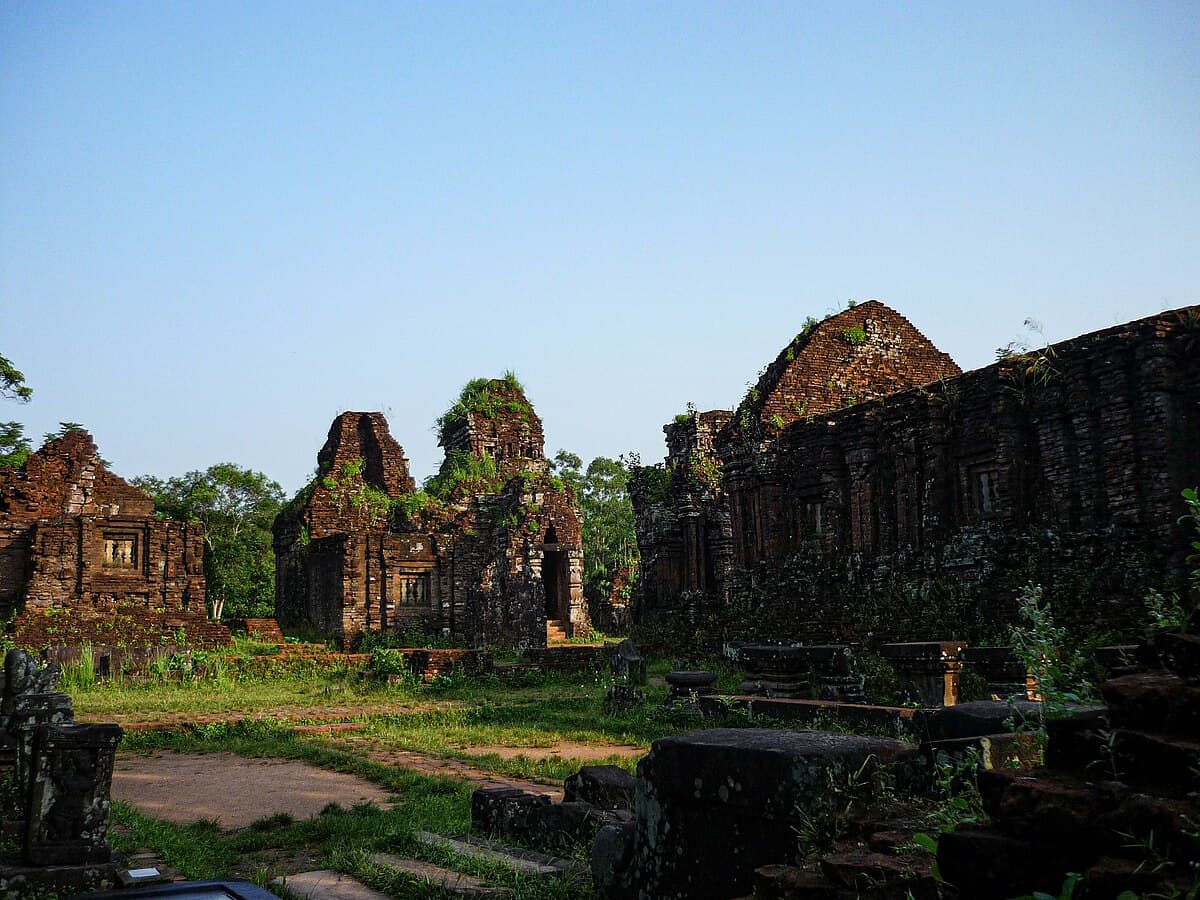
My Son Sanctuary is the ruined temple-city of the Champa kingdom, and in 2026 a foreign visitor pays 150,000 VND — about $6 — to walk in. That one ticket covers the electric buggy that ferries you the last stretch into the basin, entry to the small on-site museum, and a Cham dance performance staged through the day. The gates open around 6 a.m., and the single most important decision you make is when to arrive: come at or near opening and you get empty ruins in cool morning light; come at 10 a.m. and you share a shadeless jungle bowl at 32°C with the tour buses from Hoi An. My Son sits roughly 40 km west of Hoi An — about an hour by road — and a bit further, around 55 km, from Da Nang.
This is the deep reference guide: what the ticket buys, why the timing matters so much, how to get there, and whether the place earns a morning of your trip. If you want the booking-and-logistics version — sunrise tour versus standard versus doing it yourself, hour by hour — our My Son day trip from Hoi An guide covers that in detail.
What the ticket costs in 2026
The 2026 entrance fee is 150,000 VND for foreign adults (around $6) and 100,000 VND for Vietnamese visitors, with reduced rates for children and free entry for the very young. There is no cheaper "grounds only" option, and there is no need for one, because the single ticket is close to all-inclusive.
What it covers, per the site's published ticket details:
- The electric buggy transfer — a roughly 2 km ride from the car park to the edge of the temple groups, in both directions, at no extra charge.
- The My Son museum at the entrance — a brief but genuinely useful primer on Cham history and the brick-firing technique before you walk in.
- The Cham (Apsara) dance performance — a 15-to-20-minute set staged in a pavilion near the entrance, and repeated several times across the day.
One honest wrinkle on the dance: the performances run through the day rather than at first light, with commonly listed slots in the late morning and early afternoon, from around 10 a.m. onward. A sunrise tour usually has you back in Hoi An before the first show, so the dance and the empty-site sunrise are, in practice, competing choices rather than a package. Most operators fold the entrance fee into their tour price, but it is worth confirming when you book, since a handful quote the tour and the ticket separately.
Opening hours and why early morning wins
My Son opens early — most sources put it at 6:00 a.m., with a close around 5:00 p.m. (some list a 6:30 a.m. gate and a 5:30 p.m. latest exit, so treat the edges as approximate and check your operator's confirmation). Those early hours exist precisely because the middle of the day here is unpleasant.
The site is a forested basin ringed by hills, with very little shade among the towers. Three things stack up as the morning wears on. The heat is the first: by 9 a.m. the bowl is humid and climbing past 32°C in the dry-season months, and the brick radiates it straight back at you. The crowds are the second: the day-tour buses from Hoi An time their arrival for around 8:30 to 9 a.m., and by 10 the best-preserved clusters can hold dozens of people at once. The light is the third: the low, raking sun of the first hour is what makes the weathered brick photograph the way the postcards promise, and it is gone by mid-morning.
Put together, the same ruins genuinely read as two different places. At 6 a.m. you can stand almost alone among the towers with mist still moving through the trees; by 10 a.m. you are shuffling past other groups in the heat. This is the core reason the sunrise tours exist, and it is why almost every recent visitor who went early rates the trip more highly than those who arrived with the buses.
How to get there from Hoi An and Da Nang
My Son is closer to Hoi An than to Da Nang, which is why nearly every tour runs out of Hoi An. Reckon on about 40 km and 50 minutes to an hour from Hoi An, and roughly 55 km and 1.25 to 1.5 hours from central Da Nang. There are three ways to make the trip.
A group tour from Hoi An is the default, and for good reason. Sunrise departures pick up from your hotel around 5 a.m. and have you back by mid-morning; standard tours leave around 8 a.m. A guide is included, which matters more here than at most sites — the on-site signage is patchy and the Cham iconography is hard to read cold.
A private car with driver costs more but buys control over the start time and lets you fold in a stop on the way back. This is the sensible choice for families, anyone with mobility needs, or a group splitting the cost. Our Vietnam transport guide covers typical booking patterns and fair rates.
By motorbike, independently, it is about 40 km each way on decent roads, with the final few kilometres on rural lanes where signage thins out. It is the cheapest option and gives you free rein on timing, but you lose the guide and you will not easily beat the tour groups to the gate. If you are still weighing which city to sleep in for the wider region, our Da Nang or Hoi An base guide works through the tradeoffs.
How long to spend
Plan on a half-day round trip and about 1.5 to 2 hours on site. The walking itself is modest — perhaps 1.5 to 2 km of packed-earth paths between the tower groups — but the heat and the buggy waits eat into the clock, and most people find the towers absorbing for around ninety minutes before the repetition sets in. A sunrise tour compresses the whole thing neatly: on the road by 5, on site for the best light and the empty hour, and back in Hoi An for a late breakfast with the rest of the day free. If you would rather pair it with something, a private car lets you add a stop on the drive back without turning it into a marathon.
A brief history: the Champa kingdom and the bomb damage
My Son was the religious and political heart of Champa, a Hindu-influenced civilisation that ruled central Vietnam for the better part of a thousand years. The Cham built and rebuilt tower-temples here from roughly the 4th to the 13th centuries, dedicating most of them to Shiva — which makes the complex older than Angkor Wat and Bagan, and one of Southeast Asia's most important Hindu archaeological sites. UNESCO inscribed it in 1999; you can read the official case on the World Heritage listing.
Two things temper the picture, and it is fairer to know them going in. First, this was never a single grand monument like Angkor Wat but a scatter of smaller brick towers, and of the 70-odd structures once here, only around twenty still stand. Second, and more painfully, the site was heavily damaged during the war: American bombing in 1969 destroyed several of the most ornate towers, including the central spire of Group A, once considered the masterpiece of Cham architecture. What survives is a mix of intact towers, ruins, and patient reconstruction — an Italian-led UNESCO restoration has been at work on the site for two decades. For the fuller regional context, our Vietnam UNESCO sites atlas places My Son alongside the country's other listings.
Is My Son worth it?
For the right traveller, yes — with the timing caveat attached. If you have any interest in history, archaeology, or quiet atmospheric ruins, an early-morning visit is the most evocative ancient site within easy reach of the Hoi An and Da Nang coast, and the Cham brickwork rewards a close look in a way photographs never quite capture. The half-day fits comfortably around a beach afternoon or an Old Town evening.
Be honest with yourself, though, if ruins are not your thing. My Son is modest in scale next to Angkor or Bagan, a good deal of the finest work is gone, and the midday standard tour — hot, crowded, stripped of the dawn atmosphere — is the version most likely to disappoint. If a polished, family-friendly day out is more your speed, the very different Ba Na Hills up the coast is the obvious contrast. And whatever you choose, check the season first: the central-Vietnam rains from roughly September to January occasionally flood and close the site, as our best time to visit Vietnam guide sets out.
Limitations
Prices, hours, and the dance-show schedule reflect operator and site listings from early 2026, and the details vary from source to source — some list a 6:30 a.m. gate and a 5:30 p.m. close, others 6 a.m. to 5 p.m., and the performance times shift with visitor flow. Workaround: treat the figures here as a planning baseline, and confirm the current fee, hours, and whether the entrance ticket is bundled into your tour when you book, ideally the week you travel.
This guide deliberately stops at the practical picture and does not reproduce the hour-by-hour tour breakdown, the full price comparison, or the group-by-group tower map. Workaround: for the booking logistics — sunrise versus standard versus independent, and what each costs — use our dedicated My Son day trip from Hoi An guide, which goes into that detail.