
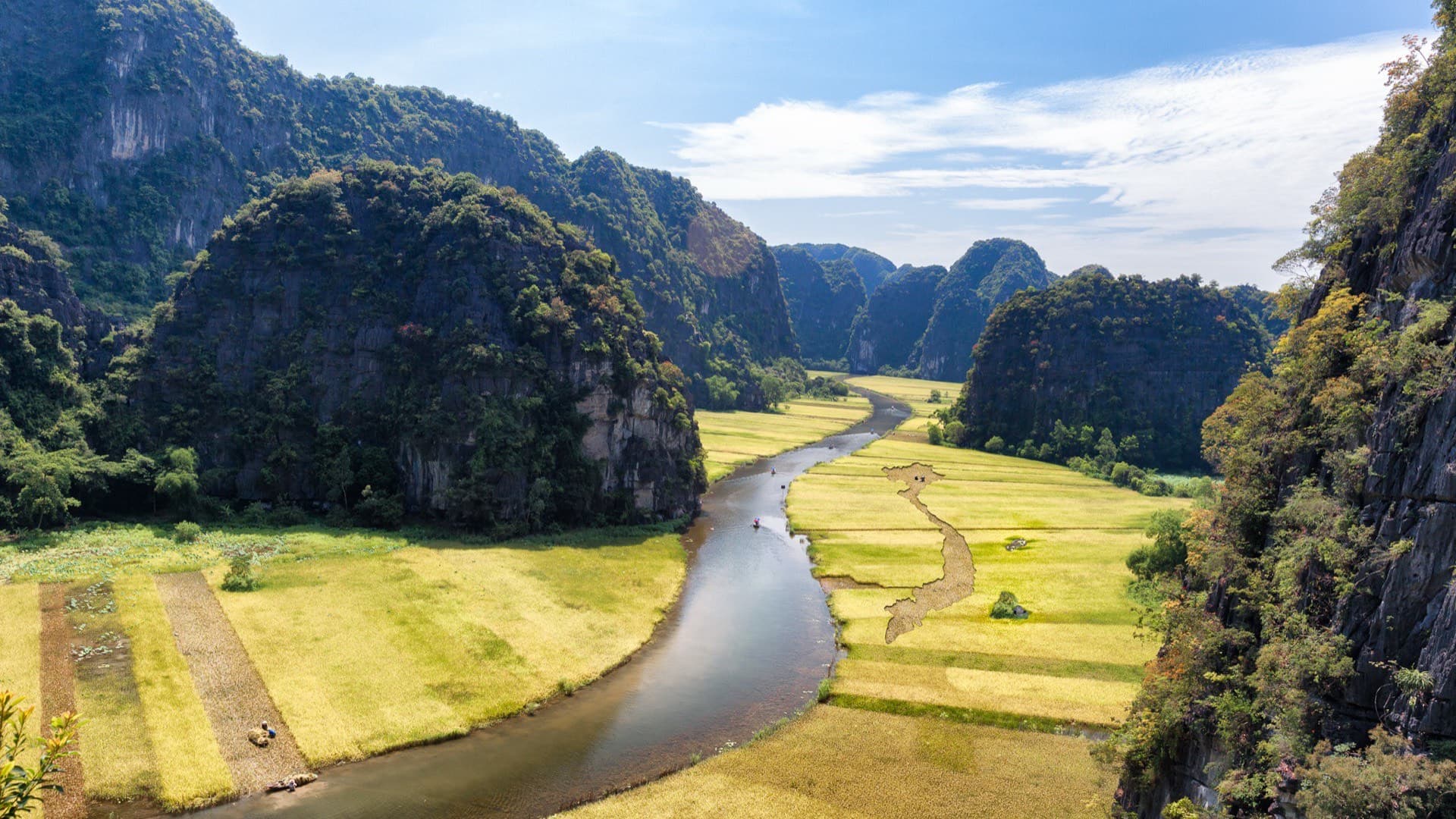
Ninh Binh's weather follows Hanoi's, about 90 km to the north. Winter, from December to February, is cool and fairly dry but grey, and February and March bring drizzle and very little sun. The wet season, from May to October, is hot and brings about 85% of the year's rain, peaking in September, when storms can close the Trang An boats. The best months for comfortable sightseeing are April, October and November, and late May to early June brings Tam Coc's golden rice.
That rhythm shapes a trip to Ninh Binh more than most places, because its highlights are boat rides through flooded caves and rice paddies, and both depend on the water and the harvest.
Ninh Binh weather at a glance
The table gives official long-run averages for the Ninh Binh weather station from the Vietnam Institute for Building Science and Technology, as published in Wikipedia's climate table. Rain days are the average number of days with rain, and sunshine is in hours per month.
| Month | High | Low | Rain | Rain days | Sunshine (h/month) |
|---|---|---|---|---|---|
| January | 19.6°C | 14.6°C | 28 mm | 9 | 70 |
| February | 20.2°C | 15.7°C | 26 mm | 13 | 45 |
| March | 22.6°C | 18.1°C | 46 mm | 16 | 44 |
| April | 27°C | 21.7°C | 74 mm | 12 | 92 |
| May | 31.1°C | 24.6°C | 169 mm | 13 | 185 |
| June | 32.9°C | 26.2°C | 211 mm | 13 | 179 |
| July | 32.8°C | 26.5°C | 236 mm | 14 | 196 |
| August | 31.9°C | 26°C | 315 mm | 16 | 165 |
| September | 30.6°C | 25°C | 362 mm | 15 | 161 |
| October | 28.4°C | 22.7°C | 219 mm | 12 | 150 |
| November | 25.3°C | 19.4°C | 67 mm | 8 | 128 |
| December | 21.7°C | 15.9°C | 29 mm | 6 | 109 |
The year totals about 1,780 mm of rain. Two things stand out. February and March have more rain days than June, on a fraction of the rainfall, because they bring days of fine drizzle rather than storms, and they get only about 45 hours of sun a month. And the rain peaks later than in Hanoi, in September rather than August. Our Hanoi weather guide shows the capital's pattern, which is otherwise almost the same.
Winter, December to February: cool, dry and grey
Winter is the dry season, with under 30 mm of rain a month from December to February. Average highs are 20-22°C and lows 15-16°C, but cold spells from the north can bring lows of 7-8°C and highs of about 15°C. December is the best of the three, a little sunnier and less damp. January and February are often overcast, and by February the drizzle has started.
It is a fine time for Bai Dinh, the temples of Hoa Lu and the Trang An boats, as long as you dress for a cool, damp day on the water. The festival season starts after Tet: the Bai Dinh pagoda festival runs from the 6th day of the first lunar month to the end of the third, which in 2027 means from 11 February, and draws large domestic crowds.
Spring, March and April: drizzle, then sun
March is the dimmest month of the year, with about 16 days of drizzle and 44 hours of sun. The karsts can disappear into mist, which is atmospheric on a boat and frustrating from the top of Mua Cave. April is the turning point: warmer at about 27°C, sunnier, and still fairly dry, which makes it one of the best months to visit. The Hoa Lu festival falls on the 9th to 11th of the third lunar month and the Trang An festival on the 18th and 19th.
Early summer, May and June: golden rice and heat
Tam Coc's fields along the Ngo Dong river have only one rice crop a year, because the river rises too high in the monsoon to farm them. The rice turns gold from about mid- or late May to mid-June, and the golden stage and harvest last only about two weeks. The timing moves each year: in 2026 the fields were gold by 22 May, as Bao Ninh Binh reported, while in 2022 they did not turn until June. The province now times its tourism week to the harvest, in the last ten days of May.
This is also when the heat arrives, with highs of 31-33°C and the first heavy storms. Lotus season follows, from about May to July, peaking from late June into July, when the ponds below Mua Cave and around Tam Coc and Trang An are in flower.
Late summer, July to September: storms and boat closures
July to September brings about half of the year's rain, peaking at about 315 mm in August and 362 mm in September. It is also typhoon season: storms can affect northern Vietnam from late May to early November, most often from July to October.
This is when the boats are most affected. After heavy rain, water rises in Trang An's cave tunnels, and the site suspends its routes. In 2026, Trang An closed one of its three routes from 31 July to 1 August, suspended all operations from 23 August during a storm, and suspended them again from 17 September after heavy rain, while Tam Coc shortened its route and Van Long closed, as VTV reported. Summer trips usually go ahead, but keep a spare day.
Autumn, October and November: the best all-round season
After September's peak, rain falls to about 219 mm in October and 67 mm in November, and days cool to 25-28°C. October can still bring an early-month storm, but the second half of the month and November are usually clear, making this one of the best periods for walking, cycling the lanes and climbing Mua Cave. You may see golden fields elsewhere in the province in October, when the main autumn crop is harvested, but not along the Tam Coc river, which has only its early-summer crop.
What the weather means for your trip
Choosing the month. April, October and November are the most comfortable; late May to early June for the rice; December for dry, cool days; August and September only with a flexible plan.
Packing. A warm layer and waterproof from December to March, sun protection and a hat for the boats from May to September, and an umbrella or light shell in any month.
Planning. Our 2 days in Ninh Binh itinerary and day trips from Ninh Binh guide cover the boats and sights, and our where to stay in Ninh Binh guide explains the Tam Coc and Trang An bases. For the Trang An boat tour, morning trips avoid the afternoon storms of the wet season. Getting there takes about two hours from Hanoi; see our Hanoi to Ninh Binh guide.
Limitations
The table uses official long-run averages for one weather station, as reproduced on Wikipedia; the source does not state the averaging period or the rain-day threshold, and other datasets differ slightly. Single years vary a lot, and harvest and lotus timing move by a couple of weeks each year. The 2026 boat closures are examples from Vietnamese press reports, not a complete record.
Workaround: use this page to choose the season, check the forecast and the Trang An and Tam Coc operators' notices in the days before you travel, and keep a spare day in August and September.