
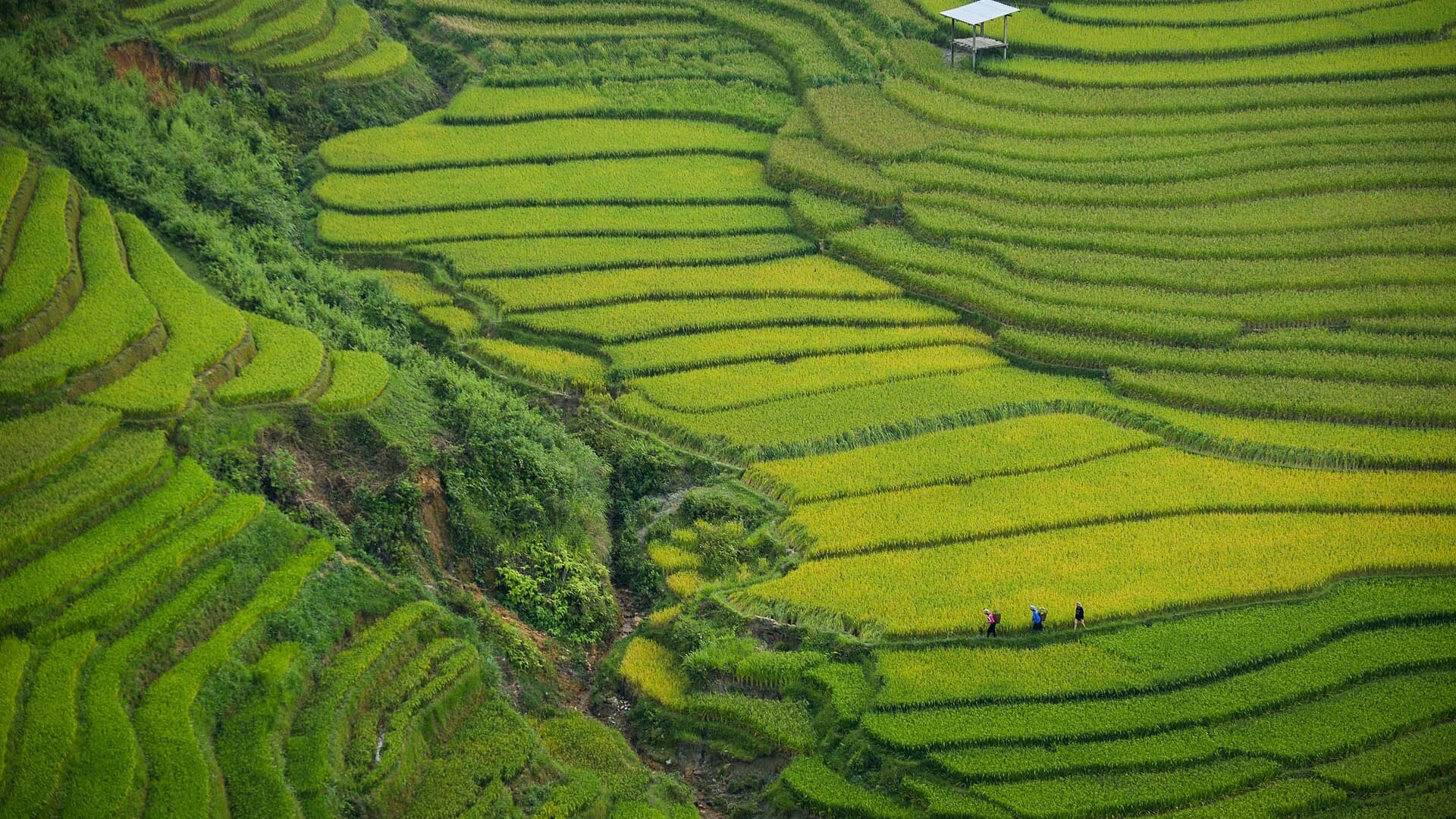
Here is the plain answer: August is the month to be in the mountains and the month to be careful on the northern coast. The terraces of Sapa, Mu Cang Chai and Ha Giang are at their fullest green and lowest prices, the southern monsoon still clears by evening, and the sea is warm on every coast. What August adds over July is typhoon risk in earnest on the north and north-central coasts — a disruption risk of one to three days, not a washout.
The second half of the answer is a calendar story. Vietnamese school holidays end in late August and the school year opens on 5 September, so the families who have filled Da Nang, Nha Trang and Phu Quoc since mid-June go home in the final week, and coastal rates fall with them. That makes the last stretch of August the best-value window of the Vietnamese summer. For the full-year picture, see the month-by-month weather guide; for how monsoon rain behaves hour by hour, the rainy season guide is the companion.
August by region: the historical averages
These are historical climate averages, not forecasts, and sources disagree by a useful margin. Treat the table as a prior.
| Region | Historical August picture | Verdict |
|---|---|---|
| Da Nang / Hoi An | 34.1°C days, 25.3°C nights, roughly 115 mm over 11 days, sea 29.7°C | Hot, mostly dry, emptying late |
| Hue | 34.8°C days, 24.7°C nights, roughly 115 mm over 11 days | Very hot and muggy |
| Nha Trang | 33°C days, 25.9°C nights, roughly 50 mm, sea 28.5°C | The driest coast this month |
| Hanoi | 32.9°C days, 25.8°C nights, roughly 275 mm over 17 days, 84 percent humidity | Hot, wet, heavy |
| Sapa | 23.1°C days, 17.4°C nights, roughly 450 mm | Coolest air, greenest terraces |
| Da Lat | 22.5°C days, 16.1°C nights, roughly 250 mm | Comfortable all month |
| Ho Chi Minh City | 32.5°C days, 24.4°C nights, roughly 270 mm | Afternoon monsoon, dry mornings |
| Phu Quoc | 29.9°C days, 26.1°C nights, roughly 545 mm over 24 days | Wettest and cheapest |
Typhoon season, and what it actually means for a trip
August sits in the heart of the northern typhoon window, and this is the honest version of a risk most guides either ignore or overstate. Vietnam's meteorological agencies put the annual average at 11 to 13 storms and tropical depressions in the East Sea, about five or six making landfall, with the northern season running from late May to early November and peaking July to October. Most August systems strike the north and north-central coast rather than the centre or south — published climate summaries put Da Nang's own typhoon season as opening in September.
On the ground that means a short, sharp interruption. A system approaching the Gulf of Tonkin triggers a sea-travel ban, suspending Ha Long Bay sailings outright. Flights into Hai Phong, Van Don and sometimes Hanoi are cancelled for a day. Coastal roads flood, far-northern passes get landslides, beaches close. Then it passes, and the next day is often bright. The risk is to fixed plans, not trips.
The trend is worth naming: the 2025 season set a record with 21 tropical systems in the East Sea by the end of November — 15 typhoons and 6 tropical depressions, beating the previous high of 20 in 2017. That does not forecast 2027, but it argues for building slack in rather than assuming the average.
The rules are simple. Do not schedule a Ha Long cruise in the 48 hours before an international departure, keep northern coastal nights refundable, and watch the forecast from about five days out, when systems become reasonably predictable. August does not require avoiding the north — it requires not building a trip that breaks if a day is lost.
The north: the green season at its peak
Hanoi in August is hot and heavy: historically around 32.9°C by day, nights that barely drop below 26°C, roughly 275 mm of rain across about 17 days, and 84 percent humidity, the figure that decides how the city feels. Five and a half hours of daily sunshine means showers rather than sheets, but the damp is relentless. Plan the Hanoi guide around early mornings and long lunches.
Go up into the mountains and everything improves. Sapa runs about 23.1°C by day and 17.4°C at night — the most comfortable air in the country — at the cost of roughly 450 mm of rain. This is the green season at its peak: terraces planted in May and June have closed over completely, so the valleys read as solid, luminous green rather than the mirrored water of spring. The Sapa guide covers the trekking; Mu Cang Chai and Ha Giang are the same trade, bigger.
The gold arrives later. Harvest runs from mid-September into early October, and only the highest fields turn in the last days of August. If photographs matter more than budget, wait six weeks and read the September guide. If you want green, empty valleys at the year's lowest prices, this is the month.
The caveat is the roads. August is among the heaviest rainfall weeks in the far north, and rain-softened slopes produce landslides on exactly the passes mountain loops run on. Ride the Ha Giang roads if you are experienced and flexible about daily distances, but not on a fixed four-day loop with a flight to catch at the end.
The south: the same afternoon rhythm, still workable
Ho Chi Minh City in August looks worse on paper than it is: roughly 270 mm of rain, and a daytime high near 32.5°C, nearly four degrees cooler than the April peak. Southern monsoon rain is convective and predictable. Heat builds through the morning, cloud stacks after lunch, and the sky opens hard for an hour or two in the mid-to-late afternoon before draining away. Mornings are usually dry.
That rhythm is the entire strategy: sightseeing before noon, lunch and an indoor stop in the 2pm to 5pm window, evening as recovered time. The Ho Chi Minh City guide is a scheduling problem in August, not a map problem. The Mekong runs the same pattern.
Phu Quoc is the extreme case: around 545 mm across about 24 rainy days and four and a half hours of daily sunshine, with the southwest monsoon hitting the west-facing beaches directly. The sea is still near 29°C and swimmable on calm days, and rooms cost a fraction of the December-to-March rate. Go in with expectations set, or go to Nha Trang, at roughly 50 mm the driest coast in the country this month.
Where the value is
The split between what costs more and what costs less moves within the month. Long-haul airfares stay high through the first half, because August is the tail of the Northern-Hemisphere school holidays: routes from Europe, the United States and Australia hold peak pricing to mid-month, then soften. The monthly price calendar shows where August lands.
On the ground, almost everything is cheap. Ha Long cruise cabins discount heavily across the June-to-September window as international demand collapses, and Sapa, Ha Giang and the Mekong are at their annual cheapest and greenest at once. Coastal cities are the exception until late August: domestic summer demand had been lifting beach-city rates roughly 20 to 40 percent, and the hotel prices guide has the tier detail.
Then the domestic holiday ends and the coastal premium goes with it. The final week of August, before National Day rebuilds demand, is the cheapest the coast gets.
What's on in August 2027
- Vu Lan, the Wandering Souls' Day, Monday 16 August. The 15th day of the seventh lunar month, and after Tet the most widely observed date in the Vietnamese Buddhist year. Pagodas fill, roses are pinned to lapels for living and departed mothers, offerings burn on pavements. Nothing closes.
- The seventh lunar month, 2 to 31 August. Traditionally inauspicious for weddings, house moves and big purchases — a reason celebratory travel dips.
- August Revolution anniversary, 19 August. Commemorative rather than a day off, marked with flags and ceremonies in the major cities.
- The green season in the north. Not an event, but the reason to be in Sapa, Mu Cang Chai or Pu Luong now rather than winter.
The festival calendar atlas has the wider picture if your dates can flex. The next statutory fixture is National Day on Thursday 2 September, with the official 2027 arrangement unpublished at the time of writing.
Where to go, and where to think twice
Go: Sapa, Mu Cang Chai, Ha Giang and Pu Luong for green terraces, cool air and the year's lowest prices; Ho Chi Minh City and the Mekong on a mornings-first schedule; Nha Trang for the most reliable swimming; Da Lat, comfortable all month; and the central coast in the final week, once the families have gone.
Think twice: Ha Long Bay if one sailing date is non-negotiable; Phu Quoc if you need dependable sunshine rather than a warm sea and a cheap room; the central coast before mid-August unless booked ahead; any fixed northern motorbike loop with a flight at the end.
The verdict: August suits travellers who want the mountains more than the beach, who can absorb a lost day, and who would rather pay less on the ground than buy the perfect month. It suits late-August arrivals markedly better than early ones, and it does not suit anyone whose trip depends on one guaranteed clear day up north.
Limitations
Everything above rests on historical climate averages, and published sources disagree meaningfully — rainfall figures vary between datasets, and a single August can run far wetter or drier than the mean. Typhoon activity is unforecastable at planning distance: a given August may pass without a landfall, or close Ha Long sailings and northern airports for days. Workaround: treat the table as a prior, check ten-day forecasts a week out, keep northern coastal nights refundable, and avoid an international departure straight after a Ha Long cruise.
The calendar claims carry their own caveats. Vietnam's official 2027 holiday arrangement had not been announced at the time of writing, so the early-September National Day break is a known date without a confirmed length. School holiday dates vary by province, so "late August" is a pattern rather than a fixed day and the price drop is gradual. The Vu Lan date is a lunar-calendar conversion, widely observed but not statutory. Workaround: confirm the 2027 schedule once published in autumn 2026, and keep bookings flexible until you check live rates.