
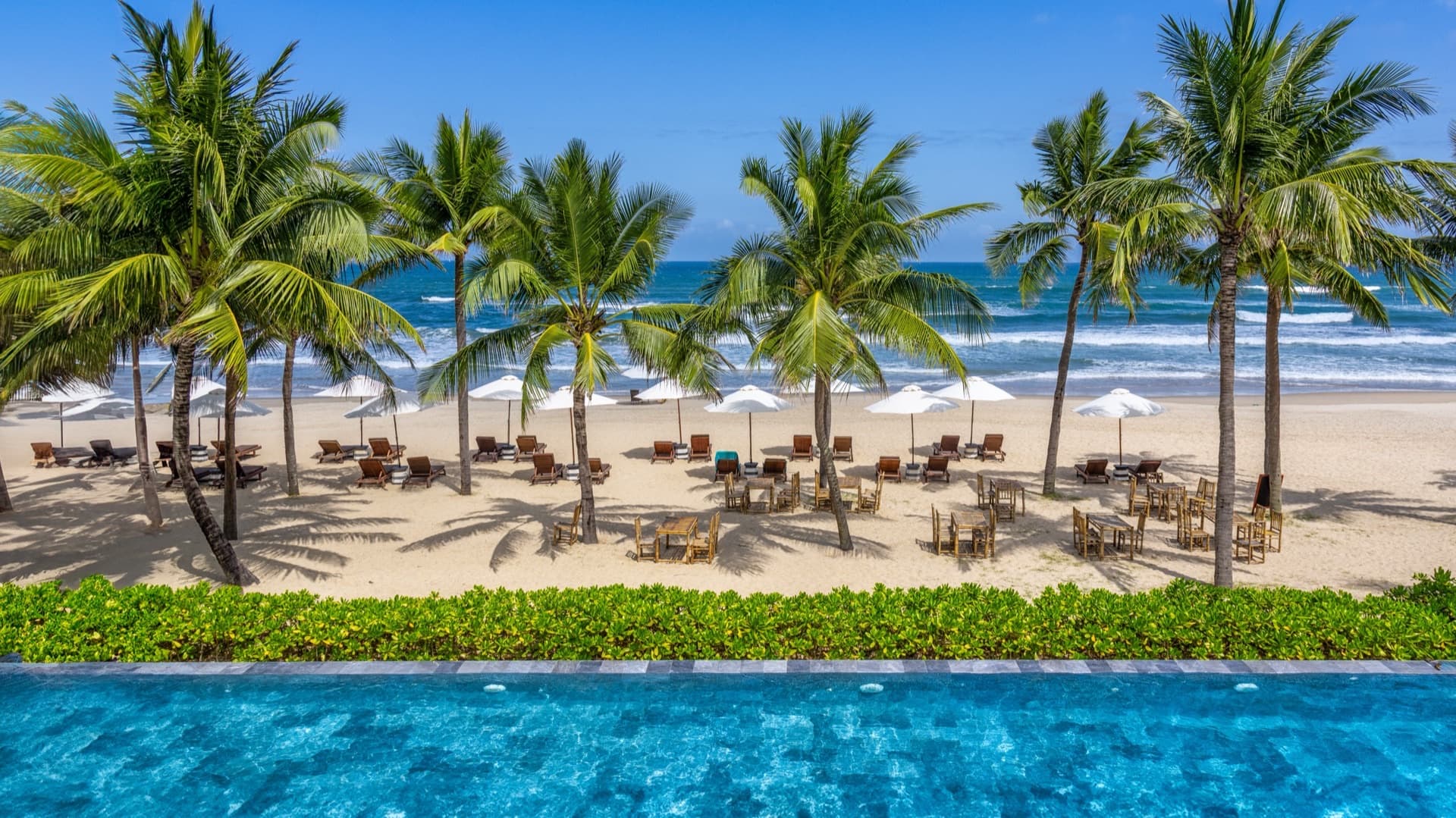
Here is the plain answer: July is more workable than almost anyone expects, provided you understand that Vietnam is running three separate weather systems at once. The southwest monsoon is at full strength in the south, but it arrives as a hard ninety-minute afternoon burst that leaves mornings dry. The north is hot, humid, at its greenest and inside the typhoon window. And the central coast — Hue, Da Nang, Hoi An, Nha Trang — is dry, sunny and warm, which is exactly why every Vietnamese family with school-age children is there at the same time as you.
That last point is the real July planning problem, and it is a crowd problem rather than a weather problem. Vietnamese school summer holidays run from roughly mid-June to late August, with the beach surge peaking mid-July to mid-August. So the month inverts the usual advice: the region with the best weather is the one to book earliest or avoid, and the regions with the worst weather are where the value is. For the full-year picture, see the month-by-month weather guide; for how monsoon rain actually behaves on the ground, the rainy season guide is the companion piece to this one.
July by region: the historical averages
These are historical climate averages, not forecasts, and single years deviate. Treat the table as a prior rather than a plan.
| Region | Historical July picture | Verdict |
|---|---|---|
| Da Nang / Hoi An | Days around 34.5°C, nights 25.5°C, roughly 85 mm over 9 days, sea near 29.6°C | Dry and hot — and full |
| Hue | Days around 35°C, nights 25°C, roughly 90 mm | The hottest city on this list |
| Nha Trang | Days around 32.5°C, nights 26°C, roughly 35 mm | Driest place in the country |
| Hanoi | Days around 33.6°C, nights 26.2°C, roughly 255 mm over 16 days, 81 percent humidity | Hot, wet, heavy |
| Sapa | Days around 23°C, nights 17.7°C, roughly 465 mm | Cool, green, very wet |
| Da Lat | Days around 22.8°C, nights 16°C, roughly 230 mm | The country's air conditioning |
| Ho Chi Minh City | Days around 32.6°C, nights 24.2°C, roughly 295 mm | Afternoon monsoon, dry mornings |
| Phu Quoc | Days around 30°C, nights 26°C, roughly 420 mm over 22 days | Wettest, cheapest, still swimmable |
The south: monsoon at full strength, and why it works anyway
Ho Chi Minh City in July looks alarming on paper — roughly 295 mm of rain — and behaves quite reasonably in practice. Southern monsoon rain is convective. Heat builds through the morning, cloud stacks after lunch, and the sky opens for one to two hours in the mid-to-late afternoon before draining away. Streets flood knee-deep for half an hour and then do not. Mornings are usually dry and entirely workable.
That rhythm is the whole strategy. Front-load sightseeing before noon, put lunch and an indoor stop in the 2pm to 5pm window, and treat the evening as recovered time. Daytime highs of around 32.6°C are also cooler than the April peak near 36°C, so July is genuinely more comfortable outdoors than the dry-season months either side of it. The Ho Chi Minh City guide is a schedule problem in July rather than a map problem.
The Mekong Delta runs the same pattern with more shade and more water, and it is one of the cheapest months to be there. Phu Quoc is the outlier: roughly 420 mm across about 22 rainy days and only five hours of daily sunshine, with the monsoon hitting the western beaches directly. The sea is still near 29.5°C and perfectly swimmable, the sunsets survive, and rooms cost a fraction of the December-to-March rate. Go in with expectations set.
The north: heat, the green season, and the first typhoons
Hanoi in July is the hardest sell in this article. Historically around 33.6°C by day with nights that barely drop below 26°C, roughly 255 mm of rain across about 16 days, and 81 percent humidity — the number that actually decides how the city feels. Six and a half hours of daily sunshine means the rain is showery rather than constant, but the heat and the damp together are draining. Plan the Hanoi guide around early mornings and long lunches.
Go up and it improves fast. Sapa sits at around 23°C by day and 17.7°C at night, which is the most comfortable air in the country, at the cost of roughly 465 mm of rain — the wettest figure on the table. Ha Giang is the same trade. This is the green season: terraces planted in May and June are full, dense and luminous by July, waterfalls run hard, and the valleys look nothing like the brown of winter. The golden harvest people photograph is September and October, not now.
The honest caveat is the roads. July and early August are the heaviest rainfall weeks in the far north, and rain-softened slopes produce landslides on exactly the mountain passes the Ha Giang loop runs on. Mist cuts visibility on the high sections. Ride it if you are experienced and flexible about your daily distances; do not book a fixed four-day loop with a flight to catch at the end.
July is also inside the typhoon window. Published climate summaries put the northern season from around 20 May to mid-November with a maximum from July to October, and July systems typically strike the north rather than the centre. The benchmark is recent: Tropical Storm Wipha crossed Ha Long Bay and made landfall between Hung Yen and Ninh Binh at 10am on 22 July 2025 with sustained winds of 102 km/h and forecast rainfall above 600 mm, under a national sea-travel ban that suspended Ha Long cruises. That is not a normal week, but it is a normal July risk.
The central coast: the good weather, and the crowd that follows it
The middle of the country is the July winner on weather and the July loser on peace. Da Nang has historically averaged around 34.5°C by day, roughly 85 mm across about nine rainy days, eight hours of daily sunshine and a sea temperature near 29.6°C. Hue is hotter still at about 35°C. Nha Trang is the driest place in Vietnam this month at roughly 35 mm. The summer monsoon simply does not reach across the Truong Son range in force, so this coast keeps its dry season while the rest of the country gets soaked.
Everyone knows it. Domestic accommodation search data for the first half of 2026 showed Da Nang leading all Vietnamese destinations with searches up around 25 percent year on year, and the mid-July to mid-August window is when families actually travel. Expect full hotels, higher rates, busy domestic flights and beaches that fill from mid-afternoon. Weekends are markedly worse than weekdays. The Da Nang guide covers which beaches absorb crowds and which do not.
Where the value is
July splits cleanly into things that cost more and things that cost less, and most travellers get the split backwards.
Flights cost more. July is a school-holiday peak on routes from Europe, the United States and Australia, so this is one of the expensive months to fly in, and the monthly price calendar shows where it lands against the rest of the year. Coastal rooms cost more too, pushed by domestic demand rather than international.
Everything else is cheap. Ha Long cruise cabins discount heavily across the June-to-September monsoon window because international demand collapses. Phu Quoc runs well below its Western high-season rate despite the Vietnamese families, because those two markets peak in different months. Sapa, Ha Giang and the Mekong Delta are at their annual cheapest and their annual greenest at the same time. If you build a July trip around the north and the Mekong rather than the beaches, the on-the-ground cost is among the lowest of the year.
What's on in July 2027
- Da Nang International Fireworks Festival. The 2026 edition ran from 30 May to 11 July across six competition nights with ten international teams, and the festival has consistently finished in early-to-mid July. The 2027 schedule had not been published at the time of writing, so treat a similar shape as likely rather than confirmed, and expect Da Nang hotel rates to spike on competition nights.
- War Invalids and Martyrs' Day, 27 July. A national commemorative day with wreath-laying and candlelight ceremonies at war cemeteries, particularly Truong Son and Road 9 in the former DMZ. It is not a public holiday and nothing closes.
- The green season in the north. Not an event, but the reason to be in Ha Giang, Sapa or Pu Luong now rather than in winter. Terraces are fully planted and waterfalls are at their strongest.
There is no statutory public holiday in July, which is why the month has no single crunch weekend the way April and September do. The pressure is spread across eight weeks of school holiday instead.
Where to go, and where to think twice
Go: Sapa, Ha Giang and Pu Luong for green terraces, cool air and low prices; Ho Chi Minh City and the Mekong Delta on a mornings-first schedule; Phu Quoc if you want a warm sea at a discount and can accept grey afternoons; Da Lat, which is the most comfortable climate in the country all month.
Think twice: the central coast in the mid-July to mid-August window unless you have booked well ahead; Ha Long Bay if a specific sailing date is non-negotiable, given the typhoon risk; and any fixed-itinerary motorbike loop in the far north with a flight at the end of it.
The verdict: July suits travellers who are flexible about the daily shape of their days, who want the north and the Mekong more than the beach, and who would rather pay less on the ground than book the perfect month. It does not suit anyone whose trip depends on one guaranteed clear day.
Limitations
Everything above rests on historical climate averages, and published sources disagree by a useful margin. Rainfall figures in particular vary between datasets, and a single July can run far wetter or drier than the mean — the 600 mm forecast for parts of the north during Wipha in 2025 is more than double Hanoi's normal monthly total. Workaround: treat the regional table as a prior, check each destination's ten-day forecast a week out, and build slack into any northern leg.
Two dated caveats. The 2027 fixtures are not settled: the Da Nang fireworks festival schedule had not been announced at the time of writing, and 2026's 30 May to 11 July run is a pattern rather than a promise. And typhoon activity is inherently unforecastable at planning distance — a July storm may not come at all, or may close Ha Long sailings and northern airports for a day or two. Workaround: keep northern coastal nights refundable, avoid scheduling an international departure immediately after a Ha Long cruise, and confirm event dates once the 2027 calendars are published. This guide also does not cover diving conditions or river levels for adventure caving, which move on their own schedules.