
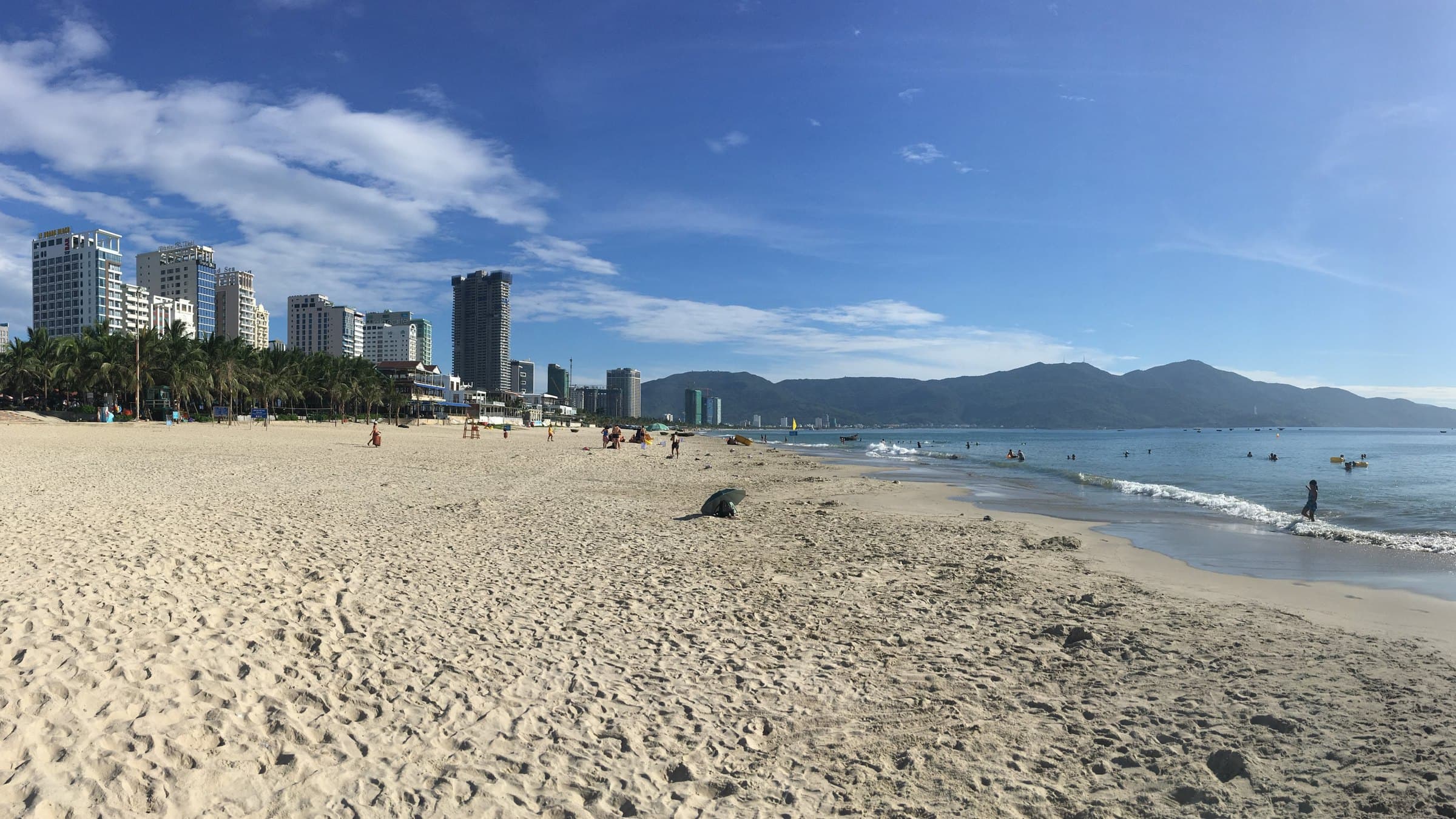
Here is the plain answer: June is Vietnam's most divided month, and how you feel about it depends on which third of the country you are standing in. The north hits its annual peak of heat and humidity. The south opens the monsoon properly, in hard afternoon bursts that leave the mornings alone. And the central coast — Hue, Da Nang, Hoi An, Nha Trang — is dry, bright and about as good as Vietnamese beach weather gets.
The complication is the calendar rather than the sky. Vietnamese schools break for summer through June and the domestic beach season moves with them, which makes the first half of the month the genuine prize: the central coast already has its dry-season sunshine, but the full family surge does not land until mid-July. Get in early and you buy July's conditions at closer to May's prices. For the full-year picture see the month-by-month weather guide, and for how monsoon rain behaves once you are standing in it, the rainy season guide is the companion to this one.
June by region: the historical averages
These are historical averages, not forecasts, and datasets disagree by a margin worth knowing — Hanoi's June rainfall is variously given as roughly 165 mm and 265 mm. Treat the table as a prior rather than a plan.
| Region | Historical June picture | Verdict |
|---|---|---|
| Da Nang / Hoi An | Days around 35°C, nights 26°C, roughly 90 mm over 9 days, sea near 29°C | The month's winner |
| Hue | Days around 35°C, nights 25°C, roughly 115 mm, sea near 30°C | Hot, dry, brutal at noon |
| Nha Trang | Days around 33°C, nights 26°C, roughly 60 mm over 9 days, sea near 29°C | Driest coast in the country |
| Hanoi | Days around 34°C, nights 26°C, roughly 165-265 mm over 14-15 days | Peak heat and humidity |
| Sapa | Days around 23°C, nights 18°C, roughly 410 mm | Cool, green, very wet |
| Da Lat | Days around 23°C, nights 16°C, roughly 215 mm | The country's air conditioning |
| Ho Chi Minh City | Days around 33°C, nights 25°C, roughly 310 mm over 19 days | Monsoon afternoons, dry mornings |
| Phu Quoc | Days around 31°C, nights 26°C, roughly 415 mm over 22 days, sea near 30°C | Wet, cheap, still swimmable |
The north: peak heat, and the number that decides how it feels
June is the hottest month of the northern year, and the averages undersell it. Hanoi historically sits around 34°C by day with nights near 26°C and humidity around 80 percent, and the humidity is what decides how the city feels. Thirty-four degrees in dry air is a warm afternoon; thirty-four at 80 percent humidity is a city you retreat from between eleven and four.
The heatwaves are the sharper edge. Vietnam's National Center for Hydro-Meteorological Forecasting, setting out the month ahead in June 2026, expected two to three further heatwaves, with 37-39°C across northern and central provinces and 41-42°C possible in mountainous districts west of Thanh Hoa and Hue. The same agency notes that forecast air temperatures can understate what you stand in on concrete and asphalt by one to three degrees or more. Plan the Hanoi guide around early mornings and air-conditioned afternoons.
Go up and it improves immediately. Sapa runs around 23°C by day and 18°C at night, the most comfortable air in the country, at the cost of roughly 410 mm of rain across about 24 days and three hours of daily sunshine. The trade is worth what June looks like: the start of the green season, terraces planted in May now filling out, valleys luminous. The gold people photograph is September. The Sapa guide and the Ha Giang loop both run better now than in the weeks that follow, because July and August are when rain-softened slopes start producing landslides on the high passes.
June is also the quiet end of the northern typhoon window. The same forecasting centre puts the June average at around 1.1 tropical systems forming over the East Sea and 0.3 making landfall — well below the July-to-October maximum, so Ha Long Bay sails reliably. The catch is haze: the summer murk that greys Hanoi flattens the karst views, making June a good month to sail and a poor one for photographs.
The south: the monsoon opens properly
Ho Chi Minh City in June looks alarming on paper and behaves reasonably in practice: historically around 310 mm of rain across about 19 days, with daytime highs near 33°C — cooler, note, than the April peak around 36°C. Southern monsoon rain is convective and predictable. Heat builds through the morning, cloud stacks after lunch, and the sky opens hard for one to two hours in the mid-to-late afternoon before draining away. Low streets flood knee-deep for half an hour and then do not.
That rhythm is the entire strategy. Front-load sightseeing before noon, put lunch and an indoor stop in the 2pm to 5pm window, and treat the evening as recovered time. The Ho Chi Minh City guide is a scheduling problem in June rather than a map problem, and the city is more comfortable outdoors now than in April's heat.
The Mekong Delta runs the same pattern with more shade and more water. Phu Quoc is the outlier and the honest disappointment: roughly 415 mm across about 22 rainy days with five hours of daily sunshine, as the southwest monsoon hits the western beaches directly. The sea is still near 30°C and rooms cost a fraction of the December-to-March rate, but read the Phu Quoc guide with expectations set.
The central coast: the best month, and the crowd arriving
The middle of the country is June's clear winner. Da Nang has historically averaged around 35°C by day, roughly 90 mm of rain across about nine days, eight hours of daily sunshine and a sea near 29°C. Hue is similar and hotter to stand in, and Nha Trang is the driest place in the country this month at roughly 60 mm. The summer monsoon does not cross the Truong Son range in force, so this coast keeps its dry season while the rest of Vietnam gets soaked — the geography that floods Hoi An every autumn works in its favour now.
The sea is the underrated part: calm water, high clarity and 29°C make June one of the best swimming months on this coast. The beach water quality atlas has the beach-by-beach detail, the Da Nang guide covers which beaches absorb crowds, and the Hoi An guide suits anyone wanting the Old Town too.
The catch is that this is when the country arrives. Vietnamese school summer holidays run from roughly mid-June to late August, and the pressure builds through the month rather than landing on one weekend. Accommodation search data for the first half of 2026 showed Da Nang leading all domestic destinations, with searches up around 25 percent year on year. Early June still feels like a shoulder week; late June feels like high summer.
What the domestic summer does to prices
June is where the pricing logic of the Vietnamese year turns over. From this month through August, school holidays push families toward Da Nang, Nha Trang, Phu Quoc and Ha Long, and beach rates lift roughly 20-40 percent while Hanoi, Ho Chi Minh City and Hue stay broadly flat. Friday and Saturday nights run harder still; our hotel price guide has the per-city detail.
International airfares move on a different clock. June sits at the front edge of the northern-hemisphere school-holiday peak, so fares are climbing but have not reached the July ceiling — see the monthly price calendar. Both curves are briefly still low in early June, and that window closes fast.
The value sits where it sits in July: the places international visitors avoid in the monsoon. Ha Long cruise cabins discount heavily across the June-to-September window, Phu Quoc runs well below its Western high-season rate, and Sapa, Ha Giang and the Mekong are at their cheapest and greenest at once.
What's on in June 2027
- Tet Doan Ngo, on or about 9 June. The fifth day of the fifth lunar month, marked in households with fermented sticky rice, seasonal fruit and rituals to clear out pests and illness at the turn of summer. A real festival with almost no tourist infrastructure attached, and not a day off.
- Da Nang International Fireworks Festival. The 2026 edition ran from 30 May to 11 July across six Saturday competition nights on the Han River, and the festival has consistently occupied June. The 2027 schedule had not been published at the time of writing, so treat a similar shape as likely rather than confirmed.
- The start of the northern green season. Not an event, but the reason to be in Sapa, Ha Giang or Pu Luong now rather than in winter. Terraces planted in May are filling out and the waterfalls are running.
There is no statutory public holiday in June, which is why the month has no single crunch weekend the way April and September do. The festival calendar atlas has the wider picture.
Where to go, and where to think twice
Go: Da Nang, Hoi An, Hue and Nha Trang, at their annual best and ideally in the first half of the month; Da Lat and Sapa for the only comfortable air in the country; Ho Chi Minh City and the Mekong on a mornings-first schedule; Ha Long Bay, in the quietest part of the typhoon year.
Think twice: Hanoi as a walking city, unless you are disciplined about the hours; Phu Quoc if you need sunshine rather than a cheap warm sea; the far-northern loops late in the month as the rain builds; and the central coast in late June without a booking.
The verdict: June suits anyone whose trip is built around the central coast and who can travel in its first half, plus budget travellers willing to take southern monsoon afternoons for the year's lower prices. It does not suit the heat-sensitive planning to spend the trip in northern cities, or a Phu Quoc beach holiday.
Limitations
Everything above rests on historical averages, and published sources disagree by more than usual this month — Hanoi's June rainfall is given as roughly 165 mm by one dataset and 265 mm by another, a gap wide enough to change how the month reads. Single years deviate further, and the forecasting centre quoted here expected nationwide temperatures to run 0.5-1.5°C above long-term averages through the summer of 2026. Workaround: treat the table as a prior, check each destination's ten-day forecast a week out, and weight the coast toward the earlier half of the month.
Two dated caveats. The 2027 fixtures are not settled: the Da Nang fireworks schedule had not been announced at the time of writing, and 2026's run is a pattern rather than a promise. Tet Doan Ngo's Gregorian date comes from lunar-calendar conversion and can shift by a day. And school-holiday dates vary by province, so the week the beach surge begins is not fixed. Workaround: book central-coast nights well ahead whichever week you choose, and confirm event dates once the 2027 calendars are published.