
Vietnam's two mainland beach cities get compared constantly and answered badly, usually inside a three-way piece that also has to accommodate an island. This is the pairwise answer.
Da Nang is a city of about 1.2 million with a 30 km beach on one side, an airport in the middle of it, and Hoi An, My Son, Hue and the Hai Van Pass within a short drive. Nha Trang is a 6 km crescent of sand backed by high-rises, facing a bay of islands, with an airport 35 km away and a marine reserve that is not what it was.
The short answer
- Pick Da Nang if you want a base rather than a beach: day trips, food, an airport you can reach in ten minutes, and a city that works when the weather does not.
- Pick Nha Trang if the water is the point, if you are travelling between January and April, or if you want islands and a bay you can get out onto.
Side by side
| Da Nang | Nha Trang | |
|---|---|---|
| The beach | My Khe, roughly 30 km of open-ocean sand | 6 km sheltered municipal crescent |
| Reliable beach season | March or April to August | January to August |
| Annual rainfall | About 2,574 mm | About 1,894 mm |
| Sea in January | Around 22-24°C | Around 24.9°C |
| Offshore islands | None | A bay of islands including Hon Mun and Hon Tre |
| Day trips | Hoi An 30 km, My Son 55 km, Hue 100 km | Islands, plus 25-50 km up a highway |
| Airport | 3-5 km, 10-15 min, 60,000-115,000 VND | Cam Ranh 35 km, 45-60 min, 250,000-400,000 VND |
| Michelin selection | Yes, 47 recognised places in 2026 | None |
| Dominant foreign market | South Korea | Russia, alongside China |
| Beachfront room (mid-2026) | From about $44, $60-90 typical | From about $50, to $145-plus |
The beaches themselves
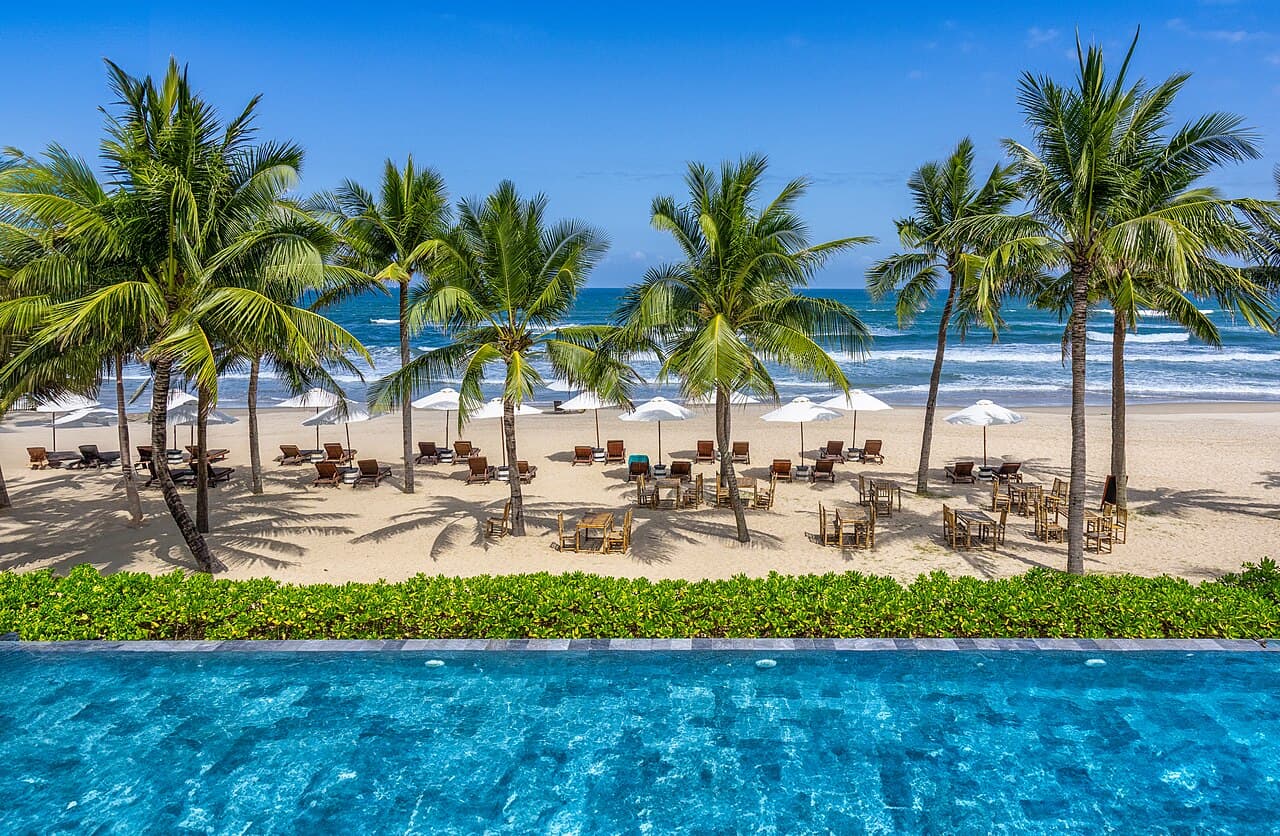
My Khe is the better piece of sand. It runs south from central Da Nang toward the Marble Mountains in a wide, uninterrupted strip, it faces open ocean, and it has room. TripAdvisor placed it sixth on its 2024 list of Asia's most beautiful beaches. The trade-off is that open ocean behaves like open ocean: there is surf, there are rip currents outside the calm months, and you should take the lifeguard flags seriously.
Nha Trang's municipal beach is more urban and more sheltered. Tran Phu runs the length of it with a wall of hotels behind, and the bay geometry keeps the water flatter than My Khe most of the year. It is a good swimming beach and a mediocre lounging one, because the strip is narrow and busy. The real asset is offshore: the islands, the boat trips out to them, and the northern bays toward Doc Let and Ninh Van, which are emptier than anything in Da Nang's reach.
Water, and the season split that decides this
Their good months genuinely differ, and this settles more bookings than anything else on the page.
Nha Trang sits in a comparatively dry pocket of the coast, taking about 1,894 mm of rain a year, and its dry season opens in January. Sea temperatures average around 24.9°C in the coldest month, which is swimmable. February to June is the sweet spot.
Da Nang takes about 2,574 mm a year, and January and February belong to the northeast monsoon: cool, grey, breezy, with the sea nearer 22-24°C. It is a fine month to eat and visit Hoi An and a poor one to swim. The reliable beach window is March or April through August.
Both cities are bad from September to December, but not equally. That period is the central coast's typhoon window, and Da Nang's rainfall peaks hard in September through November. Nha Trang's wet season is shorter and lighter.
On water quality, neither is pristine and both are documented. Da Nang's environment department describes coastal parameters as within permitted limits for recreational use, but a July 2024 storm overwhelmed pump capacity and pushed wastewater onto My Khe and My An. Nha Trang Bay's management board has recorded mercury at roughly 13 times the national limit at the Vinh Luong fishing port and 6.8 times at the north end of the bay, and it issues a fire jellyfish advisory most years between May and July. The water quality atlas has both in full.
Day trips: Da Nang's real advantage
This is where the comparison stops being close. Hoi An is 30 km from Da Nang, about 40 to 50 minutes, and since 10 August 2026 its old-town heritage sites charge 20,000 VND per person per site, the same for everyone, per the Da Nang city government; many guides still quote the old 120,000 VND ticket. Marble Mountains is 9 km. My Son is 55 km. Hue is about 100 km, roughly two hours through the tunnel or three over the Hai Van Pass. Since the 2025 provincial merger, Hoi An and My Son are administratively part of Da Nang City, which changes nothing on the ground but explains why older listings say Quang Nam. Our Da Nang day trips guide ranks them.
Nha Trang's day trips are strong on the water and thin on land. The bay delivers: island-hopping boats, snorkelling, Hon Tre and its over-sea cable car. Beyond that, Ba Ho waterfalls are 25 km, Doc Let 50 km, and Da Lat is 130 km over the Khanh Le Pass, which is three and a half hours each way and belongs to an overnight rather than a day. The Nha Trang day trips guide covers the full list.
One honest caveat on the snorkelling. Coral cover in the southeast section of the Hon Mun reserve fell from over 52 percent to about 11 percent between 2015 and 2022, and the island was closed to tourism in June 2022 before reopening in designated zones. There are still fish and there is still a good day out. There is not an intact reef.
Food and nightlife
Da Nang has the deeper food scene and the external validation to match: Michelin's Vietnam selection covers Hanoi, Ho Chi Minh City and Da Nang, and Da Nang held 47 recognised establishments in 2026, including one starred restaurant and 23 Bib Gourmand entries. The local canon is mi Quang, banh xeo with nem lui, and bun cha ca, and it is cheap outside the tourist strip.
Nha Trang's food is good and narrower, built around seafood, bun ca and the Ninh Hoa grilled pork rolls from up the coast. It has no Michelin selection, which is a fact about coverage as much as quality, but the gap in range is real.
Nightlife tilts the other way. Nha Trang has the more committed beach-club and late-bar scene, concentrated along the seafront, and it has been an international party town for two decades. Da Nang's nightlife is split between the An Thuong strip behind My Khe, which is casual and bar-hopping in character, and a riverside cluster around rooftop venues, with the Dragon Bridge fire show at weekends as the free attraction. Da Nang is livelier than it was in 2019 and still not Nha Trang after midnight.
Who else is there
Both cities have a dominant foreign market, and it shows up in signage and menus. In Da Nang that market is South Korea, which supplied 18.63 percent of inbound visitors in July 2026 and around 1.8 million travellers in 2024; expect Korean menus, Korean barbecue clusters and Korean signage at a density unusual for Vietnam.
In Nha Trang it has historically been Russia, which was Vietnam's third-largest source market in 2026 at 742,700 visitors, with Khanh Hoa alone taking 279,000 Russian arrivals in the first eight months of 2025. Cyrillic signage and Russian-speaking staff are normal. Reporting in 2026 puts Mandarin ahead of Russian on Tran Phu's shopfronts, so the character is shifting rather than fixed. None of this is a reason to choose or avoid either city; it is simply what the street will look like.
Families, prices and airports
For families, Nha Trang's calmer bay water suits under-fives better, and VinWonders on Hon Tre is a strong single day. Da Nang has more space on the sand, better-organised lifeguarding on an open beach, Ba Na Hills at around 1,000,000 VND per adult as of mid-2026, and enough within an hour to fill a week without repeating.
Prices are close. As of mid-2026, decent beachfront rooms start near $44 in Da Nang and near $50 in Nha Trang, with $60 to $90 covering good four-star in both and the premium end running past $145. Nha Trang's beachfront is denser, so competition holds rates down; Da Nang's is longer and more varied. Both sit well inside the ranges in our Vietnam budget guide.
Airports are not close. Da Nang's is 3 to 5 km from the centre, a 10 to 15 minute taxi at 60,000 to 115,000 VND as of mid-2026. Cam Ranh is 35 km from Nha Trang, 45 to 60 minutes, at 250,000 to 400,000 VND by taxi or Grab and around $3 by public bus. Over a short trip that difference is two hours and a small cost. Da Nang also has far more international routes.
The verdict
Pick Da Nang if you are travelling from about April to August, if you want Hoi An and Hue in reach, if food matters, or if you want the option of a good day when it rains. It is the better base and the better city.
Pick Nha Trang if you are travelling from January to April, if you want to be on a boat, if you want a bay rather than an ocean, or if you are travelling with small children who need calm water. It is the better beach holiday and the weaker base.
If you are also weighing an island, the three-way comparison with Phu Quoc adds that option, and the Da Nang and Nha Trang hubs have the neighbourhood detail.
Limitations
Rainfall and sea-temperature figures are long-run averages and any given year will disagree with them; treat the season split as a probability, not a promise. Hotel rates are mid-2026 observations across booking platforms rather than a surveyed sample, and they move sharply with Vietnamese domestic holidays and the June to August peak.
Two things we could not settle. Nha Trang has no Michelin selection, so its food scene cannot be compared with Da Nang's on the same measure, and absence of coverage is not evidence of lower quality. And the arrivals figures behind the market-mix section come from city and provincial tourism authorities using different reporting periods, so the Korean and Russian shares are not strictly like-for-like.